

What if the main weakness in your organisation’s road-safety approach isn’t a lack of training, but a gap between training and the risks employees actually face? Corporate road risk management works best when responsibilities are clear and decisions about controls and driver development reflect real operating conditions. In South Africa, employees may drive for work across different routes, schedules and vehicle types, so one generic approach can be difficult to apply consistently.
Accountability can become blurred when assessments, training and operational follow-up are managed separately. This guide sets out a practical process to identify work-related driving exposure, prioritise risks and match controls to driver roles, conditions and observed competence. It also explains how pre-training educational assessments can help establish learner readiness, and why driver training should balance compliance with skill development. Connecting these steps through regular review helps keep actions visible and safe-driving practices under consideration.
Key Takeaways
- Make corporate road risk management a defined organisational process, with clear ownership for decisions and follow-up.
- Use incident records, near-miss reports, journey patterns and existing procedures to understand work-related driving exposure.
- Choose controls in response to identified risks, combining suitable procedures, journey planning, driver assessment and targeted training.
- Assign actions to responsible roles, record completion and keep unresolved issues visible during reviews.
- Use driver training as one part of a wider approach, balancing compliance with skill development and learner readiness.
What corporate road risk management covers, and why it needs a system
Corporate road risk management is the organised process of identifying and addressing risks associated with employees driving for work. It covers more than driver behaviour. An organisation needs to understand who drives, which vehicles they use, where and why journeys take place, and which procedures shape those activities. Training can develop competence, but it won’t identify unsafe journey expectations, unclear reporting arrangements or a mismatch between a vehicle and its intended use.
A structured process brings these factors together. It helps an organisation assess exposure, choose appropriate controls, assign responsibility and record decisions. This follows the wider logic of Risk Management Principles and Methods: identify and analyse risks, select responses, then monitor whether those responses remain suitable. The result is a basis for consistent decisions, rather than a checklist disconnected from the work being done.
Which work-related driving risks should an organisation consider?
Start by mapping work-related driving activities and responsibilities. Include employees who drive regularly and those who drive occasionally for work. Note roles involving particular vehicle types or journey demands, then review existing journey procedures and clarify who plans, approves or monitors work travel.
Use driver competence, fatigue, distraction and vehicle suitability as prompts for assessment, not as assumed findings. For example, a demanding schedule may warrant closer examination of journey planning and rest arrangements. The assessment should establish whether fatigue exposure exists in that role. Separate verified risks, supported by records or observations, from questions that need further investigation. This helps direct attention and resources appropriately.
Who should own the corporate road-risk process?
Leadership should establish accountability, while operational owners coordinate decisions and follow-up. Depending on the organisation’s structure, relevant perspectives may include fleet, safety, human resources and line management. Fleet teams can contribute information on vehicle use, safety personnel can help maintain risk records, and managers can explain how journeys are organised in practice.
Set out who approves controls, communicates them, records completion and escalates unresolved issues. Without named owners, actions can remain open between departments. Defined responsibilities make it easier to review progress and decide whether further assessment or support is needed. For a broader view of workplace training considerations in South Africa, see the bespoke corporate safety training guide.
Documenting the process also helps maintain continuity when roles, vehicles or operating conditions change. A clear record gives decision-makers a reference for checking whether controls are still relevant, what evidence informed them and what needs follow-up.
How to identify and assess corporate road risks systematically
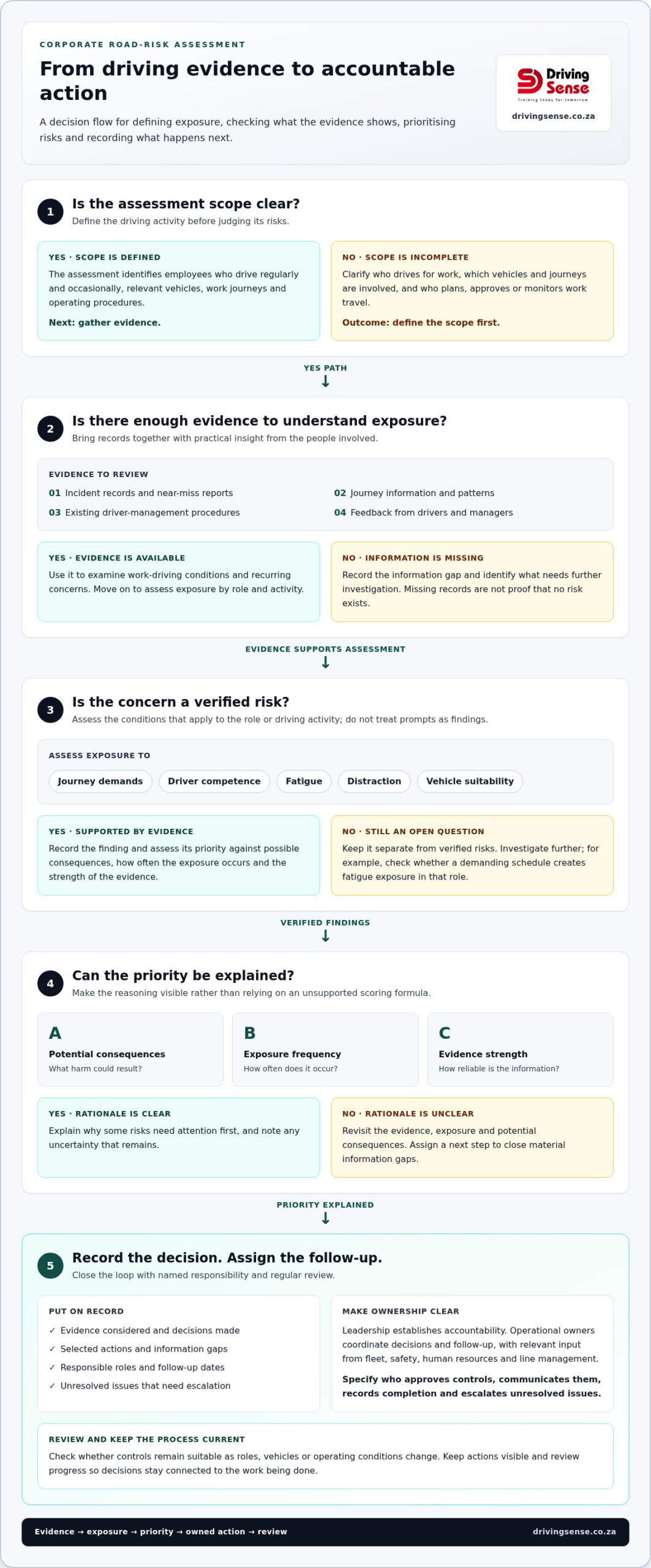
A consistent assessment turns scattered information into decisions the organisation can explain, assign and review. For corporate road risk management, the evidence should show which driving activities create exposure, who may be affected, how serious the potential consequences are and what action is justified.
- Define the scope. Specify which employees, vehicles, work journeys and operating procedures the assessment covers. Include occasional work-related driving as well as regular driving where relevant.
- Gather evidence. Review available incident records, near-miss reports, journey information and existing driver-management procedures. Speak with drivers and managers about operating conditions and recurring concerns.
- Assess exposure. Consider risks by role and driving activity, including journey demands, driver competence, fatigue, distraction and vehicle suitability. Distinguish confirmed findings from assumptions that need further investigation.
- Prioritise action. Consider potential consequences, how often an exposure occurs and the strength of the evidence. Record why some risks need attention first, without relying on an unsupported numerical scoring formula.
- Record decisions. Document the evidence considered, selected actions, responsible roles, information gaps and follow-up dates. This creates a traceable basis for implementation and review.
What evidence helps reveal fleet and driver exposure?
Start with information the organisation already has. Incident records and near-miss reports may point to recurring circumstances. Journey patterns can reveal demanding routes or schedules, while procedures show how work-related driving is expected to be planned and managed. Feedback from drivers and managers adds context, including practical pressures that records may not capture.
Handle personal information in line with applicable organisational processes, limiting access and use to the assessment’s legitimate purpose. If records are incomplete, note the gap rather than treating missing information as proof that no risk exists.
How should organisations prioritise risks for action?
Priorities should reflect possible harm, exposure frequency and the reliability of available evidence. Repeated reports of a concern across a particular driving activity may warrant earlier review than an isolated, unverified assumption. Record the reasoning, identify what remains uncertain and assign a next step to close material information gaps.
Where transport-related duties are relevant to an organisation’s operations, the South African transport compliance training guide provides related context. For driver competence as one part of the response, organisations can consider driver training alongside other controls identified in their assessment.
Which road-risk controls work together beyond driver training?
A control plan should respond to the exposure identified in the assessment, rather than apply the same checklist to every driver. Policies and procedures clarify expected behaviour and reporting. Journey planning addresses scheduling and route decisions. Driver assessment can help identify competence needs, while targeted training can develop relevant knowledge and skills. Each has a different purpose, so combining them can provide a more coherent response than relying on training alone.
For example, if an assessment identifies pressure from demanding schedules, the response may need to address journey planning as well as driver awareness. If an assessment for a particular role identifies a skills gap, appropriate training may form part of the plan. Training supports an organisational approach, but it cannot resolve every operational condition or guarantee fewer incidents.
| Control | Purpose | Suitable evidence | Review prompt |
|---|---|---|---|
| Policy and procedures | Set expectations for work-related driving, reporting and escalation. | Current procedures, staff guidance and records of reported concerns. | Are responsibilities clear and procedures understood? |
| Journey planning | Address how work journeys are scheduled and organised. | Journey plans, work schedules and driver or manager feedback. | Do arrangements reflect the conditions drivers encounter? |
| Driver assessment | Identify role-specific competence needs and areas for development. | Assessment findings and observations relevant to the driving activity. | Do findings indicate a need for support or further assessment? |
| Targeted training | Develop knowledge and practical skills linked to identified needs. | Training records and relevant learning or competence evidence. | Does the learning address the original need? |
When should driver training form part of the control plan?
Include training when the assessment identifies a relevant knowledge or skill need, and choose content that fits the employee’s driving responsibilities. Pre-training educational assessments can help establish learner readiness and inform how learning is approached. Record why training is needed, the capability it is intended to develop and how it connects to other controls. This keeps training part of the documented plan rather than treating course attendance as a complete risk response.
How can competence and compliance be considered together?
Course participation does not, by itself, show that an employee can apply relevant knowledge or demonstrate practical competence. Organisations should define what evidence is appropriate to the role and check applicable qualification or accreditation requirements against current rules. For guidance on planning organisational driver training, see the corporate driver training buying guide.
As one part of corporate road risk management, driver training can bring compliance considerations together with skill development. Organisations developing this element of their control plan can explore driver training support as part of a wider, evidence-led approach.
How to implement and review a corporate road-risk management plan
A documented plan turns assessment findings into assigned work and gives managers a clear basis for checking progress. For corporate road risk management, implementation should connect each identified risk to a suitable control, a responsible role, evidence of completion and a review point. Keep decisions and outstanding issues visible so the process remains manageable.
- Assign ownership. Name an accountable leader and operational owners for each action, so responsibility for decisions and follow-up is clear.
- Confirm the response. Match each selected control to the risk and record why it is appropriate, including whether further assessment is needed.
- Communicate the control. Explain relevant procedures and responsibilities to affected employees and managers, using channels suited to the organisation’s operations.
- Track implementation. Record action status and completion evidence, and escalate delays or unresolved issues through established governance arrangements.
- Review the evidence. Consider changes in operations, incidents, near misses, training feedback and open actions to decide whether controls remain suitable.
What should a corporate road-risk action plan record?
For each action, document the identified risk, evidence considered, selected control, responsible role and review point. Note the decision rationale, completion status and any follow-up assessment required. Keep records proportionate to the organisation’s driving activities and governance processes. The aim is a usable management record, not paperwork that obscures ownership or progress.
Useful indicators can include whether planned assessments have been completed, which actions are open or closed, and whether required communications or training have been recorded. These are monitoring measures, not performance targets. Set a threshold only when the organisation has a sound basis for doing so.
How can organisations review whether controls remain relevant?
Revisit the plan when driving tasks, vehicles, operating conditions or available risk evidence change. Review incidents and near misses alongside training feedback and outstanding actions, since one source alone may not explain whether a control is working as intended. Use the findings to update procedures, arrange further assessment or identify training needs, then record the decision and its owner.
South African legal duties and reporting requirements can depend on the circumstances and applicable rules. Verify them against current, authoritative South African sources before treating a particular action or deadline as a legal requirement. Record the source and review date so the basis for the decision can be checked later.
To strengthen the driver-competence element of your plan, explore driver training for your organisation as one part of a broader, documented control approach.
How Driving Sense supports corporate road-risk capability
Driver training is most useful when it responds to risks and competence needs identified by the organisation, rather than standing alone. Within a broader corporate road risk management process, it can support employee knowledge and practical skill development alongside suitable procedures, journey controls and ongoing review. The organisation’s assessment helps clarify which driver roles are involved and what learning is relevant.
Driving Sense delivers training nationwide across South Africa, bringing compliance considerations together with skill development. Founded in 2006, the company provides driver and statutory and legislative training for organisations. Founder Natalie Rodrigues also brings 11 years of experience at Super Group’s Truck Rental Division, adding transport-sector context to the company’s work.
What does a training-led risk intervention involve?
A considered intervention starts with the organisation’s identified needs: the driving responsibilities involved, the competence areas requiring attention and relevant compliance considerations. Driving Sense offers pre-training educational assessments to help establish learner readiness and inform a more considered approach to training. These assessments are one input into planning, not a substitute for understanding the role or assessing practical competence where relevant.
Connect training to the organisation’s wider control plan. Decision-makers can document why it has been selected, which employees or roles it is intended to support, and how its relevance will be reviewed. This keeps learning linked to operational needs without assuming that course participation alone will prevent incidents or produce particular insurance or cost outcomes.
How can organisations take the next step?
Before planning training, bring together a concise summary of priority risks, the driving roles involved and the competence needs identified through assessment or operational evidence. Include relevant procedures and note what employees need to learn or demonstrate. This provides a practical basis for discussing training that reflects actual work, rather than selecting content without reference to exposure.
For organisations developing driver capability, discuss training in relation to those identified needs. Discuss corporate driver training with Driving Sense as part of a structured approach that connects compliance, learner readiness and skill development to wider road-risk controls.
Turn your road-risk plan into sustained practice
Effective corporate road risk management starts with a clear view of work-related driving exposure, then connects evidence-based controls with driver competence and ongoing review. Assigning owners, documenting decisions and checking whether actions remain relevant helps make the process repeatable as roles and operating conditions change.
Driver training can support that system when it reflects identified needs, rather than standing alone as a universal fix. Driving Sense delivers training nationwide and was founded in 2006. Founder Natalie Rodrigues brings an 11-year tenure in the transport sector. The company’s focus on compliance and skill development helps organisations consider training as part of a wider approach.
Match training discussions to your priority risks and the driver roles involved. Discuss corporate driver training with Driving Sense and take a practical step towards a structured road-risk process for your organisation.
Frequently Asked Questions
What is corporate road risk management?
Corporate road risk management is the organised process an employer uses to identify, assess and address risks connected with work-related driving. It can include clear responsibilities, relevant operating procedures, driver competence assessment, appropriate training and regular review. Controls should reflect the organisation’s activities and available evidence. It is broader than sending employees on a course: training is one component, alongside operational measures and follow-up.
How can a company assess its work-related road risks?
Start by defining which employees, journeys and driving activities are in scope. Gather available evidence, such as incident records, near-miss reports, journey information and existing procedures, then consider how risks may differ by role and operating conditions. Prioritise issues using documented reasoning, and record actions, owners and review points. If information is incomplete, note the gap and arrange follow-up rather than assuming that a risk is absent.
Is driver training enough to manage corporate road risk?
No. Driver training can support competence, but it isn’t a complete road-risk management system. Organisations should also consider responsibilities, work procedures, journey planning, vehicle-related processes and how controls are reviewed. Training is most useful when it addresses an identified need and connects with wider operational measures. Review relevant feedback and outstanding actions afterwards to decide whether procedures or further support need attention.
What should a corporate road-risk policy include?
A useful policy should explain its scope, responsibilities, expected driving practices, reporting routes and how identified risks are managed. It should connect with relevant procedures and training so that expectations can be applied in daily operations. The details depend on the organisation’s activities and applicable requirements. Appropriate internal specialists should review legal references, and the organisation should update them when relevant legislation or operating conditions change.
How often should an organisation review its road-risk management plan?
Set review intervals that fit the organisation’s governance arrangements, and revisit the plan when meaningful changes affect driving activities, roles or operating conditions. Consider incident information, near misses, outstanding actions and training feedback together. This evidence can help determine whether controls remain suitable or need adjustment. Avoid treating an arbitrary review frequency as a legal requirement unless it has been verified against current, applicable South African sources.
How does driver assessment support corporate road risk management?
Driver assessment can help identify competence needs and make training more relevant to specific responsibilities. It should inform the wider control approach, not replace operational risk controls or applicable requirements. Driving Sense offers pre-training educational assessments to consider learner readiness. Organisations should document how assessment findings shape training or other appropriate actions, and handle personal information through suitable internal processes.
What is the QCTO’s role in occupational training in South Africa?
The QCTO is the sole accrediting body for occupational and trades-related qualifications in South Africa. Organisations should check current qualification and provider requirements against authoritative sources before making compliance decisions. The QCTO framework does not, by itself, establish that a particular provider holds QCTO accreditation, so accreditation should not be inferred without supporting information.
