

What if a completed training record doesn’t show whether an employee can carry out their responsibilities safely and competently? For organisations considering “transport compliance training south africa”, the central question is not simply which course to book, but how learning should match the work each person performs.
It’s understandable to want clear evidence that training supports legal and workplace requirements. Yet general compliance awareness and practical competence are not the same, and a driver’s learning needs may differ from those of a lifting-equipment operator. When training activity isn’t aligned with operational responsibilities, it can be difficult to assess workforce readiness and plan development systematically.
This guide explains the purpose and scope of transport compliance training, and how organisations can connect relevant requirements with role-specific learning. It explores training areas for drivers and lifting-equipment operators, including the importance of learner readiness and medical health assessments for operators. You’ll also see how a considered approach can support safer operations and a more structured workforce development plan, with compliance and practical capability treated as connected priorities.
Key Takeaways
- Use transport compliance training south africa to connect applicable requirements with the duties employees carry out in practice.
- Match learning to workplace roles, including drivers, forklift operators and employees with first-aid, fire-fighting or health and safety responsibilities.
- Consider how qualification frameworks and applicable requirements shape training choices for your organisation.
- Plan training systematically: identify responsibilities, assess learning needs, prepare learners, deliver relevant training and review outcomes.
- Explore how Driving Sense’s nationwide training can support role-relevant development across transport and workplace safety.
What transport compliance training in South Africa covers
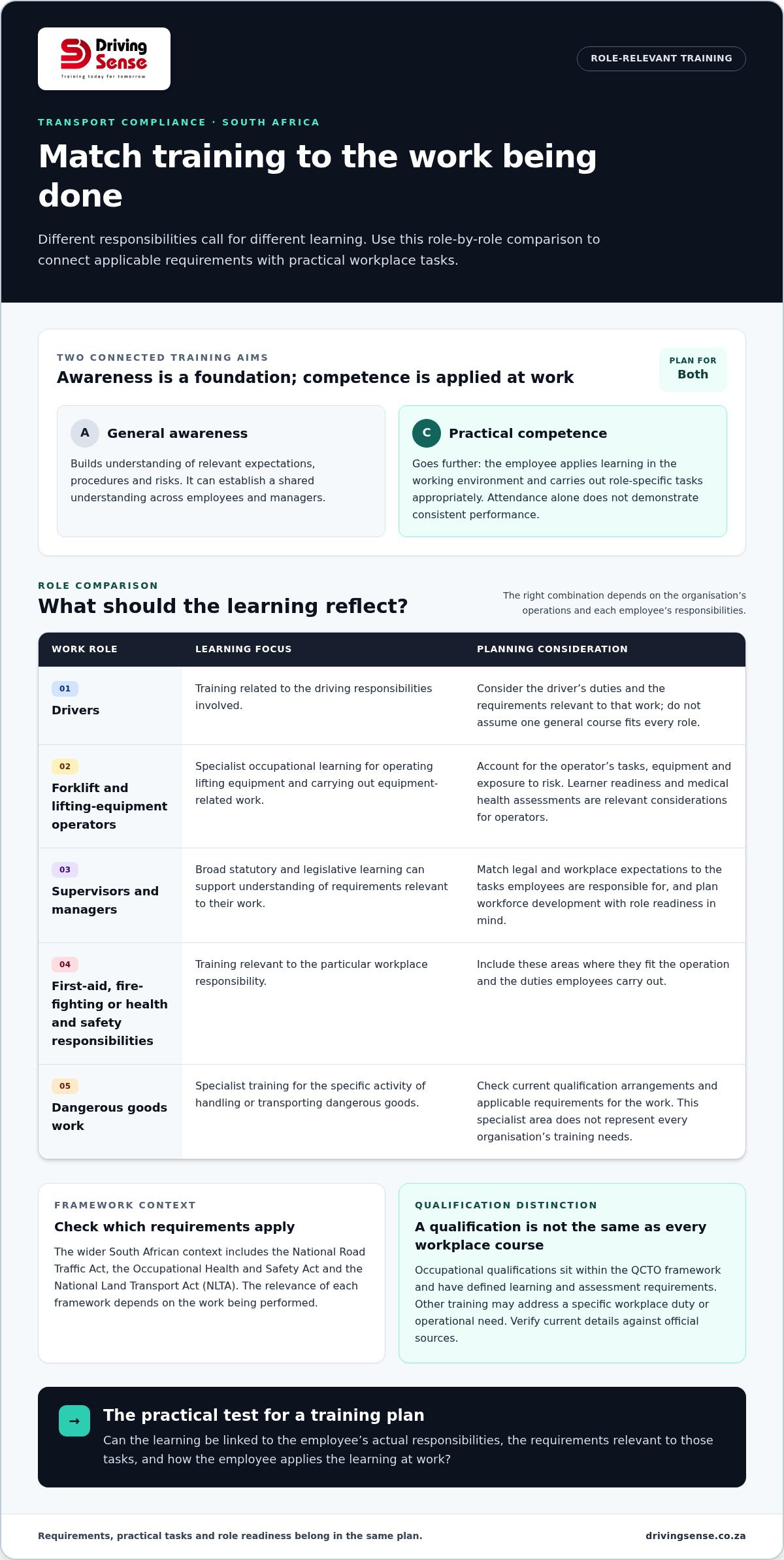
Transport organisations need to align legal and workplace expectations with the tasks employees are actually responsible for. A driver, a forklift operator and a supervisor may work within the same operation, but their duties and exposure to risk differ. A training plan should therefore reflect each role, rather than treating a single general course as sufficient for everyone.
Transport compliance training is role-relevant learning that helps employees understand applicable requirements and apply the knowledge and skills needed to work safely and competently. In South Africa, the wider context includes legislation such as the National Road Traffic Act and the Occupational Health and Safety Act, alongside the National Land Transport Act (NLTA), which provides a framework for the land transport system. The relevance of each framework depends on the work being performed.
Broad statutory and legislative training can help employees and managers understand the requirements relevant to their work. Specialist occupational learning addresses specific tasks, such as driving or operating lifting equipment. These areas complement one another: general awareness can establish a shared understanding, while task-focused learning develops capability for particular workplace activities. The right combination depends on an organisation’s operations and its employees’ responsibilities.
How compliance training differs from general awareness
Awareness means understanding relevant expectations, procedures and risks. Competence goes further: it involves applying learning in the working environment, where the employee must carry out tasks appropriately. A course can support this development, but attendance alone doesn’t demonstrate that someone can consistently perform a role to the required standard.
The depth and type of learning should reflect the level of responsibility. An employee who needs to recognise a hazard may require different preparation from one who must operate equipment or make decisions that affect others’ safety. Organisations can use learner preparation and assessment to inform training, then consider how learning is applied in practice.
Why transport organisations connect training with operational roles
Drivers and lifting-equipment operators work with different equipment, procedures and hazards. Driver training should relate to the driving responsibilities involved, while forklift learning should address the operator’s equipment-related work. First-aid, fire-fighting and health and safety training may also be relevant to workplace responsibilities, depending on the operation.
When learning reflects these distinctions, employees are better positioned to apply it within their roles, and managers can plan workforce development with greater clarity. That connection between requirements, practical tasks and role readiness is the foundation of a systematic approach to transport compliance training south africa.
How South African qualification frameworks shape transport compliance training
Training decisions need to account for the work employees perform, the requirements that apply to those activities and, where relevant, the qualification framework governing the learning. For organisations planning transport compliance training south africa, this means separating occupational qualifications from other forms of statutory, legislative or workplace training rather than treating them as interchangeable.
What the QCTO transition means for employers
South Africa’s occupational qualification system is moving from a landscape shaped by SETA-linked unit standards towards qualifications developed within the Quality Council for Trades and Occupations (QCTO) framework. The QCTO is the accrediting body for occupational and trade-related qualifications; providers offering these qualifications must meet the applicable accreditation requirements. This does not mean every type of workplace training is itself an occupational qualification, or that every training provider holds QCTO accreditation.
For employers, the practical distinction matters. A qualification may have defined learning and assessment requirements, while other training may address a particular workplace duty or operational need. Identify the purpose of the training first, then establish which qualification or other requirements apply. Framework terminology and requirements can change, so verify current details against official sources before making training decisions.
How legislation and standards relate to specific transport activities
Legal references should be matched to the activity, not applied as a generic checklist. A driver’s responsibilities, forklift operation and the handling or transport of dangerous goods involve different tasks and may engage different requirements. Dangerous goods training is a useful specialist example: it concerns a particular transport activity and should not be treated as a complete representation of every organisation’s compliance training needs.
Where dangerous goods are involved, employers should check the current qualification arrangements and applicable requirements for the specific work. The same principle applies across transport operations: use current South African sources to verify legal references and standards, and consider how they relate to the duties employees actually perform.
Occupational health and safety requirements also form part of the wider picture, but their relevance depends on workplace activities and responsibilities. For broader context on assessing this area, see the South Africa OHS training buying guide.
A sound approach connects the applicable framework to role-specific learning, while keeping qualification requirements distinct from other training needs. Organisations developing that approach can explore role-relevant transport training from Driving Sense, delivered nationwide across South Africa.
Which transport compliance training relates to each workplace role?
Training should follow assigned responsibilities, rather than job titles alone. An employee may drive as part of their duties, operate a forklift, or hold a designated workplace safety role; each calls for learning relevant to the tasks and risks involved. The table offers a starting point for scoping transport compliance training south africa, not a universal checklist. Employers should determine the appropriate scope against actual duties and current requirements.
| Role or task | Potential learning area | Why it may be relevant |
|---|---|---|
| Employees who drive for work | Driver training | Supports driving-related knowledge and skills suited to the employee’s work responsibilities. |
| Employees assigned to operate forklifts | Forklift training | Develops learning specific to operating lifting equipment and carrying out related tasks safely. |
| Employees with first-aid responsibilities | First-aid training | Prepares designated personnel to respond within the scope of their workplace role. |
| Employees with fire-safety duties | Fire-fighting training | Relates learning to relevant workplace fire-safety responsibilities and procedures. |
| Employees with general workplace safety responsibilities | Health and safety training | Builds understanding of safety responsibilities relevant to the work environment. |
| Personnel involved in dangerous goods activities | Dangerous goods training | Addresses a specialist transport activity, rather than representing all transport compliance learning. |
Driver and transport operations responsibilities
Driver training is relevant to employees whose work includes driving, with learning shaped by their duties and operating context. It should be distinguished from broader transport administration or management, which involves different responsibilities and may call for different learning. For a closer look at fleet-focused learning, see the corporate driver training guide.
Lifting, emergency and workplace safety responsibilities
Forklift training should relate to employees assigned to operate forklifts, while first-aid, fire-fighting and health and safety training should reflect the relevant workplace duties. A pre-training educational assessment can help identify learner readiness and inform preparation. For lifting-equipment operators, medical health assessments are also relevant to safety considerations. These steps help organisations align learning with both the person and the work.
Use the table as a planning aid, then document why each learning area applies to a role and check the relevant current requirements. This keeps dangerous goods learning distinct from general transport training and helps prevent course attendance from becoming a substitute for assessing role readiness and workplace application.
How to plan transport compliance training around real workplace needs
A structured plan treats training as an ongoing organisational process, rather than a course selected in isolation. For transport compliance training south africa, the starting point is to understand what employees do, what requirements apply to those activities and where learning can support safer, more competent work.
A practical sequence can help turn those questions into a clear workforce development plan:
- Identify duties: Record the tasks employees perform, equipment they use and responsibilities they hold.
- Assess learning needs: Compare those responsibilities with employees’ existing knowledge and skills to identify relevant areas for development.
- Prepare learners: Consider readiness before training, including whether learners may need additional preparation to engage with the material.
- Deliver relevant training: Select learning that matches the role, workplace context and applicable requirements.
- Review application: Consider whether the learning remains relevant and how it is applied in the work environment.
Assess responsibilities and learner readiness
Start with the actual work: driving duties, forklift operation, equipment use, workplace hazards and any assigned safety responsibilities. Identify what employees already understand and where further learning may be needed. A pre-training educational assessment can help indicate learner readiness, inform preparation and support a more appropriate training approach. It is a planning input, not a substitute for assessing practical performance or determining applicable requirements.
Document the connection between each role, its tasks and the learning selected. This creates a useful record for managers and supports consistent decisions across teams without turning the plan into an invented legal checklist.
Review training relevance and workplace application
After training, review whether the learning still aligns with employees’ duties and whether it is being applied in practice. Supervisor observations, feedback and existing workplace processes can help identify where further guidance or learning may be appropriate. Changes to duties, equipment or work processes can also prompt a review; there is no need to impose an arbitrary interval in place of considering the operational context.
Role-based needs analysis should come before course selection, so learning reflects the work employees are expected to perform. For practical context on workplace safety checks, consult the South Africa workplace safety compliance checklist.
Build a training plan around your organisation’s roles with Driving Sense’s role-relevant training, delivered nationwide across South Africa.
How Driving Sense supports transport compliance training nationwide
Driving Sense supports organisations seeking to connect relevant requirements with practical capability across different workplace roles. Its approach to transport compliance training south africa recognises that training needs can span driving, lifting equipment and wider workplace safety responsibilities, rather than sitting within a single course category.
A training approach that considers compliance and competence
Driving Sense provides driver, forklift, first-aid, fire-fighting, health and safety, and statutory or legislative training for organisations nationwide across South Africa. This range enables organisations to consider learning in relation to specific responsibilities, whether an employee drives for work, operates lifting equipment or carries workplace safety duties.
Training preparation can include educational assessments to help gauge learner readiness and inform how learning is approached. For lifting-equipment operators, medical health assessments are also considered as part of the safety context. These measures support a considered process: understand the work, prepare learners and connect training with both applicable requirements and the competence needed in practice.
The emphasis is on quality-focused delivery and on treating compliance and competence as related priorities. Training contributes to workforce development, while organisations remain responsible for aligning learning with their own activities and applicable requirements.
Building a structured training conversation
Organisations can prepare for a productive training discussion by setting out needs by role, task and relevant workplace requirements. For example, distinguish employees who drive from those who operate forklifts, then identify any first-aid, fire-fighting or health and safety responsibilities that also require learning. This gives training planning a practical basis and helps avoid selecting courses without a clear connection to the work.
Founded in 2006, Driving Sense draws on founder Natalie Rodrigues’s 11 years of transport-sector experience to support organisations with driver, forklift, first-aid, fire-fighting, health and safety, and statutory or legislative training nationwide across South Africa.
For organisations seeking to align workforce learning with operational responsibilities, explore Driving Sense training support as a considered next step.
Build a more capable, safety-focused workforce
Effective transport compliance training south africa connects applicable requirements with the real duties employees perform. The right approach is role-specific: identify responsibilities, prepare learners and select training that supports both compliance and practical competence. Ongoing review helps organisations keep learning relevant as work activities and responsibilities evolve.
Driving Sense has supported organisational training since 2006, with founder Natalie Rodrigues bringing 11 years of transport-sector experience. Training is delivered nationwide, with a focus on compliance and genuine skill development. By structuring learning around workforce roles and operational needs, organisations can take a more systematic approach to readiness and workplace safety.
Use the principles in this guide to consider where your current training aligns with employees’ responsibilities and where further development may be appropriate. Explore Driving Sense training support for your organisation and take a considered next step towards a more competent, prepared workforce.
Frequently Asked Questions
What is transport compliance training in South Africa?
Transport compliance training in South Africa is role-relevant learning that helps employees understand applicable requirements and develop the knowledge and skills to carry out their work safely and competently. It can include driver, forklift, first-aid, fire-fighting, health and safety, and statutory or legislative training, depending on the organisation’s activities. The purpose is to connect compliance expectations with workplace responsibilities, rather than assume one general course meets every need.
Which employees may need transport compliance training?
Employees may need training if their work involves driving, operating a forklift, carrying out workplace safety duties or responding to relevant emergencies. The appropriate learning depends on each person’s assigned tasks, equipment use and responsibilities. For example, a driver’s training needs may differ from those of a lifting-equipment operator or a designated first aider. Employers can map roles and tasks to relevant learning areas to identify where training may be appropriate.
How does QCTO relate to occupational training in South Africa?
The Quality Council for Trades and Occupations (QCTO) is South Africa’s accrediting body for occupational and trade-related qualifications. Its framework is relevant where training leads to an occupational qualification, but not every workplace training activity should be treated as one. Employers should distinguish qualification requirements from other statutory, legislative or role-specific learning, and check current framework details against authoritative sources. QCTO’s role does not establish the accreditation status of any individual provider.
Does transport compliance training include driver training?
Yes. Driver training can form part of transport compliance training for employees whose work includes driving. Its relevance and scope should reflect the duties involved and the requirements that apply to that work. Driver competence is distinct from wider transport administration or management responsibilities, which may call for different learning. Employers can clarify the tasks drivers perform and use that information to plan suitable training and consider how learning is applied on the job.
Can transport training include forklift and lifting-equipment responsibilities?
Yes. Forklift training is relevant for employees assigned to operate forklifts, and should relate to their equipment and workplace responsibilities. For lifting-equipment operators, medical health assessments are also an important safety consideration. Training needs should be considered alongside applicable requirements and the actual tasks involved, rather than assuming that general driver training covers equipment operation. Employers should verify current requirements for the specific lifting equipment and work activities.
How can an employer identify which transport training employees need?
Start by listing each role’s duties, equipment use and relevant workplace risks, then identify the knowledge or skills employees need to perform those tasks. Compare this with existing capability and applicable requirements before selecting learning. A driver, forklift operator and employee with first-aid responsibilities may need different preparation. Documenting the link between role, task and training gives managers a clear basis for planning and reviewing workforce development.
Why assess learner readiness before workplace training?
Assessing learner readiness before training can help identify existing knowledge and whether additional preparation may support participation. A pre-training educational assessment can inform how learning is planned and help employers understand learner needs before delivery. It does not, on its own, demonstrate practical competence or replace assessment of workplace application. Considering readiness alongside role requirements helps organisations plan training more systematically and support learners in engaging with relevant material.

Pingback: Workplace Safety Compliance in South Africa: A Practical Checklist – Driving Sense