

Fuel is only one part of fleet expenditure, but it can account for up to 30% of total operational costs. To understand how to reduce fleet operational costs in South Africa, manage both fixed commitments and variable expenses by using fleet data, driver coaching, efficient route planning and planned maintenance. These measures can help limit fuel waste and avoidable downtime whilst supporting vehicle availability.
Fuel, maintenance and vehicle finance all affect a fleet budget, but each responds to different controls. A fleet management system can make operating patterns easier to see, while driver coaching and better scheduling help turn that information into practical changes.
This article explains how fleet systems can support cost control, which driving behaviours and routing decisions affect fuel use, and how preventative maintenance can reduce disruption. It also distinguishes fixed costs, which remain broadly steady regardless of vehicle use, from variable costs that rise and fall as vehicles operate. This helps identify where each intervention fits.
Key Takeaways
- Separate fixed commitments from usage-driven expenses to see which parts of the fleet budget different controls can influence.
- Use fleet data to identify fuel-wasting driving patterns, then target coaching at the behaviours affecting efficiency and vehicle wear.
- Improve route planning and scheduling to limit unnecessary kilometres, congestion delays and avoidable idling.
- Use maintenance information and vehicle history to plan servicing and assess when continued operation is becoming costly.
- Apply Driver Training, Emergency Safety Training and Compliance Training where workforce capability and operational procedures are part of the cost-control challenge.
Driver behaviour and coaching
Driving behaviour affects fuel consumption through idling, acceleration, braking and speed. Telematics can reveal where these patterns occur, giving fleet managers evidence to guide coaching and operational decisions.
Driving Habits and Fuel Use
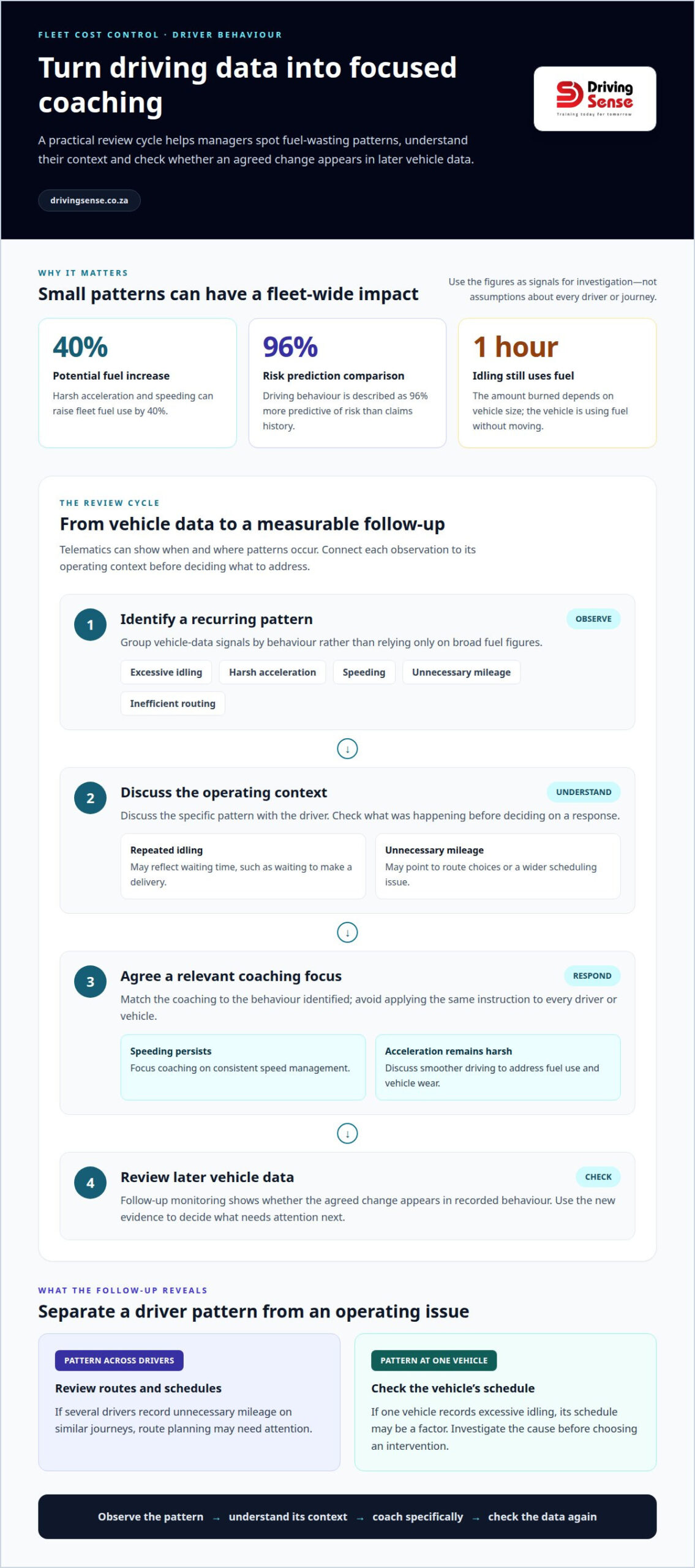
Driving habits are the repeated actions a driver takes behind the wheel, including acceleration, speed and idling. Harsh acceleration and speeding can raise fleet fuel use by 40%, while one hour of idling burns fuel, with the amount depending on vehicle size. Identifying these behaviours helps managers focus coaching on actions that affect fuel consumption.
Consider a vehicle idling while waiting to make a delivery, then accelerating sharply between stops. Idling uses fuel without moving the vehicle, while sharp acceleration can increase fuel use and vehicle wear. Across a fleet, recognising these patterns gives managers a basis for reducing avoidable consumption without assuming every route or driver faces the same conditions.
Monitoring Driver Behaviour
Driver behaviour monitoring uses vehicle data to identify patterns such as excessive idling, harsh acceleration, unnecessary mileage, speeding and inefficient routing. Telematics can show managers when and where these issues occur, rather than leaving them to rely on broad fuel figures. The evidence can then support targeted coaching and performance management.
Driving behaviour is described as 96% more predictive of risk than claims history. That comparison makes monitoring useful beyond fuel management: managers can use recurring patterns to identify areas for coaching and safety improvement. Data should inform a discussion about specific actions, such as repeated speeding or idling, rather than serve as an unsupported judgement about a driver.
A practical review has three steps: identify a recurring pattern, discuss its operational context with the driver, then agree which behaviour to address. Repeated idling, for example, may reflect waiting time, while unnecessary mileage may point to route choices. Identifying the cause helps match the response to the issue instead of applying the same instruction to every vehicle.
Follow-up monitoring can show whether the agreed change appears in later vehicle data. If speeding persists, coaching can focus on consistent speed management; if acceleration remains harsh, the discussion can address smoother driving. This cycle connects observation with action and gives managers a clearer view of whether an intervention is changing recorded behaviour.
- Group recurring patterns by behaviour, such as idling, speeding or acceleration.
- Discuss the specific pattern and its operating context with the driver.
- Agree a relevant coaching focus and review later vehicle data for change.
Consistent monitoring also helps distinguish a repeated individual pattern from a wider operational issue. If several drivers record unnecessary mileage on similar journeys, route planning may need attention. If one vehicle records excessive idling, its schedule may be a factor. This distinction helps managers direct coaching and operational reviews towards the source of avoidable fuel use.
Fuel efficiency and route optimisation
Fuel can account for up to 30% of a fleet’s total operational costs, so route choices affect running costs and margins. Telematics and scheduling tools help managers use fleet information to plan journeys more effectively.
Route Planning and Scheduling
Route planning and scheduling allocate vehicles and journeys against operational requirements, helping limit unnecessary mileage and delays. Manual route planning can take fleet businesses 2-4 hours a day, time that routing and scheduling software may help reduce by using accurate fleet information.
For example, a dispatcher can consider delivery locations, vehicle availability and planned timing together, rather than treating each trip in isolation. A schedule that avoids overlapping journeys can limit unnecessary kilometres, while a route plan that accounts for congestion can help vehicles stay productive.
Route Optimisation and Labour Productivity
Route optimisation selects practical journeys and schedules that make better use of vehicles and driver time. A driver handling 2-3 more jobs per day can improve fleet productivity without adding staff, making route design relevant to labour costs as well as fuel use.
That outcome depends on suitable job sequencing, realistic travel times and the work assigned to each vehicle. Telematics and fleet information can reveal repeated detours or inefficient schedules. Managers can then adjust allocations and assess whether drivers can complete more work without unnecessary mileage.
Fuel efficiency also depends on whether a planned route allows for steady running. A shorter route is not automatically more efficient if congestion or repeated stops extend the journey. Comparing mileage, expected conditions and work requirements gives managers a better basis for balancing fuel use, service capacity and operating margins.
Tolls and Route Planning
Tolls, including electronic charges on routes that use them, add direct trip expenditure. Route planning should weigh them alongside mileage and journey efficiency. In South Africa, compare the full operating effect of each available route, not simply whether it includes a toll.
A toll route, for example, may reduce unnecessary distance or avoid congestion, while an alternative may avoid the charge but require more driving. The right choice depends on the journey, vehicle and operating schedule. Recording tolls alongside route and fuel information helps managers compare options consistently.
When reviewing a route, fleet managers can compare planned and actual mileage, journey timing and toll charges, then adjust schedules where repeated differences appear. This gives them a practical basis for deciding whether a route supports the workload and cost controls required, rather than judging it on distance alone.
How Fleet Management Reduces Costs in South Africa
Fleet management connects vehicle use, maintenance records and operating costs, helping managers identify where planned action may prevent avoidable expense. South African tax deductions, VAT treatment and incentives depend on factors such as vehicle ownership, business use and applicable tax rules. Operational savings alone do not establish tax treatment.
Preventative Maintenance
Preventative maintenance schedules inspections and servicing before vehicle faults cause disruption. Planned maintenance is generally less expensive than reactive repairs, which can also take a vehicle out of service unexpectedly.
Telematics can provide diagnostic information to help managers schedule maintenance and inspections proactively. For example, a fleet manager can use a vehicle alert to plan an inspection around operational requirements instead of waiting for a fault to interrupt a scheduled journey. This makes maintenance decisions more visible and supports efficient vehicle use.
A sample mid-size fleet budget allocates 15% to maintenance and repairs. That figure illustrates why maintenance deserves a place in cost reviews, but actual spending depends on vehicle use and condition. Tracking recurring repair work, tyre replacement and service history helps managers identify where vehicle wear is contributing to rising variable costs.
Maintenance automation can organise diagnostic information and service records, making upcoming work easier to schedule. It does not remove the need for operational judgement: managers still need to consider vehicle condition, workload and maintenance history when setting priorities. It does, however, provide a clearer view of which vehicles need attention and when.
Vehicle Lifecycle Management
Vehicle lifecycle management assesses a vehicle’s costs and condition throughout its time in the fleet, including whether replacement may be appropriate. Continuing to operate a vehicle that is becoming more costly can affect availability as well as maintenance expenditure.
Fleet replacement timing can be assessed using vehicle age, mileage, maintenance history and running costs. A vehicle with repeated repairs may warrant a different decision from one with similar mileage but a stronger maintenance record. Reviewing these factors together gives managers a structured basis for considering continued use or replacement.
Fleet management systems can bring service records, diagnostic information and usage patterns together for more consistent review. For example, a manager can compare a vehicle’s repair history with its mileage and operating demands before allocating further work. This context helps distinguish a one-off repair from a recurring cost pattern.
Technology and telematics can influence around 65% of total operating costs through fuel efficiency, maintenance, insurance risk, driver productivity and compliance. This reflects the reach of fleet data across several cost areas, not a guaranteed saving. Maintenance information is most useful when managers connect it to vehicle use, repair history and availability decisions.
To keep reviews practical, consider each vehicle through three related questions: what does its maintenance history show, how does its current running cost compare with its operational role, and what would replacement change? Recording decisions alongside mileage and service history supports consistent lifecycle management. It also helps managers plan maintenance before an expensive fault causes disruption.
Downtime and vehicle availability
Leasing and buying affect fleet costs differently through financing commitments, ownership responsibilities and replacement decisions. Compare each option against vehicle use, expected holding period, maintenance history and the effect of downtime on operations.
A sample mid-size fleet budget allocates 30% to vehicle acquisition and depreciation, making availability and replacement decisions material to cost control.
Reducing Vehicle Idling
Reducing vehicle idling means limiting engine running when a vehicle is stationary and does not need to operate. Idle time consumes fuel and can add up across a fleet. Telematics can help identify when, where and how often it occurs.
For example, managers can review repeated idling at delivery points or during waiting periods, then consider whether scheduling or operating procedures can reduce it. Unnecessary idling across multiple vehicles and drivers can add up to substantial wasted time.
Vehicle and cargo theft or hijacking can create direct losses, raise insurance premiums and disrupt South African operations. Real-time tracking and cargo security measures can help deter theft, support faster asset recovery and provide evidence to insurers. Their operational value includes limiting disruption, not just recording a vehicle’s location.
Vehicle Replacement Timing and Depreciation
Vehicle replacement timing means assessing whether continued operation remains practical compared with replacing the vehicle. Depreciation is the reduction in a vehicle’s value over its useful life. Tracking it helps managers understand ownership costs alongside running expenses.
Assess replacement using vehicle age, mileage, maintenance history and running costs. A vehicle with recurring repairs and rising operating costs may call for a different decision from one with a stronger service history. Depreciation can be estimated by subtracting residual value from purchase price, then dividing the difference by useful life in years.
Availability depends on more than repair decisions. Managers can also consider how vehicle downtime affects scheduled work and fleet capacity. If one vehicle is unavailable, its workload may need to be reassigned, affecting other vehicles’ schedules and operating costs. Comparing downtime records with maintenance history helps identify recurring causes and inform replacement planning.
Leasing and buying should be compared using the full operating picture, rather than a single payment or vehicle price. Finance or leasing, insurance and licensing are fixed costs that stay broadly similar regardless of vehicle use. Managers can weigh those commitments against expected use, maintenance history, depreciation and the operational consequences of downtime.
For a practical review, group each vehicle’s information into three areas: availability and downtime, maintenance and running costs, and age and mileage. This makes it easier to identify vehicles that repeatedly interrupt operations and distinguish an isolated repair from a pattern. Applying the same criteria across the fleet supports consistent replacement decisions and more predictable vehicle availability.
Fixed and variable fleet costs
Separate fixed commitments from usage-linked expenses before deciding where cost controls can make a difference. A sample mid-size fleet budget illustrates how different categories compete for the same operating resources.
Fixed costs stay broadly similar regardless of vehicle use. They include vehicle finance or leasing, insurance and licensing, so reducing mileage alone will not necessarily change these commitments. Variable costs rise and fall with use, including fuel, tyres, maintenance, repairs and tolls. This distinction helps managers match each control to the right expense and understand how to reduce fleet operational costs in South Africa.
In a sample mid-size fleet budget, fuel and energy account for 25%, insurance and claims for 8%, and technology and telematics for 5%. Drivers and labour represent 12%, whilst administration and compliance account for 5%. These figures are an illustrative allocation, not a required budget for every South African operation.
Use these categories to organise tracking rather than treating total fleet expenditure as a single figure. Rising fuel expenditure, for example, may reflect additional mileage, while higher insurance and claims expenditure belongs to a different cost category. Comparing each category over consistent reporting periods helps managers see whether a change reflects greater vehicle use, a recurring commitment or an operational decision.
Variable expenses respond more directly to day-to-day operating decisions. Unnecessary mileage can raise fuel use and tyre wear; repeated repairs can increase maintenance expenditure; and tolls add a direct cost to particular journeys. For organisations assessing how to reduce fleet operational costs in South Africa, reviewing these expenses together can reveal which operating patterns contribute to increases.
Fixed costs still matter when making utilisation decisions. Finance, leasing, insurance and licensing remain commitments when a vehicle is underused, making those costs harder to absorb across operations. Managers can compare vehicle availability and workload to identify underused capacity before committing to additional vehicles or changing schedules.
Driver behaviour also links variable expenditure with workforce management. Tracking can reveal patterns in speeding, idling or harsh acceleration, while coaching can address behaviours associated with fuel use and component wear. The key measure is whether the operational pattern changes, not simply whether the fleet has collected more data. A consistent review links driver activity to the relevant cost category.
A practical cost review can group expenses into fixed commitments, usage-based costs, and workforce or administration costs, then assign an appropriate control to each. For example, review scheduling for unnecessary mileage, maintenance records for recurring repairs, and operating arrangements for underused vehicles. This clarifies where action may influence expenses and where commitments remain largely independent of use.
For a structured approach to driver behaviour and workforce capability, explore fleet cost-control guidance alongside these budget categories.
Driving Sense
Driving Sense supports organisations addressing the people and safety factors behind fleet operating costs. Driver training can help build more consistent driving practices, while Emergency Safety Training and Compliance Training support broader workplace readiness and procedures. Specialist cargo handling training is also relevant to workforce capability for fleets managing regulated goods.
These training services complement operational measures such as vehicle data reviews, route planning and planned maintenance; they do not replace mechanical repairs or fleet management systems. Consider training when driver practices, safety preparedness or compliance requirements contribute to the issues affecting your operations.
For a discussion about relevant training for your organisation, contact Driving Sense.
Make your next fleet review actionable
Turn the question of how to reduce fleet operational costs in South Africa into a defined management priority by selecting one area for closer review. Set a baseline, assign responsibility for monitoring it and agree when to assess progress. A focused review can help teams distinguish a change in operating conditions from the effect of a particular intervention.
For the next review, decide which operational indicator matters most to your fleet, such as vehicle availability, fuel use or recurring driver patterns. Connect that indicator to a practical action and a responsible team member. This creates a clear basis for decisions and helps maintain accountability without treating every cost movement as a separate initiative.
Where workforce capability is part of the priority, Driving Sense can discuss relevant training for your organisation. Arrange a fleet-cost discussion with Driving Sense and identify a suitable next step for your operational goals.
Frequently Asked Questions
What are the main fleet operating costs in South Africa?
The main costs include vehicle finance or leasing, insurance, licensing, fuel, tyres, maintenance, repairs, tolls, driver labour, technology and administration. For a useful comparison, classify each transaction by vehicle and cost type. A repair invoice, for example, belongs with variable maintenance expenditure, while a monthly finance commitment is fixed. This helps identify whether a budget change comes from greater vehicle use, a recurring commitment or an operational decision.
How can South African fleets reduce fuel consumption and fuel costs?
Compare fuel records with mileage and assigned work to identify unusual consumption patterns. If one vehicle’s fuel use changes on a regular delivery run, for example, examine journey records and operating conditions before changing the schedule. Separating fuel volume from expenditure also helps distinguish increased usage from a change in fuel prices. Record the issue, the action taken and subsequent performance to assess whether the intervention addressed the cause.
What telematics and fleet management systems are available in South Africa, and what do they cost?
South African fleets can use GPS tracking, telematics, routing and scheduling software, or systems that combine several functions. Choose capabilities according to the management need, such as locating vehicles, reviewing journeys or coordinating work. System expenditure varies with fleet size, selected features, equipment and ongoing support. Compare the functions required and the full operating arrangement, rather than choosing by system name alone.
How can preventative maintenance reduce commercial fleet costs in South Africa?
Preventative maintenance helps avoid the expense and disruption of faults that develop unnoticed. A practical measure is to record driver-reported defects consistently, then prioritise vehicles according to the defect’s operational impact and maintenance history. For example, assess a reported warning light before assigning the vehicle to demanding work. Scheduling maintenance during quieter operating periods can also limit the effect of workshop time on planned services.
How do vehicle choice, right-sizing and replacement cycles affect fleet costs in South Africa?
Vehicle choice affects how well capacity matches the work, while replacement timing influences ownership and operating expenditure. A vehicle that regularly carries less than its intended capacity may not suit its assigned role; one repeatedly operating beyond its practical capacity may face different pressures. Electric vehicles can have slightly lower operating costs per kilometre than typical fleet vehicles. Compare vehicle suitability with actual duties, mileage and lifecycle records.
How can businesses reduce vehicle insurance, accident and driver-related costs in South Africa?
Use incident records to identify recurring circumstances, then address the relevant driving or work practice through targeted coaching. If reports repeatedly identify the same type of manoeuvre, for example, review how drivers are prepared for that task and how it is managed operationally. Consistent incident documentation also helps managers understand claims patterns and assess whether procedures or driver support need to change.
What South African traffic, roadworthy, licensing and transport regulations affect fleet operating costs?
Fleet budgets should account for applicable traffic, roadworthy, licensing and transport obligations, which can vary with vehicle type, use and operation. Build a vehicle register recording relevant requirements, responsible personnel and applicable inspection or renewal dates. A vehicle used for a different operational purpose, for instance, may need a different compliance review. This makes compliance work traceable and helps managers plan administrative responsibilities alongside vehicle availability.
How can fleets manage fuel theft, fraud and load security risks in South Africa?
Reconcile fuel transactions against vehicle assignments, mileage and trip records so discrepancies can be investigated promptly. For load security, define who records handovers and what information must accompany each movement. Matching a dispatch record with delivery confirmation, for example, creates a clearer audit trail if a load is delayed or missing. Tracking tools can add journey information, while consistent reporting helps identify recurring vulnerabilities in operating procedures.
