
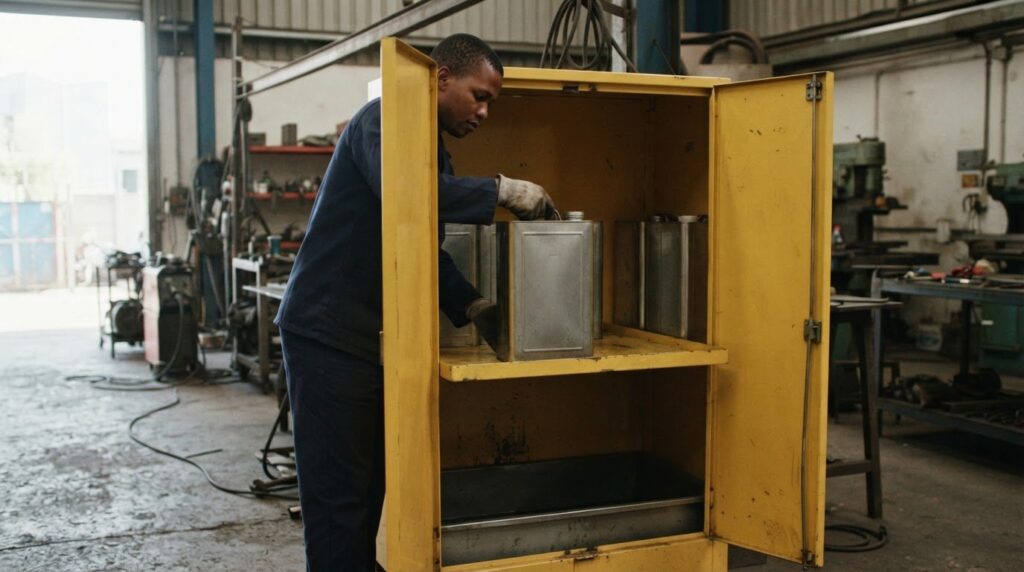
A cabinet, a room or a dedicated store is appropriate only when it suits the substances, quantities and risks involved. The compliance requirements for storing flammable goods in South Africa depend on those factors and the rules that apply to the site. In Cape Town, storing or using more than 200 litres of flammable liquid in danger groups (i) to (iv) requires a Flammable Substance Certificate from the controlling authority; this is a municipal threshold, not a universal South African limit.
Choosing a storage location is an important first step, but it is not the only consideration. Containers must be suitable and properly closed, and the storage arrangement must account for hazards, emergency controls and the information workers need to handle substances safely.
This article explains how to choose between a cabinet, room and dedicated store, and what to consider when checking containers, flammable-liquid classes, inventory, safety data sheets and risk assessments. It also shows how these elements work together to support a practical, well-controlled storage decision.
Key Takeaways
- Choose a cabinet, room or dedicated store according to the substances, quantities and site-specific requirements.
- Include container condition, clear labelling and secure closure in your storage checks.
- Distinguish dangerous-goods transport classes from workplace fire classifications when reviewing flammable liquids.
- Plan storage around fire and explosion hazards, suitable controls and emergency arrangements.
- Use an up-to-date inventory, nearby safety data sheets and a risk assessment to support sound storage decisions.
1. Container condition, labelling and closure
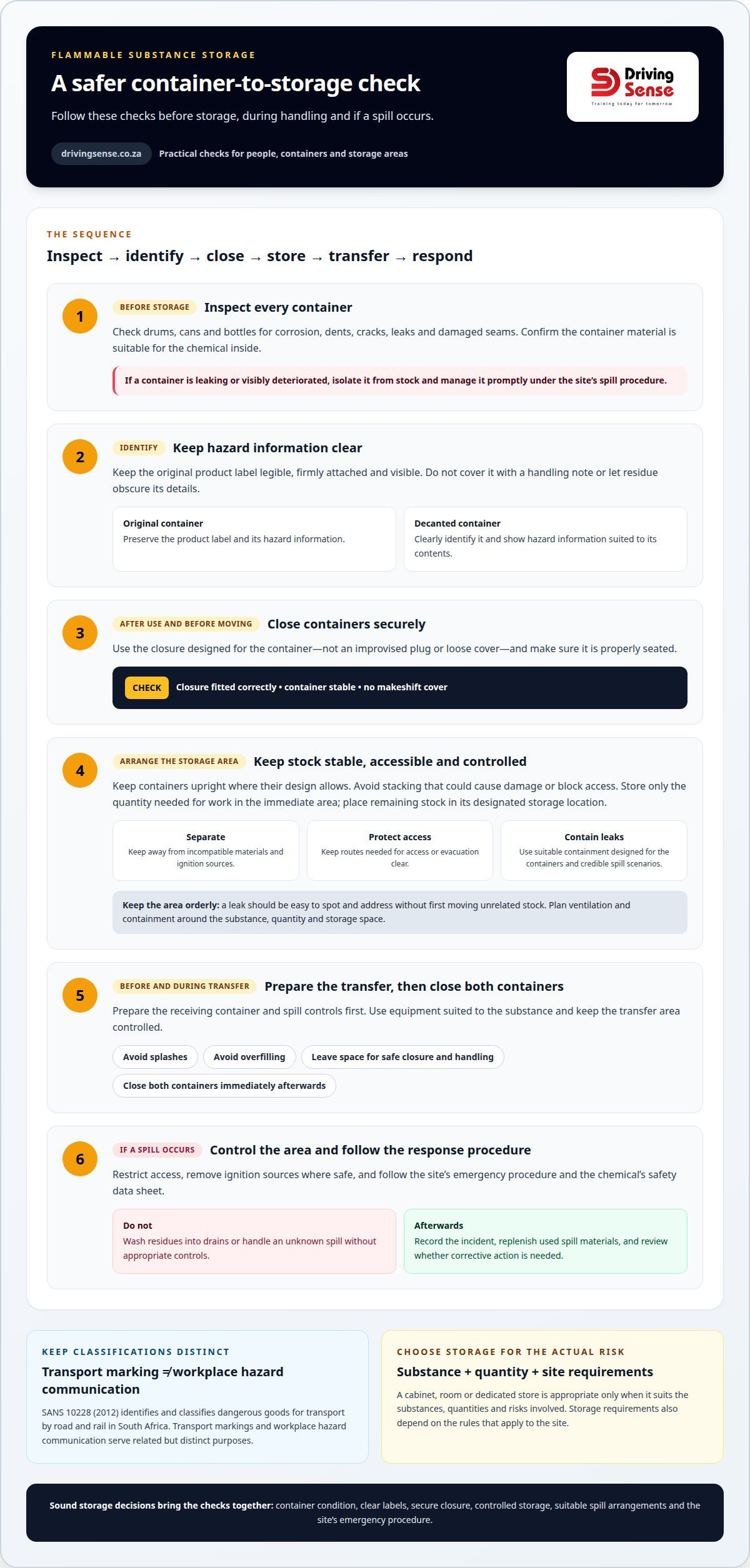
Start with the container. Before storage, inspect each drum, can or bottle for corrosion, dents, cracks, leaks and damaged seams. Isolate any leaking or visibly deteriorated container from stock and manage it promptly under the site’s spill procedure. Check that the container material is suitable for the chemical inside, since an unsuitable container can weaken or fail. Keep containers stable and upright where their design allows, and avoid stacking them in ways that could cause damage or block access.
Labels help workers identify hazards before they handle or move a container. Keep the original product label legible, firmly attached and visible; do not cover it with a handling note or allow residue to obscure its details. If a container is decanted, the receiving container also needs clear identification and hazard information suited to its contents. SANS 10228 (2012) identifies and classifies dangerous goods for transport by road and rail in South Africa, so transport markings and workplace hazard communication serve related but distinct purposes. The Occupational Health and Safety Act 85 of 1993 is South Africa’s overarching workplace health and safety law, according to the South African Government.
Close containers securely after use and before moving them. Use the closure designed for that container, rather than an improvised plug or loose cover, and make sure it is properly seated. During filling, use a controlled process that avoids splashes and overfilling; leave sufficient space for safe closure and handling. Store only the quantity needed for the work in the immediate area, with remaining stock placed in its designated storage location. The Hazardous Chemical Agents Regulations, 2021 may apply where workers are exposed to hazardous substances.
Plan ventilation and containment around the substance, quantity and storage space. Keep flammable goods away from incompatible materials, ignition sources and routes workers need for access or evacuation. A bund or other suitable containment can help limit the spread of a leak; its design should account for the containers and credible spill scenarios at the site. Keep storage areas orderly so a leak can be spotted and addressed without first moving unrelated stock.
Before transferring or decanting, prepare the receiving container and spill controls. Use equipment suited to the substance, keep the transfer area controlled, and close both containers immediately afterwards. If a spill occurs, restrict access, remove ignition sources where safe, and follow the site’s emergency procedure and the chemical’s safety data sheet. Do not wash residues into drains or handle an unknown spill without appropriate controls. Record the incident, replenish used spill materials, and review whether the container, transfer method or storage arrangement needs corrective action.
2. Definitions and flash-point classes for flammable liquids
A flammable liquid is identified by how readily it can produce ignitable vapour, and its flash point helps describe that hazard. Flash point is the lowest temperature at which a liquid gives off enough vapour to ignite under specified test conditions. It is not the liquid’s boiling temperature and does not describe every storage risk. Vapour from a spill may travel and encounter an ignition source away from the container.
In the former Durban Fire By-law, flammable liquids were grouped by closed-cup flash point. A Class I liquid had a flash point below 21°C. Class II covered liquids from 21°C up to and including 55°C. Class III covered liquids from 55°C up to and including 100°C. These are Durban by-law categories, not a universal national classification. The stated ranges meet at 55°C, so use the applicable local classification framework rather than assuming these categories apply everywhere.
Dangerous Goods Class 3 and Class B fire describe different things. Class 3 is a dangerous-goods transport classification for flammable liquids. Class B is workplace fire terminology for fires involving flammable liquids. A liquid may therefore be Class 3 for transport purposes, while a fire involving it is described as Class B. Keeping those terms distinct supports accurate transport documents, workplace procedures and emergency communication.
Classification also helps determine how information should be used. SANS 10228 (2012) identifies and classifies dangerous goods for transport by road and rail in South Africa. That transport classification should not be treated as a complete storage assessment. The product’s safety data sheet provides chemical-specific hazard information, while the quantity, container, storage location and work activity affect the controls needed on site. For example, a small container used at a workbench and bulk stock in a dedicated area create different exposure and incident scenarios.
In South Africa, non-compliant storage may lead to enforcement measures and legal liability, depending on the requirement breached and the circumstances. A liquid’s class alone does not determine a single penalty; applicable duties and consequences depend on the facts of the case.
Apply the classification consistently across the inventory, labels, storage arrangements and emergency information. Where staff handle or transport dangerous goods, Dangerous Goods training can help build understanding of the distinctions and their practical implications.
3. Fire and explosion hazards and prohibited acts
Flammable vapours can ignite when they meet a suitable ignition source, so fire precautions must address both the substance and its surroundings. Keep storage and handling away from activities that could create sparks or heat, such as hot work, unless the work area has been assessed and controlled. Smoking, open flames and unauthorised equipment do not belong in a designated flammable-goods area. A spill can create a vapour hazard beyond the immediate container, making prompt isolation and incident procedures essential.
Construction work has a specific fire-precaution reference: Construction Regulation 29 sets out requirements that include suitable storage for flammable liquids, solids and gases. These precautions sit under South Africa’s Construction Regulations, 2014. On a building site, assess where materials are stored in relation to work activities, access routes and possible ignition sources. A temporary work area should not become an informal store simply because it is close to the task; storage arrangements need to account for the work taking place nearby.
Fire prevention and protection at premises storing or handling hazardous materials must suit the goods. Consider the substances, quantities, storage layout and credible incident scenarios together. Keep exits and emergency equipment accessible, and make emergency arrangements available to people working in the area. Emergency management plans are required when necessary. A plan should explain how workers raise an alarm, move away from danger and communicate relevant information to responders.
Signs help workers and responders recognise hazards before entering a site. Premises storing or handling hazardous materials must display signs in accordance with legislation. Exterior signs at South African sites with significant amounts of dangerous goods must warn that dangerous goods are present, using the word ‘HAZCHEM’ or dangerous-goods diamond symbols. A manifest box at the gate is also required when applicable. Keep signs visible and ensure emergency information is accessible without entering the hazardous area.
Fire-fighting equipment should match the risks and the site’s emergency arrangements. The former Durban fire code referred to S.A.B.S. 810 for dry-chemical portable fire extinguishers and S.A.B.S. 1151 for portable halogenated-hydrocarbon fire extinguishers. These are references in a former local code, not a blanket specification for every South African premises. Select and position equipment as part of a site-specific assessment, and ensure workers understand the response expected of them. A worker should raise the alarm and follow the evacuation procedure rather than attempt to tackle a fire beyond their training or available equipment.
Storage, handling and transport of flammable substances
South Africa’s overarching workplace health and safety law is the Occupational Health and Safety Act 85 of 1993, according to the South African Government. The Hazardous Chemical Agents Regulations, 2021 may apply where workers are exposed to hazardous substances, while Construction Regulation 29 addresses suitable storage on construction sites. Local rules also matter: in Cape Town, storing or using more than 200 litres of flammable liquid in danger groups (i) to (iv) requires a Flammable Substance Certificate from the controlling authority. That 200-litre threshold is a Cape Town municipal requirement, not a universal national limit.
Choose a cabinet, room or dedicated store by assessing the substances, quantities, work activities and site layout together. A cabinet may suit smaller quantities needed near a work area, while a separate room or dedicated store may better suit larger stocks or operations requiring distinct access controls. Locate storage away from work that could introduce ignition sources, and ensure workers can reach stock without obstructing escape routes. The arrangement should also allow practical access for inspection, handling and emergency response.
A flammable-liquid cabinet is one possible control, but its suitability depends on what it will hold and how staff use it. Check that its capacity, construction, internal arrangement and spill containment suit the containers and planned inventory. UK guidance is not South African legislation, so its cabinet quantity recommendations are not local legal limits. A storage room or dedicated store also needs controls suited to its contents, including suitable ventilation and arrangements to contain leaks.
Storage tanks, including those proposed for basements, need a site-specific assessment rather than a decision based on location alone. Consider the tank’s contents and capacity, access for filling and inspection, possible leak paths, ventilation and how an incident could affect people or property. For outdoor storage, account for weather exposure, unauthorised access, vehicle movements and delivery routes. Keep transfer and loading areas orderly, with clear access to relevant emergency arrangements.
Additional requirements depend on the product, quantity, activity and municipality. Petroleum products, LPG and other flammable goods should be assessed against the rules applying to their specific use and location; the former Durban fire code, for example, referred to S.A.B.S Code of Practice No. 087, Part I for liquefied petroleum gas. Costs for compliant cabinets, rooms and fire-safety equipment depend on capacity, materials, installation and site controls, and are established through a quote request. For storage and transport decisions, keep product information, quantities and movement records aligned, so the controls reflect what is actually stored.
5. Inventory, safety data sheets and risk assessment
A reliable assessment starts with an accurate inventory, not an estimate. Record each flammable product, its hazard classification, storage location, container size and maximum quantity. Include working stock, reserve containers and materials awaiting removal, as all contribute to the actual inventory. Update the record when a product changes, a delivery arrives or stock moves. This keeps the assessment aligned with real conditions rather than an outdated store plan.
Keep the relevant safety data sheets (SDS) close to the area where each chemical is stored. An SDS provides product-specific information to guide decisions about handling, exposure, spills and emergency response. Ensure workers can identify the correct sheet by product name and access it promptly, including during an incident. If two liquids have similar packaging, for example, matching each SDS to its product and storage location can help prevent the wrong response.
South African permit and certificate requirements depend on the substance, quantity and local authority. A premises owner or person in charge must obtain a flammable substance certificate from the controlling authority before storing or using more than 100 kilograms of flammable gas, or more than 200 litres of flammable liquid in danger group (i), (ii), (iii) or (iv). The 200-litre threshold is a Cape Town municipal requirement, not a universal South African threshold. The Occupational Health and Safety Act 85 of 1993 provides the overarching workplace health and safety framework, according to the South African Government.
Build the risk assessment around four connected steps: identify, assess, control and sustain. Identify products, quantities, activities and people who could be exposed. Assess credible events, such as a leaking container near routine work or excess stock increasing the consequences of a fire. Select controls that address the identified risks, then sustain them through assigned responsibilities, records and review when conditions change. The Hazardous Chemical Agents Regulations, 2021 may apply where workers are exposed to hazardous substances.
Use planned inspections to compare the inventory and risk assessment with conditions on site. Check that stored products match recorded quantities, SDS remain accessible, controls are in place, and damaged or excess stock is addressed. This is a practical verification process, not a universal inspection frequency. A delivery, process change, spill or new chemical can trigger an earlier review. A workplace risk assessment can help organise these findings into controls and follow-up actions.
Driving Sense: Dangerous Goods
Driving Sense provides Dangerous Goods training for organisations whose staff handle, store or transport hazardous substances. It is a practical next step when inventory reviews or risk assessments reveal gaps in workers’ understanding of classifications, handling procedures or emergency responsibilities. Training can help staff apply site procedures consistently, while Compliance Training can support a broader understanding of applicable requirements.
For organisations coordinating storage and transport, the relevant training depends on staff duties and the substances involved. Clear procedures, accurate product information and informed handling decisions should work together as part of the organisation’s safety controls.
Contact Driving Sense to discuss Dangerous Goods training for your organisation.
Make safe storage part of everyday operations
A storage decision remains effective only when it is built into routine work. Assign responsibility for keeping procedures current, communicating changes and ensuring staff understand their roles. When products, processes or work areas change, review the controls to ensure they still reflect actual operations. This makes meeting South Africa’s compliance requirements for storing flammable goods an ongoing management practice, not a one-off exercise.
Driving Sense supports organisations with Compliance Training and Emergency Safety Training, while Driver Training addresses relevant workforce needs when dangerous goods are transported. The right focus depends on employees’ responsibilities and the procedures they must follow. Developing staff capability alongside sound operational controls helps establish safer, more consistent practices.
Take the next step by discussing your organisation’s training needs. Explore training support with Driving Sense, and move towards a more informed, prepared workplace.
Frequently Asked Questions
Cabinet, room or dedicated store?
Choose storage based on the quantity held, how often staff need access and the work taking place nearby. Applying the compliance requirements for storing flammable goods means matching the setup to these factors rather than defaulting to a cabinet. A cabinet can keep limited working stock near a task, while a separate room or dedicated store may suit larger stocks or controlled access. Occasional maintenance supplies, for example, may need a different arrangement from production stock.
What are the safe practices for the storage and handling of flammable liquids?
Keep only the stock needed for the work area there, and return reserve containers to their designated location. Before transferring liquid, prepare the receiving container and suitable spill controls. Close containers after use and keep handling areas orderly. Store flammable liquids away from ignition sources and incompatible materials. Workers should follow the product’s safety data sheet and site procedures, including the response steps for a spill or other incident.
What should an employer inspect around flammable liquids?
Inspect the storage area, containers and supporting safety arrangements together. Look for leaks, corrosion, damaged closures, unclear identification, blocked access and discrepancies between the stock and inventory. Confirm that workers can access the relevant safety data sheets and emergency information. A new delivery or changed work process should prompt a review of whether the arrangement still reflects actual quantities and activities.
How are flammable goods and dangerous substances classified in South Africa?
Classification depends on its purpose: transport classification and fire classification describe different hazards. Dangerous Goods Class 3 identifies flammable liquids for transport, while Class B describes flammable-liquid fires. SANS 10228 (2012) covers dangerous-goods identification and classification for road and rail transport. The former Durban Fire By-law also used closed-cup flash-point classes for liquids, but those local categories should not be assumed to apply nationally.
What quantity thresholds trigger specific flammable-liquid storage requirements in South Africa?
A flammable substance certificate from the controlling authority is required before storing or using more than 100 kilograms of flammable gas, or more than 200 litres of flammable liquid in danger group (i), (ii), (iii) or (iv). The 200-litre requirement is a Cape Town municipal threshold, not a universal South African limit. Identify the substance, danger group and location when assessing which threshold applies.
What are the requirements for flammable-goods storage rooms, cabinets, tanks and separation distances?
No single storage layout or separation distance suits every substance and site. The compliance requirements for storing flammable goods depend on the materials, quantity, work activities, ignition risks and access needs. Assess tanks, including basement installations, for ventilation, leak paths, inspection access and potential effects on people or property. For cabinets and rooms, consider capacity, containment and location alongside applicable municipal requirements and the site risk assessment.
What fire protection, ventilation, spill containment and safety signage are required?
Controls must suit the materials and credible incident scenarios at the site. Plan ventilation and spill containment around the substances and storage arrangement, and keep emergency equipment and exit routes accessible. Premises handling hazardous materials must display signs in accordance with legislation. Exterior signs at South African sites with significant amounts of dangerous goods must warn of their presence and feature ‘HAZCHEM’ or dangerous-goods diamond symbols. A gate manifest box is required when applicable.
What workplace training, personal protective equipment and emergency procedures are required?
Training, protective equipment and emergency arrangements should match the workplace’s tasks, products and identified risks. Staff need to understand how to handle the substances they use, access relevant safety data sheets, report spills and follow evacuation instructions. The risk assessment and product information help determine suitable protective equipment and procedures. Workers transferring liquid, for example, need task-specific instructions, while others may need clear alarm and evacuation responsibilities.
