

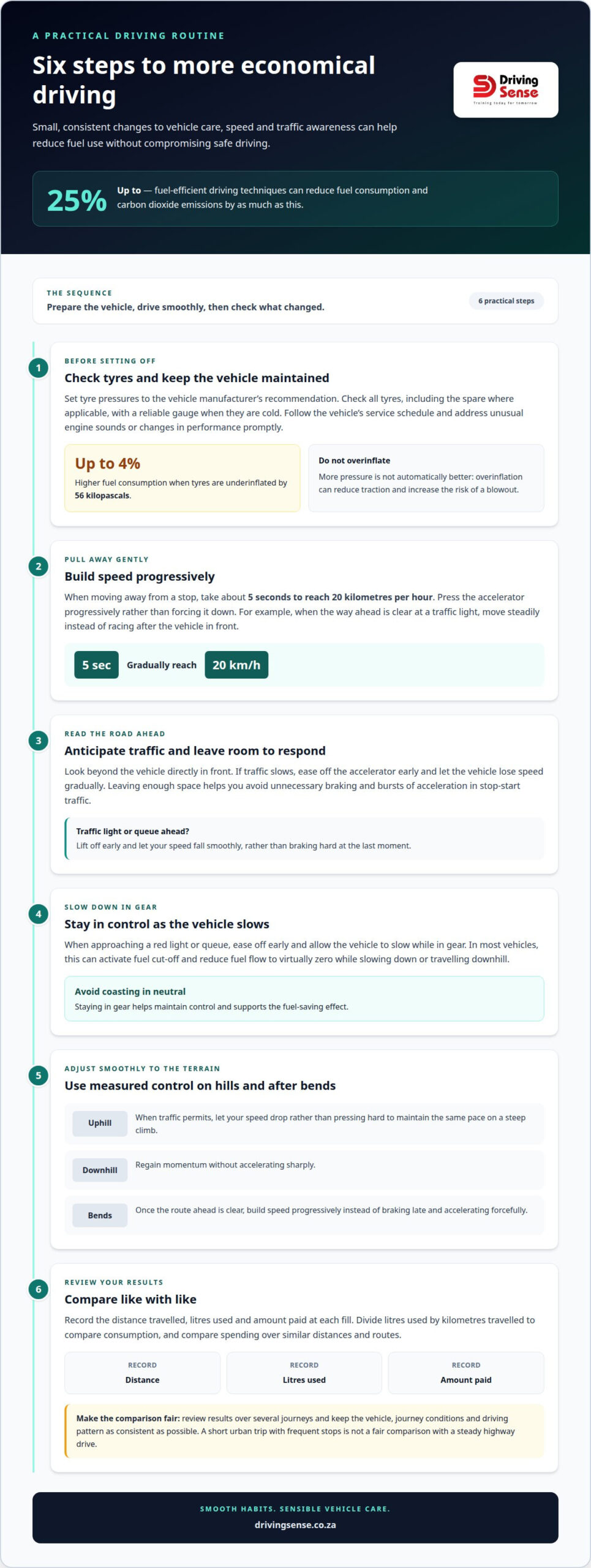
Small, consistent changes behind the wheel can make a measurable difference: fuel-efficient driving techniques can reduce fuel consumption and carbon dioxide emissions by as much as 25%. The most practical economic driving techniques to save fuel focus on how you maintain your vehicle, manage speed and respond to traffic, rather than on any single adjustment.
It’s understandable to want to use less fuel without making daily journeys more complicated. A steady pace, gentle acceleration and looking ahead can help you avoid unnecessary braking, while good vehicle care supports efficient running. This guide explains how to put these habits into practice on South African roads, from checking tyre pressure to combining errands and removing unnecessary weight. You’ll see how each step can contribute to more economical driving and how sensible habits work together to help manage fuel use over time.
Key Takeaways
- Look ahead and ease off the accelerator early to reduce unnecessary braking and acceleration.
- Keep tyres at the pressure recommended by the vehicle manufacturer, and maintain the vehicle regularly.
- Choose a steady, appropriate speed and use cruise control where road conditions allow.
- Plan routes to combine errands and avoid repeat journeys, then remove items you do not need to carry.
- Organisations can use Driver Training to build safer, more consistent driving habits among employees.
1. What Techniques Can You Use to Save Fuel?
Fuel-efficient driving techniques can reduce fuel consumption and carbon dioxide emissions by as much as 25%. These economic driving techniques to save fuel centre on controlling acceleration, anticipating traffic and avoiding unnecessary stops. The aim is not to drive unpredictably or compromise safety. Instead, make each movement deliberate: build speed gradually, watch for changing traffic and leave enough room to respond smoothly.
When moving away from a stop, take about 5 seconds to reach 20 kilometres per hour. This gradual acceleration limits the extra fuel an engine needs when speed rises sharply. Press the accelerator progressively rather than forcing it down, and maintain a smooth pace as traffic allows. For example, at a traffic light, begin moving steadily when the way ahead is clear instead of racing to catch a vehicle that has already pulled away.
Look well ahead to avoid repeated braking and acceleration. If traffic slows, ease off the accelerator early and let the vehicle lose speed gradually instead of maintaining your pace and braking hard at the last moment. Leave enough space to respond safely to vehicles ahead. In stop-start traffic, this can help you avoid unnecessary bursts of speed between queues and make your driving more predictable for other road users.
Plan for the road ahead, not just the vehicle directly in front. When approaching a red light or queue, for example, lift off the accelerator early and allow the car to slow while in gear. In most vehicles, this can activate fuel cut-off and reduce fuel flow to virtually zero while slowing down or travelling downhill. Avoid coasting in neutral: staying in gear helps maintain control and supports this fuel-saving effect.
Use measured control on hills, too. When traffic permits, let your speed drop uphill, then regain momentum downhill without accelerating sharply. Avoid pressing hard on the accelerator to maintain the same speed on a steep climb, as the engine has to work harder. Smooth acceleration matters after a bend or junction as well: once the route ahead is clear, build speed progressively instead of braking late and accelerating forcefully.
To measure fuel consumption and compare spending in rand, record the distance travelled, litres used and amount paid at each fill. Divide the litres used by the kilometres travelled to compare consumption, and compare spending over similar distances and routes. Keep the vehicle, journey conditions and driving pattern as consistent as possible, so changes in spending more clearly reflect your driving habits.
Use the same method before and after changing your habits, then review the results over several journeys. A fuel-consumption display can help show how acceleration affects efficiency, while receipts show the amount actually paid. Compare similar journeys: a short urban trip with frequent stops is not a fair comparison with a steady highway drive. Consistent records make it easier to assess the effect of smoother driving.
2. Vehicle maintenance and tyre pressure
A well-maintained vehicle can run more efficiently, while neglected components may increase fuel consumption. Underinflated tyres create greater rolling resistance, so the engine uses more energy to keep the vehicle moving. Driving on tyres underinflated by 56 kilopascals can increase fuel consumption by up to 4%. The effect can also compromise tyre wear, making regular pressure checks useful for both efficiency and maintenance.
Use the tyre pressure recommended by the vehicle manufacturer, not a general figure. You can usually find the correct values in the vehicle handbook or on a label inside the vehicle. Check all tyres, including the spare where applicable, with a reliable pressure gauge. Measure them when cold, as driving warms the tyres and can affect the reading.
Check tyre pressures regularly, especially before a long journey. Check again after carrying a heavier load, as added weight can affect the pressure needed for the trip. If a tyre seems low, compare its reading with the manufacturer’s recommendation and adjust it accordingly. Don’t assume a tyre is properly inflated just because it has no visible sag.
More pressure isn’t automatically better. Overinflating tyres can reduce traction and increase the risk of a blowout, so don’t exceed the specified pressure. The goal is to keep each tyre at its recommended level, not to maximise pressure in the hope of reducing resistance. Correct inflation supports predictable handling as well as fuel efficiency.
Tyre pressure is only one part of vehicle care. Regular servicing helps maintain engine efficiency by supporting the systems that keep the vehicle operating as intended. Follow the vehicle’s service schedule and address changes, such as unusual engine sounds or a noticeable shift in performance, promptly. A service can identify issues that tyre checks alone won’t reveal.
Build a simple routine around how you already use the vehicle. For example, check tyre pressures before a planned highway journey and note any tyre that repeatedly loses air. A recurring drop may indicate a puncture or another fault that needs attention. Keeping a record of readings can help you distinguish a one-off change from a persistent problem. Check again after adjustments to confirm that all tyres match the recommended values.
For organisations, consistent driving habits complement sound vehicle care: Driver Training can help develop more considered behaviour on the road. Maintenance reduces avoidable mechanical inefficiency, while appropriate tyre pressure limits resistance at the contact with the road. Together, these measures support more efficient travel and can help control fuel use and emissions across routine journeys.
3. Maintaining a steady speed
A steady pace helps avoid unnecessary changes in engine demand. Repeated acceleration and braking use more fuel than maintaining a consistent speed when traffic and road conditions allow. On a South African highway, anticipate slower vehicles and changing traffic, then adjust smoothly. Choose a pace that is safe and compliant rather than accelerating sharply to close gaps.
There is no single efficient speed for every vehicle or journey. Most cars, vans, pickup trucks and SUVs are most fuel-efficient between 50 and 80 km per hour, but the best cruising speed depends on the vehicle, road, gradient and traffic. Treat that range as a general guide, not a reason to drive below a posted speed limit or obstruct other road users.
In South Africa, follow the posted speed limit and adjust your driving to the conditions. Fuel efficiency never takes priority over road rules or safe control. Where possible, maintain a steady, legal speed and leave enough space to respond to traffic without harsh braking. The posted limit and conditions take precedence over any general fuel-saving speed range.
Higher speeds can increase fuel use because air resistance rises as the vehicle moves faster. At 120 km per hour, a vehicle uses about 20% more fuel than at 100 km per hour. On a 25-kilometre trip, increasing speed from 100 to 120 km per hour saves only two minutes. That comparison shows why accelerating beyond a comfortable, legal cruising pace may offer little practical time benefit.
On suitable highways, cruise control can help maintain a consistent speed, particularly when traffic flows steadily and the road is relatively level. It doesn’t replace attentive driving: be ready to slow down for congestion, roadworks, hazards or changing weather. In stop-start traffic or on a winding, steep road, adjust your speed manually instead of relying on cruise control.
In a manual car, changing up to a higher gear when the vehicle can comfortably handle it may improve efficiency. Avoid holding a low gear when the engine can run smoothly in a higher one, but don’t select a gear that makes the engine struggle or respond poorly. The right point depends on the vehicle, load, gradient and acceleration needed.
Compare your speed choices on similar journeys rather than judging a single trip. A fuel-consumption display can show how frequent speed changes affect efficiency, while a consistent cruising pace makes comparisons more meaningful. On a clear highway, choose a comfortable speed within the limit, use cruise control if suitable, and avoid repeated surges that create unnecessary acceleration and braking.
4. Planning routes and combining journeys
Plan your destinations before setting off. Group nearby errands into one outing instead of returning home between separate trips. For example, combine a supermarket visit, a collection and an appointment in the same area, then plan an order that avoids crossing the same roads repeatedly. Fewer separate journeys mean less duplicated travel, and a clear sequence can help prevent unnecessary detours.
Compare practical routes before departure using a route-planning feature. The shortest route on a map may involve congestion, repeated stops or frequent interruptions. Depending on traffic and conditions, a slightly different route may allow more consistent progress. Check the route before setting off, then follow road signs and adjust safely if a closure or delay changes your journey.
Timing matters as much as distance. If your schedule allows, plan your commute to avoid the busiest peak traffic, when repeated stopping and starting can put extra demands on the engine. For instance, moving a flexible appointment away from the busiest part of the morning may make the route less interrupted. Never rush to beat traffic: arriving safely matters more than reaching your destination faster.
Combining short errands can also reduce repeated cold starts. Modern vehicle engines don’t need long idle periods to warm up in winter, so avoid starting the car early and leaving it stationary. Instead, group nearby stops and set off when you’re ready. This reduces separate journeys without using idling as a warm-up method.
Consider the route before choosing between local roads and a highway. A highway may allow steadier travel, while an urban route may involve traffic lights, queues and more frequent braking. However, distance, congestion and road conditions all affect the practical choice. Choose a safe, suitable route instead of assuming one type of road will always use less fuel.
For a regular commute, review your route after travelling it in different conditions. Note where queues regularly form, where roadworks cause delays and which turns lead to avoidable backtracking. Then adjust your departure time or route when your schedule allows. The same planning benefits apply whether your car has a manual or automatic transmission: reducing duplicated distance and interrupted travel improves the overall journey.
Before leaving, confirm your destinations, their order and your route, then allow for changes during the trip. If an unexpected stop comes up, consider whether you can combine it with another nearby errand instead of making a separate return journey. This practical approach can reduce repeat driving and support more efficient everyday travel across South Africa.
5. Reducing vehicle weight
Every unnecessary item adds work for the engine, so clear the boot before routine travel. A mid-size car’s fuel consumption increases by about 1% for every 25 kilograms carried. Remove tools, sports equipment or supplies you no longer need, while keeping essential safety items and equipment required for the journey. Reducing weight is a simple way to limit avoidable fuel use.
Check the roof as well as the cabin. Roof and bicycle racks create wind resistance, and aerodynamic drag can increase highway fuel consumption by as much as 20%. Take off an empty rack or roof box when you are not using it. Even without extra cargo, leaving equipment mounted makes the vehicle work harder at higher speeds.
Weather-related choices can affect fuel consumption too. In hot South African conditions, parking in a shaded area or garage can reduce the need for air conditioning. Air conditioning can increase fuel consumption by as much as 20%, so use it thoughtfully and select a comfortable setting. At slower speeds, opening windows may be a practical alternative where conditions allow.
At speeds faster than 80 km/h, open windows create wind resistance and use more fuel than running the air conditioning. On a highway, keep the windows closed and use air conditioning if needed; at lower speeds, ventilation through open windows may avoid using the system. Choose according to speed and conditions, rather than assuming one option is always more efficient.
Avoiding unnecessary idling is especially useful during cold starts. Modern vehicle engines don’t need long idle periods to warm up in winter. Start the engine when you’re ready to leave, then drive off smoothly instead of leaving the vehicle stationary to warm up. If you expect to be stopped for more than a minute, switching off the engine can prevent fuel being wasted while idling.
Make checking the load part of your routine. Before a trip, remove items you don’t need, take off unused roof equipment and decide whether air conditioning is necessary for the speed and weather. These practical steps address weight, wind resistance and idling without requiring changes to the vehicle or extra equipment. They can also support lower emissions by reducing avoidable fuel use.
For organisations, consistent driving practices help employees apply these checks across routine journeys. Develop efficient driving habits through training that reinforces practical decisions about vehicle use, speed and loads.
Driving Sense
Driving Sense provides Driver Training to help organisations put fuel-conscious driving principles into practice. It’s a relevant next step when employees regularly drive for work and consistent habits matter across daily journeys. Training can cover managing speed, anticipating traffic, avoiding unnecessary braking and making considered decisions about vehicle use, supporting safer and more efficient driving behaviour.
These techniques complement vehicle maintenance and journey planning; they don’t replace either. Organisations can include practical driving guidance in their wider approach to workplace safety and operational consistency, with training tailored to their needs.
Contact Driving Sense to discuss Driver Training for your organisation.
Make efficient driving part of everyday practice
Applying economic driving techniques to save fuel is most effective when sensible choices become part of routine journeys, rather than occasional adjustments. For organisations, that means aligning individual driving behaviour with clear expectations for safe, responsible vehicle use. A consistent approach can support operational discipline whilst helping employees make considered decisions on the road.
Driving Sense offers Driver Training alongside Emergency Safety Training and Compliance Training, giving organisations practical learning connected to workplace operations. These services can support a broader effort to strengthen safe driving practices and responsible work routines.
Consider what would help your team put these principles into practice, whether that is reinforcing driving habits or connecting them with wider safety priorities. Contact Driving Sense to discuss the training that suits your organisation, and take a considered next step towards more efficient journeys.
Frequently Asked Questions
What Techniques Can You Use to Save Fuel?
Combine measured driving with sensible preparation: avoid abrupt speed changes, keep the vehicle maintained, reduce unnecessary loads and organise journeys efficiently. For example, a driver travelling through town can anticipate a queue, ease off early and avoid accelerating towards a stop. Across driving techniques used together, fuel consumption and carbon dioxide emissions can fall by as much as 25%. The actual contribution comes from the combined habits, not one isolated action.
What is hypermiling?
Hypermiling refers to driving and vehicle-use practices intended to maximise fuel efficiency. These can include careful acceleration, anticipating traffic, limiting unnecessary weight and planning journeys to avoid repeat trips. The term doesn’t make unsafe manoeuvres acceptable: drafting closely behind another vehicle or coasting in neutral can compromise control. Use efficient habits as part of safe driving rather than pursuing a fuel target at the expense of road awareness.
What driving techniques reduce fuel consumption the most?
The strongest practical approach is to combine steady speed, smooth inputs and forward planning, rather than relying on one technique. In everyday traffic, avoid accelerating towards a queue, then braking sharply; on an open highway, minimise unnecessary speed changes. Efficient driving methods used together can reduce fuel consumption by as much as 25%. Vehicle condition, traffic flow, journey type and load all influence how much each driver can achieve.
How much fuel can smooth acceleration and braking save?
Smooth acceleration and braking form part of a group of efficient driving techniques that can reduce fuel consumption by as much as 25% when used together. That figure is not a separate saving for acceleration alone. To assess the effect of smoother inputs, compare fuel use over similar routes and conditions, and account for distance travelled. A fuel-consumption display can also show how driving behaviour changes during a journey.
What is the most fuel-efficient speed for a car on South African roads?
Most cars, vans, pickup trucks and SUVs are most fuel-efficient between 50 and 80 kilometres per hour, though the vehicle and road conditions affect the best cruising pace. Treat this as an efficiency guide, not a target that overrides posted limits or safe traffic flow. Higher speeds can use more fuel: at 120 kilometres per hour, a vehicle uses about 20% more than at 100 kilometres per hour.
How does idling affect fuel consumption, and when should you switch off the engine?
Idling uses fuel while the vehicle remains stationary, so switch off the engine if you expect to be stopped for more than a minute. A vehicle with stop-start can use that feature more efficiently than idling when stationary for 10 seconds or more. For example, switch off during a prolonged wait when safe and appropriate, rather than leaving the engine running simply to keep it warm.
How do tyre pressure, vehicle load, and roof racks affect fuel economy?
Underinflated tyres increase rolling resistance; tyres underinflated by 56 kilopascals can raise fuel consumption by up to 4%. A mid-size car’s consumption increases by about 1% for every 25 kilograms carried. Roof or bicycle racks add aerodynamic drag, which can increase highway fuel consumption by as much as 20%. Keep tyres at the manufacturer’s recommended pressure, remove unneeded cargo and take off unused roof equipment.
How can route planning and avoiding traffic reduce fuel use?
Combine nearby errands into one outing and choose a route that avoids unnecessary backtracking. Planning your commute to avoid the busiest peak traffic can also reduce stop-start driving, which puts extra demands on the engine. For example, group a collection and a shop visit in the same area, then decide their order before leaving. A route-planning feature can help you compare options, but stay alert to changing traffic and road conditions.
