
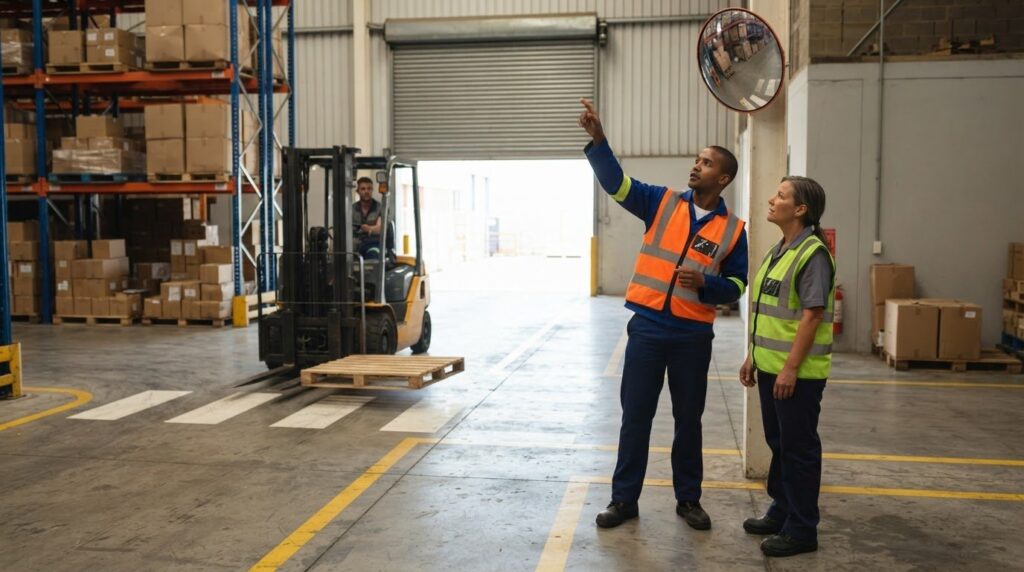
A safety culture is shaped by the shared beliefs and everyday behaviours that influence how people identify and respond to workplace risks. Building a positive safety culture in logistics takes more than written procedures: leaders and employees need to make safe choices part of routine operations. When people can raise concerns and learn from incidents without blame, those lessons can lead to practical improvements.
Clear rules and training matter most when they reflect the realities of driving, warehousing and moving goods. This article explores how learning from incidents and using appropriate technology can support safer decisions, how recognition can reinforce good practice, and how employee feedback can reveal hazards that formal processes may miss. It also considers how leadership can make these practices consistent across logistics teams.
Key Takeaways
- Use incident reports and near-miss information to identify recurring hazards and guide practical safety improvements.
- Recognise safe conduct and meaningful milestones to reinforce the behaviours that support reliable operations.
- Align procedures and training with the risks workers encounter across driving, warehousing and goods handling.
- Involve employees in safety discussions and audits, then respond constructively to the hazards they raise.
- Make safety visible in leadership decisions, operational planning and everyday communication.
1. Learning from incidents and adopting technology
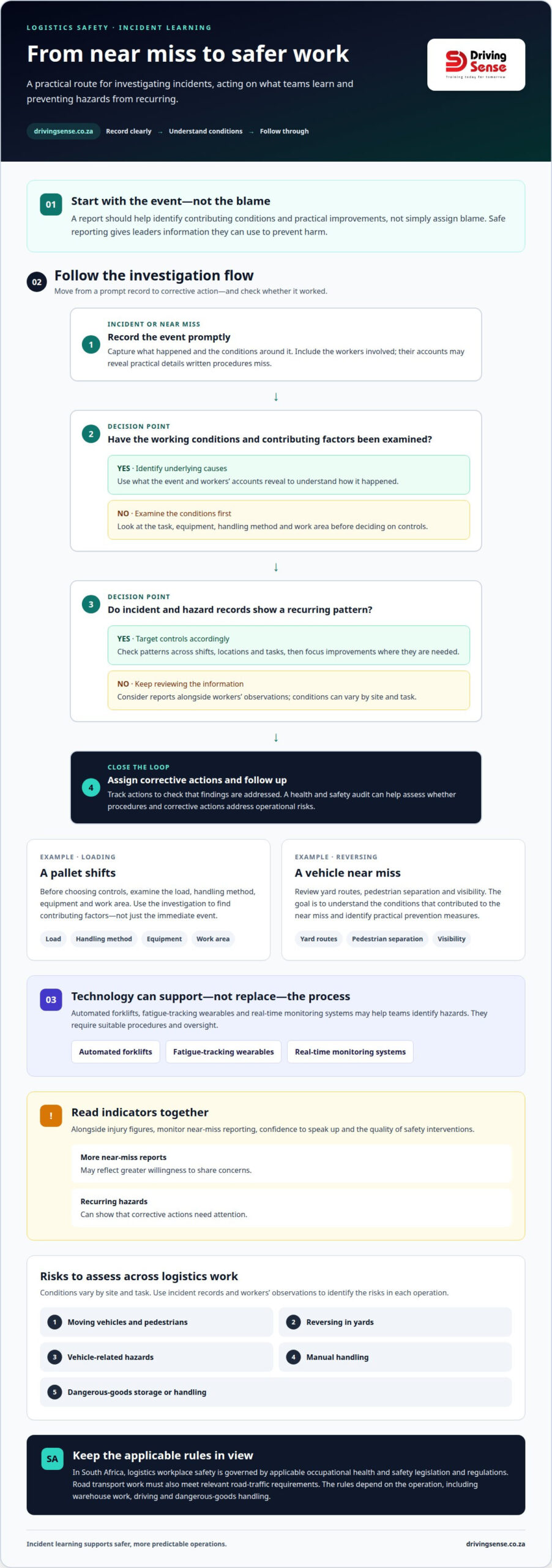
Learning from incidents means turning reports into practical changes to tasks, equipment and supervision. For example, a near miss involving a reversing vehicle can prompt a review of yard routes, pedestrian separation and visibility. The goal is to identify contributing conditions, not simply assign blame. When employees can report concerns safely, leaders gain information that supports prevention and continuous learning.
In South Africa, logistics workplace safety is governed by applicable occupational health and safety legislation and regulations. Road transport work must also meet relevant road-traffic requirements. The rules that apply to a particular operation depend on its activities, including warehouse work, driving and dangerous-goods handling.
Investigate near misses and incidents consistently: record what happened, establish the conditions, identify contributing factors, assign corrective actions and follow up. Include the workers involved, whose accounts can reveal practical details that written procedures may miss. If a pallet shifts during loading, for example, examine the load, handling method, equipment and work area before deciding on controls.
Which safety culture KPIs should logistics companies track? Alongside injury figures, monitor near-miss reporting, confidence to speak up and the quality of safety interventions. Consider these indicators together: more reports may reflect greater willingness to share concerns, while recurring hazards can show that corrective actions need attention.
What are the most common warehouse and road transport risks in South Africa? Assess risks such as moving vehicles and pedestrians, reversing in yards, vehicle-related hazards, manual handling, and dangerous-goods storage or handling. Conditions vary by site and task, so use incident records and workers’ observations to identify the risks in each operation.
Incidents can disrupt more than the task where they occur. In a distribution centre, an aisle closure or equipment inspection may interrupt picking, packing and dispatch, with knock-on effects for transport and customer service. Investigation, administration, workforce changes and delays also use operational capacity. These hidden costs can arise even when an incident causes no severe injury.
How can near misses and workplace incidents be investigated and prevented from recurring? Record the event promptly, examine working conditions and underlying causes, then implement and track corrective actions. Technology can support the process: automated forklifts, fatigue-tracking wearables and real-time monitoring systems may help teams identify hazards, but they require suitable procedures and oversight.
Review incident and hazard data for recurring patterns across shifts, locations and tasks, then target controls accordingly. A health and safety audit can help assess whether procedures and corrective actions address operational risks. In logistics, linking each finding to an accountable action supports more predictable warehouse activity and helps prevent avoidable service interruptions.
2. Recognition and safety milestones
Recognition makes safe conduct visible and gives workers a practical example to follow. In a warehouse, a supervisor might acknowledge a team that secures a load correctly, keeps an access route clear and coordinates equipment movement. Naming the action explains why it matters, while recognising the people involved shows that safety includes everyday decisions, not only formal inspections.
Effective recognition points to a specific behaviour rather than praising someone as generally “safe”. A manager could thank a driver for a careful handover or recognise a colleague who pauses work to address an unsafe condition. These examples connect recognition to repeatable practices, helping teams understand which decisions protect people and support reliable operations.
Milestones can reinforce collective progress. A warehouse might mark 100 days without an incident, then use the occasion to discuss the controls and teamwork behind that record. The milestone should prompt reflection, not imply that safety is achieved permanently. Teams can also recognise improvements in reporting, housekeeping or consistent use of established procedures.
Choose recognition that suits the work and the people receiving it. A mention during a shift briefing, a team acknowledgement or a written note can highlight a useful contribution without turning safety into a competition. For example, recognise a loading team for coordinating a complex dispatch safely, rather than for moving the greatest volume.
Frame milestones carefully. If a reward depends only on recording zero incidents, workers may feel pressured to stay silent about problems. Pair incident measures with positive examples, such as reporting hazards, helping colleagues follow procedures or suggesting practical improvements. This keeps the focus on learning and responsible action, not appearances alone.
Apply consistent criteria across shifts, roles and sites. A driver working away from a depot should have the same fair opportunity for recognition as a warehouse team. Managers can record the behaviour being recognised and explain its relevance, making decisions more transparent and helping leaders identify practices worth reinforcing elsewhere.
Recognition should complement, not replace, clear procedures, suitable equipment and effective supervision. A comprehensive approach connects individual actions with shared operational goals, including safe handling, compliance and dependable productivity. Leaders can review whether recognition reaches different teams and whether the examples reflect actual work. For guidance on embedding these standards, explore consistent safety practices.
Recognition is most useful when workers understand both the conduct being valued and how it contributes to shared protection. Leaders can base acknowledgements on observed actions, including careful preparation, timely communication and cooperation across tasks. This makes appreciation meaningful without implying that good outcomes depend on luck or silence.
Organisations can strengthen safety culture by recognising employees who follow safety rules, prevent problems and work together to avoid accidents. Brown Trucking recognises employees who reach a million safe miles with the company with an embroidered leather jacket and an invitation to a congratulatory dinner. This gesture connects a long-term record to a tangible expression of appreciation, while managers can also recognise everyday choices that help teams identify risks and support one another.
3. What Is a Safety Culture?
A safety culture comprises the shared beliefs and everyday practices that shape how people understand workplace risks. Peter Furst described it through the shared truths, ideas and beliefs people hold about risk, accidents, injuries and occupational health. In logistics, these beliefs show in choices such as keeping pedestrians clear of vehicle routes and reporting damaged equipment before use.
Procedures give those choices a consistent operational basis. A warehouse process can specify how to secure loads, where pedestrians may walk and how to park equipment. A transport procedure can explain safe vehicle checks and handovers. Supervisors reinforce these standards by applying them consistently, even when dispatch schedules are demanding.
What safety training should warehouse and transport workers receive? Training should match each role’s tasks and operational risks, including safe work procedures, emergency response and relevant vehicle or equipment practices. Warehouse teams may need instruction in handling and storing goods, while drivers need training suited to their responsibilities. Dangerous-goods work requires relevant handling knowledge.
Training is most useful when drivers, warehouse teams and supervisors share an understanding of how their work connects. For example, a loading exercise can bring together the driver securing the vehicle, the warehouse worker preparing the load and the supervisor coordinating dispatch. Each person can practise their role and clarify handover points before routine operations resume.
One-off instruction can fade as tasks, equipment and workplace conditions change. Short refreshers and toolbox talks can revisit the behavioural models covered in more immersive training. A pre-shift discussion might focus on pedestrian routes, then ask workers to identify a route conflict in the warehouse. This links a concise learning session to a real task.
Operational discipline means following procedures during everyday work, not only during training or audits. A supervisor can observe a shift change, check whether teams follow the agreed handover process and address gaps promptly. If a procedure proves impractical at a loading bay, worker input can help refine it without weakening its intended controls.
A consistent approach also helps temporary staff and partners understand site expectations. Clear instructions, induction and shared safety language can explain local vehicle routes, reporting processes and emergency arrangements before work begins. Refresher discussions can address changes in tasks or conditions, helping the workforce apply common standards across shifts and connected logistics operations.
4. Employee feedback and safety improvements
Employees often notice hazards that formal procedures miss, particularly during busy shifts. A picker might spot a blocked aisle, while a driver may identify an unsafe loading arrangement. Their observations give managers practical information for improvement, provided reports receive a visible response.
How can logistics leaders encourage employee safety reporting and participation? Gather feedback weekly through shift discussions, reporting channels or safety committees, and thank workers who raise concerns. Explain what action follows, so employees can see that sharing information contributes to safer work rather than blame.
Make reporting straightforward across warehouse and transport operations. Workers should be able to describe the location, task and hazard, such as damaged racking beside a picking route or poor visibility near a loading bay. Supervisors can record the concern, assign responsibility and tell the employee who reported it what happens next.
The response matters as much as collecting reports. If a forklift operator reports that pallets obstruct a pedestrian crossing, managers should assess the layout and address the obstruction. If an immediate change is not possible, explain interim controls and provide an update. Silence after a report can discourage future participation.
Employees can also contribute through safety audits and committees. Involve workers who perform the relevant tasks and invite them to assess whether procedures match actual conditions. A loading team, for example, can identify where a handover instruction becomes unclear during dispatch. Its input can inform a workable revision and focused training.
Open discussion helps distinguish individual mistakes from wider process problems. During a toolbox talk, a supervisor might ask which steps make a task difficult to complete safely. If several workers describe the same pressure point, managers can examine scheduling, equipment placement or unclear instructions instead of treating each concern in isolation.
Track whether feedback leads to action, not just how many reports come in. A simple review can group hazards by location, task and status, then identify overdue actions and recurring concerns. Managers can share completed improvements at shift briefings and explain why other issues need further assessment. This closes the feedback loop.
Use employee input to guide continuous improvement, then review the change in the workplace. After adjusting a storage layout, for instance, ask warehouse workers whether access and visibility have improved. If hazards persist, revise the control and discuss the new approach with affected teams. This cycle connects participation, learning and injury prevention.
instance, check whether it works for workers doing the task. Weekly feedback uses workers’ firsthand experience to improve safety processes; employees who feel heard are 4.6 times more likely to perform at their very best.
5. Building a positive safety culture
Safety practices take hold when leaders treat them as part of operational performance, not as something separate. In a warehouse, that means planning realistic dispatch timelines so workers can follow procedures without pressure to take shortcuts. Leaders should make clear that safe work takes priority, even when a task takes longer.
What practical safety culture examples and checklists can South African logistics companies use? Leaders can open shift briefings with a safety moment, discuss a task-specific hazard and invite workers to identify controls. A practical pre-shift check can cover protective equipment, vehicle and pedestrian routes, loading conditions, emergency communication and unresolved hazards.
Leadership behaviour shows whether expectations apply in practice. A manager who wears required protective equipment, follows site routes and pauses unsafe work demonstrates the standard personally. Spending time on the warehouse floor also helps managers see how procedures work in real operating conditions and discuss risks directly with employees.
Safety should be properly resourced and built into routine decisions. If a loading area lacks clear separation between people and vehicles, for example, leaders need to address the layout rather than rely on reminders alone. Reasonable production planning, suitable facilities and maintained equipment help workers carry out tasks safely and consistently.
Organisations can set measurable annual safety goals, such as reducing incidents by a defined percentage, then review progress against the operational context. A target is more useful when teams understand what it means for their work. Leaders can connect it to practical controls, such as improving pedestrian routes or strengthening task-specific knowledge.
A checklist can support consistent action across shifts and sites. It should identify who is responsible for each action, the issue being addressed and how completion will be reviewed. Supervisors can use pre-shift meetings, updated signage and digital alerts to communicate changing conditions, while ensuring essential information reaches employees who may not use the same channel.
Extend shared expectations to temporary workers and supply-chain partners through clear instructions, relevant training and accessible procedures. A new worker joining a dispatch team, for instance, needs to understand local routes and communication arrangements before starting. Consistent safety language helps people coordinate, even when they work for different organisations.
Recognise practical contributions, review controls and adjust them as operations change. This approach makes success visible through actions, not slogans, and supports continuous improvement across the working environment. To strengthen operational capability, arrange safety support for your logistics team.
Driving Sense
Driving Sense supports South African logistics organisations with training suited to practical workplace requirements. Its Emergency Safety Training, Driver Training and Compliance Training can help teams build relevant knowledge, while Dangerous Goods training addresses the safe handling of these materials. These services can support organisations reviewing how employees prepare for their roles and apply safety procedures in daily operations.
Consider this support when incident reviews, employee feedback or operational changes reveal a need for clearer training or more consistent practices. The right focus depends on the risks and responsibilities in each team, from transport work to warehouse operations.
For support in strengthening safety practices across your logistics operations, contact Driving Sense.
Make safety part of the next operational decision
Building a positive safety culture in logistics is an ongoing commitment shaped by decisions leaders make as operations change. A new route, shift pattern, storage arrangement or team can alter how work is done, so review safety practices alongside operational planning. This keeps improvement connected to how the organisation actually works, rather than treating it as a separate initiative.
A useful next step is to identify an operational priority and decide how leaders and employees will address it together. That might mean revisiting a task, clarifying responsibility or building relevant knowledge before work changes. A focused action gives teams a practical starting point and a basis for ongoing review.
Where structured support can help translate those priorities into workplace capability, Driving Sense offers training relevant to logistics operations. Contact Driving Sense to discuss safety and consider the next step for your teams. With consistent attention and shared accountability, safety can remain integral as your operation develops.
Frequently Asked Questions
What Is a Safety Culture?
A safety culture is the set of workplace expectations that shapes how people make decisions when risks arise. It shows in everyday choices, such as whether a supervisor pauses a dispatch when a loading concern appears or whether a worker feels able to question an unsafe instruction. Written rules matter, but culture is revealed by how consistently people apply them under operational pressure.
What is a positive safety culture in logistics?
Building a positive safety culture in logistics means creating an environment where employees and leaders share responsibility for safer work. People can raise concerns, receive constructive responses and contribute to improvements without treating safety as an obstacle to output. For example, a driver and warehouse team can coordinate a safer loading plan while managers ensure schedules allow the agreed process to be followed.
What are the key steps to build a safety culture in a logistics company?
Start with a defined operational area, such as vehicle movements in a loading yard, and agree on what safer work looks like there. Assign responsibility for implementing controls, communicate expectations to affected teams and incorporate them into routine supervision. Review worker feedback and operational changes regularly, then adapt the approach where needed. Consistent expectations for contractors and temporary staff help prevent gaps between teams.
How can companies reduce forklift, pedestrian, loading and vehicle incidents?
Where the site layout allows, design work areas to separate vehicle movements from pedestrian routes and make crossing points clear. Set site-specific movement and loading procedures, then reinforce them through supervision and practical instruction. For example, a dispatch team can agree how vehicles enter, where loading takes place and how people communicate before moving a load. Review the arrangement when workflows or layouts change.
How do safety culture programmes affect logistics costs, productivity and accident rates?
Effective safety programmes can support more reliable operations by addressing hazards before they interrupt work. An incident may require investigation, equipment checks or staffing changes, while a disrupted warehouse process can affect dispatch schedules. Better controls and worker participation can help limit interruptions, although results depend on how well measures suit the operation and are maintained. Track incident patterns alongside operational disruptions to assess progress.
