
An unlicensed driver’s risk does not stop with the person behind the wheel. In South Africa, the consequences of hiring an unlicensed driver can extend to an employer or vehicle owner, particularly when a work-related crash raises questions about responsibility, damages or vehicle impoundment. The outcome depends on the circumstances and applicable rules.
It is understandable to assume that the driver alone will bear the consequences, but the decision to let someone use a borrowed or work vehicle may also be scrutinised. This article explains when impoundment may arise, how liability can come into question after a collision, and what further issues may follow if a crash causes a death.
You’ll also learn why driver screening and suitable training matter to an organisation’s risk controls, and how professional driver and compliance training can support safer, more accountable vehicle use.
Key Takeaways
- Understand why responsibility may extend beyond the driver when an unlicensed person uses a borrowed or work vehicle.
- Learn which factors can affect whether a vehicle is impounded and what may happen after it is held.
- See how a fatal crash can lead to separate questions about criminal sentencing, liability and compensation.
- Identify how driver competence, screening and training fit into an organisation’s road-safety controls.
- Explore how structured driver and compliance training can support safer, more accountable vehicle use.
Sentencing for causing death while driving unlicensed or uninsured
In South Africa, a fatal crash involving an unlicensed or uninsured driver does not result in one automatic sentence. The outcome depends on the conduct connected to the death, the offence charged and the circumstances of the case. Licence status is relevant, but it does not by itself explain how the collision happened or determine the outcome.
Sentencing for causing death while driving unlicensed or uninsured must be distinguished from penalties for the underlying driving or insurance offences. A case may involve questions about the driver’s conduct, the cause of the collision and whether the required licence or insurance was in place. Each issue can affect how the matter is assessed.
“Unlicensed” can describe different situations, including an expired licence, a suspended licence or no licence at all. These are not identical: an expired document differs from a suspension, while having no licence raises a separate authorisation issue. The specific licence problem and the driving involved therefore matter when assessing the consequences.
What penalties or fines apply to driving without a valid licence in South Africa? There is no single penalty that applies to every situation. The consequence depends on the specific offence and circumstances, including the driver’s conduct and the licence issue.
Can insurance refuse or reduce a claim if an unlicensed employee drives a company vehicle? An insurer may deny the vehicle owner’s claim if the owner knowingly allowed an unlicensed driver to use the vehicle. The circumstances of that permission and the applicable policy terms are relevant to assessing the claim.
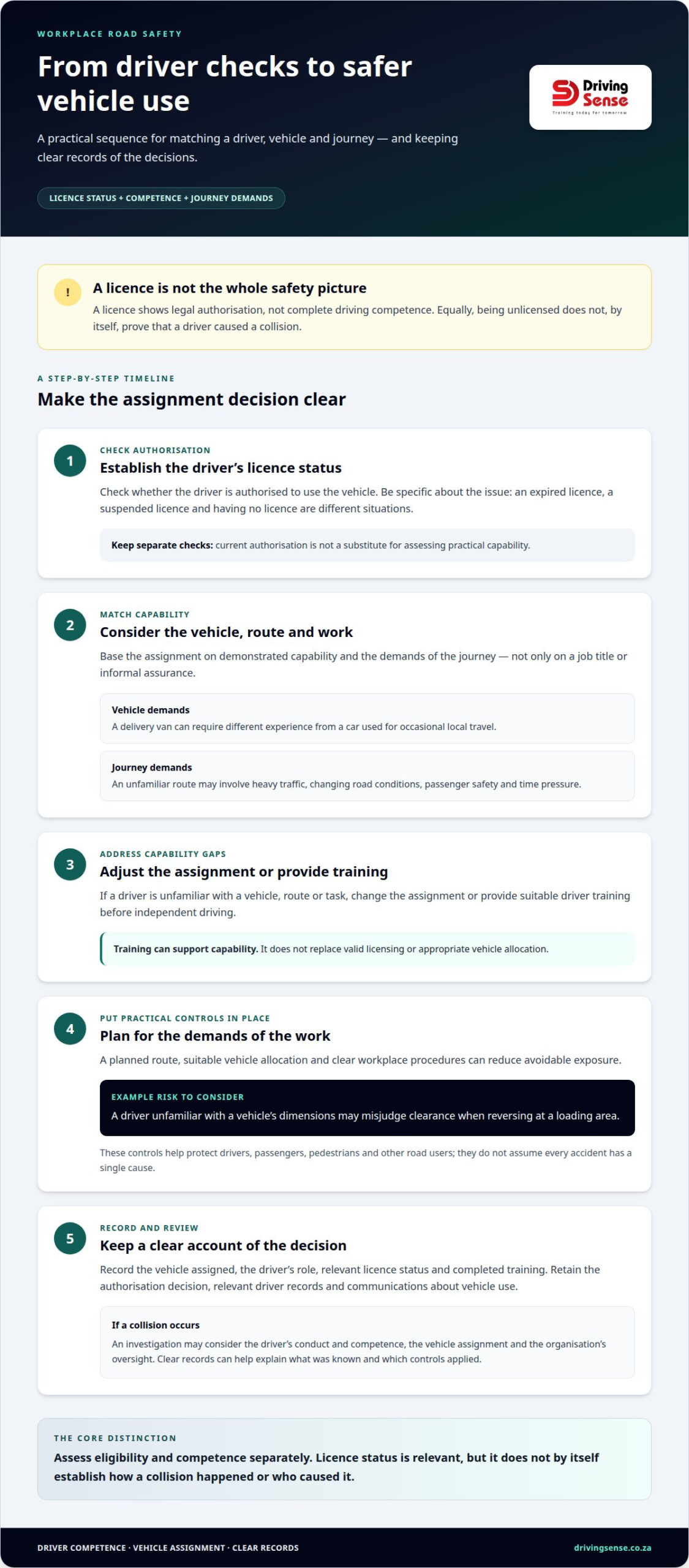
For an employer, records can help establish how a driver was assigned a work vehicle. Retain the authorisation decision, relevant driver records and communications about vehicle use. If a fatal crash occurs, these materials can clarify what the organisation knew and how it handled the assignment.
Licence status should be considered separately from causation. An investigation may examine the driver’s actions and the events leading to the collision, as well as the licence issue. Being unlicensed is relevant context, but it is not, on its own, proof that the driver caused the death.
The sentencing guideline for causing death by driving while unlicensed or uninsured took effect on 01 July 2023. Separately, in Western Australia, an unlicensed-driving offence can carry a maximum prison term of 18 months in certain circumstances.
Accident risks posed by unlicensed or inexperienced drivers
A licence is evidence of legal authorisation, not a complete measure of safe driving. An employee may have limited experience with a particular vehicle, such as a delivery van, even if licensed for that class. Conversely, an expired or suspended licence does not by itself establish that a driver caused an accident. Operational risk depends on eligibility, competence and the demands of the journey.
Consider a new employee assigned a company vehicle for an unfamiliar route. They may need to manage heavy traffic, changing road conditions, passenger safety and time pressure at once. Limited experience can make it harder to anticipate hazards, judge following distance or respond smoothly when another road user acts unexpectedly. These are practical risk factors, not proof that every inexperienced driver will crash.
For an organisation, match each assignment to the driver’s demonstrated capability. A vehicle used for frequent deliveries, for example, presents different demands from a car used for occasional local travel. Before assigning work, assess whether the employee can manage the vehicle type, route requirements and relevant tasks. If a capability gap emerges, adjust the assignment or provide suitable driver training before the employee drives independently.
Treat licence status and competence as separate checks. A driver may hold a valid licence but need guidance on operating a larger or unfamiliar vehicle; another may have strong practical experience but lack current authorisation. A sound process records the assigned vehicle, the driver’s role, relevant licence status and completed training. This gives managers a clearer basis for decisions than relying on a job title or informal assurance.
Inexperience can also affect decisions when a hazard emerges. For example, a driver unfamiliar with a vehicle’s dimensions may misjudge clearance while reversing at a loading area. A planned route, suitable vehicle allocation and clear workplace procedures can reduce avoidable exposure. These controls help protect drivers, passengers, pedestrians and other road users without assuming that every accident has a single cause.
After a collision, an investigation may distinguish between the driver’s conduct, competence, vehicle assignment and the organisation’s oversight. Licence status may be relevant to an investigation, but it does not by itself determine who caused a collision or whether a driver acted improperly. Clear assignment and training records help explain what was known and which controls applied at the time.
For workplace fleets, driver training for employees can address practical capability gaps before they become operational risks. It is most relevant when staff take on unfamiliar vehicle duties, routes or driving tasks, rather than as a substitute for valid licensing or appropriate vehicle allocation.
Causing death while unlicensed or uninsured
After a fatal road crash in South Africa, the driver’s licence and insurance status are only part of the information relevant to the incident. The sequence of events, the driver’s actions and the vehicle’s use also need to be understood. For example, in a work-related journey, investigators would distinguish the employee’s driving conduct from the employer’s decision to assign the vehicle.
For an organisation, the circumstances of the journey can bring hiring and operational controls into focus. Records showing who authorised the trip, the employee’s assigned duties and the vehicle involved help establish how the journey came about. They also provide context for assessing what the organisation knew before the employee drove.
Preserve evidence connected to the incident. A company can retain its vehicle-allocation record, relevant employment information and communications about the journey. If a work vehicle was assigned for a specific task, details of the task and approval process can help show whether the trip fell within the employee’s duties.
A fatality can raise separate questions about the driver’s conduct, the cause of the collision and the organisation’s decisions. These should not be collapsed into one conclusion. For example, unlicensed status is distinct from evidence about how the collision occurred; each fact needs to be considered in context.
Insurance status is also distinct from driving conduct. An uninsured vehicle or driver can raise a separate coverage issue, while the circumstances of the crash remain relevant to responsibility for the death. An employer’s records of vehicle use and insurance arrangements can help clarify which vehicle was involved and how it was being used.
If the employee was driving as part of their job, the company’s role may also be examined. Hiring records, assigned duties, training information and prior communications can show how the organisation managed the driving function. These materials do not replace an assessment of the collision, but they can clarify the operational context.
For example, if a delivery employee used a work vehicle outside an assigned route, the assignment record and relevant communications can help establish that distinction. If the trip was authorised, those records show the decision process. Preserving accurate information promptly supports a clearer account of the fatal incident and the responsibilities involved.
Economic and non-economic damages
A road accident can cause financial losses and personal harm beyond damage to a vehicle. Economic losses are costs or lost earnings that can be documented, such as medical expenses, vehicle repairs or income lost during recovery. Non-economic harm concerns effects such as pain, distress or reduced ability to manage ordinary activities. Each claim depends on the harm and supporting evidence.
For example, someone injured in a company vehicle collision might need treatment and time away from work. Relevant records could include invoices, earnings information and medical documentation. These materials help describe the financial impact and connect it to the accident. On their own, they do not establish who caused the collision or who must pay compensation.
Non-economic harm is less readily expressed through receipts. A serious injury could affect someone’s mobility, sleep or participation in family life. A claim may describe those effects alongside the injury and any treatment records. The distinction matters because financial losses and personal consequences are different parts of the impact, even when they stem from the same traffic incident.
When an unlicensed employee drives a company vehicle, an investigation may consider both the driver’s conduct and the employer’s decisions. Records may show who authorised the journey, what the employer knew about the driver’s status and whether the driver had suitable duties. A person injured in a truck accident may bring a claim against the company if its driver caused the accident and the company failed to use reasonable care.
That possibility does not make an employer automatically responsible for every loss. The connection between the driving, the injury and the organisation’s conduct matters. A documented allocation process can clarify whether the employee was assigned the vehicle, what checks informed the decision, and what training or supervision applied. These details are relevant when assessing responsibility and the basis for compensation.
Insurance is a separate consideration. An insurer may deny a vehicle owner’s claim if the owner knowingly allowed an unlicensed driver to use the vehicle. A company’s claim can therefore depend on the circumstances of permission and the relevant policy terms. Keep records of vehicle allocation and authorisation rather than relying only on an employee’s verbal assurance.
Driving without a licence may also lead to higher insurance rates if insurers regard the driver as a greater risk. That potential increase is distinct from injury compensation, vehicle repair costs or lost earnings. For an organisation, separating these categories helps assess the full financial exposure after an accident and preserve evidence relevant to each loss and the decisions surrounding the journey.
Trucking company responsibility for driver hiring and training
A driver’s employment status does not remove an organisation’s responsibility for its hiring and assignment decisions. Trucking companies need to consider whether drivers are authorised and competent for the work they do.
Employer consequences of hiring unlicensed drivers
Employing an unlicensed driver means assigning driving work to someone without current authorisation for that work. The consequences of hiring an unlicensed driver can include scrutiny of the employer’s decisions if the driver causes an injury. An injured person may claim against a trucking company if its driver caused an accident and the company failed to use reasonable care.
In South Africa, an employer’s exposure depends on the circumstances, including its role in hiring, authorising and supervising the driver. A claim does not arise automatically merely because the driver lacked a valid licence. Company records should show how it assessed the driving role’s requirements and the employee’s suitability.
A valid licence also does not prove that someone is prepared for every vehicle or duty. Employers should consider the work involved, the driver’s demonstrated competence and whether relevant training has been completed. The consequences of hiring an unlicensed driver are part of a broader risk review, alongside the company’s responsibility to put competent, adequately trained drivers on the road.
Responding to an unlicensed hired driver
Respond by pausing the driver’s vehicle assignment, establishing the licence issue and documenting the organisation’s decisions. Continuing to authorise driving after discovering a problem can increase exposure if a collision and injury follow.
If you discover that a hired driver is unlicensed, stop assigning driving duties, record what you discovered and hear the driver’s explanation. Review employment and vehicle-allocation records, then follow the organisation’s relevant disciplinary process before deciding on employment action. This creates a clear record of how the matter was handled.
If the role requires a professional driving permit (PrDP), its absence means the employee should not be treated as qualified for that assignment. Assess the role and permit issue before authorising further work-related driving. Disciplinary or dismissal decisions should follow the applicable employment process and consider the circumstances, the driver’s explanation and the role’s requirements.
For a structured approach to workplace driving competence, arrange driver training that reflects the vehicles and duties employees undertake. Training supports competence, while licence and permit status remain separate considerations when assigning work.
Driving Sense: Driver Training
Driving Sense provides Driver Training to help organisations address practical capability gaps in workplace driving. It is relevant when employees take on unfamiliar vehicles, routes or driving duties, but it does not replace the need for appropriate licences or permits.
For organisations managing broader operational risks, Emergency Safety Training, Compliance Training and Dangerous Goods training can support related workplace responsibilities. The appropriate training depends on employees’ duties and the risks associated with them.
Contact Driving Sense to discuss how Driver Training can support your organisation’s workplace driving needs.
Strengthen your organisation’s driver controls
The consequences of hiring an unlicensed driver are a reminder to treat vehicle access as an operational decision, not an administrative formality. A clear process connects employment responsibilities with assigned vehicles and duties, helping managers identify gaps before work-related driving begins.
Use this issue as an opportunity to review how driving roles are approved, how changes to employee responsibilities are handled, and how decisions are recorded. Keep the process practical: eligibility, capability and assignment should each have a defined place in your organisation’s controls. If a gap emerges, address it before authorising further driving.
For support with workplace driver capability, contact Driving Sense to discuss your organisation’s training needs. A considered approach can help your team make clearer decisions and build more accountable driving practices.
Frequently Asked Questions
Can my vehicle be impounded even if it’s borrowed or used for work?
Borrowed or work-related use does not, by itself, establish whether a vehicle can be impounded in South Africa. The key question is whether an applicable legal power allows impoundment in the circumstances, not simply who owns the vehicle. For work vehicles, retain records showing who authorised their use and for what purpose. Overseas impoundment rules should not be treated as South African rules.
What happens if an unlicensed driver borrows your car?
The driver may face consequences for driving without valid authorisation, while the owner’s decision to lend the car may also be examined. Evidence that an owner knew about the licence issue, for example, could affect questions about permission, care and insurance. Lending the car does not automatically prove the owner caused a later collision, but informed permission may become relevant if someone is injured.
What happens to the car owner in this situation?
Ownership alone does not establish that the owner is responsible for a crash or must pay compensation. The owner’s knowledge and actions may matter, particularly if they knowingly allowed an unlicensed person to drive. An insurer may deny the owner’s claim in that situation. Keep evidence of who had permission to use the vehicle and what the owner knew when it was lent.
Can an employer be held liable if an unlicensed employee causes a road accident in South Africa?
An employer may face a claim if an employee causes an accident and the company failed to use reasonable care. Relevant circumstances may include how the driver was selected, which duties were assigned and whether the employer knew about an authorisation problem. The employee’s licence status alone does not establish the company’s liability. Hiring and vehicle-allocation records help clarify the decisions made.
Does a South African employer need to verify a driver’s licence and PrDP before hiring?
Employers should verify licence and PrDP status against the driving duties they intend to assign. A practical screening process records which authorisations the position requires and whether the applicant holds them. This is a risk-control recommendation, not a claim that the same verification duty applies to every role. For example, assess a professional driving position in light of its vehicle and work requirements before assigning driving tasks.
How do liability and penalties differ when the licence is expired, suspended, or for the wrong vehicle class?
These situations involve different issues: an expired licence is no longer current, a suspension restricts driving, and the wrong class does not match the vehicle being driven. Their consequences are not necessarily identical. The relevant offence, the driver’s conduct and the circumstances of any crash all matter. Employers should record the specific issue rather than treating every licence problem as the same breach.
