
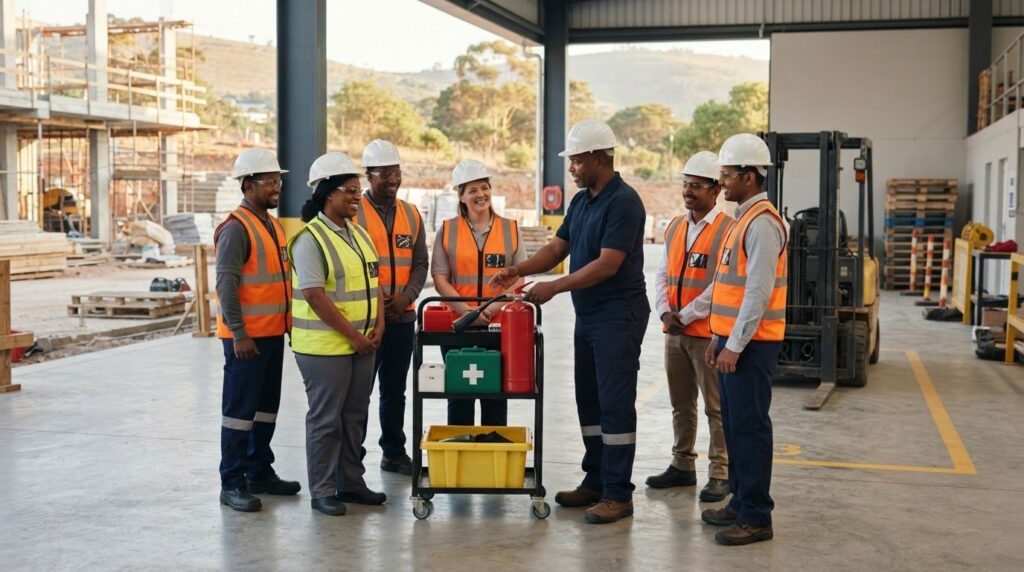
What if safety training met compliance requirements on paper but left employees unsure how to apply it to their daily tasks? Bespoke corporate safety training is most useful when it connects workplace risks and role responsibilities with practical learning, rather than relying on generic modules that may not reflect how work is done.
For organisations operating across South Africa, coordinating consistent training across different roles and sites can be as important as choosing the right subjects. Learners also need to understand how training applies to their work. This guide explains how to build a programme around operational risks, compare providers using consistent criteria and support both compliance and competence.
The case-study approach in this guide shows how to organise training priorities around job requirements and workplace hazards. It also covers how pre-training educational assessments can inform learner readiness, and how health and safety, first-aid, fire-fighting, driver and forklift training can be coordinated for teams working across multiple sites.
Key Takeaways
- Set training priorities using workplace risks, role responsibilities and learner readiness before selecting learning content.
- Bespoke corporate safety training can connect statutory objectives with practical, job-relevant competence when it reflects operational needs.
- Compare tailored and standardised approaches by their fit with risks, support for consistency and the evidence available for review.
- Plan delivery across sites by mapping priority roles, locations and evidence requirements, particularly for teams spread across South Africa.
- Review a case-study approach through its documented needs, programme design and evidence, not unsupported claims about results.
Why bespoke corporate safety training must start with workplace risk
For a decision-maker, the challenge is not simply to confirm that required training has taken place. Employees also need to understand the hazards connected with their work and develop the competence to respond safely. A course may address a compliance objective yet remain disconnected from daily tasks if its examples, activities and assessment do not reflect the workplace.
Bespoke corporate safety training is shaped around an organisation’s identified risks, job responsibilities and learner needs. That means more than changing a course title or adding a company logo while leaving the content and delivery untouched. Meaningful tailoring affects what learners need to understand, what they practise and how learning is reviewed. Start with the work people actually do, rather than assumptions based on job titles alone.
A useful case study makes those decisions visible. It describes the operational risk, explains why particular learning objectives or delivery choices were selected, and identifies what evidence was reviewed afterwards. It should not present one organisation’s experience as a guaranteed result for another: conditions, roles, learner readiness and existing controls can differ.
What makes corporate safety training genuinely bespoke?
Connect learning objectives to responsibilities, actual tasks and relevant workplace risk assessments. For example, forklift training should relate to the work learners are expected to perform. Fire-fighting training should address the response knowledge and practical skills relevant to learners’ assigned responsibilities. The Occupational Safety and Health principles provide useful context for treating hazard prevention and worker wellbeing as connected priorities.
Learner readiness matters too. A pre-training educational assessment can help identify what learners already understand and where further explanation or support may be useful. Use that information to inform pacing and learning activities, without assuming that every participant or site needs a separate course. Shared core content can support consistency, while role-based examples and appropriate learning support help make training relevant to different groups.
Why compliance and competence belong together
Statutory or legislative learning and practical competence serve related but distinct purposes. Training can address applicable formal requirements, while competence concerns whether employees can apply relevant knowledge and skills at work. A coherent programme considers both, rather than treating attendance or completion records as conclusive evidence of practical capability.
South Africa’s occupational qualification landscape is also important to understand. The QCTO is the sole accrediting body for occupational and trades-related qualifications in South Africa. This does not mean every corporate safety module is an occupational qualification, nor does it establish a provider’s accreditation status. Define the purpose of each training component and the evidence required for it.
Bespoke training aligns learning with identified workplace risks and role-specific competence, while retaining clear evidence of what learners have understood and can apply. A case study can show the assessment approach, learning activities and documented review without overstating what the programme proves. This gives decision-makers a more useful basis for judging relevance than course labels alone.
How a tailored safety programme turns identified risks into learning
A risk-led programme has a traceable design: each learning priority relates to a hazard, a responsibility or a defined organisational requirement. This makes it easier to explain why a module is included, who needs it and what evidence will help assess learning. Tailored learning starts with documented risks and defined job responsibilities, then turns those priorities into relevant learning objectives and reviewable evidence.
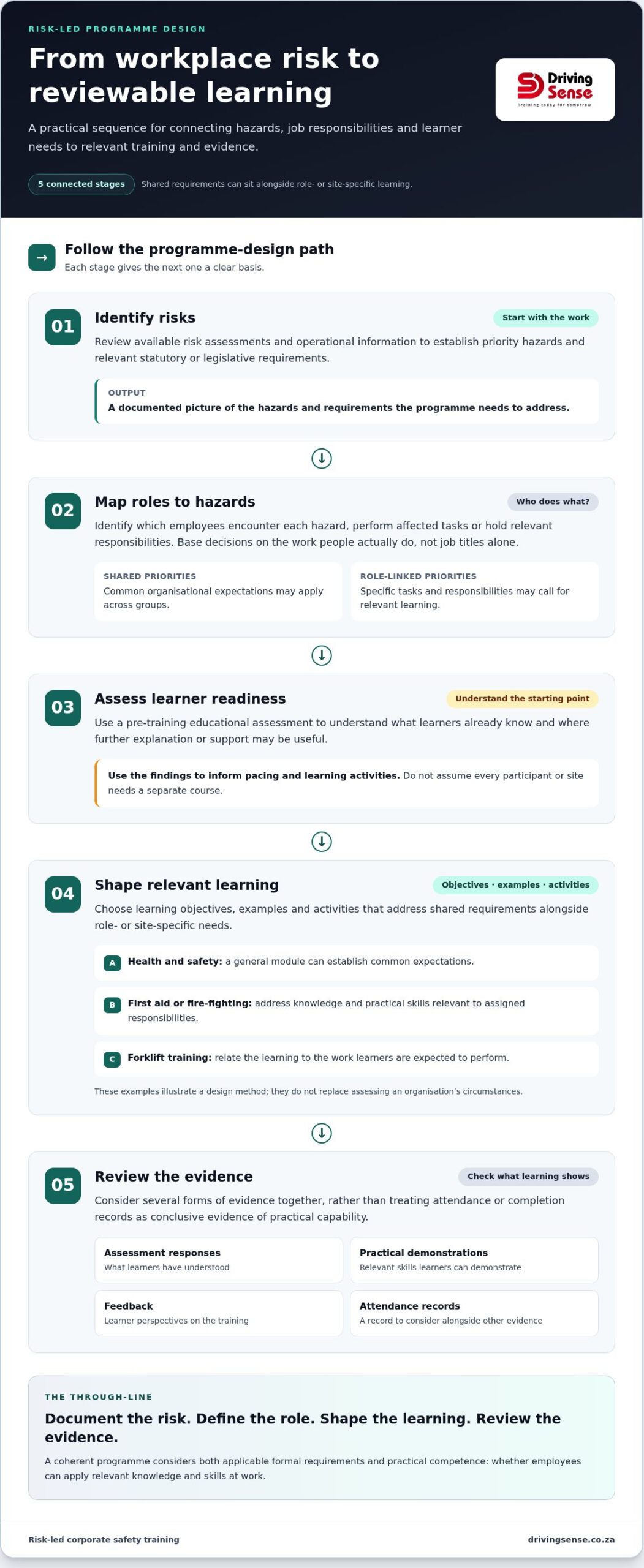
Use a practical sequence to keep programme design organised without assuming that every site needs a different course:
- Identify risks: review available risk assessments and operational information to establish priority hazards and relevant statutory or legislative requirements.
- Map roles: identify which employees encounter each hazard, perform affected tasks or hold relevant responsibilities.
- Assess readiness: use a pre-training educational assessment to understand learners’ starting points and possible support needs.
- Shape learning: choose objectives, examples and activities that address shared requirements alongside role- or site-specific needs.
- Review evidence: consider assessment responses, relevant practical demonstrations and feedback alongside attendance records.
From risk assessment to role-specific learning objectives
Mapping hazards to people and tasks helps distinguish shared organisational objectives from learning needed by particular roles. A general health and safety module may establish common expectations, while employees with specific emergency responsibilities may need relevant first-aid or fire-fighting training. Forklift training, in turn, should relate to the responsibilities and work activities of the intended learners. These examples illustrate a design method, not a substitute for assessing an organisation’s circumstances.
South African employers should connect training design to applicable legislation and their own operational controls, without assuming that one module alone establishes compliance. Requirements depend on the work and its context, so legal interpretations should be checked against current authoritative sources. As a supplementary educational resource, OSHA workplace safety training guidelines describe training resources in the United States. They can inform general learning considerations, but do not determine South African legal obligations.
Readiness, learning delivery and evidence
A pre-training educational assessment can indicate whether learners may benefit from further explanation, a different pace or support with foundational material. Use it to inform delivery, not to predetermine an outcome. Shared content can remain consistent across teams, with examples or learning support adjusted where roles, experience or site conditions make that useful.
Match evidence to the learning objective. Attendance records show participation, but do not by themselves establish understanding or practical competence. Depending on the subject, review might include knowledge checks, learner explanations or observation of relevant practical tasks. These records help an organisation understand what was assessed and where further learning may be useful. Do not present them as proof of outcomes that were not measured.
For organisations bringing statutory and operational learning together, corporate statutory and legislative training can form part of a coordinated programme alongside health and safety, first-aid, fire-fighting or forklift training. Connect each component to a defined need and review its evidence within the wider training plan.
Bespoke or standard safety training: how organisations can compare approaches
Choosing between a standard module and a tailored programme is not a choice between consistency and relevance. A standard foundation can establish common expectations across an organisation. Additional tailoring may be useful where roles, operational exposures or learner needs differ. Neither approach is automatically better: suitability depends on documented requirements and whether the learning addresses them.
Compare the options against the same criteria. Ask whether the content reflects priority risks, whether examples relate to employees’ responsibilities, how learner readiness is considered and what evidence can be reviewed afterwards. This gives decision-makers a consistent way to identify where shared material is appropriate and where adaptation has a practical purpose.
When a consistent standard module may be appropriate
A shared module can support consistent organisational expectations when employees have common responsibilities or need a baseline understanding of workplace health and safety. The learning objectives should be clear, and the examples should make sense in the work context. A standard format alone does not establish that a module addresses every applicable requirement, so consider relevant South African legislation and operational needs separately.
When additional tailoring can add practical value
Tailoring can help when teams face different hazards, perform distinct tasks or need different kinds of learning support. It can adjust emphasis and examples without rebuilding every course or removing shared foundations. Related training can also be coordinated while keeping objectives distinct: first-aid, fire-fighting and forklift training address different responsibilities and are not interchangeable.
Use the following framework to compare approaches before finalising programme design:
| Criterion | Question to consider | Evidence to look for |
|---|---|---|
| Risk fit | Does the content address hazards identified for the organisation’s work? | A clear link between risk priorities and learning objectives. |
| Role relevance | Can learners see how the material relates to their responsibilities and tasks? | Role-appropriate examples, activities or assessment criteria. |
| Learner readiness | Can differences in prior understanding or learning support needs be addressed? | Assessment or other documented information that informs delivery. |
| Consistency | Can common expectations be maintained across teams or sites? | Shared core objectives, with any variations clearly identified. |
| Reviewability | Can the organisation examine what was taught and what learners demonstrated? | Learning materials and assessment records suited to the stated objectives. |
Bespoke corporate safety training is most useful when each adaptation addresses a documented need. If a standard module already fits the risks, roles and learning objectives, extra customisation may add little value. Where it does not, targeted changes can improve relevance while preserving a common programme structure. Base the decision on evidence of fit, not on the label attached to the course.
How to implement and evaluate corporate safety training across South Africa
Implementation starts with a clear view of where training is needed and what it must address. For organisations with teams across South Africa, planning should account for locations, job responsibilities, priority risks, learner readiness and the evidence needed to review learning. A national programme can use shared objectives for consistency while adapting examples and delivery arrangements to the work at each site.
Planning delivery for multiple teams or sites
Group learners by relevant responsibilities and training objectives, rather than assuming that everyone at one location has the same needs. A team may share core health and safety learning, while particular roles need first-aid, fire-fighting, forklift or driver training. Map these requirements before arranging delivery so related modules can be coordinated without treating their distinct objectives as interchangeable.
Consistent objectives help maintain a common standard across sites; relevant examples help learners connect that standard with their tasks and risks. Record which objectives are shared and where an adjustment is needed, so programme differences are deliberate and reviewable. Organisations with transport-related risks can also use a corporate road risk guide to inform related planning.
Before delivery, establish who will coordinate learners, how readiness information will inform support and how completion and assessment records will be brought together. A South African workplace safety compliance checklist can support wider compliance planning alongside these training decisions, but does not replace an organisation’s own risk assessment or legal review.
Reviewing learning evidence and maintaining alignment
Evaluate training against the objectives set before delivery, rather than relying on a broad claim that a programme has improved safety. Keep evidence proportionate to what was taught and assessed. Useful categories include:
- Readiness: pre-training assessment information that helps identify learning support needs.
- Participation: records showing who attended or completed the relevant learning.
- Assessment: knowledge checks or practical assessment evidence suited to the module’s objectives.
- Follow-up: documented actions where evidence indicates that further explanation, practice or review may be useful.
Attendance confirms participation, not necessarily understanding or practical competence. Reviewing assessment and follow-up evidence can help identify gaps and inform future training decisions. Do not use it to claim accident reduction or financial savings without appropriate documented evidence. Keep clear records of the objective, assessment method and any action taken.
For legislative context, consult this OHS Act training guide alongside current authoritative sources relevant to the organisation’s circumstances. To plan corporate safety training across your teams, connect each learning objective to the roles, risks and evidence requirements identified for your programme.
A Driving Sense case-study approach to bespoke corporate safety training
A useful case study explains how a training decision was reached, rather than simply listing courses delivered. The process-led example here shows how an organisation can define its need, connect training design to that need, plan delivery and identify evidence for review. It illustrates a way to structure a case study without presenting a named client result or promising a particular outcome.
Start by documenting the work activities, roles and safety priorities the organisation wants training to address. Then identify which objectives are shared across the workforce and which relate to particular responsibilities. Explain how the selected statutory and legislative training supports those objectives, how learning activities connect with the work and what evidence will be reviewed. This makes the rationale open to scrutiny and distinguishes a proposed approach from a completed intervention.
What the Driving Sense approach brings to the case
Driving Sense was founded in 2006 and provides training nationwide across South Africa. Its statutory and legislative training includes health and safety, first-aid, fire-fighting and forklift training. For a programme involving dispersed teams, nationwide training capability supports planning across locations, while consistent learning objectives help maintain coherence.
Driving Sense offers pre-training educational assessments to inform learner readiness before delivery. The results can help identify where learners may benefit from further explanation or support, rather than relying on attendance alone as evidence of understanding. The training approach balances compliance with skill development; any claims about learning outcomes should be supported by documented evidence.
For transport-sector organisations, founder Natalie Rodrigues’s 11-year tenure at Super Group’s Truck Rental Division provides relevant context when considering operational training priorities. Driving Sense is a 100 % B‑BBEE, Level Four contributor. These details provide organisational context; they do not establish a particular client result or replace review of programme design and assessment records.
From evaluation framework to a practical next step
For an organisation considering bespoke corporate safety training, define priorities, identify affected roles, consider learner readiness and select evidence that corresponds to each learning objective. A case study can then be evaluated through four questions: Was the need stated clearly? Did the design respond to it? Was delivery planned for the relevant learners and sites? Is the evidence sufficient to support the conclusions?
This approach keeps intention and result distinct. Training records may show participation, while assessments or relevant practical evidence may indicate what learners understood or demonstrated. Neither supports claims about wider operational outcomes unless those outcomes have been measured and documented. The framework provides a practical basis for considering organisational needs, programme design and how learning can be reviewed.
To discuss your organisation’s safety training priorities and how statutory learning, learner readiness and practical competence can be considered together, discuss bespoke corporate safety training with Driving Sense.
Set a clear next step for your safety programme
At your next programme review, identify one priority area where training needs a clearer connection to operational risk and employee responsibilities. Define what learners should understand or demonstrate, how their readiness will be considered and what evidence will inform follow-up. This gives your organisation a practical starting point without assuming that every module needs to be redesigned at once.
With bespoke corporate safety training, the objective is not customisation for its own sake. It is a deliberate fit between workplace needs, relevant learning and evidence that informs ongoing programme decisions. A focused discussion can help clarify which training priorities matter first and how they can fit into a coherent plan for your teams.
Discuss bespoke corporate safety training with Driving Sense to take a considered next step towards a programme aligned with your organisation’s priorities.
Frequently Asked Questions
What is bespoke corporate safety training?
Bespoke corporate safety training adapts learning to an organisation’s work context instead of relying only on generic examples. Adaptation might include using relevant terminology, selecting scenarios that reflect actual procedures or distinguishing learning needs between job functions. The core subject matter can remain consistent where appropriate. The aim is to help learners connect safety principles with decisions they make at work, without treating every team as identical.
Is bespoke safety training better than a standard course?
Not automatically. A standard course may suit learners with similar responsibilities if its content meets the organisation’s documented needs. Tailoring becomes more useful when examples or emphasis do not reflect particular work activities, hazards or learner requirements. Compare options against defined objectives, relevance to the intended audience and evidence of learning, rather than assuming a customised format is inherently more effective.
How can a business measure whether safety training is effective?
Measure learning against objectives established before delivery. For example, compare assessment responses with the knowledge learners were expected to gain, or review an observed practical task against stated criteria. Consider learner feedback and follow-up actions as additional information, not proof of operational impact. To assess effects on incidents or other business outcomes, use appropriate records and analysis. Do not attribute changes to training without supporting evidence.
Can corporate safety training be delivered across multiple South African sites?
Yes. Driving Sense provides training nationwide across South Africa. Map each site’s learner groups, relevant training objectives and delivery requirements, then maintain shared programme records. Where teams perform different tasks, use examples relevant to their work while keeping core objectives consistent. This supports coordination across locations without assuming that every site has identical operational conditions.
How does QCTO relate to occupational training in South Africa?
The QCTO is the sole accrediting body for occupational and trades-related qualifications in South Africa. It provides unified standards and supports competency assurance for occupational qualifications. Corporate safety training should not automatically be described as an occupational qualification. Distinguish general or statutory learning from qualification-based training and identify the requirements relevant to the specific programme.
Why assess learner readiness before safety training?
A readiness assessment can indicate what learners already understand and whether foundational concepts may need more attention during delivery. If participants have varied prior exposure to safety terminology, for instance, an assessment can help the trainer decide where to clarify concepts before moving to more specialised material. It provides planning information, not a prediction of success, and should support learning rather than label or disadvantage participants.
What information should a company prepare before planning bespoke training?
Prepare current risk assessments, a summary of relevant tasks, role descriptions and any existing training objectives or materials. Include the intended learner groups, differences between sites, known readiness needs and the evidence the organisation wants to retain or review. Identify applicable compliance requirements for the work and distinguish confirmed obligations from internal preferences. This information helps shape a programme around operational facts rather than assumptions about what employees need.
