

What if a valid driving licence gives you only part of the picture? For organisations planning pre-employment driver screening south africa, confirming a candidate’s licence and history matters, but it does not show on its own whether they meet the practical demands of a specific driving role.
A consistent process helps employers assess candidates against the duties of the job without applying irrelevant checks. A driver’s history, licence information, risk profile and practical competence each provide different evidence. The scope should match the role, and candidate information should be handled responsibly.
This guide compares screening approaches and explains how to build a proportionate framework for different driver roles. You’ll learn how document and history checks differ from profiling and competence assessment, and how to use findings to support consistent, well-documented hiring decisions. Driving Sense provides pre-employment screening, driver profiling and assessments for organisations across South Africa, bringing together information on candidate competency, risk profiles and driver history before placement.
Key Takeaways
- Shape pre-employment driver screening south africa around the duties and risks of each driving role, rather than using the same checks for every candidate.
- Distinguish what driver-history and licence reviews can establish from what profiling and competence assessments can reveal.
- Use a consistent workflow to set role criteria, assess relevant evidence and record the reasons behind hiring decisions.
- Handle candidate information carefully, considering consent, relevance and the responsible treatment of screening findings.
- Driving Sense’s screening brings together candidate competency, risk profiles and driver history to inform decisions before placement.
Why pre-employment driver screening in South Africa needs a role-based approach
Pre-employment driver screening considers a candidate’s role-relevant history, risk profile and competence before placement. The central question is not simply whether someone has driven before. It is whether the available evidence aligns with the responsibilities, vehicle and operating conditions of the vacancy.
A driving appointment connects decisions on the road with employee welfare, customer commitments, public safety and business continuity. A freight driver’s responsibilities, for example, may depend on the vehicle, goods carried and demands of the work. A corporate driver may have a different operating context, even when driving is central to both roles. Treating these positions as interchangeable can overlook relevant differences or give undue weight to evidence that does not address the job.
Role-based driver screening matches each assessment to the vacancy’s duties and risks, then considers the findings together before a hiring decision. Screening informs that decision; it does not make it. A record, qualification or assessment result needs to be interpreted consistently and in the context of the work the candidate would perform.
What does pre-employment driver screening assess?
A structured review can consider three distinct areas: a candidate’s driver history, relevant qualifications and role-related competence. General background checks can cover different types of information, as outlined in Understanding Background Checks, but a driver-screening process should focus on evidence relevant to the position.
Set the scope by looking at the actual duties and vehicle-related requirements. For one vacancy, relevant evidence may centre on driving history and whether qualifications align with the vehicle and work. Another position may call for closer attention to practical competence or a driver profile. These evidence types answer different questions: a history review provides information about past driving, while an assessment helps evaluate capability in relation to the role. Neither alone establishes overall competence or predicts future behaviour.
Keeping these distinctions clear avoids a common mistake: treating one positive check as proof of complete suitability, or treating one adverse finding as conclusive without considering its relevance to the job.
Which employers benefit from a structured driver screening process?
Road transport and freight businesses, along with corporate employers recruiting drivers for operational roles, can use structured criteria to assess candidates consistently. Because driving duties vary across transport and operational settings, recruitment criteria should reflect the work rather than rely on a generic checklist.
Before recruitment begins, define role-specific criteria and apply them consistently to candidates for the same vacancy. This allows meaningful comparisons while recognising that different jobs have different requirements. For example, a business can distinguish the evidence needed for regular goods transport from that needed for local operational driving, rather than assume one assessment suits both.
Clear criteria also make decisions easier to explain internally. Employers can show what evidence they considered, how it related to the position and why further assessment was or was not relevant. Screening then forms one part of a role-focused evaluation, not a stand-alone pass-or-fail exercise.
How a driver screening process connects history, risk profiling and competence
A reliable screening process turns separate pieces of candidate information into a structured, role-focused review. In pre-employment driver screening south africa, the sequence matters: establish what the job requires, select relevant evidence, assess it in context and record how it informed the hiring decision. This helps prevent a document check from being mistaken for a complete assessment of suitability.
Start with the driving role and its inherent requirements
Begin with the vehicle, operating context and responsibilities. Consider whether the role involves goods or passenger transport, regular route driving or other duties that shape the capabilities required. Then match each proposed check to a specific requirement. If a qualification or permit is relevant, identify that need and verify the applicable current requirements before relying on it.
This keeps screening purposeful. A check included simply because it appears on a standard list may not answer a meaningful question about the vacancy.
A practical workflow has four stages:
- Define the duties. Describe the driving tasks, vehicle-related requirements and responsibilities the candidate will hold.
- Identify relevant evidence. Decide which parts of the candidate’s driver history, qualifications, risk profile and role-related competence can help assess those requirements.
- Assess the candidate. Review the evidence together, noting what each source can establish and where further assessment is relevant.
- Record a considered decision. Document the role criteria, evidence reviewed and reasoning, applying the same approach to candidates for the same vacancy.
Combine driver history with relevant assessment evidence
Driver history can provide context about a candidate’s experience and record, but it does not demonstrate how they will perform a role-specific task. Profiling and competence or aptitude assessment contribute different information, helping employers consider a candidate’s risk profile and suitability in relation to the role. These inputs complement rather than replace one another.
Document evidence helps answer what is recorded or held; competence assessment helps answer how a candidate’s capabilities relate to the driving role. Neither should be treated as a stand-alone verdict. Interpret findings consistently, consider their relevance to the duties and keep the reasoning clear, particularly when evidence differs across candidates.
Driving Sense’s pre-employment screening evaluates candidate competency, risk profiles and driver history before placement, bringing these strands into a role-focused review. Its driver profiling and assessments support organisations recruiting for driving responsibilities across South Africa. For employers seeking a structured pre-employment driver screening process, considering these evidence areas together can provide a more informative review than relying on history or paperwork alone.
Comparing driver screening checks: what each can and cannot tell you
Different screening methods answer different hiring questions. A history review provides context about a candidate’s driving background, verification checks specified documentation, and an assessment considers capability. For pre-employment driver screening south africa, the objective is not to run every possible check on every applicant. Choose relevant evidence and understand what each result can and cannot tell you.
| Check | Hiring question it can help address | What it cannot establish alone |
|---|---|---|
| Driver-history review | What relevant driving background or history is available for consideration? | Whether the candidate can currently perform every task required by the position or how they will behave in future. |
| Licence or PrDP verification | Does the candidate hold the relevant licence or permit for the duties, subject to current requirements? | Practical skill, judgement or overall suitability for the role. |
| Driver profiling | What information can help structure consideration of the candidate’s risk profile? | A definitive prediction of future incidents or an independent measure of practical driving ability. |
| Competence assessment | How does the candidate’s assessed capability relate to the role’s driving requirements? | A complete picture of driving history, documentation or performance in every future operating condition. |
Driver history and licence-related verification
A driver history verification checklist for South Africa can help employers review a candidate’s driving background in relation to the vacancy’s duties. It may inform questions about a candidate’s driving background, but it is only one part of the assessment. Licence and PrDP checks are also role-specific. Identify what the position requires and verify the applicable requirements against current guidance, rather than assuming one document applies to every driving job.
Verification matters, but it is not a practical demonstration. Documentation that appears relevant does not, on its own, show present-day competence behind the wheel, sound judgement or readiness for a particular role.
Driver profiling and competency assessment
Profiling helps organise information about a candidate’s risk profile for consideration during recruitment. Competency assessment addresses a different question: how the candidate’s capability relates to the duties involved. Where appropriate, these inputs can add context that documents and history cannot provide on their own.
Give each result weight according to the role, applying the same criteria to comparable candidates. An assessment is evidence for a considered decision, not a guarantee of future performance or a substitute for examining other relevant information.
The appropriate combination depends on the vehicle, operating context and responsibilities of the vacancy. For instance, an employer may prioritise verification relevant to the vehicle requirements, then use profiling or competence assessment to address a defined recruitment question. Keeping the scope proportionate helps avoid collecting or interpreting evidence without a clear purpose.
Driving Sense’s pre-employment screening brings together candidate driver history, risk profiles and competency assessment before placement. Employers seeking role-focused driver screening support can use these complementary evidence areas to inform a structured hiring review.
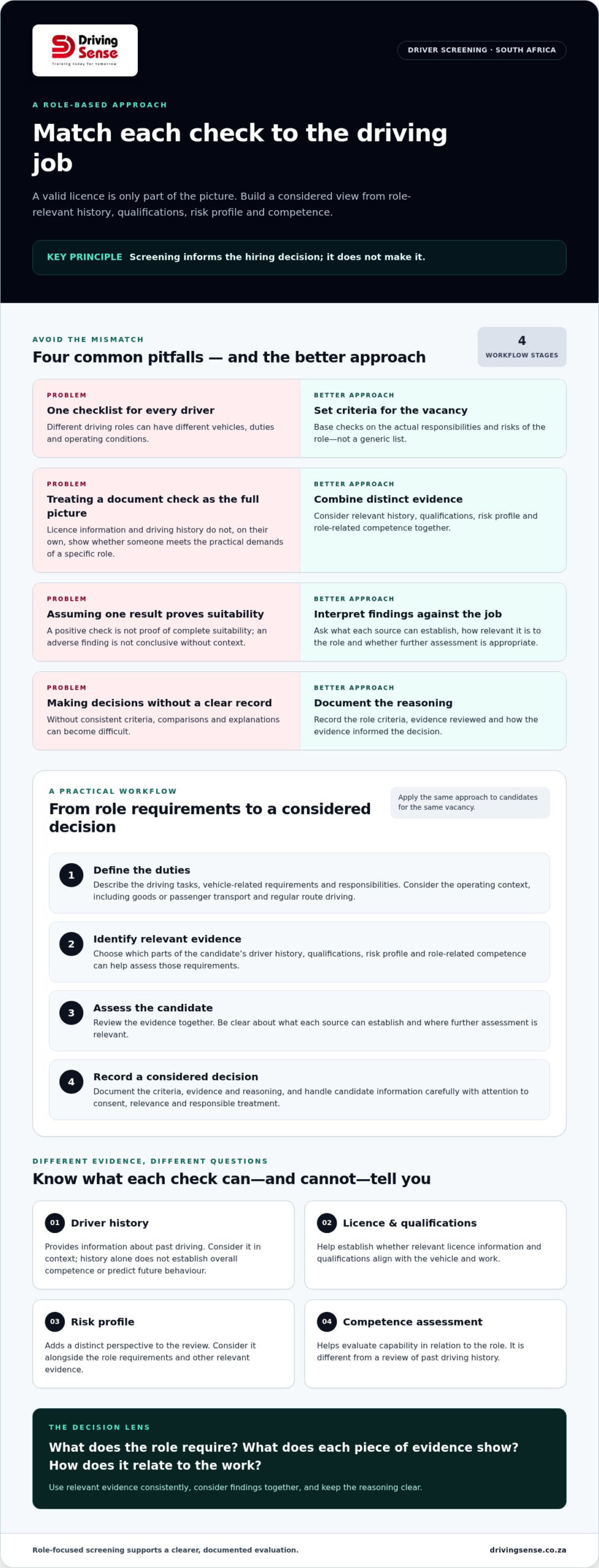
A responsible South African workflow for evaluating screened driver candidates
A structured process moves from role requirements to a reasoned decision without treating a single screening result as a verdict. For pre-employment driver screening south africa, set criteria before reviewing candidates, explain the process, handle personal information responsibly and record how relevant evidence informed the outcome.
Proportionate screening starts with clearly defined job requirements and uses evidence that helps assess a candidate against them. This supports consistency while allowing the assessment to reflect the specific driving duties involved.
Set consistent criteria and manage candidate information
Before screening begins, document the vacancy requirements and the purpose of each proposed check. For example, note whether licence or permit information relates to a vehicle requirement, or whether profiling or competence assessment addresses a defined aspect of the role. Applying the same criteria to candidates for the same position makes comparisons more transparent, subject to relevant legal review.
Explain the process and obtain appropriate consent before collecting or reviewing candidate information. POPIA and other applicable requirements should guide the handling of personal information. Employers should verify current obligations, including the appropriate consent process, who may access records, how information is secured and how long it may be retained. Avoid collecting material simply because it is available. Keep the scope connected to the role and limit access to those involved in the recruitment decision.
Interpret findings fairly before making a hiring decision
Review a finding for accuracy, context and relevance before it influences an outcome. An item in a candidate’s history, for instance, may need clarification before an employer can determine what it means for the duties. A profiling result or assessment observation should also be understood within the limits of the method and the role criteria, not treated as a definitive statement about future conduct.
Where information is unclear or inconsistent, establish a fair follow-up process that allows the candidate to clarify the matter. This does not presume guilt or unsuitability; it helps distinguish a verified fact from an incomplete record or misunderstanding. Handle follow-up in line with the organisation’s current legal and privacy procedures.
Keep three elements distinct in the decision record:
- Verified information: what a check or record actually establishes.
- Assessment observations: what was observed or indicated through profiling or competence assessment.
- Employer judgement: how the evidence relates to the role requirements and informs the outcome.
This separation gives decision-makers a clearer basis for consistent review and helps explain why particular evidence was relevant. Driving Sense’s pre-employment screening assesses driver history, risk profiles and candidate competency before placement, supporting a considered, role-focused process. Explore driver screening support to apply these evidence areas within your recruitment workflow.
Choosing pre-employment driver screening support with Driving Sense
Screening support is most useful when it reflects the driving role an organisation is filling, rather than treating every vacancy as the same assessment exercise. Driving Sense provides pre-employment screening, driver profiling, assessments and driver training for organisations across South Africa. Its screening evaluates candidate competency, risk profiles and driver history before placement, helping employers consider these evidence areas in relation to their hiring requirements.
Founded in 2006, Driving Sense brings transport-sector experience to this work. Founder Natalie Rodrigues spent 11 years at Super Group’s Truck Rental Division, and the company provides training and services nationwide. This background informs an understanding of driver recruitment, while its quality-focused customer care supports a considered discussion of an organisation’s assessment needs.
What employers can expect from a tailored screening discussion
A useful discussion starts with what the candidate will be expected to do and what the employer needs the assessment to help determine. Set out the driving role, the hiring context and the purpose of screening. For instance, decide whether the organisation needs to consider a candidate’s driver history, risk profile or competence relevant to the position.
Then align the screening scope with the role requirements. An employer recruiting for different operational roles may need different criteria for each vacancy, rather than assume the same combination of checks suits the whole business. Clear objectives also help decision-makers understand how assessment findings relate to their recruitment process.
From candidate assessment to broader driver capability
Pre-employment screening informs a decision before placement; driver training addresses capability development separately and may be relevant after hiring. Keeping those purposes distinct helps employers identify what they need to understand about a candidate now and what driver development may form part of their wider operational approach later.
Driving Sense provides screening and driver training for organisations nationwide. Employers can consider candidate assessment alongside the role, then approach training needs as a separate part of workforce planning. An assessment is not a guarantee of future performance.
For organisations reviewing pre-employment driver screening south africa, define the roles being recruited for, the decisions screening needs to inform and how driver training may fit into operational requirements. Discuss driver screening support with Driving Sense to start a role-focused conversation about candidate assessment and driver capability.
Put a consistent screening framework into practice
Translate your organisation’s driver-role requirements into a process that can be applied consistently as vacancies arise. A clear framework helps hiring teams know what they are assessing, how findings will inform decisions and where driver development may support operational needs after placement. For businesses planning pre-employment driver screening south africa, it provides a practical foundation for accountable recruitment.
Driving Sense supports organisations with screening, driver training, profiling and assessments, with customer care focused on understanding operational needs. Its status is 100 % B‑BBEE, Level Four contributor.
Take the next step by setting out your recruitment requirements and the driver roles you need to fill. Discuss pre-employment driver screening with Driving Sense and build a process around your organisation’s needs.
Frequently Asked Questions
What is included in pre-employment driver screening in South Africa?
The scope can include relevant driver-history information, qualifications, profiling and assessment of role-related competence. A goods-transport position, for example, may call for different evidence from a role where driving is occasional and operational. Select checks that answer a defined question about the vacancy rather than assume every candidate needs the same package. Current legal and privacy requirements should inform the process.
Is driver screening the same as a driving assessment?
No. Driver screening is the wider recruitment process for considering relevant candidate information, while a driving assessment focuses on capability or aptitude relevant to a role. An employer might use an assessment to examine a skill that a licence record cannot demonstrate. Interpret the method and findings according to what they measure, rather than treating them as a complete account of the candidate’s history or future performance.
Do employers need to verify a driver’s PRDP before hiring?
Verify a PRDP when it is required for the position’s driving duties. South African requirements depend on the vehicle and work involved, so check current rules and the applicable permit category rather than assume every driver needs one. For a role involving passenger or goods transport, establish the relevant requirements before appointment and assess whether the candidate’s permit details align with the duties.
Can a background check alone show whether a driver is suitable?
No. A background check can provide information about a candidate, but it cannot by itself demonstrate practical driving capability or how well the person meets the demands of a particular position. A clear record, for example, does not show how a candidate responds to role-specific tasks. In pre-employment driver screening south africa, treat background information as one input and consider whether a relevant competence assessment is also needed.
How much does pre-employment driver screening cost in South Africa?
Screening fees are charged per candidate or through a retainer, depending on the service arrangement. The scope should reflect the role and the assessment required, such as consideration of driver history, risk profiles and competency. Driving Sense can discuss your organisation’s recruitment requirements and the relevant screening scope.
What happens if screening identifies a concern about a candidate?
A concern should prompt careful review, not an automatic hiring decision. Establish what the information confirms, whether it is accurate and how it relates to the role. If details are unclear, give the candidate a fair opportunity to clarify them, following the organisation’s privacy and recruitment procedures. Record verified information separately from assessment observations and the employer’s judgement about relevance.
How does driver profiling differ from driver history verification?
Driver-history verification examines available information about a candidate’s driving background. Profiling structures information about a candidate’s risk profile for consideration during recruitment. Neither replaces the other: a history check does not provide the same perspective as profiling, and profiling does not verify historical records. Understand the purpose and limits of each before using findings to inform a hiring decision.

Pingback: Fleet Driver Risk Profiling for South African Businesses – Driving Sense