

A driver’s highest risk score may tell you less than the evidence behind it. For South African businesses, fleet driver risk profiling is most useful when it brings relevant information together and helps managers understand the pattern, rather than reducing a person’s performance to one number.
Driver records, assessment results and incident information may be held separately, making it difficult to see where support is needed. A score can also hide important context: a concern may call for clarification, targeted training or further assessment, rather than a fixed judgement about the driver. The aim is to identify risks fairly and respond in proportion to the evidence.
This article explains what a practical fleet driver risk profile can include, how to interpret its limits and why no single indicator should be treated as conclusive. It also shows how findings can inform appropriate development, including driver training and assessment, so profiling supports fleet operations and individual skill development.
Key Takeaways
- Build a driver profile to guide assessment and development, not to predict performance or assign a permanent label.
- Use evidence from different sources for their distinct purposes, rather than treating every indicator as equivalent.
- Fleet driver risk profiling is more useful when findings are considered alongside context and confidence in the evidence.
- Match follow-up to the specific pattern identified, then review whether the chosen training or safety action remains appropriate.
- Driving Sense provides driver training, profiling and assessments to organisations nationwide across South Africa.
What fleet driver risk profiling means for South African businesses
Fleet driver risk profiling is a structured way to bring relevant information about a driver’s work, observed driving and development needs into one decision-support picture. It helps an organisation decide where further understanding, assessment or support may be appropriate. It is not a prediction of what a driver will do next, nor a verdict on their suitability based on one score or incident.
A useful profile reflects the driving responsibilities involved. A driver operating a heavy vehicle on long-distance routes faces different demands from one making frequent deliveries in busy traffic. Consider the role and operating conditions before interpreting the evidence. This reflects broader road safety principles, which recognise that safer outcomes depend on people, vehicles and the environments in which they operate.
Profiles can serve two related purposes. For an individual, they can help managers identify development needs and decide whether further assessment or training may be useful. Across a fleet, reviewing profiles collectively can reveal recurring themes, such as a capability gap among drivers in similar roles. That fleet-wide view can inform development priorities, but it should not erase differences between individuals.
What questions should a fleet driver profile help answer?
Start by defining the responsibilities and operating conditions that matter to the organisation. Then use the profile to ask: What does the evidence indicate? What context could affect its interpretation? Where would further understanding or support be useful? For instance, a concern linked to a particular task may warrant a focused assessment before anyone draws a broader conclusion. The next step should match the evidence, not exceed it.
How profiling differs from screening and competency assessment
Profiling brings relevant information together to support decisions about development and follow-up. A competency assessment examines a driver’s capability in a defined assessment context, so its findings should be interpreted within that scope. Screening serves a different purpose, particularly during hiring. Organisations reviewing that process can refer to the pre-employment driver screening guide.
These approaches can inform one another, but they are not interchangeable. A profile should make clear what evidence it draws on, what conclusions it can reasonably support and what remains uncertain. Treat it as a working view that guides proportionate next steps, not as a permanent label or automatic basis for a management decision. This helps keep driver development fair, relevant and connected to operational needs.
Which evidence can inform a fleet driver risk profile?
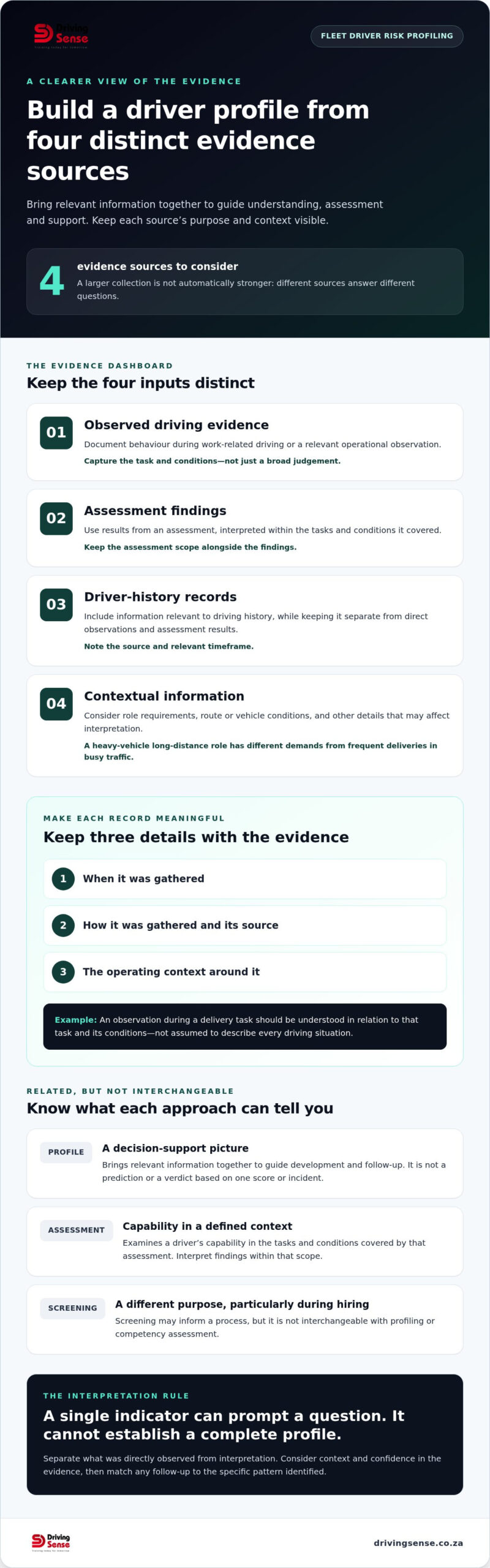
A useful profile depends on evidence that is relevant to the driver’s responsibilities and clear enough to interpret. In fleet driver risk profiling, a larger collection of records is not automatically stronger. Different sources answer different questions, so do not combine them as though every indicator measures the same thing.
Organise information by source and purpose. For each item, record when and how it was gathered, along with the operating context. A brief observation on a particular route, for example, should be understood in light of the conditions of that drive, not treated as a complete account of the person’s usual behaviour.
- Observed driving evidence: documented behaviour during work-related driving or a relevant operational observation.
- Assessment findings: results from an assessment, interpreted within the tasks and conditions it covered.
- Driver-history records: information relevant to driving history, kept distinct from direct observations and assessment results.
- Contextual information: role requirements, route or vehicle conditions, and other details that may affect how the evidence should be understood.
Consider these categories together while keeping their differences visible. OSHA’s Employer guidelines for motor vehicle safety provide a general resource on vehicle safety programmes, but are not a substitute for South African legal guidance.
Driving behaviour and operational context
Use documented observations that relate to the driver’s actual duties, with enough detail to make each record meaningful. Note the task, conditions and source, rather than relying on a broad judgement such as “unsafe”. An observation during a delivery task, for example, should be considered in relation to that task and its conditions, not assumed to describe every driving situation.
A single event or indicator can prompt a question, but it cannot establish a complete profile on its own. Separate what was directly observed from interpretation, and record any context that could affect the meaning of the observation.
Assessment findings and driver history
Competency findings show how a driver performed in a particular assessment context. They add useful evidence, but do not represent every aspect of work-related driving. Keep the assessment scope alongside its findings so managers can see what was examined and avoid drawing conclusions beyond it.
Driver-history information is a separate input. Record its source and relevant timeframe, and consider it alongside current evidence, not in place of it. Employers reviewing the process can use the driver history verification checklist.
Evidence quality depends on relevance and context as much as quantity. A few clear, role-related records may support better follow-up than a larger collection of disconnected indicators. A practical evidence register can note the source, date, operating context, what the information supports and what remains uncertain. This makes gaps visible and helps managers decide whether further assessment or development is appropriate. Driving Sense’s driver profiling and assessments can help organisations build a clearer, evidence-informed view of driver needs.
How to interpret driver risk profiles without oversimplifying them
A profile is only as useful as the judgement applied to it. Managers should distinguish a prompt for review from a supported conclusion, and separate evidence from interpretation and questions that still need follow-up. This helps fleet driver risk profiling guide proportionate decisions without turning uncertainty into a judgement about a person.
Consider a recorded observation that a driver appeared distracted during one task. On its own, this is an indicator: it warrants clarification, but does not establish recurring behaviour or explain its cause. If relevant observations from separate occasions point to a similar concern, they may suggest a pattern worth examining. Reserve a confirmed finding for information that has been appropriately assessed and supports the conclusion being drawn.
Indicator, pattern or confirmed finding: what is the difference?
An indicator is a single piece of information that raises a question. A pattern is a set of related observations considered together, taking their dates, sources and operating conditions into account. A confirmed finding has been assessed sufficiently to support a specific conclusion. Keeping these distinctions visible prevents one incident, incomplete record or untested assumption from carrying more weight than it deserves.
A comparison table can help managers apply consistent reasoning while preserving the differences between cases. For each item, record:
- Evidence: What was observed or assessed, and from what source?
- Context: When and under what role, task or operating conditions was it obtained?
- Confidence: Is the information direct, relevant and sufficiently complete, or is it uncertain or incomplete?
- Follow-up: Would clarification, a focused assessment, development or no immediate action be proportionate?
This is a comparison aid, not a scoring formula. Avoid unsupported numerical risk bands or predictions about who is likely to have an accident. Such labels can imply a level of precision that the available evidence does not justify and may obscure the reasons behind a concern. Where evidence is mixed, record the uncertainty rather than forcing a single overall rating.
Why fair interpretation depends on context
Interpretation should reflect the driver’s actual role and the conditions in which information was gathered. An observation from one type of task may not describe performance in another. An assessment may clarify capability within its scope, but it cannot automatically answer every question about day-to-day driving. Make the limits of each source clear before combining findings.
Missing or outdated information matters too. Note what is unavailable and whether it affects confidence in the profile. Do not fill gaps with assumptions or treat an absence of records as proof of safe or unsafe performance. A profile describes the evidence currently available, not a permanent identity. Update it when relevant information changes, so decisions reflect present circumstances rather than an old label.
Before acting, managers can ask whether the evidence supports the proposed response, whether another explanation remains plausible and whether further assessment could resolve an important uncertainty. If the answer is unclear, the proportionate next step may be to gather better information rather than strengthen a conclusion. This keeps profiling useful for development and operational review, while recognising that no summary replaces informed, case-by-case judgement.
How to turn fleet driver risk profiling into practical action
A profile creates value when it leads to a reasoned response, rather than being filed as a score or used to apply the same intervention to every driver. A repeatable process helps fleet managers make decisions they can explain: each action should connect to a relevant finding, account for uncertainty and have a clear point for review.
Use this sequence to move from information to follow-up:
- Define the purpose. State the question the profile needs to address, such as whether a role-specific capability needs further assessment.
- Organise the evidence. Record relevant information alongside its source, date, context and limitations.
- Interpret the findings. Separate direct evidence from assumptions, and identify what is supported, uncertain or missing.
- Agree an action. Choose a proportionate response, such as clarifying information, arranging further assessment or addressing a specific development need.
- Assign responsibility and review. Record who will take the next step and when the organisation will consider whether it remains appropriate.
A profile is useful when it informs a proportionate next step, not when it becomes a label. This keeps fleet driver risk profiling connected to practical development and accountable management decisions.
A clear review process for fleet managers
Set the profile question before reviewing driver information so the process stays focused on a defined operational need. Document the evidence considered, its context and limitations, and the reasoning behind the conclusion. Then agree on the follow-up, the person responsible and a review point. If evidence is insufficient, record the gap rather than treating an assumption as a finding.
A written record also supports consistency across the fleet. Managers can compare how similar evidence was considered without assuming that different drivers, roles or circumstances require identical responses.
Connecting a profile to driver development
Use relevant assessment findings to identify a specific learning or capability need. If an assessment indicates that a particular skill requires attention, development can focus on that area. A broad concern without supporting detail may instead call for clarification or further assessment before training is selected. This avoids prescribing the same intervention simply because drivers share a role or profile category.
Training should relate to the evidence and the responsibilities involved. Follow-up should consider whether the original need has been addressed. Employers considering how to structure this approach can consult the corporate driver training guide.
Driving Sense provides driver training, profiling and assessments to organisations across South Africa. Explore driver training and assessment support to see how profile findings can inform relevant development for your organisation.
How Driving Sense supports fleet driver profiling and development
Driving Sense provides driver training, profiling and assessments across South Africa for organisations looking to connect driver information with practical development. These services can support a considered process in which managers use relevant findings to inform assessment or development, rather than treating a profile as a fixed judgement about an individual.
Driving Sense was founded in 2006. Founder Natalie Rodrigues spent 11 years at Super Group’s Truck Rental Division, bringing transport-sector experience to the organisation’s understanding of driver roles and skills needs. The company focuses on quality and on combining compliance with genuine skill development. Its training capability extends nationwide across South Africa.
A driver-development approach grounded in transport experience
Transport experience matters because driver responsibilities sit within particular operating settings, and development needs should relate to the work being performed. Rodrigues’s 11-year tenure at Super Group’s Truck Rental Division provides relevant sector background for an organisation focused on driver profiling, assessments and training. This experience informs a skills-development perspective, while recognising that a profile alone cannot determine a driver’s future performance.
Driving Sense is a 100 % B-BBEE, Level Four contributor. Its focus on quality and skill development connects organisational requirements with relevant driver development, without promising a particular result for every driver or fleet.
From profile findings to a structured next step
Profiling and assessment can help an organisation clarify where further understanding or training may be relevant. For example, if an assessment identifies a capability that needs attention, managers can consider a development response related to that finding. If the evidence is incomplete, further assessment may be more appropriate than assuming a broad training intervention will address the issue. The aim is to connect the response to the evidence and the driver’s responsibilities.
South African organisations should also distinguish training support from qualification accreditation. The Quality Council for Trades and Occupations (QCTO) is the sole accrediting body for occupational and trades-related qualifications in South Africa. This distinction helps employers consider the applicable qualification framework separately from the practical process of profiling, assessment and development.
Driving Sense’s services can help organisations turn driver information into a clearer development pathway. To explore driver profiling and assessment support, consider how your organisation’s role requirements and existing evidence can inform appropriate next steps.
Make driver development part of your next review
Use your next fleet review to decide how driver information will inform development over time. Agree who is responsible for considering new evidence, how decisions will be documented and when existing profiles should be revisited. A consistent review practice helps keep fleet driver risk profiling relevant as operational needs and individual development priorities change.
Start with a practical question: what decision would a clearer understanding of driver capability help your organisation make? Then identify whether profiling, assessment or training is the appropriate next step, and keep the response proportionate to the information available. The objective is not to assign a lasting label, but to make more considered development decisions.
Driving Sense supports organisations with driver profiling, assessments and training. Explore Driving Sense driver profiling and assessment support to consider how these services can inform your organisation’s driver development approach. A measured next step can turn useful information into a more purposeful safety and skills process.
Frequently Asked Questions
What is fleet driver risk profiling?
Fleet driver risk profiling organises relevant information about driving and development needs so an employer can decide what to examine or support next. For example, a manager might use it to distinguish a role-specific training need from an issue that requires more information. Its value lies in supporting considered decisions, not forecasting a particular driver’s behaviour or treating a profile as a permanent judgement.
How often should a fleet review driver risk profiles?
There is no single review interval that suits every fleet, and this guidance does not prescribe a legal frequency. Set an approach that fits your operations and internal governance, then apply it consistently. A role change, new assessment information or a relevant documented concern could prompt an earlier review. Record why a review took place and what changed, so managers can distinguish a current picture from information that may no longer reflect the work.
Can fleet driver risk profiling predict which drivers will have an accident?
No. A profile cannot guarantee that an individual will or will not have an accident, and it should not be presented as a prediction. It organises available information to support review and development decisions, while uncertainty remains. If a profile raises concern, identify what evidence supports it and whether more information is needed. Avoid unsupported scores or claims of certainty; use sound operational judgement when deciding what follow-up is appropriate.
What information should an employer consider in a driver risk profile?
Consider information relevant to the role, such as documented driving observations, assessment results, appropriate driver-history information and details about the work context. A record from a particular driving task, for example, needs to be understood in relation to when and how it was gathered. Keep the source and date with each item, and note any limitations. This makes it easier to judge whether the information is current and suitable for the decision being considered.
Is fleet driver risk profiling only useful when hiring drivers?
No. Profiling can also help employers consider development needs among existing drivers. The purpose should be clear: a hiring process and an employee development review may call for different information and follow-up. For an existing driver, a new responsibility might prompt a focused review of relevant skills. Avoid using an isolated observation as a lasting judgement or treating every driver in the same role identically.
Does driver risk profiling replace a competency assessment or driver training?
No. Profiling organises information and identifies areas that may need attention; it does not demonstrate capability in the way a focused assessment can, and it does not provide instruction. If a driver is assigned a different vehicle or task, for instance, an assessment may help clarify a capability question, while training can address an identified learning need. These processes serve distinct purposes and should fit within the organisation’s wider operational safety arrangements. For employers considering role-specific evaluation, see this guide to driver evaluation services in South Africa.
How is fleet driver risk profiling different from driver history verification?
Driver history verification reviews relevant history information, while profiling considers appropriate history alongside other evidence and the demands of the role. A history record may raise a question for an employer, but it does not by itself explain a driver’s current capability or identify the right development response. Keep verification distinct, consider the information’s relevance to the decision, and use other appropriate evidence where a broader understanding is needed. Explore Driving Sense’s driver profiling and assessment support to discuss a practical approach for your organisation.

Pingback: Driver Competency Assessment in South Africa: What Businesses Need to Know – Driving Sense