

What if a valid licence and a completed pre-employment screen still leave important questions about someone’s readiness to drive for work? A search for “driver competency assessment south africa” often reflects this practical concern: businesses need to understand how a person’s capability relates to a work-driving role, not simply what their records show. Screening, assessment and training serve different purposes, and none should be treated as a complete verdict on future performance.
A structured assessment can help clarify a driver’s strengths and development needs in relation to the job. Its value lies in connecting relevant findings to role expectations, then using them to guide fair, proportionate decisions. It should not be treated as a standalone prediction of future performance.
This guide explains what a competency assessment can and cannot reveal, how it differs from screening and driver training, and how organisations can use findings to guide development. Driving Sense provides driver training, profiling and assessments to organisations across South Africa, supporting a broader approach to driver capability and workforce development.
Key Takeaways
- Use the responsibilities of the role as the reference point for deciding what driver capability means in practice.
- A driver competency assessment south africa can contribute to a more complete capability picture when interpreted alongside relevant context and evidence.
- Keep assessment, screening and training distinct by focusing on the different questions each is intended to answer.
- Review findings consistently, discuss them with the driver and document proportionate development steps.
- Driving Sense provides driver training, profiling and assessments nationwide, and was founded in 2006.
What Is a Driver Competency Assessment in South Africa?
A driver competency assessment considers how a person’s capability relates to the responsibilities of a particular work-driving role. Rather than asking only whether someone holds a valid licence, it focuses on whether their knowledge, judgement and approach to safe work practices are suited to the job. A driver competency assessment south africa businesses use should therefore be considered in relation to the role, not as a universal measure of every aspect of a person’s driving.
An assessment is not the same as a licence test, formal qualification or background check. A driving test generally checks performance against its own requirements, while a workplace assessment considers capability in relation to job expectations. A qualification recognises learning or achievement within a formal framework; a background check examines records or other candidate information. Each provides a different kind of information, and none guarantees how someone will perform in every future situation.
Assessment findings can inform workforce decisions, but they do not replace an employer’s judgement. Consider the role, the evidence available and the context in which findings were produced. A result may prompt further discussion or point to a development need, but it should not automatically determine someone’s suitability without careful interpretation.
What does driver competency mean at work?
At work, competency means being able to meet the driving responsibilities relevant to a role. Depending on the job, this may involve applying road knowledge, exercising sound judgement, following safe work practices and responding appropriately to routine demands. These are examples of work-related capability, not a universal checklist.
Role context matters. The requirements for someone who drives occasionally between work locations may differ from those for a person whose duties involve regular commercial driving or transporting goods. Employers can define the responsibilities that matter to their operation, then assess whether available information relates to those requirements. This is more useful than relying on a broad label such as “competent” without explaining what it means for the job.
Who uses driver competency assessments?
Transport businesses and other employers may seek a clearer view of driver capability when considering people for work-related driving roles or reviewing the development needs of current employees. In either situation, an assessment can help structure a discussion about role expectations and capability rather than leaving decisions to assumptions or licence status alone.
During recruitment, competency assessment may complement pre-employment screening, which addresses broader candidate or history checks. For current employees, findings may inform development discussions and decisions about support. In both cases, use consistent criteria, record the reasoning behind decisions and avoid treating a single assessment as a prediction of future performance.
How Driver Competency Assessments Build a More Complete Capability Picture
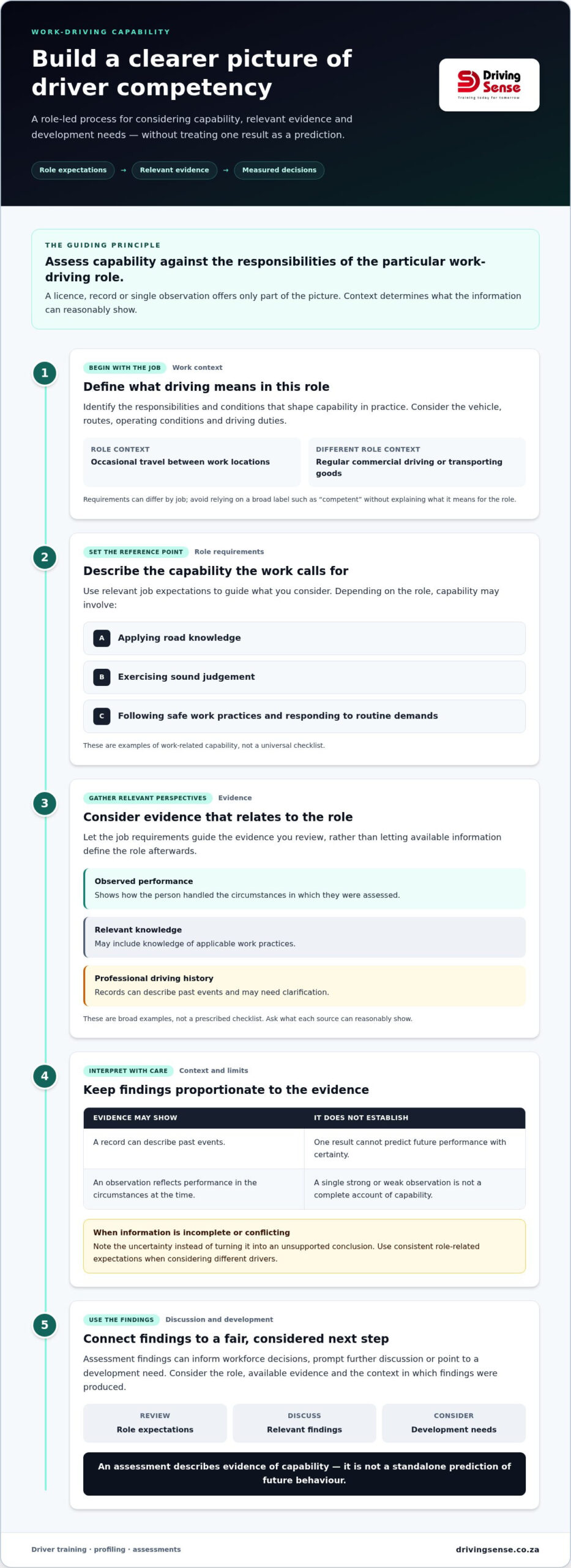
A useful assessment considers evidence against the responsibilities of a particular role. The framework below explains how an organisation can think about capability; it is not a description of a specific test or scoring system. The aim is to avoid treating one result or observation as a complete account of a driver’s strengths, development needs or likely conduct.
Start with the work context. The vehicle, routes, operating conditions and driving responsibilities all shape what capability means in practice. Then consider relevant evidence, such as observed performance, knowledge of applicable work practices and fleet driver risk profiling. Each source offers a different perspective. Records can describe past events, for example, while observed performance shows how someone handled the circumstances in which they were assessed.
What kinds of evidence can inform a competency picture?
Let role requirements guide the evidence you consider, rather than allowing whatever information happens to be available to define the role afterwards. An employer might compare job expectations with observed capability, consider relevant knowledge and review appropriate professional driving history. These are broad examples, not a prescribed checklist. Ask what each piece of information can reasonably show and where its limits lie.
Evidence needs context. A record may require clarification, and one strong or weak observation may reflect the particular conditions at the time. Consistency also matters: using the same role-related expectations when considering different drivers supports more considered comparisons. If information is incomplete or conflicting, note that uncertainty rather than turning it into an unsupported conclusion.
Competency assessment describes evidence of capability, not certainty about future behaviour. This distinction is central to a responsible driver competency assessment south africa employers can use as part of workforce development. It encourages measured conclusions, useful questions for discussion and consideration of relevant development, without presenting an assessment as a prediction or guarantee.
Where do QCTO and SAQA fit into the wider picture?
A workplace competency assessment and a formal occupational qualification are related, but distinct. An employer may assess capability in relation to a work role; that assessment does not, by itself, award a qualification. In South Africa, the Quality Council for Trades and Occupations (QCTO) is the sole accrediting body for occupational and trades-related qualifications. The QCTO framework provides the formal qualifications context, while a role-specific assessment considers capability in relation to an employer’s requirements.
For organisations connecting assessment with a broader capability and development process, Driving Sense’s driver training, profiling and assessments can be part of that approach. Keeping evidence, role expectations and formal qualifications distinct supports clearer decisions and more useful development conversations.
Competency Assessment, Driver Screening and Training: What Is the Difference?
These terms are sometimes used together, but they describe different activities. Separating their purposes helps employers use information appropriately: assessment considers capability, screening gathers broader candidate or history information, and training develops knowledge or skills. A driver competency assessment south africa organisations use can complement screening and training, but it cannot replace either one.
| Activity | Purpose | Typical use | Question it answers |
|---|---|---|---|
| Competency assessment | Evaluate capability against relevant driving responsibilities | Recruitment or workforce development | What evidence indicates the person can meet the role’s requirements? |
| Screening | Review broader candidate or history information | Recruitment processes | What relevant background information should inform the decision? |
| Training | Develop knowledge or skills | Learning and development | What can the driver learn or practise to build capability? |
How does assessment differ from pre-employment screening?
Assessment focuses on evidence of capability in relation to driving responsibilities. Screening is broader and may include relevant background information that helps an employer understand a candidate’s history. Both can inform the same recruitment decision, but they answer different questions. For a closer look at how capability evaluations fit into workplace decisions, see professional driver evaluations.
This distinction prevents a common reasoning error: assuming a favourable screening result proves driving capability, or treating an assessment as a complete review of a candidate’s background. Consider each source for what it can show, how it relates to the role and what it cannot establish. This keeps information in context and avoids duplicating the detailed screening considerations covered in a separate recruitment guide.
How does assessment differ from driver training?
An assessment describes or evaluates capability; training develops knowledge or skills. One is primarily evaluative, while the other is developmental. Assessment findings may help an organisation identify learning priorities, such as an area where additional instruction or practice could be useful. They do not guarantee a particular training outcome or future level of performance.
Used in sequence, the activities can support a considered development process: identify a role-related need, select suitable learning, then consider whether follow-up is appropriate. Training should respond to an identified objective rather than substitute for understanding capability. Driving Sense provides corporate driver training in South Africa for this distinct learning and skills-development purpose.
For organisations considering how assessment and training can contribute to driver capability, Driving Sense’s driver training and assessment support can form part of a wider workforce-development approach. Define what each activity is intended to establish, then use its findings for that purpose.
How Should Employers Interpret Driver Competency Assessment Findings?
Assessment findings become useful when an organisation connects them to role requirements and a clear decision-making process. Assessment results are most useful when interpreted against defined role requirements. A result should prompt considered review, not an automatic label. Its relevance depends on the work, the evidence available and the purpose of the assessment.
Use a consistent sequence to move from findings to proportionate action:
- Define expectations. Set out the driving responsibilities and capability relevant to the role. This gives the organisation a clear basis for interpretation.
- Review the evidence. Consider what the findings indicate, how they relate to expectations and whether context affects their meaning.
- Discuss the findings. Give the driver an opportunity to understand the feedback and provide relevant context, particularly where information appears incomplete or unclear.
- Identify next steps. Consider whether support, training, further review or no immediate action is proportionate to the evidence and the organisation’s process.
Clear records can show which expectations informed the decision, what evidence was considered and why a particular response was selected. Applying the same approach across comparable roles supports consistency, while differences between roles may justify different expectations. A driver competency assessment south africa employers use should inform workforce decisions, not remove the need for careful organisational judgement.
How can findings inform a development plan?
Where findings point to a development need, translate it into a relevant learning objective. For example, if evidence suggests that a particular area of role-related knowledge needs attention, consider learning that addresses the subject. Keep the action linked to the observed need and work context; avoid prescribing a broad intervention when the evidence supports a narrower response.
Distinguish an identified learning priority from a promised result. Training may support knowledge or skill development, but employers should not assume that assessment or training alone will produce a particular performance outcome. Consider any follow-up through the organisation’s usual workforce-development process.
What limits should decision-makers keep in mind?
No single assessment can guarantee how a person will drive in future circumstances. Findings describe evidence gathered in a particular context; they cannot account for every condition, decision or event that may arise on the road. Treating a result as conclusive can overstate what it establishes and lead to decisions that are not properly grounded in the role.
Transparent criteria and consistent interpretation help make decisions more understandable and fair. If evidence is mixed, record that nuance rather than reducing it to an unsupported pass-or-fail conclusion. Keep the rationale factual, role-related and clear. Consider current South African requirements separately when a decision involves a legal or regulatory question.
For organisations seeking to connect assessment findings with driver development, explore driver assessment and training with Driving Sense.
How Driving Sense Supports Driver Training, Profiling and Assessments
Driving Sense provides driver training, profiling and assessments as connected parts of workforce development. Founded in 2006, the company supports organisations throughout South Africa that need to consider driver requirements across their operations. Its services bring together compliance awareness, competence and skills development, while keeping each activity focused on its intended purpose.
Transport-sector experience can inform an understanding of the demands placed on work drivers. Founder Natalie Rodrigues spent 11 years at Super Group’s Truck Rental Division, gaining experience in a commercial transport environment. This background sits alongside Driving Sense’s focus on competence and quality-focused customer care. It does not replace an organisation’s knowledge of its own roles, but it provides relevant context when considering how driver capability and development fit together.
What does an organisation gain from an experienced assessment partner?
An experienced partner can help an organisation approach driver assessment as part of a considered capability process, rather than treating a result as a standalone label. For businesses in road transport and freight, the practical value is in keeping assessment discussions connected to work requirements, compliance awareness and potential development needs. Driving Sense provides driver training, profiling and assessment services to support this approach.
How can assessment fit into a wider workforce approach?
Assessment findings can inform what an organisation considers next, while remaining one source of information in its decision-making process. Depending on the role and findings, an organisation may consider further discussion, relevant training or another development step. Keeping these activities distinct helps match the response to the need identified, rather than assuming assessment alone develops capability.
A joined-up approach can help an organisation to:
- Relate driver capability discussions to the responsibilities of the role.
- Consider whether training is relevant to an identified learning need.
- Keep assessment, development and wider workforce decisions clear and distinct.
Driving Sense is a 100 % B‑BBEE, Level Four contributor. For employers considering a driver competency assessment south africa as part of a broader workforce-development approach, nationwide service capability supports driver training, profiling and assessments across the organisation. The appropriate role expectations and next steps remain matters for each organisation to consider carefully.
To discuss your organisation’s driver capability needs, explore Driving Sense’s driver training, profiling and assessment services.
Build Driver Capability into Your Workforce Planning
Consider how your organisation reviews driver capability as work changes. New responsibilities, operating conditions or workforce-development priorities may be a reason to revisit whether expectations remain clear and existing support is relevant. A driver competency assessment south africa can contribute to that process when it is connected to defined roles and treated as one part of informed decision-making.
A practical next step is to identify where your organisation needs a clearer view of driver capability, then consider how assessment, profiling and appropriate training could support that objective. Keep the purpose explicit, make decisions proportionate to the evidence and use the process to guide considered development rather than relying on a label or prediction.
Driving Sense supports organisations with driver training, profiling and assessments. Explore Driving Sense’s driver training, profiling and assessment services to discuss an approach suited to your workforce priorities.
Frequently Asked Questions
Is a driver competency assessment the same as a driving test?
No. A driving test checks performance against its own requirements, whereas a workplace assessment considers capability in relation to job responsibilities. The two may have some driving-related aspects in common, but they answer different questions. Passing a licence test does not by itself give an employer a complete view of how a person’s capability relates to the work they will be doing.
Can a driver competency assessment identify training needs?
Yes. Findings may help an employer identify areas that warrant further learning or discussion. For instance, if an assessment indicates a knowledge gap relevant to a driver’s duties, the organisation could consider whether suitable learning addresses that need. The finding should guide consideration rather than automatically prescribe a course. Any development action should relate to the evidence and role, and should not be treated as a guarantee of future performance.
How does driver competency assessment differ from pre-employment screening?
Competency assessment considers evidence relevant to a person’s driving capability for work, while pre-employment screening gathers driver history verification information in South Africa that may include relevant history. A screening result does not, on its own, explain how capability aligns with a role; an assessment is not a substitute for broader screening. Employers can keep the distinction clear by recording which activity produced each finding and what question that information is intended to inform.
Does a driver competency assessment provide a formal qualification?
Not automatically. A workplace assessment provides information about capability in a work context; a formal occupational qualification belongs to a structured qualifications framework and has its own requirements. Employers should distinguish an assessment record from evidence of a qualification when reviewing a driver’s credentials. If a role requires a particular qualification, assess that requirement separately rather than assuming an assessment has awarded or replaced it.
Who can benefit from a workplace driver competency assessment?
Organisations may use workplace assessments when considering people for driving duties or reviewing the development needs of current employees. This can be relevant in transport and freight operations, as well as in other businesses where driving forms part of a job. The assessment is most useful when the employer has a clear purpose, such as understanding role-related capability or deciding whether a development discussion may be appropriate.
What should an employer do with driver assessment findings?
Keep findings with their context, note which role expectations they relate to and make the next decision through the organisation’s established process. If a result is unclear or incomplete, avoid treating it as conclusive; identify what needs clarification before relying on it. If you select a development action, record its objective and who will review whether it remains relevant, so the finding leads to an accountable next step.

Pingback: Pre-Employment Driver Screening in South Africa: A Business Buying Guide – Driving Sense