

A complete incident report is more than a record of what happened; it helps prevent a similar event from happening again. In South Africa, workplace incident investigation and reporting procedures should begin promptly at the incident location, establish the immediate and underlying causes, and document findings and corrective actions. According to the Department of Employment and Labour, a work-related incident that leaves a person unable to work for 14 days or longer must be reported to the Provincial Director under Section 24 of the OHS Act.
Managers and workers may be unsure where an investigation should take place, who should contribute, or which reports must be submitted. This guide explains how to preserve evidence, identify root causes, involve employees and witnesses, meet reporting requirements, and complete and submit incident reports. It also shows how to turn findings into corrective actions and strengthen workplace safety, whether an incident caused an injury or exposed a hazard through a close call.
Key Takeaways
- Start an investigation promptly at the incident location, after providing any necessary first aid, so evidence and recollections can be preserved.
- Look beyond the immediate event to identify underlying equipment, procedure or training failures, then assign and follow up corrective actions.
- Involve managers, employees and witnesses in a fact-focused process, using open questions and avoiding blame.
- Record what happened, where and when it occurred, who or what was affected, and the causes and actions identified.
- Under Section 24 of the OHS Act, according to the Department of Employment and Labour, an incident that leaves a person unable to work for 14 days or longer must be reported to the Provincial Director.
Why Conduct Incident Investigations?
Use each investigation to identify what failed, reduce the risk of recurrence, and turn findings into accountable corrective action.
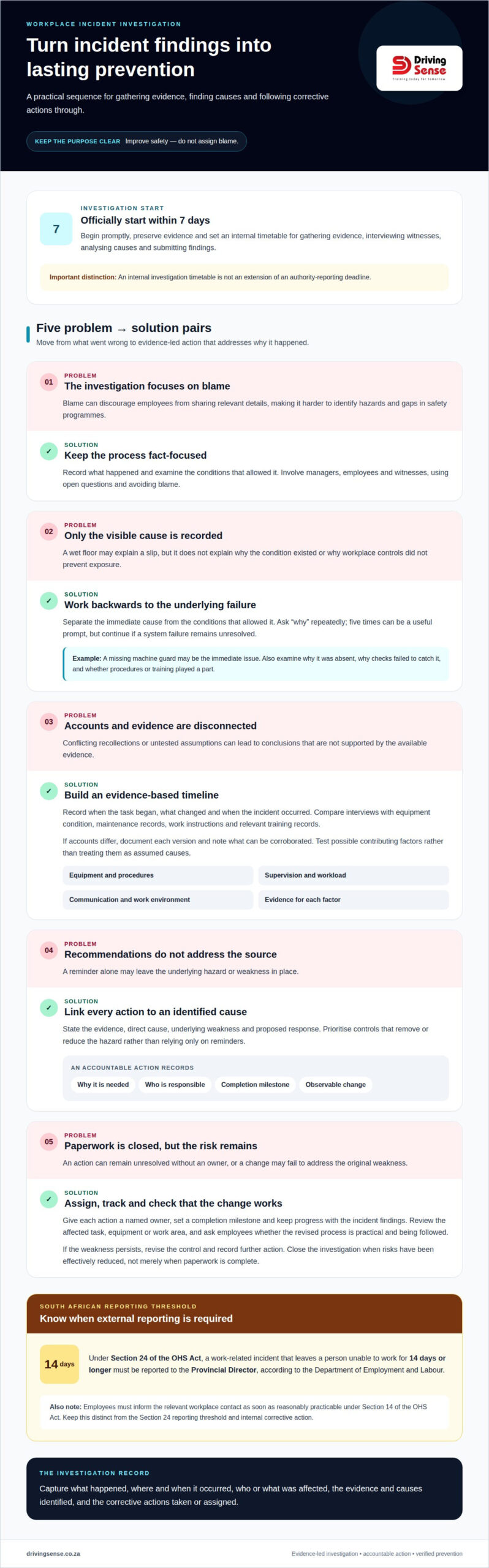
- Set a prevention-focused purpose. Treat the investigation as a way to improve workplace safety, not assign blame. If a worker slips beside a production line, for example, record what happened and examine the conditions that allowed it. Blame can discourage employees from sharing relevant details. A prevention-focused process helps managers and workers identify hazards, gaps in safety programmes, and practical improvements.
- Separate the immediate event from the underlying failure. Record the direct work-related factor, such as a wet floor, damaged tool, or unclear instruction. Then examine why the condition existed and why existing controls did not prevent exposure. A wet floor may explain a slip, but a missing inspection process may point to a deeper system failure. Distinguishing these causes helps ensure recommendations address the source, not just the visible outcome.
- Convert findings into specific recommendations. Link every proposed action to an identified cause. If a walkway becomes slippery during cleaning, recommendations might address the cleaning sequence, warnings, or floor condition. Prioritise controls that remove or reduce the hazard rather than relying only on reminders. Record why each action is needed, who is responsible, and what observable change will show it is complete.
- Assign ownership and track progress. Assign each corrective action to a named person, set a completion milestone, and record progress. Without an owner, a recommendation can remain unresolved after the investigation closes. A supervisor might oversee a revised equipment check while a maintenance lead addresses a fault. Keep the action register with the incident findings so managers can identify overdue work and outstanding risks.
- Apply the reporting threshold correctly. Under Section 24 of the OHS Act, a work-related incident that leaves a person unable to work for 14 days or longer must be reported to the Provincial Director, according to the Department of Employment and Labour. This reporting requirement is distinct from internal corrective action. Record the injury outcome and resulting absence accurately, then ensure the investigation’s findings support the organisation’s follow-up and reporting process.
- Check whether each change works. Once an action is implemented, review the affected task, equipment, or work area to see whether the original hazard remains. Ask employees doing the work whether the revised process is practical and being followed. If the weakness persists, revise the control and record the further action. Close the investigation when risks have been effectively reduced, not merely when the paperwork is complete.
Investigation deadlines and root cause analysis
Employees must inform the relevant workplace contact as soon as reasonably practicable under Section 14 of the OHS Act. Under Section 24, incidents causing incapacity for 14 days or longer must be reported to the Provincial Director, according to the Department of Employment and Labour.
-
Establish investigation and reporting deadlines
Start the investigation promptly and set an internal timetable for gathering evidence, interviewing witnesses, analysing causes, and submitting findings. An investigation should officially start within 7 days. Keep workplace incident investigation and reporting procedures aligned, but distinguish investigation milestones from external notifications. Do not treat an internal investigation period as an extension of an authority-reporting deadline.
-
Analyse root causes and contributing factors
Work backwards from the event, separating its immediate cause from the conditions that allowed it. Asking “why” five times can be a useful prompt, but continue if the answers expose an unresolved system failure. A missing machine guard, for example, may be the immediate issue. Examine why it was absent, why checks failed to catch it, and whether procedures or training played a part.
- Build an evidence-based timeline. Record when the task began, what changed, and when the incident occurred. Compare interviews with equipment condition, maintenance records, work instructions, and relevant training records. If accounts differ, document each version and note what can be corroborated. A timeline can help establish whether a fault came before the event or a change in the work process contributed.
- Test contributing factors systematically. Examine equipment, procedures, supervision, workload, communication, and the work environment. Treat these as areas to investigate, not assumed causes. If a worker handled a chemical without the expected protection, establish whether equipment was available, instructions were clear, and training covered the task. Record the evidence for each factor and avoid conclusions based on assumption alone.
- Connect findings to corrective actions. State the evidence, direct cause, underlying weakness, and proposed response. If an inspection missed a damaged machine guard, actions might address both the inspection process and the equipment defect. Assign responsibility, track progress, and assess whether the changes address the cause. Close each action only after follow-up confirms the weakness has been addressed.
- Keep investigation and statutory reporting distinct. A completed internal report does not itself meet an external notification requirement. Apply workplace incident investigation and reporting procedures by checking the incident outcome against Section 24, including its 14-day incapacity threshold, and recording any required submission to the Provincial Director. For suspected occupational disease, Section 25 applies to certain diseases; a medical practitioner uses form WCL 22 to report a suspected employment-related disease to the employer and Chief Inspector.
Investigating injuries, illnesses, fatalities and close calls
Arrange necessary medical assistance first. Then preserve evidence at the incident location and interview witnesses separately. Investigate close calls as well as events causing harm, since both can expose hazards and control failures.
- Secure the scene and identify the event. Once immediate care is arranged, control access to the affected area without disturbing relevant evidence. Record whether the event involved an injury, illness, fatality, property damage, or close call. A worker narrowly avoiding a falling object can reveal a hazard even when nobody is hurt. Note any urgent risks that must be controlled before the investigation continues.
-
Preserve incident evidence
Document the scene promptly, before equipment, materials, or work conditions change. Photograph relevant details, note the positions of objects, and record environmental conditions and equipment settings. OSHA training guidance recommends scanning video slowly through a full 360-degree view to establish an incident location. Preserve relevant records, but don’t record a witness without permission. Investigations are most effective at the incident location.
-
Interview witnesses and investigate the incident
Speak with witnesses individually and ask open-ended questions such as, “What happened next?” Listen without interrupting, then ask concise questions to clarify the sequence, location, and actions. Keep the discussion focused on facts and preventing recurrence, not assigning blame. Record each person’s account accurately, distinguish direct observations from assumptions, and let witnesses explain differences without pressuring them to agree.
- Appoint an appropriate investigation team. The employer or machinery user can investigate directly or appoint an investigator. A health and safety representative or committee member may also participate. For significant injuries or possible legal consequences, the company’s legal team may manage the process with internal support. Where possible, choose a trained investigation lead and include people familiar with the task, equipment, and work area.
- Gather and compare relevant accounts. Review witness statements alongside the scene record, work instructions, equipment condition, and relevant maintenance or training records. For an illness, document the worker’s account of the task and workplace conditions, and preserve relevant records for the investigation. For a fatality, handle evidence carefully and maintain a clear record of who collected or reviewed it. Note gaps and conflicting accounts for further examination.
- Document findings and communicate them. Record the sequence of events, evidence considered, conclusions, and recommended controls. Include close calls, even when no injury or damage occurred, so hazards can be addressed before they cause harm. After completing the investigation, communicate findings and recommendations to relevant stakeholders. Keep the written record factual, distinguish evidence from conclusions, and record required follow-up actions.
Manager and employee participation
- Appoint a lead and define each role. The employer or machinery user can conduct the investigation or appoint an investigator. A health and safety representative or committee member may also participate. Name the person coordinating interviews, evidence, and records, then identify managers and workers with direct knowledge of the task. For a machine incident, include someone familiar with its normal operation and maintenance.
- Include employees who understand the work. Where appropriate, invite the injured worker and colleagues who witnessed the event or perform the same task to contribute. Their practical knowledge can clarify how instructions, equipment, and actual work practices differ. Employees may explain, for example, that a frequently used route passes close to a moving vehicle, a detail missing from written procedures.
- Explain the purpose before gathering accounts. Tell participants that the investigation aims to establish facts and prevent recurrence, not assign blame. Explain how their observations will inform the findings and corrective actions. Workers may be more comfortable describing a confusing instruction or unavailable tool when the discussion focuses on work conditions rather than personal fault.
- Invite accounts using open questions. Ask each worker to describe the task, sequence of events, equipment involved, and any change in conditions. Questions such as “What happened next?” encourage detail without suggesting an answer. Listen without interrupting, then clarify specific points. Interview witnesses individually where practicable, and record what each person observed separately from conclusions or second-hand information.
- Meet the reporting responsibility promptly. Under Section 14 of the OHS Act, employees must inform the relevant workplace contact of an incident as soon as reasonably practicable. Managers should make the reporting route clear, including who receives the initial notification and how it is recorded. If a worker reports a close call involving a reversing vehicle, the manager can ensure the hazard is recorded for investigation.
- Review findings with relevant participants. Share the investigation’s conclusions and recommendations with people affected by proposed changes. A supervisor can explain a revised work sequence, while employees can identify practical obstacles before implementation. Record feedback, decisions, and responsibilities. If a proposed control changes a task, explain the new process to those who do the work and give them an opportunity to raise operational concerns.
- Use committee participation for follow-through. A health and safety committee can discuss findings, consider recommendations, and add remarks to the incident report. Keep discussion grounded in evidence, such as a damaged guard or unclear instruction, rather than speculation. Track agreed actions and report progress during subsequent reviews, connecting employee input to implementation and assessment of the control in the affected work area.
Completing and submitting incident report forms
In South Africa, Section 24 of the OHS Act requires qualifying incidents, including cases where a person cannot work for 14 days or longer, to be reported to the Provincial Director. Section 25 covers certain occupational diseases; a medical practitioner who suspects a disease arose from employment must report it to the employer and Chief Inspector using form WCL 22. Well-defined workplace incident investigation and reporting procedures help keep these separate reporting duties clear.
-
Complete incident report forms
Have the responsible line manager, supervisor, teacher, or health and safety representative complete the Incident Report. It should state when and where the incident happened, who or what was affected, the direct cause, and any root cause requiring correction. Describe the sequence of events clearly and factually, distinguishing recorded evidence from conclusions.
Include relevant witness accounts, work conditions, equipment details, and recommended corrective actions. If a worker is injured near a machine, for example, record the task, the machine involved, its observed condition, and the evidence supporting the finding. Avoid speculation and blame-focused wording. Explain how each recommendation relates to an identified cause.
-
Submit incident report forms
Send a copy of the completed Incident Report to the HR office. Before submission, check that the form is complete, legible, and consistent with the investigation records. Distinguish established details from information still under investigation instead of presenting assumptions as facts. Keep a record of the submitted copy and its recipient as part of the workplace incident investigation and reporting procedures.
Separate this internal submission from statutory notification. An internal report to HR does not replace a required report to the Provincial Director under Section 24 or the disease notification process under Section 25. For a suspected occupational disease, form WCL 22 supports notification by a medical practitioner to the employer and Chief Inspector. Keep relevant submission records with the investigation file.
Retain incident reports and health and safety committee meeting minutes for at least 3 years. The committee can discuss findings and recommendations, then record its remarks on the incident report. Keep forms, supporting evidence, committee comments and corrective-action progress together, so later reviews can trace how findings led to workplace changes. For support with strengthening incident-reporting practice, align staff training with the reporting process.
Driving Sense: HIV/Aids in the workplace
Driving Sense offers HIV/Aids in the workplace training for organisations addressing employee awareness and workplace wellbeing. This is a relevant next step when incident reviews identify a need for clearer staff education or a more considered approach to workplace health matters. For wider operational needs, Emergency Safety Training and Compliance Training can support staff understanding of safety and compliance responsibilities. These offerings complement incident procedures by helping organisations build knowledge alongside investigation, reporting and corrective action processes. Contact Driving Sense to discuss workplace training needs.
Build investigation findings into everyday practice
Use each investigation to improve safety decisions across your organisation. Turn identified gaps into clear responsibilities, practical staff guidance, and routine reviews, so improvements become part of daily operations rather than ending with the report. Keep communication open, give employees a clear way to raise concerns, and revisit corrective actions when work conditions change.
Where staff capability is part of the response, Driving Sense offers Emergency Safety Training, Driver Training and Compliance Training. These options can support organisations addressing safety awareness, workplace driving practices or compliance knowledge. Select training that aligns with the risks and needs identified in your workplace, and connect it to the procedures employees are expected to follow.
Contact Driving Sense today to discuss relevant workplace training. A consistent approach can help your organisation turn investigation learning into stronger day-to-day safety practice.
Frequently Asked Questions
When and where are workplace incident investigations conducted?
Investigate as soon as possible, once injured people have received necessary medical assistance, and conduct the investigation at the incident location where practicable. The scene can show how equipment, materials and work conditions interacted. If the area must be changed to control a hazard, record its condition first where safe to do so. An investigation should officially start within 7 days, while any separate reporting deadline still applies.
What are the steps for investigating a workplace incident?
Use a structured sequence: preserve and document the scene, collect information, determine root causes, and implement corrective actions. After a pallet falls from storage, for example, record its position, gather accounts from nearby workers, examine the handling process, and identify control gaps. Then assign an action that addresses the cause, such as reviewing how loads are secured. Keep the evidence, findings, and action record connected.
How should workplace incidents be reported and documented?
Record the event through the organisation’s incident reporting process, noting its time and place, people or equipment affected, direct cause, root cause, and proposed actions. The responsible line manager, supervisor, teacher, or health and safety representative completes the Incident Report and sends a copy to HR. Keep entries factual, distinguish observations from assumptions, and retain supporting evidence with the form for a clear record.
What methods identify the root cause of a workplace incident?
Use the “five whys” as a starting point: ask why the event occurred, then examine each answer until the underlying failure becomes clear. For a tool injury, the immediate cause may be a damaged handle; further questions might reveal missed inspections or an unclear replacement process. Also examine equipment, procedures, and training. Compare these factors with witness accounts and records rather than relying on one explanation.
What are the employer’s and employee’s responsibilities during an incident investigation?
Employees must inform the relevant workplace contact of an incident as soon as reasonably practicable under Section 14 of the OHS Act. The employer or machinery user can investigate directly or appoint an investigator, while a health and safety representative or committee member may participate. Employees can contribute task knowledge and observations; managers coordinate access to records, support evidence gathering and ensure findings reach those responsible for action.
What corrective actions should follow an investigation, and how should they be tracked?
Choose controls that address both the immediate hazard and the underlying failure, using the hierarchy of controls from hazard elimination downwards. Personal protective clothing and equipment is the least acceptable measure, to be used only as an interim measure or alongside other controls. Assign each action an owner, record progress, and follow up to assess effectiveness. If workers still encounter the hazard, review the control and document further changes.
What are the risks of failing to report or investigate a workplace incident?
Without an investigation and report, an organisation may miss conditions that could expose another worker to the same hazard. It may also lack a reliable record of what happened, what evidence was considered, and whether corrective actions were completed. If an incident meets a statutory reporting criterion, failing to submit the required report leaves that obligation unmet. Prompt, accurate records support follow-up and informed safety decisions.
