

What if a workplace safety file looks complete, but the controls it describes aren’t consistently applied on site? For organisations, workplace safety compliance south africa depends on more than policies: applicable obligations, practical risk controls, employee competence and reliable records need to work together. A structured review helps replace uncertainty about which requirements apply or whether training evidence is sufficient with clear, practical priorities.
This checklist helps you review the main elements of a workplace safety system, spot gaps in practice or documentation, and plan proportionate next steps. Work through relevant duties, workplace hazards, responsibilities, controls, training and records. Distinguish confirmed gaps from questions that need further assessment. Where a role or risk calls for additional competence, statutory and legislative training can support employees’ ability to work safely, but training alone doesn’t fulfil an organisation’s wider responsibilities. The aim is to clarify what’s in place, what needs attention and how to strengthen safety practice over time.
Key Takeaways
- Workplace safety compliance south africa depends on aligning applicable duties with practical controls, employee competence and suitable records.
- Identify relevant requirements by considering your organisation’s activities and workplace risks, rather than relying on assumptions.
- Use a checklist to review hazards, controls, training needs and evidence, then assign responsibility and a review date for each item.
- Prioritise gaps according to risk and applicable obligations, and document actions and follow-up to support a consistent review cycle.
- Relevant statutory and legislative training can strengthen competence, but it doesn’t replace appropriate operational controls or wider compliance responsibilities.
What workplace safety compliance in South Africa involves
Workplace safety compliance in South Africa is an ongoing management process, not a document exercise. An organisation needs to identify the duties that apply to its operations, put suitable measures into practice, support employees to work competently and keep records that show how safety is managed. These elements need to align. A written procedure has limited value if work practices don’t follow it, and training records alone don’t show that workplace hazards are adequately controlled.
Definition: Workplace safety compliance is the management of applicable health and safety duties through appropriate workplace practices, controls, employee competence and suitable records.
In short: workplace safety compliance means identifying the requirements relevant to your organisation, putting them into practice and keeping appropriate records to support review.
An audit, policy document or training course can contribute to a safety system, but none is the system by itself. Effective compliance management connects responsibilities, operational controls, employee competence and evidence, then uses review findings to address gaps. The precise scope depends on the organisation, its work activities and current South African requirements. Treat a checklist as a guide to assessment, not a universal legal answer.
How the OHS Act fits into a workplace safety system
The Occupational Health and Safety Act is a central reference point for workplace health and safety in South Africa. The Occupational Health and Safety Act, 1993 provides background on the legislation. For detailed duties, refer to current official guidance and requirements relevant to your sector and activities. The risks and obligations associated with office work, handling dangerous goods or working at height, for example, won’t necessarily be the same. These examples show why context matters, rather than setting out a complete list of legal duties.
Who should use this workplace compliance checklist?
Business leaders can use the checklist to oversee accountability and resourcing. Operations managers can connect requirements to day-to-day work, while people responsible for workplace safety can organise reviews and supporting evidence. Adapt the checklist to your organisation’s activities, hazards and existing controls instead of applying every item indiscriminately. If a legal obligation is unclear or may have changed, verify it against current official South African guidance before making a compliance decision.
Build a workplace safety compliance checklist around real duties and risks
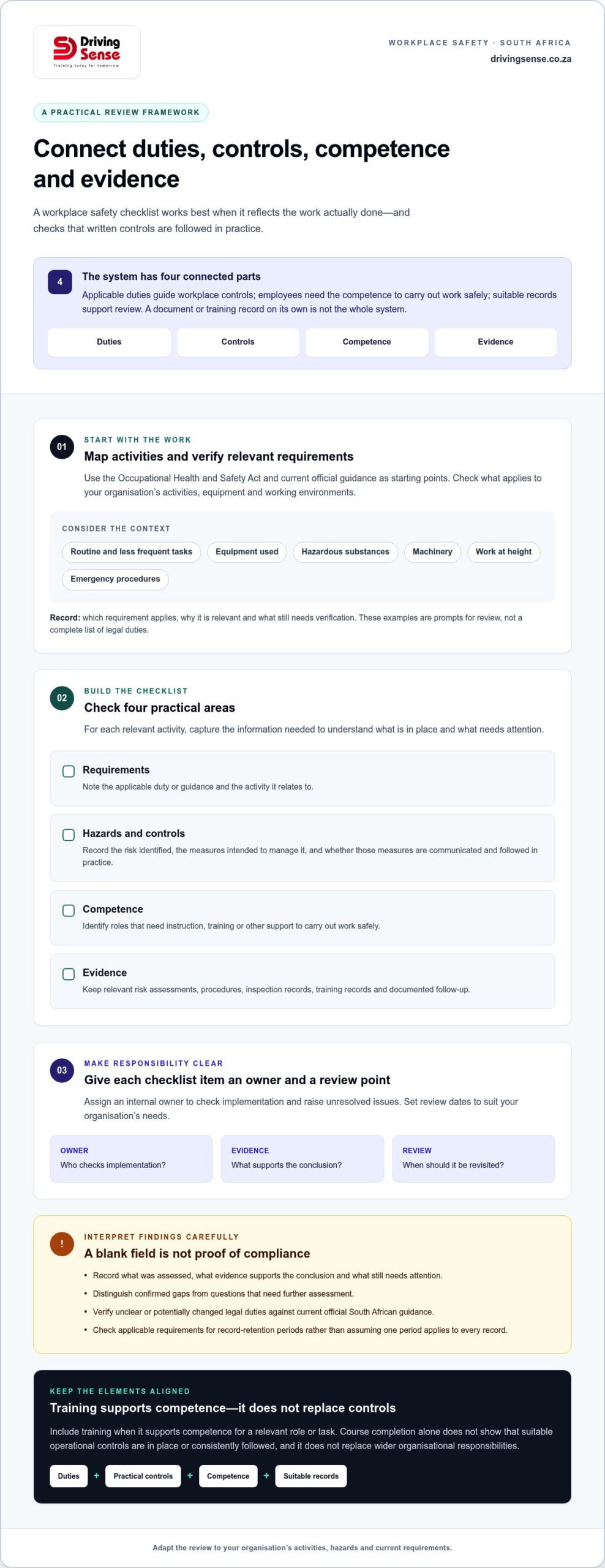
A useful checklist starts with the work your organisation actually performs, not a generic template copied from another business. For workplace safety compliance south africa, use the Occupational Health and Safety Act and current official guidance as starting points. Then identify which requirements relate to your activities, equipment and working environments. Verify detailed legal duties against current sources, as they can differ according to the work and context.
Identify applicable requirements and workplace activities
Map the activities that could affect employee or workplace safety. Include routine tasks, less frequent work and the equipment used. Consider whether employees handle hazardous substances, operate machinery, work at height or take part in emergency procedures. These examples are prompts for internal review, not a universal list of legal duties. For each relevant activity, record which requirements apply, why they’re relevant and what still needs verification.
Record hazards, controls, responsibilities and evidence
For each relevant activity, note the hazards identified, the controls intended to manage them, and how those controls are communicated and followed in practice. A checklist might include:
- Requirements: the applicable duty or guidance and the activity it relates to.
- Hazards and controls: the risk identified and the operational measures used to address it.
- Competence: the roles requiring instruction, training or other support to carry out work safely.
- Evidence: relevant risk assessments, procedures, inspection records, training records or documented follow-up.
Assign an internal owner to each item so responsibility for checking implementation and raising unresolved issues is clear. Set review dates to suit your organisation’s needs, and revisit items when work activities, equipment or relevant requirements change. Don’t treat a blank field as proof of compliance. Record what was assessed, what evidence supports the conclusion and what still needs attention. Retention periods can depend on the applicable requirement, so verify them rather than assuming one period applies to every record.
Include training in the checklist when it supports competence for a relevant role or task. Course completion alone doesn’t show that suitable controls are in place or consistently followed. For help relating training choices to workplace needs, consult the South African OHS training buying guide. Driving Sense provides nationwide statutory and legislative training to support employee competence. Explore statutory and legislative training as one part of a broader compliance approach.
Check whether controls, employee competence and records work together
A compliance review should test whether documented arrangements match what employees do in practice. Use a comparison table to connect each relevant requirement with its operational control, the competence people need and evidence that can help you assess implementation. The examples below are prompts for review, not a universal statement of legal duties or mandatory records.
| Requirement | Practical control | Competence support | Evidence to review |
|---|---|---|---|
| Managing a hazard identified in a work activity | Apply and communicate an appropriate procedure or other operational control. | Provide instruction or training relevant to the task and the people doing it. | Risk assessment, procedure, inspection notes or other records showing the control is reviewed and used. |
| Responding to a workplace fire or emergency | Maintain arrangements suited to the workplace and communicate relevant roles and actions. | Consider fire-fighting or emergency-response training for employees with relevant responsibilities. | Relevant training records, emergency procedures and documented review or practice activity. |
| Providing first-aid support in the workplace | Establish arrangements that reflect workplace needs and applicable requirements. | Consider first-aid training for employees assigned relevant responsibilities. | Records identifying trained employees, completed learning and any follow-up review. |
What training can support, and what it cannot replace
Health and safety, first-aid and fire-fighting training can help employees build knowledge and skills related to their roles and workplace risks. However, course attendance doesn’t replace appropriate equipment, procedures, supervision or other operational controls. Nor does it, on its own, establish that an organisation has met its wider responsibilities. For context when matching learning to workplace needs, see this OHS Act training guide for South African businesses.
How to review competence and supporting records
Check whether records identify the training or assessment completed and the employees involved. Compare that information with role requirements and observed work. Can employees explain and follow the relevant procedure? Are controls being used as intended? If evidence is missing, outdated or inconsistent, investigate and improve record-keeping rather than treating it as proof of a legal breach. Verify current certification and record requirements against relevant official guidance before drawing legal conclusions.
This joined-up review strengthens workplace safety compliance south africa by showing whether controls, competence and evidence support one another. Driving Sense provides nationwide statutory and legislative training to support employee competence as part of that broader process. Explore statutory and legislative training in relation to your organisation’s identified needs.
Prioritise compliance gaps and establish a review cycle
A checklist creates value when identified gaps lead to clear, documented action. For workplace safety compliance south africa, prioritise issues by considering potential workplace risk and the obligations that apply. Avoid relying on an invented scoring system or a deadline that may not fit the requirement. To maintain progress between formal reviews, record what needs attention, identify who will act and track follow-up.
- Record the gap. Describe what is missing, inconsistent or not working as intended. Note the relevant activity, control or evidence.
- Assess its relevance. Establish the workplace risk involved and whether a confirmed requirement applies. Separate verified obligations from questions that need current legal or specialist review.
- Assign an owner. Identify the internal role or person responsible for coordinating the response and keeping the item visible.
- Agree and take action. Document the next step, such as clarifying a procedure, addressing a control issue or identifying a role-specific training need.
- Document follow-up. Record what was done and whether it addressed the gap. Keep unresolved or newly identified issues open for further action.
How to act on a gap without making unsupported assumptions
Use evidence to distinguish an implementation problem from an uncertain legal interpretation. If an obligation is unclear or may have changed, record the question and verify it against current official guidance or obtain appropriate specialist advice before treating it as a confirmed breach. Assign an internal owner and document the decision and action agreed. Escalate significant safety concerns through the organisation’s established processes so they receive attention at the appropriate level.
When to revisit the workplace safety checklist
Review relevant items when work activities, equipment, people or applicable requirements change. Incident findings, recurring control issues, new training needs, or incomplete and inconsistent records can also signal that a checklist entry needs attention. These are prompts for a proportionate review, not automatic proof of non-compliance. Set review dates internally to support accountability, but don’t assume one interval applies where requirements may differ.
Keep the cycle active by linking each action to an owner and recorded follow-up, then update the checklist as the workplace changes. If a review identifies a competence gap, relevant statutory and legislative training can support employees’ skills as part of the wider response. Explore statutory and legislative training to support workplace learning needs.
Use relevant statutory and legislative training to strengthen compliance
Training needs should follow from the organisation’s identified duties, work activities and competence gaps, rather than from a general course list. Review which roles carry safety responsibilities, what tasks employees perform and where the checklist shows that knowledge or practical skills may need support. This makes training part of a considered response to workplace safety compliance south africa and keeps it connected to the organisation’s actual operations. For role-specific learning across transport operations, see transport compliance training in South Africa.
Select training that reflects workplace roles and activities
Match learning to the risks and responsibilities identified in your review. Health and safety training may support employees who need to understand workplace procedures. First-aid training may be relevant to designated first-aid responsibilities, while fire-fighting training may suit roles connected to workplace fire response. These are examples, not a universal prescription. Align the training plan with role requirements and observed competence needs. Before making legal decisions, verify current qualification, certification and accreditation requirements against applicable guidance.
Driving Sense provides statutory and legislative training nationwide across South Africa, including health and safety, first-aid and fire-fighting training. Founded in 2006, the organisation focuses on training that supports compliance and genuine skill development. Training can help employees build relevant competence, but attendance alone doesn’t establish that suitable procedures, supervision and operational controls are in place or that wider compliance responsibilities have been met.
Turn the checklist into a practical training plan
Translate review findings into a simple plan that identifies the competence need, the roles or employees involved, the action owner and the evidence the organisation will maintain. For example, if the review identifies that employees assigned an emergency role need additional knowledge, record the training need, who is responsible for arranging and tracking it, and what records will show participation or assessment. Then consider whether workplace practice reflects the learning and whether operational arrangements also need attention.
Keep the plan connected to the wider compliance system. Training supports capability, while procedures, risk controls, supervision and appropriate records support safe implementation. Revisit the plan when roles, activities or relevant requirements change, and verify any legal training or record obligations against current official guidance.
Driving Sense supports organisations seeking statutory and legislative training as part of a structured workplace safety approach. To discuss training in relation to your organisation’s identified needs, Discuss workplace safety training with Driving Sense.
Put your workplace safety checklist into action
Effective workplace safety compliance south africa depends on aligning applicable requirements with everyday controls, employee competence and reliable evidence. A practical checklist helps your organisation identify what applies to its activities, distinguish confirmed gaps from questions needing verification, and assign clear responsibility for follow-up.
Keep the process active. Prioritise actions according to workplace risks and relevant obligations, then revisit the checklist as work, equipment, roles or requirements change. Where your review identifies a competence need, relevant statutory and legislative training can support employees, while procedures and operational controls remain essential parts of the wider system.
Driving Sense provides training nationwide across South Africa and is a 100 % B‑BBEE, Level Four contributor. If training is one of your organisation’s next steps, discuss workplace safety training with Driving Sense. Use your checklist to set clear priorities, assign ownership and follow actions through.
Frequently Asked Questions
What does workplace safety compliance mean in South Africa?
It means identifying the health and safety requirements relevant to an organisation and managing them through workplace practice, suitable controls, employee competence and appropriate records. The Occupational Health and Safety Act is a central reference point, but obligations can depend on the organisation’s work, activities and applicable requirements. A policy, completed course or audit may support compliance, but none alone demonstrates that the whole system is being implemented effectively.
Is workplace safety training enough to achieve compliance?
No. Training can help employees develop knowledge and skills relevant to their roles, but it doesn’t replace suitable operational controls, procedures or supervision. Employees may need first-aid or fire-fighting training for their responsibilities, while the organisation also maintains appropriate workplace arrangements and checks that they’re followed. Select learning based on identified role and risk needs, and treat it as one part of the wider compliance system.
How can a business check its workplace safety compliance?
Start by identifying applicable requirements and work activities, then review hazards, controls, employee competence and supporting evidence. Compare what procedures and records say with what employees do in practice, and note gaps or questions requiring further verification. Assign an internal owner to each action and document follow-up. A workplace safety compliance south africa checklist can structure this review, but it shouldn’t be treated as a universal legal checklist for every organisation.
Who is responsible for workplace safety compliance in a South African business?
Responsibility should be managed across the organisation. Business leadership oversees accountability and appropriate resources, managers implement relevant arrangements in operations, and employees follow applicable procedures and report concerns. Assigning a safety role can help coordinate activities, but responsibilities should be clear at every relevant level. Identify who owns each checklist item, who must act on findings and how significant safety concerns are escalated through the organisation’s established processes.
What records should an organisation review for workplace safety compliance?
Review records relevant to your activities and applicable requirements. These may include risk assessments, procedures, inspection records, training or assessment details, incident information and documented follow-up. Check whether records identify the work or issue involved, the people or roles concerned and the action taken. Missing or inconsistent evidence signals a need to investigate or improve record-keeping, but doesn’t by itself prove a legal breach. Verify applicable retention requirements.
When should a workplace safety compliance checklist be updated?
Revisit it when work activities, equipment, roles or applicable requirements change. Incident findings, observed control problems, newly identified training needs and gaps in supporting records can also prompt a review. Set review dates internally to maintain accountability, but don’t assume one interval applies to every workplace or requirement. Update relevant checklist items, record decisions and actions, and verify current official guidance where a legal requirement may have changed.
Does QCTO accreditation apply to every workplace safety course?
No. QCTO accreditation relates to occupational and trades-related qualifications, so it shouldn’t be assumed to apply identically to every workplace safety course. The relevant qualification, course purpose and current regulatory requirements matter. Before specifying an accreditation or certification requirement in a training plan, verify it against current official guidance for that course or qualification. Don’t infer a provider’s accreditation status simply because a course relates to workplace safety.

Pingback: OHS Act Training: Guide for South African Businesses – Driving Sense