

Driver retention depends on the everyday employment experience, not pay alone. Creating an effective driver retention strategy means understanding why drivers leave and addressing the factors that shape whether they feel supported and valued, including career development, compensation, flexibility and management practices.
For South African employers, turnover can disrupt operations and put extra pressure on recruitment, productivity and team morale. Identify concerns early and address their underlying causes rather than relying on a single retention measure.
This article explains how to assess turnover, clarify growth opportunities, review pay and working arrangements, and equip managers to support their teams. It also looks at how training can contribute to development, helping organisations take a balanced, sustainable approach to retaining experienced drivers.
Key Takeaways
- Use exit and stay conversations to identify why drivers leave and address recurring concerns through clear follow-up.
- Make development more visible by discussing career goals and connecting drivers with relevant training and internal opportunities.
- Review pay and benefits fairly against relevant industry standards, and ensure the overall package reflects the demands of the role.
- Consider how scheduling flexibility and respect for personal time can support work-life balance and reduce avoidable pressure.
- Equip managers to communicate consistently, recognise contributions and resolve concerns early, building trust through their everyday actions.
1. What are the main causes of employee turnover?
Drivers may leave because of poor management, limited career growth, low pay, burnout, inflexible schedules or feeling undervalued. These causes can overlap: unpredictable rosters may affect wellbeing, while unresolved concerns weaken engagement and trust. A poor onboarding process can also leave new drivers feeling confused or unsupported. One study found a third of new drivers quit within 90 days; another reported that 22% leave within six months. For employers creating an effective driver retention strategy, early feedback can reveal which issues require attention.
Turnover also carries operational consequences. Replacing an employee is estimated to cost 50% to 200% of their annual salary, depending on role complexity. Departures can remove practical knowledge, reduce productivity and place pressure on remaining staff. In South Africa, losing key employees can leave talent gaps that constrain growth and competitiveness. Retaining experienced drivers helps preserve operational knowledge and workforce stability, especially where consistent service depends on employees who understand established processes.
South African truck drivers’ hours, wages and working conditions are regulated by applicable labour and transport legislation. The relevant requirements depend on the employment arrangement and the duties involved, so employers need to consider hours, pay and working conditions within their applicable legal framework. To measure retention, subtract new hires during a period from the number of employees at its end, divide by the number present at the start, then multiply by 100. Track the result quarterly and record departures separately to identify patterns.
Regular conversations help managers understand patterns before they lead to resignations. In one-to-one meetings, ask drivers what helps them do their work, what causes frustration and what might prompt them to leave. Stay interviews explore why employees remain and what could change that; exit interviews record their stated reasons for leaving. Compare feedback across teams and roles, then explain what action will follow, even if immediate changes are not possible. Following up shows employees their contributions are taken seriously.
Employee wellbeing also affects whether drivers can sustain their work. Review workload pressures, access to support and whether schedules leave room for personal responsibilities. Employee Wellness initiatives can contribute to a broader wellbeing approach, alongside realistic workload planning and timely follow-up from managers. Recognition matters too: specific thanks for safe practices, reliable teamwork or helpful contributions make expectations clear and acknowledge effort.
Fleet safety and recognition programmes can bring together clear safety communication, relevant training, regular feedback and recognition for demonstrated contributions. For example, a manager can discuss safe work practices during a check-in, identify a development need and acknowledge a practical improvement. Recognition should be timely and consistent, not limited to occasional awards. Creating an effective driver retention strategy means using evidence, two-way communication and wellbeing measures to strengthen engagement and workforce continuity.
2. Career development and internal mobility
Drivers are more likely to see a future with an employer when development has a practical purpose. A career conversation can identify the skills a driver wants to build, the responsibilities they hope to take on and the opportunities available within the organisation. A driver interested in supporting colleagues, for example, could develop mentoring skills, while someone seeking broader responsibilities might progress towards coordinating routes or supporting safety processes.
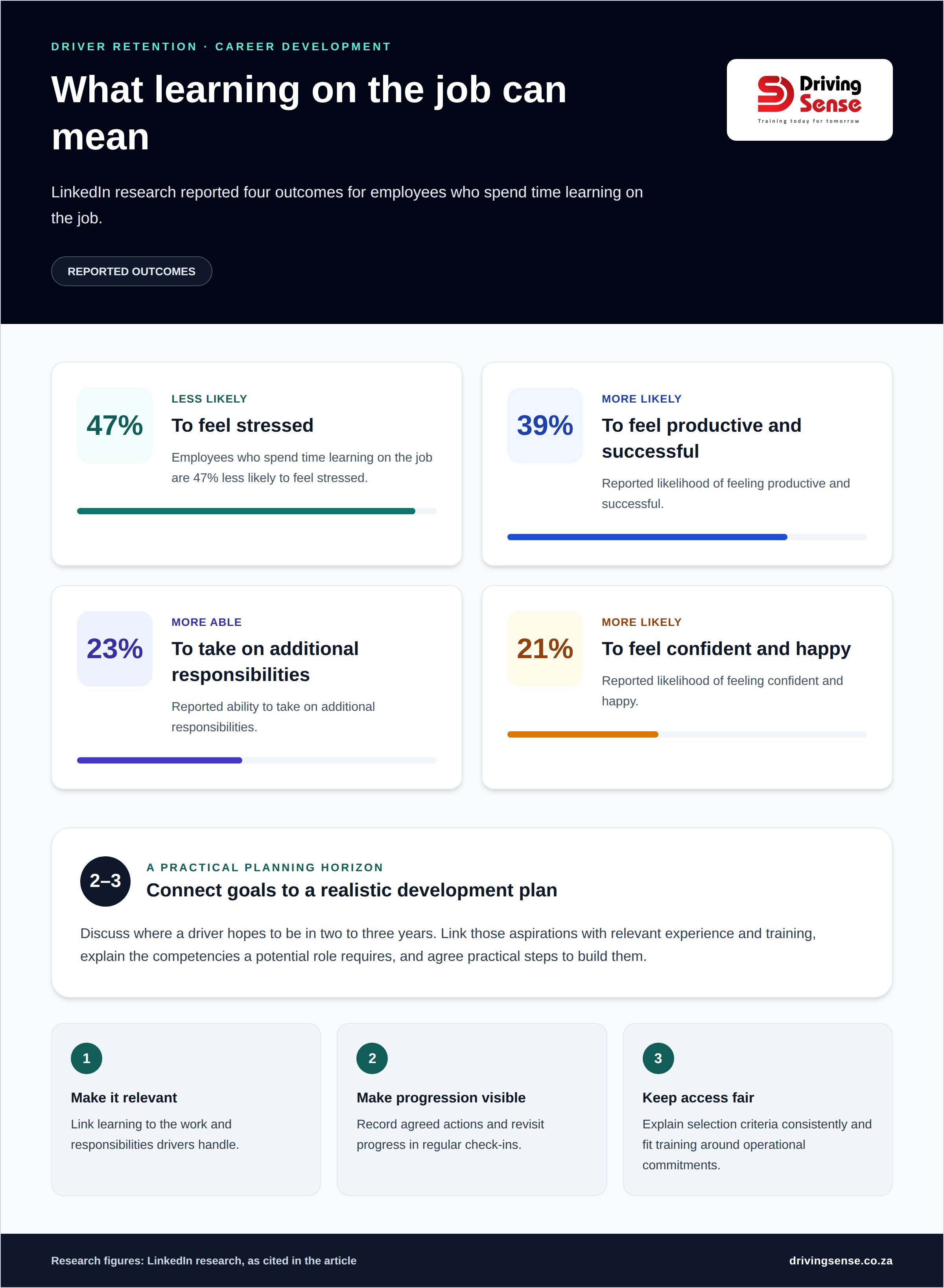
Make progression visible rather than leaving it as an informal promise. Managers can discuss longer-term goals, record agreed development actions and revisit progress in regular check-ins. Plans based on where an employee hopes to be in two to three years can connect their aspirations with relevant experience and training. Keep the discussion realistic: explain the competencies required for a potential role and identify practical steps to develop them.
Learning should link directly to the work and responsibilities drivers handle. Role-specific training, workshops, mentoring and opportunities to learn alongside experienced colleagues can strengthen skills whilst showing that development is part of the employment relationship. LinkedIn research found that employees who spend time learning on the job are 47% less likely to feel stressed and 39% more likely to feel productive and successful. It also found they are 23% more able to take on additional responsibilities and 21% more likely to feel confident and happy.
Internal mobility lets employees apply their experience in different roles, departments or projects without leaving the organisation to progress. A driver with strong communication skills, for instance, might help mentor new starters or contribute to a safety improvement project. Managers can identify suitable opportunities through performance discussions and recorded development goals. Explain selection criteria consistently so access does not depend on informal relationships.
Development also needs to fit the realities of the role. For drivers working shifts or changing routes, explain training arrangements clearly and discuss how participation can fit around operational commitments. Flexible work arrangements may help where the role permits, but development plans should not suggest that every position offers the same flexibility. Fair access, relevant content and follow-through matter more than a long list of courses.
Review each plan by asking whether the employee has gained a skill, used it in practice or taken on an agreed responsibility. If progress stalls, identify the barrier, such as scheduling, unclear expectations or a lack of coaching, then adjust the next step. Where wellbeing affects an employee’s ability to engage with development, Employee Wellness support can form part of a broader approach to sustainable growth. Consistent development conversations help make career opportunities tangible and support longer-term employee retention.
3. Competitive compensation and benefits
Drivers assess compensation by more than basic salary; the whole package shapes its practical value. Review pay alongside benefits, incentives and the working conditions attached to the role. Two positions with similar salaries, for example, may differ in roster demands, responsibilities or access to paid time off. Comparing these factors helps employers assess whether the offer reflects the work drivers actually do, rather than focusing on a headline figure.
Benchmark salaries against relevant industry standards, then review each role’s scope and requirements. Compare responsibilities, experience expectations and the demands of different assignments, and document the criteria used. This provides a more consistent basis for decisions than informal comparisons between employees. Where pay differs, managers should be able to explain the reasons, such as role requirements or added responsibilities, through a transparent process that supports equitable compensation.
Benefits can also influence whether a package meets employees’ needs. Depending on the organisation’s arrangements, benefits may include health insurance, retirement plans and paid time off. Assess each element alongside employees’ circumstances and the demands of their roles. Paid time off, for instance, may matter especially to employees balancing work with family responsibilities, while a retirement plan can contribute to longer-term financial planning.
Incentives should have defined criteria and a clear link to individual or team achievements. A team reward could recognise reliable collaboration, while an individual incentive might reflect agreed performance measures. Explain how eligibility is assessed, when results are reviewed and how employees can track their progress. Avoid criteria that reward output alone if they could undermine safe, sustainable work. Consistent criteria help employees understand how contributions relate to recognition and reward.
Review compensation packages regularly against industry standards as roles and labour-market conditions change. A structured review can consider salary, benefits, workload, responsibilities and employee feedback together. If recruitment is difficult or experienced drivers are leaving, assess whether compensation is contributing before changing individual elements. This helps distinguish pay concerns from scheduling, management or development issues, so resources address the underlying cause rather than a perceived symptom.
Communicate changes in plain language. Give employees a summary of the package, eligibility requirements, incentive criteria and how to raise questions. Managers should explain these consistently across teams, particularly when roles have different responsibilities or schedules. A documented review process supports fair, reasoned decisions and builds confidence in the employment environment. For South African employers, compensation works best as part of a balanced approach to productivity and work-life balance, not as a substitute for sound management.
4. Flexible work arrangements and work-life balance
For drivers, flexibility usually means workable scheduling rather than remote work. Review route assignments, shift patterns and how much notice employees receive of rosters to identify avoidable pressure. Sharing schedules early, for example, can help drivers plan family responsibilities and rest. A consistent process for requesting adjustments also gives managers a fair basis for decisions, instead of relying on informal arrangements that vary between teams.
Hybrid work may suit some transport roles, but driving duties must be carried out on site or on the road. Where responsibilities include administration, planning or training, employers can assess whether some tasks can be done remotely. Define which duties can be performed elsewhere, how communication will work and how operational coverage will be maintained. This role-based approach avoids presenting hybrid work as an option for every driver.
Flexible policies need clear expectations. Explain how employees request shift changes, how managers assess operational requirements and how approved adjustments are communicated. A driver seeking a roster change, for instance, should follow the same documented process as colleagues. Managers should record agreed arrangements and review them when routes or team requirements change, keeping flexibility transparent and avoiding uncertainty for others.
Work-life balance also depends on respecting personal time. Review how late schedule changes, additional duties and contact on rest days affect employees. If a delivery delay requires a change, communicate the reason, revised expectations and any relevant support promptly. Practical boundaries help managers prevent routine work pressures from spilling into personal time while preserving the operational knowledge needed to plan routes effectively.
Consider pay, rewards and flexibility together. A reward may recognise reliable performance, but it should not encourage drivers to accept unsustainable schedules or compromise safe working practices. Explain incentive criteria and make sure roster decisions follow consistent principles. When employees understand how pay, recognition and scheduling decisions are made, they can assess the full employment offer more accurately.
Onboarding is an early opportunity to clarify these arrangements. Explain roster processes, how to raise scheduling concerns and what flexibility applies to the specific role. A new driver, for example, should know whom to contact about a change and how the decision will be communicated. Managers can check that expectations are clear during later conversations and use feedback to improve the process where practical difficulties emerge.
Review flexible working practices alongside employee feedback and operational outcomes. If repeated requests point to a roster problem, assess whether route planning or shift allocation can be adjusted. If a change is not possible, explain the operational reason and consider other workable options. This structured approach links flexibility to workforce needs, maintains consistent expectations and supports a sustainable balance between employees’ lives and business requirements.
5. How do you build manager capability to support retention?
Retention policies become credible when managers apply them consistently in daily decisions. A company may promise fair scheduling, development opportunities and prompt support, but employees judge those commitments by their manager’s actions. Set clear expectations for roster changes, feedback and problem-solving, then explain how managers should apply them. A shared process for handling shift requests, for example, can reduce inconsistent decisions between teams.
Managers also shape how employees experience the working environment. A 25-year Gallup study found that management actions and behaviours are linked to about 50-70% of an employee’s perception of their work environment. This makes leadership practice a practical retention priority, not simply a matter of policy. Training can help managers communicate expectations, give useful feedback, resolve conflict and motivate teams without relying on inconsistent personal styles.
Regular conversations give managers a chance to notice concerns before they escalate. One-to-one check-ins can cover workload, working relationships, progress and support needs. Stay interviews focus on what employees value and what might prompt them to leave. Managers should listen without becoming defensive, agree on practical next steps and follow up. A conversation that leads to no response can weaken trust instead of strengthening it.
Develop these skills through applied learning. Managers can practise listening, giving clear feedback and handling difficult conversations using realistic workplace scenarios. For instance, when a driver raises a recurring scheduling issue, the manager needs to understand its impact, explain operational constraints and agree on an appropriate next step. Mentoring and peer discussions can reinforce these practices, especially for newer supervisors learning to lead experienced employees.
Align company policy with the authority managers actually have. If a policy allows flexibility but supervisors cannot approve a change, explain the escalation route and decision criteria. Give managers clear guidance on when they can act, when approval is needed and how to communicate the outcome. This helps close the gap between written commitments and employees’ experience while keeping operational requirements in view.
Give line managers the time and support to act on feedback. Provide relevant training, guidance on wellbeing concerns and a clear route for escalating issues they cannot resolve. If an employee needs additional support, managers should respond respectfully and follow the organisation’s established process. Senior leaders can reinforce accountability by reviewing recurring concerns and whether agreed actions were completed, rather than judging managers only by recruitment or operational targets.
Strong manager relationships develop through consistent actions: listening, explaining decisions and honouring commitments. To support consistent expectations and practical capability development, explore professional Driver Training as part of a broader approach to workforce development.
Driving Sense: Driver Training
Driving Sense provides Driver Training for organisations that want to strengthen driver capability as part of workforce development. When feedback identifies a need for clearer expectations, role-related skills or ongoing learning, relevant training can complement a broader retention approach. This helps employers connect development with the demands of drivers’ work, rather than treating training as a standalone intervention.
Driver Training can complement career conversations, supportive management and fair working practices. For roles with specific compliance or transport requirements, Compliance Training and Dangerous Goods training may also meet development needs. Training is most useful when its purpose is clear and managers reinforce learning in daily practice.
If driver development is part of your retention planning, contact Driving Sense to discuss Driver Training.
Put a practical retention plan into action
Turn priorities into a managed process by assigning responsibility, setting review points and recording what changes after employee feedback. Creating an effective driver retention strategy is ongoing work: operational demands, workforce needs and individual circumstances can shift, so regular review keeps decisions relevant. Start with one clearly defined improvement, assign an owner and explain how its impact will be assessed. This gives managers a practical path from policy to consistent action.
Training can support this work by strengthening role-related skills and helping employees apply expectations in practice. Organisations can consider Driving Sense’s Driver Training, Emergency Safety Training and Compliance Training as part of workforce development and operational planning.
Contact Driving Sense to discuss training for your organisation and identify a suitable next step. With clear ownership and sustained attention to employee experience, your organisation can build a more stable foundation for its drivers and its operations.
Frequently Asked Questions
What role do managers play in employee retention?
Managers influence retention through the everyday decisions employees experience directly. A manager who explains a route change, applies policies consistently and follows up on unresolved concerns makes workplace expectations more dependable. If a driver raises an issue about handover arrangements, for example, the manager can document it, agree on an action and report back. This follow-through helps employees judge whether the organisation’s stated commitments are reflected in daily practice.
How do you build an effective retention strategy?
Build the strategy around a defined workforce issue, an accountable owner and a way to review progress. Start by examining departure records and employee feedback, then identify a concern that matters to operations and is within the organisation’s control. Set an action, such as improving handovers for new starters, and decide how managers will monitor implementation. Review the evidence regularly, adjust the response if conditions change and communicate decisions to affected employees.
What are the main causes of employee turnover?
Employees may leave when the work experience does not meet their needs or expectations. A driver might value predictable communication but face repeated uncertainty about assignments, while another may see no opportunity to develop new skills. Reasons can vary between teams, so do not treat every resignation as evidence of the same problem. Consider the employee’s role, tenure, manager and stated reasons, then look for recurring patterns across departures.
How do you build manager capability to support retention?
Develop managers with practical guidance, coaching and opportunities to practise workplace conversations. Training can use scenarios such as responding to a driver who reports conflict with a colleague or uncertainty about performance expectations. Managers should learn to listen, clarify the issue, explain what they can do and refer concerns through the appropriate internal process. Senior leaders can reinforce these skills by discussing difficult cases with managers and reviewing whether agreed follow-up took place.
How do you identify retention risks before people leave?
Look for changes in workplace feedback, participation and employee behaviour rather than waiting for a resignation. A driver who stops raising concerns, withdraws from team discussions or repeatedly reports the same unresolved obstacle may benefit from a private check-in. These signs prompt a respectful conversation; they do not prove someone intends to leave. Managers can record themes without making assumptions, agree on support and revisit the matter in a later check-in.
How do you prove ROI on retention initiatives?
Assess whether an initiative’s measurable benefits justify its implementation costs. Establish a baseline before making a change, then compare relevant recruitment and onboarding expenditure, vacancy disruption and retention outcomes over a consistent period. For example, review whether a revised induction process is followed by fewer early departures and less repeat recruitment. Interpret results in context, since changes in workload or staffing needs can also affect outcomes.
Should retention strategies focus on engagement or wellbeing?
Address both, because engagement and wellbeing describe different aspects of the employee experience. Engagement concerns an employee’s connection with their work and organisation, while wellbeing includes whether working conditions support health and sustainable performance. A driver, for instance, may feel committed to the team but struggle with an unmanageable workload. Consider feedback and operational indicators together, then choose measures that address the identified issue rather than treating either area as a substitute for the other.
What’s the difference between retention tactics and a retention strategy?
A tactic is an individual action, such as introducing mentoring or changing how shift requests are handled. A strategy connects selected actions to an identified retention risk, assigns responsibility and sets a method for reviewing results. If departure feedback points to weak onboarding, mentoring could be one tactic in a broader plan covering role expectations, colleague support and manager check-ins. The strategy provides direction; tactics are the practical measures used to carry it out.
