

A useful workplace wellness programme starts with the pressures employees actually face, not a calendar of disconnected activities. For employers exploring workplace wellness programs south africa, health screenings may address a specific need, but they do not automatically cover workplace safety, skills or organisational priorities.
To plan support that is practical and relevant, first identify employee needs and organisational priorities. Then decide which activities address them and how you will coordinate and review those activities. This makes it easier to avoid a generic programme that is difficult to explain or assess.
This guide outlines common workplace wellness approaches and components, then offers a practical planning framework. It also explains how employee support can sit alongside workplace training, including health and safety, first aid and fire-fighting training. For organisations operating across South Africa, considering these needs together can support more coherent planning.
Key Takeaways
- Consider employee and organisational needs beyond health screenings or one-off activities.
- Compare focused screening, integrated wellbeing and workplace training by the need each is intended to address.
- Use workforce feedback and existing organisational information to set priorities, plan support, communicate its purpose and review relevance.
- Workplace wellness programs south africa can connect employee support with practical workplace skills and safety training.
- Driving Sense provides Employee Wellness alongside Health and Safety training, First Aid Training and Fire Fighting training nationwide. Driving Sense is a 100 % B‑BBEE, Level Four contributor.
What workplace wellness programmes in South Africa are designed to address
A workplace wellness programme is a planned set of activities or practices intended to respond to employee and organisational needs. Rather than treating a screening or event as a complete solution, employers can consider how employee support relates to work conditions, safety and skills. This broader view gives organisations exploring workplace wellness programs south africa a way to consider individual needs alongside the setting in which people work.
A practical definition is a coordinated approach to employee support that considers people’s needs and the workplace conditions that shape their working lives. The right mix depends on the workforce, job demands and organisational context, rather than a standard package applied unchanged everywhere. This overview of workplace wellness programmes also illustrates the range of approaches that may fall under the term.
Which workplace needs can a wellness programme address?
Some priorities concern individual wellbeing, such as providing relevant health awareness or explaining available support. Others relate to workplace systems and operational conditions, including safety practices, role-specific skills and how work is organised. These needs can overlap, but they are not interchangeable. Awareness activities do not replace relevant safety training, and training alone may not meet every employee support need.
For example, driving, loading or work at height may involve different safety and skills considerations from office-based work. Treat these as areas to assess, not assumptions about every employee. Reviewing actual tasks alongside workforce feedback can help distinguish the support employees need from changes to systems or work conditions. Employers assessing these priorities for professional drivers can also consult this guide to driver wellness programs for corporate teams.
Why should employers treat wellness as an organisational priority?
Employee wellbeing is connected to the environment in which people work. Considering expectations, safety practices and support together can help an organisation plan a more coherent approach. This is a planning aim, not a guaranteed outcome: the value of activities depends on whether they address relevant needs and are coordinated appropriately.
A clear purpose gives employees and managers a shared understanding of what the programme is intended to address. It also helps decision-makers separate immediate priorities from issues to consider later, and connect employee support with operational requirements without treating wellness as a substitute for sound workplace systems.
Across South Africa, priorities can differ by role, site and working arrangement. Start with the workforce and its context rather than assuming one set of activities will suit everyone. For employers using workplace wellness programs south africa as a planning framework, this means defining the need, explaining why it matters and selecting support accordingly.
How workplace wellness programmes work: components, coordination and scope
A programme is a coordinated set of activities with a defined purpose, not a screening day expected to address every concern. Its components should follow the needs identified and the organisation’s working context. For instance, a transport workforce may include employees with different duties and safety responsibilities, so the same activity may not be equally relevant to everyone. The Workplace Wellness Association of South Africa (WWASA) offers a local point of reference for employers considering workplace wellness practice.
Coordination makes it easier to explain why activities are included, who they are intended to support and how they relate to one another. Depending on identified priorities, possible components include:
- Awareness: Information that helps employees understand relevant health or wellbeing topics.
- Health support: Activities focused on employee health needs, with scope set by the organisation.
- Safety learning: Relevant instruction that builds practical workplace knowledge.
- Workplace practice: Reviewing how work is organised or communicated when these practices affect employee experience.
These components serve different purposes. A programme need not include every type of activity. Instead, make the link between identified needs and planned support clear. That is particularly useful when workforce roles and operating arrangements differ between organisations.
How do employers coordinate wellness activities?
Agree the programme’s purpose and assign responsibility for planning, communication and review. This helps prevent activities becoming disconnected initiatives without a shared rationale. Explain what each activity addresses, who it is for and why it may be relevant. Keep messages consistent across teams and sites, adapting them to different work contexts when needed.
Where do workplace training and safety fit?
Training can be one part of a broader programme when it addresses a practical skills or safety priority. Health and Safety training, First Aid Training and Fire Fighting training can build relevant workplace knowledge. They are distinct from health awareness and other employee support activities. Map training to relevant roles and needs, then coordinate it with other programme elements without treating one intervention as a replacement for another.
For organisations considering how employee support and workplace skills fit together, Driving Sense’s Employee Wellness and workplace training can form part of the planning process.
Comparing workplace wellness approaches: screenings, integrated support and training
No single model suits every organisation. Focused screening, broader wellbeing support and workplace training serve different purposes. Compare them by asking which identified need each approach addresses, who it is intended for and what planning it requires. The table summarises typical distinctions to help employers consider organisational fit, rather than rank approaches or assume one will deliver better results.
| Approach | Primary purpose and likely scope | Organisational fit | Planning considerations |
|---|---|---|---|
| Focused screening | Draw attention to a defined health or awareness priority through screening, education or related activities. | May fit an organisation seeking to address a specific, clearly identified topic. | Set the purpose and explain the activity’s scope. Screening is a focused intervention, not a complete assessment of workplace wellbeing. |
| Integrated wellbeing | Bring several forms of employee support into a broader occupational health and wellbeing offer. | May suit organisations whose priorities extend across more than one area of employee wellbeing or workplace support. | Define which needs are in scope, how support relates to organisational priorities and how activities will be coordinated. |
| Workplace training | Build practical knowledge and skills relevant to workplace tasks and safety priorities. | May be appropriate where role-related learning needs or safety requirements have been identified. | Connect the training subject to relevant tasks and roles, and distinguish learning objectives from other forms of wellness support. |
These approaches need not compete. An organisation might use a focused activity for a defined awareness priority, broader support for wider employee needs and training where practical knowledge is relevant. Make the combination deliberate: each component needs a clear rationale, and adding activities without establishing their purpose can make coordination harder. When assessing workplace wellness programs south africa, match the scope to the need rather than assembling as many interventions as possible.
When might a focused health-awareness approach be relevant?
CANSA’s workplace model, which combines cancer screening and education, illustrates a focused approach centred on a defined health-awareness priority. Such an activity may be relevant when an employer has identified that topic as important and can explain its purpose. Screening alone does not address every wellbeing, safety or workplace practice concern, so it should not replace broader planning where other needs have been identified.
When might integrated support or training be more relevant?
Momentum Corporate presents a broader occupational health and wellbeing offer, which may be relevant when an organisation is considering several related support needs. Training serves a different function: health and safety, first aid or fire-fighting training can address practical workplace knowledge and safety priorities. These elements may complement broader support, but they are not interchangeable. Keep qualification-framework and accreditation considerations distinct from general wellness planning.
How to plan a workplace wellness programme in South Africa
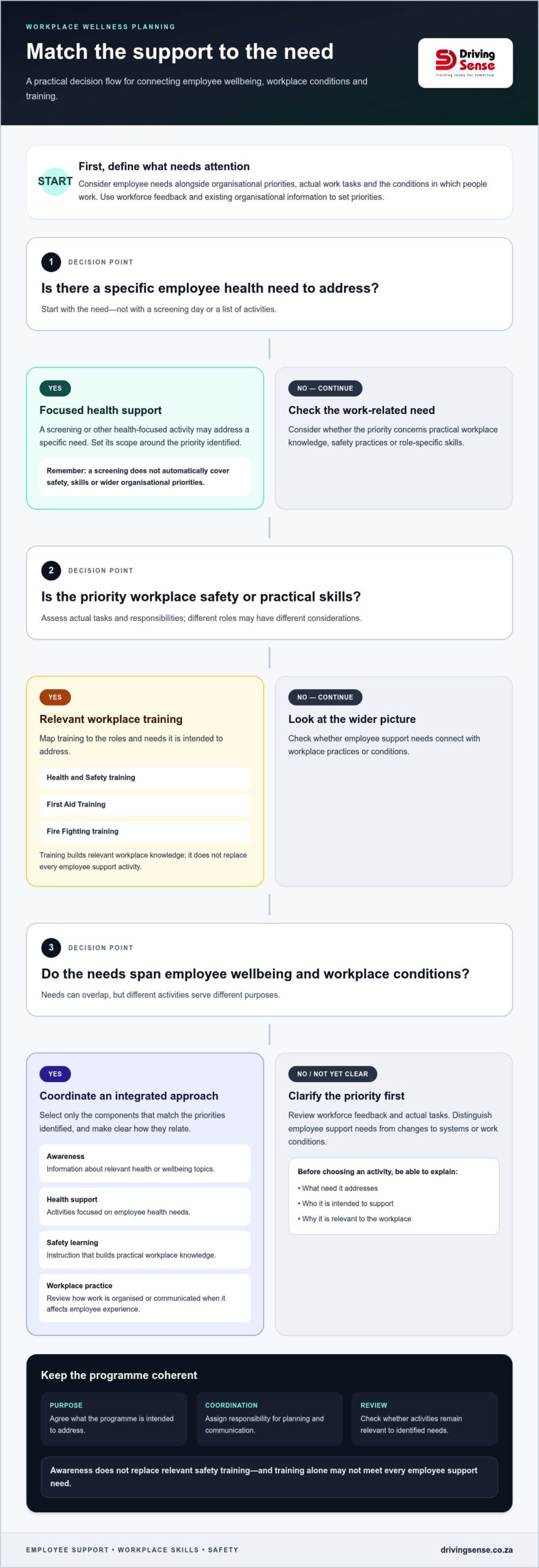
A useful planning process starts with the workforce and the work itself, then connects identified needs to proportionate action. For employers considering workplace wellness programs south africa, the aim is not to adopt a fixed package. It is to establish what matters in the organisation, what support is appropriate and how its relevance will be reviewed.
A needs-led programme listens to employees, assesses workplace priorities, plans proportionate support, communicates its purpose and reviews whether activities remain relevant. Use this sequence to turn that principle into a workable plan:
- Understand the context. Consider workforce roles, workplace conditions and stated wellbeing concerns. Invite employee feedback and use existing organisational information to clarify needs. Do not assume every team or site has the same experience.
- Separate priorities. Distinguish immediate safety requirements from broader wellbeing opportunities. This keeps essential safety matters from being treated as optional wellness activities, while allowing other needs to be considered according to relevance and urgency.
- Set objectives. Describe the support the programme intends to provide. For example, an objective might focus on access to relevant health awareness or a specific workplace skills need. State the planned activity or support, not a promised health, attendance or productivity outcome.
- Plan proportionate action. Match activities to the priority, workforce and organisational capacity. Decide who will coordinate each action, what information employees need and how activities fit alongside existing workplace responsibilities.
- Communicate and review. Explain the programme’s purpose and how activities relate to identified needs. Review whether planned actions took place and whether employees and the organisation still consider them relevant.
How should employers identify priorities and set objectives?
Start with the work: consider employees’ roles, working conditions and concerns identified by the organisation. Compare these with workforce feedback to distinguish a shared issue from a need affecting particular roles or teams. Set objectives that describe the support to be planned. Keep immediate safety requirements separate from broader wellbeing opportunities so priorities remain clear.
How can employers review programme relevance over time?
Choose indicators that relate directly to the objectives and are proportionate to the programme’s scope. Depending on the activity, employers might review whether planned activities were completed, participation levels or employee feedback. These measures can inform decisions about relevance and future planning, but should not be presented as proof of a guaranteed outcome or compared with unsupported benchmarks.
Reviewing the programme also provides an opportunity to adjust its scope. If feedback or organisational circumstances change, consider whether the original priorities still apply, communication needs improvement or a different kind of support is more relevant. Keeping the rationale, planned activity and review measure connected makes the process easier to understand and manage.
To align employee wellness planning with practical workplace training, explore Driving Sense’s workplace wellness and training support.
How Driving Sense supports workplace wellness and training nationwide
For employers, a workplace wellness approach is most useful when it reflects the organisation’s actual priorities. Driving Sense provides Employee Wellness alongside workplace training services, giving organisations a way to consider employee support and relevant skills development in the same planning process. This can help employers account for roles with different responsibilities and training needs.
For organisations reviewing workplace wellness programs south africa, this approach connects employee needs with operational context without treating every concern as a training issue or every training need as a wellness intervention. The appropriate scope depends on what the organisation has identified and the support it intends to plan.
Connecting employee wellness with practical workplace training
Employers can first distinguish priorities relating to employee support from those requiring practical workplace learning. Driving Sense provides occupational training and assessments, statutory and legislative training, and health and safety training. First Aid Training and Fire Fighting are also available for organisations considering workplace safety skills.
These services can be considered alongside wellness priorities, but they serve distinct purposes. Training addresses relevant knowledge and skills, while Employee Wellness relates to employee support. Keeping these purposes clear helps organisations plan coherently without assuming that one combination or delivery arrangement fits every workplace.
A nationwide partner for organisational training needs
Driving Sense serves organisations nationwide in South Africa, including employers whose operations span different locations and workforce contexts. The company was founded in 2006. Natalie Rodrigues brings 11 years of experience at Super Group’s Truck Rental Division, giving her relevant transport-sector experience. Driving Sense is a 100 % B‑BBEE, Level Four contributor.
Employers can use the planning framework in this guide to define priorities, distinguish employee support from skills requirements and identify relevant services. Driving Sense’s Employee Wellness and workplace training can then be considered against those needs rather than selected as a generic package or assumed to produce a particular outcome.
Explore Driving Sense’s Employee Wellness, occupational training and health and safety training to find support relevant to your organisation’s wellness and training priorities.
Make your next wellness priority actionable
Move from general intention to a defined organisational priority. Identify an area where employee support, workplace practice or relevant training deserves attention. Then decide who will coordinate the response and how you will review its relevance. Starting with a clear priority keeps planning focused while leaving room to adapt as workforce needs and organisational circumstances change.
For employers exploring workplace wellness programs south africa, the aim is not to adopt every available activity. It is to build an approach that reflects the people, roles and operational context involved. Clear objectives and relevant support give decision-makers a practical basis for action.
Driving Sense provides Employee Wellness alongside workplace training support for organisations. Explore workplace wellness and training support from Driving Sense to consider services that fit your organisation’s priorities.
Turn a broad commitment to employee wellbeing into purposeful workplace action by defining the need and planning relevant support.
Frequently Asked Questions
What is a workplace wellness programme?
A workplace wellness programme is an employer-coordinated approach to employee and organisational needs through relevant activities or workplace practices. Unlike a single event or standalone benefit, it has a defined purpose and considers how support fits the organisation. An employer, for example, might plan health awareness for one group and review a workplace practice for another. Components depend on context and priorities; clinical care, screening and training are not automatic inclusions.
Are workplace wellness programmes required by law in South Africa?
Not every general wellness initiative is automatically a legal requirement. The answer depends on the activity and the obligations that apply to the workplace. Employers should distinguish optional wellbeing activities from statutory health and safety responsibilities and requirements connected to specific occupational qualifications. These are separate matters. For a particular activity or qualification, refer to current official South African guidance relevant to that requirement. A wellness programme is not a substitute for compliance advice.
Can workplace wellness programmes include health and safety training?
Yes. Employers can include relevant workplace learning when it supports an identified need and fits the programme’s objectives. Health and safety training, First Aid Training and Fire Fighting are examples of training categories, not requirements for every wellness programme. The practical distinction is that training addresses relevant knowledge or skills, while other programme activities may serve different support purposes. Set the scope according to the organisation’s roles and context.
How should an employer choose workplace wellness priorities?
Consider employees’ roles, working conditions, workforce feedback and the organisation’s objectives. Use these perspectives to identify needs before choosing activities. For example, feedback about unclear work practices may call for a different response from a role-specific learning need. Then distinguish immediate safety priorities from broader wellbeing goals so operational concerns are not obscured by optional activities. Priorities should be relevant to the workforce and manageable for the organisation.
How can employers tell whether a workplace wellness programme is relevant?
Review the programme against its original objectives and consider whether planned activities were carried out in a way that still fits employee and organisational needs. Participation, completion of planned activities and employee feedback can provide useful context, but none alone proves a health or financial outcome. Keep review proportionate to the programme’s scope, and use what you learn to refine future planning rather than relying on unsupported benchmarks or promised returns.
Do workplace wellness programmes only focus on physical health?
No. A programme may address physical health, workplace safety, relevant skills development or other employee support priorities. A focused screening activity, for example, addresses a defined health-awareness need; a broader approach may bring together several types of support. Neither is automatically right for every employer. The appropriate scope depends on organisational priorities and the workforce. This does not mean every programme includes psychological, social or medical services.
