

Employee health and wellness training can build useful skills, but it cannot, by itself, resolve the workplace conditions that affect wellbeing. Organisations may expect training to support employees, yet uncertainty about its scope can make it difficult to choose relevant learning or assess what it can achieve.
Well-designed training can help employees develop awareness and practical skills. It is not a substitute for a wider workplace wellness programme, appropriate employee assistance or action on workplace risks. Each has a different role, and training is most relevant when its priorities reflect the needs of the people doing the work.
This guide explains what workplace wellness training can cover, where its boundaries lie, and how it differs from broader programmes and employee assistance. It also sets out practical ways to identify learning priorities and review whether learning is being applied. Driving Sense has provided training nationwide across South Africa since 2006, with Employee Wellness among its offerings. The aim is to treat training as one part of an organisation’s broader commitment to employee wellbeing.
Key Takeaways
- Use employee health and wellness training to build relevant understanding and skills, while being clear about what training alone can achieve.
- Set objectives by identifying workplace needs first, then selecting relevant learning and reviewing its application.
- Distinguish training, coordinated wellness programmes and employee assistance so each can play its appropriate role.
- Plan accessible, role-relevant learning and adjust it in response to feedback and review, rather than relying on generic assumptions.
- Driving Sense provides Employee Wellness training nationwide across South Africa and has been operating since 2006.
What employee health and wellness training can contribute at work
What can training contribute beyond awareness? Its practical value lies in helping people understand relevant issues, develop useful skills and make informed choices in work-related situations. Employee health and wellness training can support those aims when learning priorities reflect employees’ roles and working conditions, rather than a generic list of topics.
Workplace wellness training is structured learning intended to develop employees’ understanding, skills or informed workplace behaviours. It is one part of a wider organisational approach, not a complete wellness programme. A programme may coordinate activities, workplace practices and support over time, whilst training focuses on learning. The distinction matters when setting expectations: training can contribute to wellbeing, but cannot guarantee individual health outcomes or organisational change.
For example, learning may help employees recognise when an issue needs attention, understand relevant workplace procedures or raise a concern through an appropriate channel. Applying that learning still depends on factors such as the work environment, management practices and access to suitable support. An overview of Workplace Wellness Programs can help place learning within the wider range of workplace wellness approaches, including prevention and support.
Workplace challenges that can prompt wellness learning
Learning needs can differ across roles because employees face different demands, schedules and working conditions. A team working to tight deadlines may need shared understanding of how to communicate about workload, whilst employees in public-facing roles may benefit from guidance relevant to challenging interactions. These examples can help employers frame learning priorities. They are not a prescribed course list. General awareness can build a shared foundation, but concerns requiring clinical, counselling or other specialist support should not be treated as training needs alone.
To identify an appropriate response, distinguish between a gap in knowledge or skill and a workplace issue that requires a change in conditions, management action or access to assistance. Training may help when employees need to understand a process or practise a work-related behaviour. It is not a substitute for addressing an underlying hazard or providing individual support. This distinction also prevents an organisation from treating attendance as evidence that a concern has been resolved.
Who should be involved in setting learning priorities?
Priorities are more credible when employees, line managers and relevant HR or safety stakeholders contribute. Employees can describe day-to-day demands and barriers; managers can explain role requirements and operational context; HR and safety personnel can connect those insights with existing workplace processes. Bringing these perspectives together helps the organisation decide whether learning is appropriate, who it should serve and what observable objective it should address.
Job context should shape both the learning objective and how its relevance will be reviewed. A single organisation may have office-based, mobile and operational teams with different responsibilities and workplace pressures. Avoid assuming that every employee needs the same content or that one intervention will suit every role. Instead, define a common baseline where useful, then identify role-specific priorities and appropriate support. This gives employers a sounder basis for assessing learning without promising results that training alone cannot deliver.
How to define useful employee wellness training outcomes
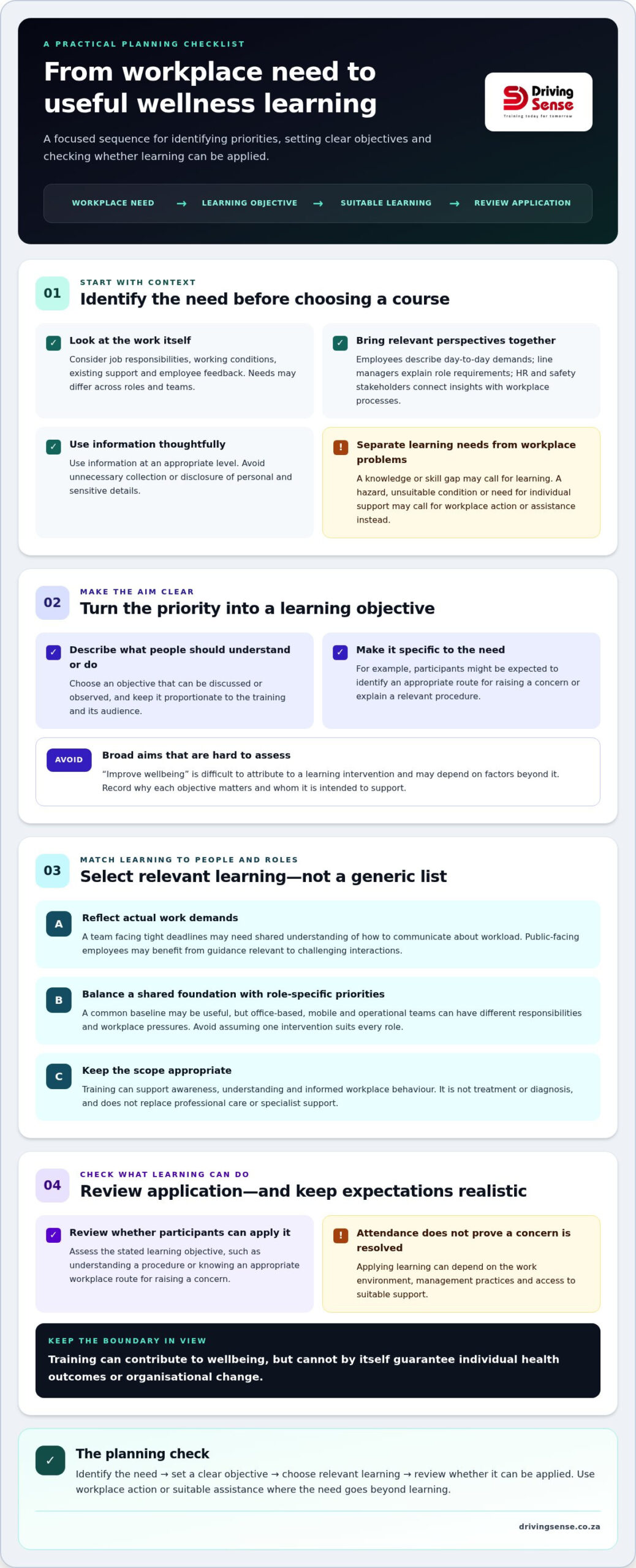
To assess the contribution of employee health and wellness training, decide what participants should learn rather than promising a broad improvement in wellbeing. A clear planning sequence keeps the intervention focused: identify a workplace need, set a learning objective, select suitable learning, then review whether participants can apply it. This gives the organisation something specific to evaluate without implying that training alone will improve health, productivity or risk levels.
Start with needs and workplace context
Identify priorities by considering job responsibilities, working conditions, existing support and employee feedback. Discussions with employees and managers can reveal where understanding or practical skills may be relevant. Organisational information can help show whether a need is shared or specific to particular roles. Use information at an appropriate level, avoiding unnecessary collection or disclosure of personal and sensitive details. Record why each proposed objective matters and whom it is intended to support.
Turn priorities into clear learning objectives
An objective should describe what participants are expected to understand or be better prepared to do, in terms that can be discussed or observed. For example, employees might be expected to identify an appropriate workplace route for raising a concern or explain a relevant procedure. These are planning examples, not promises of a particular learning outcome. Avoid broad objectives such as “improve wellbeing”, which are difficult to attribute to a learning intervention and may depend on factors beyond it.
Keep the objective proportionate to the training and its audience. Learning can support awareness, understanding and informed workplace behaviour, but it is not treatment, diagnosis or a substitute for professional care. Employers should also consider how learning fits alongside wider workplace support, making clear which needs training can address and which may require a different response.
A practical planning record can follow four steps:
- Identify the need. Describe the workplace issue or capability gap, using relevant employee feedback and organisational context.
- Set the objective. State what the intended participants should know, understand or be prepared to do.
- Select the learning. Choose an approach that fits the objective, audience and role requirements. Check that the planned learning addresses the identified need.
- Review application. Decide how the organisation will assess whether learning was understood and can be used in the relevant work context, then adjust priorities if needed.
Keep the measures close to the objective. A short knowledge check or structured discussion may indicate whether a concept was understood; workplace observation or follow-up feedback may help assess application where appropriate. These are indicators of learning, not proof that training caused a change in health, productivity or risk. Organisations considering Driving Sense Employee Wellness training can use this outcome-led approach to define relevant learning priorities.
Employee wellness training, wellness programmes and assistance: what differs?
These terms are related, but describe different functions. Training develops learning, a wellness programme coordinates organisational activity, and assistance provides support. Separating them helps employers decide what response is appropriate and avoids expecting one intervention to meet every need.
| Approach | Purpose | Typical scope and relationship to learning |
|---|---|---|
| Training | Develop understanding, skills or informed workplace behaviours. | Structured learning with defined objectives. It may contribute to a broader response, but it is not the programme or support service itself. |
| Wellness programme | Coordinate organisational activities that support workplace wellbeing. | May bring together learning, workplace practices and other initiatives. Training can be one element, depending on the organisation’s priorities. |
| Employee assistance | Provide support to employees facing personal or work-related concerns. | Provision varies. Assistance is distinct from general learning and may involve referral or specialist support rather than a training session. |
The boundaries and exact provision vary between workplaces. Employers should not assume that clinical assessment, counselling or treatment is part of employee health and wellness training. Learning can explain relevant processes or help build skills, whilst individual concerns may call for separate support. For a South African organisational perspective on coordinated provision, see this South African employer guide to workplace wellness programmes.
What training can do, and where its limits lie
Training can give employees shared information, develop relevant capabilities and clarify how a workplace process is intended to work. For instance, learning might help participants understand how to raise a concern or where to find internal guidance. These are educational contributions, not a guarantee that a concern will be resolved. A session alone cannot change every working condition or address every personal difficulty. Referral and specialist support should remain separate routes where appropriate.
This distinction also matters when a concern relates to a workplace hazard. Learning may explain safe procedures, but it should not replace assessing or controlling hazards. The National Institute for Occupational Safety and Health (NIOSH) provides occupational safety and health research and recommendations; its material is a reference point, not South African legal guidance.
When approaches may work alongside one another
Where needs overlap, learning can sit within a wider framework of workplace support. An organisation might use training to build common understanding, managers to communicate expectations and respond appropriately, and relevant HR or safety functions to coordinate workplace processes. If a personal or specialist concern arises, the response may require a separate assistance or referral pathway. Responsibilities should be clear, including how employees can raise issues and who manages follow-up.
No single arrangement suits every workplace. Role demands, existing resources and the nature of the concern should guide the combination of approaches. A coordinated response clarifies the purpose of each element whilst keeping training focused on what it can reasonably contribute.
How employers can plan, deliver and review wellness training
A responsible approach to employee health and wellness training treats delivery as part of a cycle, not a stand-alone event. Employers can connect learning to a defined workplace need, make participation practical for the intended audience, and review what participants take back into their roles. The aim is to improve the relevance and application of learning, not to assume that attendance alone demonstrates impact.
- Assess needs. Consider role responsibilities, working conditions, employee feedback and existing workplace support. Use relevant information to identify a learning need, taking care not to expose unnecessary personal or sensitive details.
- Define the audience and objectives. Identify who the learning is for and what participants should understand or be prepared to do. Set objectives that reflect job context rather than assuming that one set of needs applies across the workforce.
- Plan access and participation. Account for different roles, shift patterns and practical barriers to taking part. Select accessible ways for the intended audience to engage, and explain whether participation is expected or voluntary in the relevant context.
- Communicate before delivery. Explain the purpose, intended learning and boundaries of the training. Clarify how it relates to existing workplace support and where employees can raise concerns that need a response beyond general learning.
- Review and adjust. Gather learner feedback, check understanding against the stated objectives and consider whether participants can apply the learning in their work context. Use the findings to refine future priorities and delivery.
Prepare a learning plan that fits the workforce
Before delivery, document the intended audience, objectives and connection to existing support, so managers and participants share a clear understanding of the training’s role. Consider whether shift arrangements or differences in job duties affect access, timing or relevance, and communicate the plan in a form employees can understand. A considered plan helps prevent a general learning activity from being mistaken for individual assistance or a complete organisational response.
For transport-related workplaces, the guide to fleet safety training programs for South African employers provides context for considering the particular demands of driving roles when planning workplace support. A related driver risk assessment checklist for corporate fleets explains how assessment findings can inform proportionate next steps, including targeted training.
Review learning without overstating results
Match the review method to the objective. If the aim is understanding, a knowledge check or structured feedback may help show what participants took from the learning. If the objective concerns application, follow-up discussions or appropriate workplace observations may provide useful insight. Interpret these findings as evidence about learning and opportunities to improve, not as proof that training caused a health, productivity or risk outcome.
Review should also consider whose experience is represented. If some roles or shifts had less opportunity to participate, that may indicate an access issue to address before drawing conclusions about the learning’s relevance. Driving Sense provides Employee Wellness training as part of its nationwide South African training services. Explore Driving Sense Employee Wellness training as one component of a broader, planned approach to workplace capability.
How Driving Sense fits into employee health and wellness training
For South African organisations considering employee health and wellness training, the provider’s role should be considered alongside the organisation’s own priorities. Employers can first define the workplace need, intended audience and learning objectives, then decide how training may contribute within existing support arrangements. This keeps the decision grounded in organisational context rather than assuming that a course, by itself, will address every aspect of employee wellbeing.
Driving Sense includes Employee Wellness among its training offerings. Founded in 2006, the company delivers training nationwide across South Africa. Its Employee Wellness training can form part of a broader organisational approach to workplace capability, alongside management action, ongoing support and review.
A quality-focused training partner for South African organisations
Employers seeking structured workplace learning can use their identified priorities to frame decisions: what employees need to understand, which roles the learning concerns, and how its relevance will be reviewed. A quality-focused approach starts with those requirements and treats training as a defined contribution to organisational capability. Nationwide delivery is relevant for organisations operating across South Africa, where learning priorities may need to be considered across different teams and work contexts.
Quality also depends on setting proportionate expectations. Training can support learning, but employers remain responsible for considering how workplace arrangements and other forms of support relate to the need identified. Clear objectives help keep the intended contribution visible, whilst a review of learning and application can inform future decisions. This provides a disciplined basis for assessing training without making unsupported promises about health, productivity or risk outcomes.
Choose a practical next step for your organisation
Before selecting a learning intervention, summarise the workplace need, the employees or roles it concerns, and the objective participants should work towards. Consider whether the priority is shared across the organisation or specific to particular work contexts, and how the learning will sit alongside existing support. These points help employers approach training with a clear purpose and a reasonable basis for later review.
Driving Sense’s nationwide training services include Employee Wellness training for organisations considering structured learning in this area. Set out the need and intended learning objective, then consider how training can fit into your wider approach to employee wellbeing. To explore the range of workplace learning, visit Driving Sense’s training services.
Make your next wellness decision measurable
Before committing to a learning initiative, create a brief decision record: identify the workplace need, the employees it affects, what learning should enable and what evidence could indicate that it has been applied. This gives managers a practical reference for follow-up and helps distinguish a learning contribution from issues that may require broader organisational action or specialist support.
This discipline also helps integrate employee health and wellness training into ongoing planning. Treat review as an opportunity to listen, identify barriers and refine the response, rather than as a pass-or-fail judgement on employees or a guarantee of outcomes. If feedback points to concerns beyond learning, use it to inform an appropriate workplace response.
Driving Sense includes Employee Wellness among its training offerings. Explore Driving Sense training services to consider structured learning for your organisation.
Clear priorities and thoughtful follow-through can help make that next step more confident and responsible.
Frequently Asked Questions
How often should employers provide employee health and wellness training?
There is no universal schedule for employee health and wellness training. Employers can reconsider timing when roles or working conditions change, new needs emerge, employee feedback points to gaps, or an organisational review identifies a reason to refresh learning. For instance, a change in work processes may make existing guidance less relevant. Set the timing in response to these factors, rather than assuming that a fixed interval or repeated sessions will guarantee better health outcomes.
Can employee wellness training be tailored to different job roles?
Yes. Employers can frame learning objectives around relevant responsibilities and workplace context, so employees can relate the subject to their day-to-day work. For example, communication priorities may differ between customer-facing staff and employees working independently. Keep access fair across roles and shifts, whilst recognising that employees may have different learning needs and suitable ways to participate.
Is employee wellness training confidential?
Training participation and private health or assistance records are different types of information, and employers should not assume they are handled in the same way. Before collecting information, explain what will be recorded, who can access it and how it will be used, in line with applicable organisational policies and requirements. For example, feedback about a session need not require employees to disclose personal health details. Do not promise a particular confidentiality arrangement unless it has been established and communicated.
Can employee wellness training replace employee assistance or professional healthcare?
No. Training provides learning; it is not a substitute for clinical assessment, treatment or individual support. Employee assistance and healthcare are distinct forms of support, with their own purposes and processes. If a participant raises a concern that goes beyond the learning objective, employers should make the appropriate support or referral route clear, rather than attempting to address it through the session. Training can form part of a wider response, but it will not resolve every concern.
How can employers encourage employees to participate in wellness training?
Explain why the learning is being offered, who it is intended for and what it can reasonably provide. Give practical information about participation, including how it fits around work schedules and role responsibilities, and provide an appropriate way for employees to offer feedback. Avoid using pressure as a substitute for relevance. Attendance records can show who took part, but attendance alone does not establish engagement, understanding or improved wellbeing.
How can an organisation assess whether wellness training was useful?
Compare participant feedback and learning checks with the objectives set before delivery. If the aim was to explain a workplace process, for example, a short check of understanding can indicate whether that subject was addressed. Where appropriate, follow-up feedback may show whether employees found the learning relevant to their work. Use these findings to inform improvements; they do not, by themselves, prove broader health, productivity or financial outcomes.
