

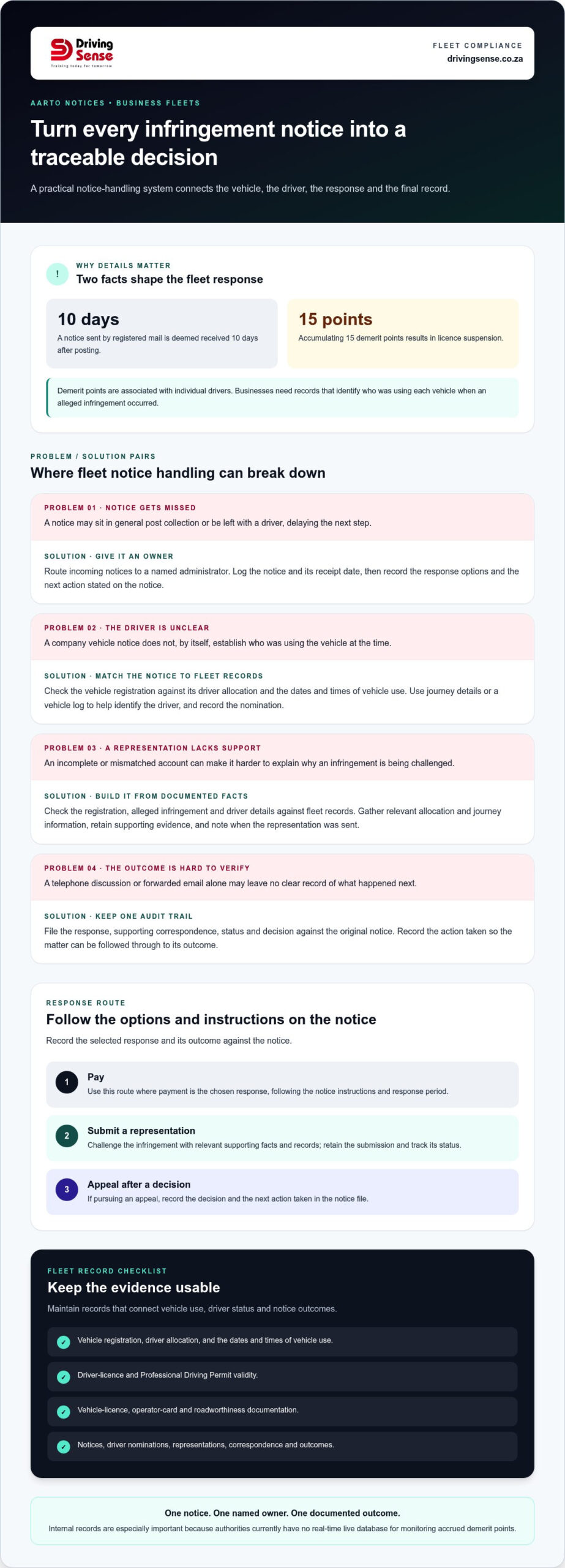
AARTO compliance requires South African fleet operators to manage infringement notices, allocate offences to the correct driver and keep vehicle and driver records in order. The South African Government identifies the Administrative Adjudication of Road Traffic Offences Act as the AARTO Act, 1998; under the demerit system, accumulating 15 points results in licence suspension. An infringement notice sent by registered mail is deemed received 10 days after posting.
For businesses, the challenge is not simply receiving a notice. It is identifying who was driving, responding through the required process and keeping records that support consistent decisions. This AARTO for business fleet compliance guide explains how legislation, representations and enforcement orders can affect fleet operations.
This guide covers the key stages, practical steps for managing driver nominations and notices, and the consequences that may follow enforcement action. It also explains how structured compliance and driver training can support safer, more accountable fleet practices.
Key Takeaways
- Understand how AARTO notices, representations and enforcement orders shape the steps a business must manage.
- Keep an audit trail linking each driver to their licence status, vehicle allocation and vehicle-use records.
- Allocate infringements to the correct driver promptly and keep address details current so notices can be delivered appropriately.
- Assign responsibility for fleet licensing, roadworthiness and traffic-fine administration.
- Use driver and compliance training to embed safer, more accountable practices across fleet operations.
AARTO legislation and draft regulations
South Africa’s AARTO framework establishes an administrative process for enforcing road traffic infringements and supporting road safety. The South African Government identifies the Administrative Adjudication of Road Traffic Offences Act as the AARTO Act, 1998. A practical AARTO for business fleet compliance guide connects this legal framework to everyday vehicle allocation, recordkeeping and notice handling.
AARTO uses a demerit system that allocates points to drivers who commit traffic infringements. The Road Traffic Infringement Authority and the Road Traffic Management Corporation manage the system together. Because points apply to drivers, accurate identification is essential when a company vehicle receives an infringement notice.
How does AARTO compare with the current traffic-fine system for business fleets? AARTO is an administrative law instrument, while the Criminal Procedure Act provides a contrasting criminal procedure framework. While older pilots applied the system in selected areas, the broader legislative rollout progressively replaces the standard criminal procedure framework across the country.
The Aarto Amendment Bill was passed in August. Under the Bill, company representatives cannot lose demerit points on behalf of company drivers. Businesses can manage notices and identify drivers, but points remain associated with individual drivers.
Implementation has been staged across municipalities. The rollout schedule began in selected municipalities in December 2025, with expansion to additional municipalities throughout South Africa in early 2026. Nationwide implementation of South Africa’s AARTO demerit points system is expected by September 2026. Fleet procedures should account for national application.
What AARTO compliance records and processes should a South African business fleet maintain? Keep records linking each vehicle to its assigned driver and the dates and times of vehicle use. Track document validity, and retain notices, responses and decisions in an audit trail.
- Record each vehicle’s registration and allocation to a driver.
- Track driver-licence and Professional Driving Permit validity.
- Monitor vehicle-licence, operator-card and roadworthiness documentation.
- Log infringement notices, driver nominations, representations and outcomes.
These records help establish who controlled a vehicle when an alleged infringement occurred. They also support prompt action when a notice arrives, instead of relying on memory or incomplete handover notes. An effective AARTO for business fleet compliance guide from Driving Sense should explain how to make these records usable across the organisation.
The AARTO programme covers the Road Traffic Infringement Authority and the AARTO Appeals Tribunal. The process has three stages, so fleet procedures should specify who receives notices, prepares responses and records outcomes. A clear escalation route helps prevent missed administrative steps.
Authorities currently have no real-time live database for monitoring accrued demerit points. Businesses should therefore keep their own driver records and review them when assigning vehicles. These records support informed allocation and follow-up alongside official processes.
AARTO notices and representations
An AARTO infringement notice starts a formal process that requires a recorded response. First, capture the notice, identify the vehicle and infringement details, and assign responsibility for follow-up. The fleet office should record when it received the notice, the stated response options and the next action.
For registered mail, an infringement notice sent to the infringer’s last known address is deemed received 10 days after posting. This makes current address records and prompt handling important. Route incoming notices to a named administrator, rather than leaving them with a driver or general post collection.
What are the deadlines and steps for paying, disputing or appealing an AARTO infringement? Follow the response period and instructions on the notice: pay, submit a representation disputing the infringement, or pursue an appeal after a decision. Record each submission and its outcome against the notice.
A representation gives the recipient a way to challenge an infringement. Before preparing one, gather relevant records, including the vehicle allocation, driver identity and journey details. For example, a vehicle log may help establish who was using the vehicle when the alleged offence occurred.
Keep the submission focused on the notice and supporting facts. Check that the vehicle registration, alleged infringement and driver details match the fleet’s records. Attach or retain relevant evidence, note when the representation was sent, and file any resulting decision with the original notice.
- Log the notice and its receipt date.
- Match the registration and alleged offence to fleet records.
- Identify the driver using allocation and vehicle-use records.
- Record the response, supporting documents and decision.
How can fleet operators check infringement notices and driver demerit points? Reconcile notices against internal driver and vehicle records, then keep current records of relevant correspondence and outcomes. Authorities currently have no real-time live database for monitoring accrued demerit points, making internal records important for fleet oversight.
Do not treat a notice as resolved simply because someone discussed it by telephone or forwarded an email. The responsible administrator should record the action taken and retain supporting correspondence. If a representation is submitted, track its status and keep the decision with the original notice.
The AARTO Appeals Tribunal forms part of the programme, so an appeal may follow the representation stage where the process allows. Keep the decision, grounds raised and related records together to create a coherent file if the matter progresses. A consistent notice register also helps managers identify recurring administrative gaps without mixing up individual drivers’ cases.
Enforcement orders and consequences
Under South Africa’s AARTO demerit system, accumulating 15 points results in licence suspension. A driver’s points therefore affect more than an individual journey. For a fleet, suspension can disrupt vehicle allocation, planned routes and service commitments.
An employee who has received 13 demerit points is no longer allowed to drive a vehicle. Fleet managers need a process for acting on this threshold before assigning further driving duties. A record showing a driver’s status should inform vehicle allocation and internal escalation.
What are the AARTO fine amounts, added fees and early-payment discounts? The amount due and applicable payment terms appear on the specific infringement notice. Review its stated total, any listed additional charges, discount conditions and payment deadline instead of relying on a general figure.
For each notice, distinguish the financial response from the driver’s demerit consequences. A payment record does not replace accurate driver identification or an internal record of the infringement. Keep the notice, payment evidence and driver allocation together.
An enforcement order marks a serious stage in handling an infringement. Record the order, identify the vehicle and driver concerned, and assign responsibility for the next administrative action. Do not leave an order in a shared inbox without a named owner.
A practical escalation process can use these steps:
- Register the notice or order against its vehicle and date received.
- Identify the driver from the allocation and vehicle-use records.
- Record the required response and its stated deadline.
- Track the outcome, payment evidence or further process.
- Review whether driver status affects upcoming vehicle assignments.
These steps help prevent a business from treating every consequence as a simple fine. A driver approaching the 13-point threshold requires attention to driving duties. A driver reaching 15 points faces licence suspension under the system.
Managers should use the same controlled workflow across depots and business units. For example, a notice received by a regional office should be entered in the central register promptly. The fleet administrator can then link it to the correct driver and retain supporting records.
Keep decisions traceable. Record who reviewed the notice, what action followed and where supporting documents are stored. If a driver’s status changes, update vehicle-allocation decisions and retain the reason for the change.
Regular reviews of open notices and orders can reveal missed handovers, incomplete driver records or unresolved actions. Use those findings to improve responsibility and escalation procedures. This makes individual AARTO cases part of a controlled compliance process, rather than disconnected paperwork.
Who is liable for traffic fines when a company vehicle is involved in an offence?
Using a company vehicle does not remove the need to identify the person responsible for an alleged infringement. In South Africa, a company must have a responsible person accountable for licensing, roadworthiness and traffic-fine issues. Assign that role clearly so each notice has an owner and the relevant records can be found.
Administrative responsibility and driver responsibility are related but not identical. The company’s responsible person oversees fleet records and notice handling, while accurate driver identification links an alleged offence to the person who used the vehicle. Under the Aarto Amendment Bill, company representatives cannot lose demerit points on behalf of company drivers.
For example, if a delivery vehicle receives a notice, first match its registration to the vehicle register. Then compare the alleged offence details with the allocation records and vehicle-use log. These steps help establish who controlled the vehicle at the relevant time.
Build responsibility into fleet procedures before a notice arrives. Obtain a driver’s particulars before allowing that person to control a vehicle. Link the driver’s identity to the assigned vehicle, period of use and relevant licence documentation.
- Appoint a responsible person for licensing, roadworthiness and traffic-fine administration.
- Record vehicle allocation and driver identity before each assignment.
- Maintain dates and times of vehicle use to support identification.
- Route each notice to the responsible person for review and action.
- Keep the notice, response and outcome together in the audit trail.
Clear internal responsibility also helps when a vehicle is shared across shifts or teams. For instance, if one employee returns a vehicle before another takes it, the handover record should show who used it during each period. Without this information, the company may struggle to allocate an infringement accurately.
Address management is another part of the company’s control. AARTO notices posted by registered mail to an infringer’s last known address are deemed received 10 days after posting. Keeping the address details held on eNatis current supports delivery to the correct person and helps the responsible employee act promptly.
Separate the company’s administrative duties from decisions about an individual driver. The responsible person can coordinate records and responses, but company payment or administration does not transfer demerit points. A consistent process documents who used the vehicle, who handled the notice and what action followed.
Review these controls when vehicles change hands, drivers change roles or records reveal gaps. A named owner, reliable allocation history and retained notice trail give the business a practical basis for managing traffic-fine matters and showing how each case was handled.
How must businesses nominate drivers and manage AARTO infringement notices?
Driver nomination should follow a documented chain from vehicle allocation to notice response. South African fleet operators should allocate infringements to the correct driver within statutory timeframes to reduce legal exposure. The process relies on accurate records created before a vehicle leaves the depot, not recollections gathered after a notice arrives.
Before a person controls a company vehicle, obtain and record their particulars. Link the person to the vehicle, the relevant dates and times of use, and licence-validity records. For a shared vehicle, record each handover to distinguish successive drivers.
Use a controlled workflow whenever an infringement notice arrives:
- Register the notice and link it to the vehicle record.
- Compare the infringement details with allocation and use logs.
- Identify the driver and preserve the supporting records.
- Submit the driver’s particulars through the applicable process and timeframe.
- Record the response, correspondence and eventual outcome.
This sequence helps prevent a common records problem: the vehicle is known, but its driver at the relevant time is unclear. A dispatch sheet, signed handover or trip record can help establish who had control. Keep this evidence with the notice, rather than in separate email folders.
Employment documentation can support the process. Companies should include an AARTO clause in employment contracts for employees exposed to the demerit system, allowing the employer access to the employee’s demerit history. This provides a defined basis for reviewing relevant driver information alongside vehicle-allocation decisions.
Accurate address details also matter. Keep the company’s eNatis address details up to date so infringement notices reach the correct person. A central register should record notices received, the driver nominated, response dates, supporting material and final status.
- Use a consistent driver and vehicle identification format across locations.
- Restrict notice handling to assigned, accountable staff.
- Retain records that explain each nomination and response.
- Review open matters regularly to identify incomplete actions.
Comprehensive compliance documentation and audit trails help show how each notice was handled. For example, a manager should be able to trace an infringement from vehicle use through nomination and response without relying on informal messages. Apply the same recordkeeping process across departments and depots.
Driver Training can reinforce the responsibilities that sit behind these procedures, including careful vehicle use and prompt reporting of relevant incidents. Strengthen fleet driver practices with driver training as part of a consistent compliance approach.
Driving Sense: Emergency Safety Training
Driving Sense supports businesses seeking to strengthen fleet safety and compliance through practical training. Its Emergency Safety Training, Driver Training and Compliance Training can complement internal procedures by helping employees understand their responsibilities and respond appropriately at work.
Where vehicles carry dangerous goods, Dangerous Goods training is also relevant to employee preparation. These services support workforce capability, but do not replace AARTO notice-handling procedures, driver records or the business’s legal responsibilities.
Consider training when reviewing fleet procedures, addressing knowledge gaps or reinforcing consistent workplace practices. Contact Driving Sense to discuss training that suits your organisation’s needs.
Build a stronger fleet compliance culture
Use this AARTO for business fleet compliance guide to review how responsibilities are understood across your organisation. Next, identify where employees need clearer guidance, whether on safe driving behaviour, emergency preparedness or consistent compliance practices. Linking these learning needs to everyday fleet operations can make procedures part of routine decision-making.
Driving Sense offers Driver Training, Emergency Safety Training and Compliance Training to help organisations strengthen these capabilities. The right focus depends on your workforce, operating procedures and the risks employees encounter. Consider which training would best complement your existing controls.
Give your fleet team a practical way to build capability and reinforce accountability. Explore training support from Driving Sense and take the next step towards more consistent fleet practices.
Frequently Asked Questions
Need Expert Assistance with AARTO Compliance?
Driving Sense offers Driver Training and Compliance Training to strengthen practical fleet capability. These services can improve employees’ understanding of safe driving and workplace procedures, complementing the business’s own notice-management controls. For example, a fleet manager could identify recurring driver knowledge gaps and use training to address them. Training supports internal capability; it does not replace formal AARTO processes or determine the outcome of an infringement matter.
What Is the AARTO Demerit System?
The AARTO demerit system assigns points to drivers who commit traffic infringements. Points accumulate against the driver, not as a transferable fleet or vehicle record. This distinction matters when a vehicle has several authorised users: reliable allocation records help connect an infringement to the person driving, rather than attributing the consequences to whoever manages the fleet.
What is AARTO and how does it affect South African businesses with vehicle fleets?
AARTO is South Africa’s administrative process for dealing with road traffic infringements. For a fleet business, infringement handling is part of operational governance, alongside vehicle allocation and driver documentation. For instance, when reviewing a route or shift plan, a manager should ensure that driver and vehicle records are complete so a later notice can be handled through a traceable internal process.
Which AARTO rules and offences apply to company vehicles and fleet drivers?
AARTO applies to traffic infringements committed by drivers using company vehicles, and the notice identifies the alleged infringement to be addressed. Fleet operators should also monitor the validity of driver licences, Professional Driving Permits, vehicle licences, operator cards and registration documents. Since the notice specifies the allegation, assess it alongside its related records rather than assume every fleet offence follows the same response.
How are AARTO demerit points assigned to drivers and operators?
Under the system, points are allocated to drivers who commit traffic infringements, not to a company representative instead. The Aarto Amendment Bill states that company representatives cannot lose demerit points on behalf of company drivers. In practice, separate administrative handling of a notice from the driver’s individual record, and do not treat payment or internal discipline as a transfer of points.
What are the risks for businesses if drivers or operators accumulate demerit points?
The key fleet risk is reduced driver availability when an employee’s points reach the stated thresholds: at 13 demerit points, an employee is no longer allowed to drive, while accumulating 15 points results in licence suspension. A business can assess operational exposure by reviewing driver assignments and upcoming work against current records. Build contingency planning around vehicle coverage, rather than assuming a driver will remain available.
