

A fire plan works only when people know what to do and who is responsible. In South African workplaces, fire warden and marshal training for OHS compliance helps designated staff understand their roles in routine checks, evacuation arrangements and emergency response.
Fire safety involves more than knowing where extinguishers are kept. It depends on recognising workplace hazards, understanding fire risk assessment findings and following an emergency plan suited to the site’s layout and operations. Clear responsibilities help staff respond in a coordinated way if a fire occurs.
This article explains the duties of fire wardens and marshals, the purpose of Level 2 training and how daily checks, risk assessments and emergency plans fit into workplace safety. It also outlines the South African compliance context, so you can understand how training contributes to a practical, organised approach to fire safety.
Key Takeaways
- Understand how fire drills, evacuation records and clear reporting help turn an emergency plan into an organised workplace response.
- Identify the routine checks and practical responsibilities that support a fire marshal’s role.
- See what Level 2 training contributes to designated wardens’ and marshals’ preparedness.
- Learn how UK fire safety duties connect the Responsible Person, staff awareness and evacuation arrangements.
- Use fire risk assessments to inform emergency plans, then consider how Emergency Safety Training can support your organisation’s workplace readiness.
What is fire safety and why is it important?
Fire safety combines workplace precautions with clear response arrangements. In South African workplaces, evacuation plans and recorded drills help staff understand their assigned actions.
Evacuation planning and drills
An evacuation plan explains how people can leave a workplace safely and where to assemble. A drill tests whether those arrangements work for the building, its occupants and its work activities.
For example, a warehouse plan should account for storage aisles, exit routes and visitors unfamiliar with the site. A drill can show whether staff know which route to take and where to assemble. Observers can note congestion, blocked passages or confusion about who checks each area.
After an exercise, record its date, location, participating teams, observations and follow-up actions. Assign each corrective action to a responsible person and record when it is completed. If a drill identifies an obstructed exit, note its location and the action taken.
Drills are most useful when they test the actual plan, not just a memorised route. Changes to a work area, access point or team arrangement can affect evacuation. Review the plan after such changes to keep instructions aligned with workplace conditions.
Risks of fire safety non-compliance
Fire safety non-compliance means failing to manage workplace hazards or maintain workable evacuation arrangements. In South Africa, this can expose an organisation to enforcement or legal consequences, as well as risks to people and operations.
Consequences depend on the circumstances, including the hazard, the organisation’s precautions and the effects of an incident. A blocked exit can delay evacuation, while unclear instructions can leave staff unsure where to go. Fire, injury, property damage and interrupted work are practical risks that make prevention and preparedness important.
Drill records and incident reports help organisations spot recurring problems instead of treating each one as isolated. If staff repeatedly gather at the wrong point, the plan or briefing may need revision. When a reported hazard remains unresolved, assigning an owner and tracking the corrective action makes follow-up clearer.
Reports should state what happened, where it occurred and what response followed. A report of a faulty alarm or obstructed passage, for example, gives the responsible workplace team a specific issue to investigate. Accurate records also help managers check that plans, staff instructions and corrective actions remain aligned with workplace risks.
Training can complement workplace-specific evacuation arrangements and hazard controls. The Level 1 OFQUAL-accredited fire safety awareness course lasts 4 hours, and its assessment is a 15-question multiple-choice exam. The Level 2 fire safety course requires delegates to be at least 14 years old. These course details describe learning options; they do not replace suitable routes, clear instructions or action on problems identified during drills.
The UK Health and Safety at Work Act is dated 1974. The training provider reports a 99% pass rate across its training suite. Course format and reported outcomes can help inform training choices, while practical preparedness still depends on reviewing arrangements and following up when exercises expose problems.
Fire marshal duties and daily workplace checks
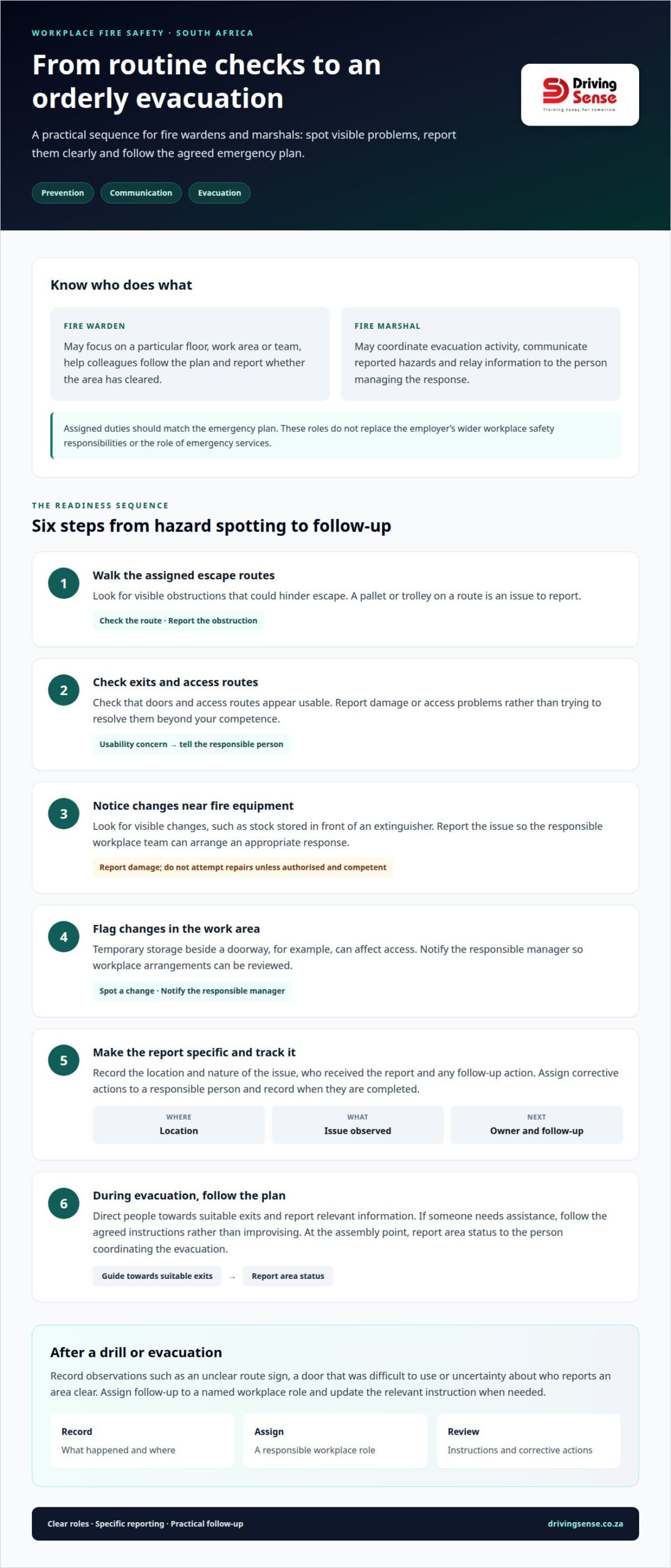
In South African workplaces, fire wardens and marshals support prevention, communication and orderly evacuation. Their assigned duties should reflect the emergency plan, such as checking a designated area and reporting a blocked exit.
A fire marshal may coordinate evacuation activity, communicate reported hazards and relay information to the person managing the response. A fire warden may focus on a particular floor, work area or team, helping colleagues follow the plan and reporting whether the area has cleared.
These roles need clear boundaries. For example, a warehouse plan could assign a warden to check office rooms and a marshal to communicate status at the assembly point. Neither role replaces the employer’s wider workplace safety responsibilities or the role of emergency services.
Routine checks give designated staff a practical way to spot conditions that could obstruct an escape or delay a response. Checks should follow site procedures and focus on visible issues, not repairs or technical testing beyond the person’s competence.
- Walk assigned escape routes and report a pallet, trolley or other obstruction.
- Check that exit doors and access routes appear usable, then report damage or access problems.
- Note visible changes near fire equipment, such as stock stored in front of an extinguisher.
- Identify changes in the work area, such as temporary storage beside a doorway, and notify the responsible manager.
- Record the location and nature of each issue, who received the report and any follow-up action.
These observations do not replace specialist inspection or equipment maintenance. A marshal, for example, can report a damaged extinguisher but should not attempt repairs unless specifically authorised and competent. Clear reporting helps the responsible person arrange an appropriate response and track unresolved hazards.
During an evacuation, wardens should follow agreed instructions, direct people towards suitable exits and report relevant information. If a colleague needs assistance, the warden should follow the plan rather than improvise a response that could create further risk. At the assembly point, the team can report area status to the person coordinating the evacuation.
Afterwards, record observations such as an unclear route sign, a door that was difficult to use or uncertainty about who reports an area clear. Assign follow-up to a named workplace role and update the relevant instruction when needed. Organisations arranging role-specific preparation can explore Fire Marshall Evacuation Warden training as part of their workplace safety arrangements.
Fire marshal certification in the UK should be refreshed at least once every three years, with earlier refresher training if workplace risks or evacuation performance change. A refresher can help designated staff revisit their procedures and consider whether changed conditions affect their roles. If checks or evacuation feedback reveal uncertainty, managers can consider earlier training alongside updates to workplace arrangements. Training supports staff in carrying out assigned duties within the established plan, but does not replace clear reporting or specialist maintenance.
Level 2 fire warden and fire marshal training
Level 2 training develops the knowledge designated wardens and marshals need for their assigned workplace responsibilities. The appropriate staffing and preparation depend on site hazards, layout, occupancy and evacuation arrangements.
Training requirements under OHS legislation
A course level describes training; it does not, by itself, establish a South African statutory requirement for that exact course. Fire warden and marshal training for OHS compliance should therefore be distinguished from workplace legal duties, which depend on the organisation’s applicable OHS obligations.
For employers, the practical test is whether appointed staff can carry out their defined responsibilities. Training should relate to the site plan, including how wardens communicate, direct colleagues and report area status. A course certificate alone cannot show that someone understands a changed layout or workplace procedure.
Training certificates and refreshers
A training certificate records course completion and can support an organisation’s training records. Keep it with the employee’s appointment details and role-specific instruction so managers can see who received preparation and what responsibilities they were assigned.
Refresher training should respond to changed duties, site hazards, evacuation arrangements or performance during exercises. For example, a warden moving from an office to a production area may need instruction on different routes and local hazards. The Level 2 course lasts 1 day and has a 20-question multiple-choice exam. These are course details, not a universal South African legal certificate or refresher rule.
Appointing and training workplace fire wardens
Appoint wardens with workplace areas, shift patterns, staff presence and evacuation responsibilities in mind. Then define each person’s area, reporting line and duties in the workplace plan.
Provide training linked to those duties, explain site arrangements and practise the role through an exercise. Record appointments, course completion and any further instruction. Review allocations when staff change roles or the workplace changes, so each area continues to have clear cover.
Staffing should reflect risk rather than a single headcount formula. For high-risk manufacturing sites, a rule of thumb is one fire marshal for every 15 to 20 workers. The number and placement of wardens should also account for separated work areas, shift coverage, access routes and people who may need evacuation assistance. A single marshal may not provide effective coverage where teams work across disconnected buildings or floors.
Level 2 preparation is most useful when it connects general knowledge to local procedures. Delegates should understand how their assigned area fits the wider response, whom to notify and what information to communicate. Fire warden and marshal training for OHS compliance can support that role-based preparation when it reflects actual workplace arrangements. Managers can then use exercises and workplace changes to identify where further instruction is needed, rather than relying on course completion alone.
UK fire safety legislation and the Responsible Person
The UK framework differs from South African workplace requirements, so its rules should not be treated as local law. The Regulatory Reform (Fire Safety) Order 2005 is the UK regulation named for this topic; its relevance is understanding UK duties, not applying them automatically in South Africa.
Within the UK framework, the Responsible Person is the role associated with organising fire safety arrangements. Employers must provide all staff with general fire safety awareness at induction and periodically thereafter. Nominated employees need formal fire marshal training when they have dedicated evacuation duties and ongoing safety checks.
This distinction separates workplace-wide awareness from preparation for a specialist role. A new employee, for example, should receive general awareness during induction, while a nominated marshal needs preparation for assigned evacuation tasks. Training should match each person’s responsibilities rather than treating every worker as a marshal.
The Responsible Person concept also clarifies accountability. An organisation can identify who oversees arrangements, who communicates instructions and which nominated employees carry out specific checks. If a marshal is assigned to an office area, that role should connect to wider evacuation arrangements and reporting lines.
Periodic awareness matters because induction alone may not keep instructions current. A change to a team’s work area, for example, can affect the route staff should use. Employers can use staff briefings and workplace exercises to reinforce applicable arrangements and identify instructions that need updating.
Formal marshal training has a narrower purpose: preparing nominated employees for dedicated evacuation duties and ongoing safety checks. General awareness is for all staff. This helps organisations allocate training by role and avoids assuming that training a few people replaces workforce-wide awareness.
For South African organisations, the practical value is comparison, not substitution. The UK Order and its Responsible Person terminology describe a UK legal context. South African employers should assess their workplace obligations under the applicable local framework, using UK examples only to understand ways to structure role allocation and staff awareness.
A simple responsibility map can clarify these distinctions. It can record who oversees arrangements, which employees are nominated for evacuation duties and which teams receive general awareness. For example, a site induction record and a marshal training record serve different purposes because they document different audiences and responsibilities.
Keep those records aligned with actual roles. If an employee stops serving as a marshal, update the role allocation; if a new employee joins, include them in induction awareness. Clear records help managers distinguish general staff awareness from nominated marshal preparation without confusing the UK framework with South African law.
Fire risk assessments and emergency plans
A fire risk assessment identifies workplace fire hazards, who could be affected and how existing precautions work. Its findings should inform an emergency plan so staff instructions reflect the building and its activities.
Start by examining work areas, equipment and materials that could contribute to a fire. A workshop using heat-producing equipment presents different considerations from an office with shared kitchens. Record hazards by location, identify people who may be exposed and note existing precautions.
Next, assess whether the precautions address the hazards. Stored cartons beside an exit, for example, can obstruct escape even if the route is marked. A kitchen assessment might identify cooking equipment, nearby combustible materials and the route staff would use to leave.
Then turn findings into clear actions. Assign each action to a responsible role, record its status and revisit unresolved issues. If a passage must be cleared, identify who will arrange it and how completion will be recorded. This links assessment findings to workplace decisions rather than leaving them as observations.
An emergency plan turns those decisions into instructions people can follow. It should explain how to raise the alarm, which exits are available, where people assemble and how relevant information is communicated. At a site with several areas, distinguish routes and responsibilities for workshops, offices and shared spaces.
Consider people who may need assistance during evacuation. The plan should state how support is arranged, who has an assigned role and how that person communicates during an emergency. For example, a visitor unfamiliar with the building may need clear directions from their host.
Wardens and marshals connect the written plan with workplace practice. Their area assignments should match the assessment and evacuation arrangements. If a temporary storage zone changes an exit route, review the affected instructions and inform the staff who use that area.
Use an exercise to test the plan in practice. Observe whether staff can identify the correct exit, reach the assembly point and report relevant information. Record difficulties, assign follow-up actions and update the plan when the assessment identifies a gap. Share revised instructions with affected teams rather than leaving them only in a document.
The key is traceability: each identified hazard should lead to a control, an assigned action or an informed decision. A documented assessment, practical plan and follow-up record help managers see how workplace risks connect to evacuation arrangements.
To align workplace hazards with practical controls, arrange a workplace risk assessment and develop evacuation arrangements around its findings.
Driving Sense: Emergency Safety Training
Driving Sense provides Emergency Safety Training for organisations preparing staff to respond to workplace risks and emergencies. It is a practical next step when a risk assessment identifies training needs or employees need preparation aligned with workplace emergency arrangements.
Training can connect written procedures with the responsibilities people carry out in practice. For example, when reviewing evacuation plans, organisations can consider how staff preparation supports clear roles and coordinated action. Driving Sense also provides Compliance Training for organisations whose workplace training forms part of a broader compliance programme.
To discuss Emergency Safety Training for your organisation, contact Driving Sense.
Strengthen your workplace readiness
Make fire safety arrangements practical by reviewing how staff training supports your organisation’s procedures. Consider whether people assigned emergency responsibilities understand their roles and whether training reflects workplace risks. Fire warden and marshal training for OHS compliance can help align staff preparation with wider operational priorities.
Driving Sense provides Emergency Safety Training, Driver Training and Compliance Training for organisations seeking structured workforce preparation. The right focus depends on the responsibilities and safety needs your organisation has identified. Use those priorities to guide the next discussion.
For a practical conversation about training for your workplace, contact Driving Sense about training. A clear next step can help your organisation continue building a prepared, accountable workplace.
Frequently Asked Questions
How many fire wardens or marshals should a South African workplace appoint?
There is no single headcount that suits every workplace; appointments should reflect its fire risks and operational arrangements. A compact office with one work area differs from a site with separate buildings, changing shifts or higher-risk areas. Consider whether designated people can cover each occupied area during working hours, including staff absences, and whether responsibilities remain clear across shift handovers.
What is the difference between fire warden, fire marshal, and fire safety officer training?
Titles vary between organisations, so match training to assigned duties rather than title alone. A warden may be responsible for a defined area, while a marshal may coordinate or support wider evacuation arrangements. Fire safety officer training may cover broader workplace safety responsibilities. For example, distinguish area-level evacuation tasks from oversight of fire safety procedures.
