

A safety officer’s pathway in South Africa depends on the industry and role. Safety officer training requirements in South Africa generally involve a relevant industry qualification, safety officer training and experience in that industry. Organisations must comply with the Occupational Health and Safety Act.
One course or certificate may seem like a clear route into the role, but qualifications, practical experience and professional registration can all matter. The appropriate pathway also differs across general workplace, construction, mining and medical safety roles.
This article explains how to assess course accreditation and delivery, identify relevant industry qualifications and registration pathways, and understand the value of hands-on experience. It also covers hazard identification and risk assessment as practical parts of workplace safety.
Key Takeaways
- Map the role to its industry before choosing training, as qualifications and professional registration pathways differ across sectors.
- Plan for a combination of an industry-relevant formal qualification, safety officer training and practical experience.
- Understand how professional registration works in your field, including the assessment and examination pathway for construction applicants who pass.
- Look beyond certification alone: hazard identification and risk assessment help translate safety knowledge into workplace practice.
- Consider Emergency Safety Training when your organisation needs structured preparation for workplace emergencies.
Course accreditation and training locations
Course accreditation matters because a certificate’s value depends on its learning outcomes, assessment and recognition. Before enrolling, identify the qualification or competency the course is intended to provide, then compare it with the requirements of your target role. A course title alone does not show whether its content suits construction, mining or general workplace safety.
Consider accreditation alongside the provider, assessment method and certificate. Find out which organisation recognises the programme, what evidence shows successful completion, and whether the qualification supports the relevant professional pathway. For construction, SACPCMP registration involves an assessment, followed by an examination for applicants who pass. Training and professional registration are connected, but they are separate steps.
The training format affects how learners access instruction and complete practical tasks. Classroom sessions allow direct discussion with a facilitator, while online coursework can fit around work commitments. Some programmes combine remote theory with in-person practical assessment, so check that the delivery format covers the course outcomes. For example, studying incident procedures online still requires understanding how they apply in a real workplace.
Course duration and weekly study requirements depend on the syllabus, assessment schedule and format. Compare the stated learning hours with the time needed for assignments, revision and practical activities. An introductory course may suit someone building awareness, while a specialised programme may require focused study of a particular industry or risk. Check the timetable for assessment dates and any practical attendance requirements.
Introductory training can establish core knowledge, while specialised courses cover hazards and responsibilities associated with a particular work setting. Entry requirements also vary. Review prerequisites such as prior learning, literacy expectations or relevant work experience, then compare them with your background before applying. This helps you avoid a course that is either too basic or beyond your current preparation.
How much do safety officer courses cost in South Africa? The price depends on the course scope, delivery format, assessment and practical requirements, and is provided after a quote request. These factors determine the resources and instruction included, not the course title alone.
What are the risks of taking an unaccredited safety officer course in South Africa? Its certificate may not meet the recognition or registration requirements for your intended role. If the course content or assessment does not reflect workplace responsibilities, you may also finish without the preparation needed to apply safety procedures effectively.
Industry qualification, experience and safety training
In South Africa, entering safety work involves industry knowledge, role-specific learning and practical experience. The right combination depends on the workplace and the responsibilities of the position.
Safety roles and responsibilities
A safety officer generally supports workplace safety arrangements, a safety representative raises employee concerns, and a health and safety practitioner is a broader professional description. These terms are related, but do not necessarily refer to the same role or qualifications.
The distinction matters when choosing training for a position. A representative, for example, may need knowledge to raise workplace hazards, while an officer’s role may require industry-specific safety competence. “Practitioner” can describe someone working across health and safety functions, rather than one particular job title. Review the position description and its scope before selecting a course.
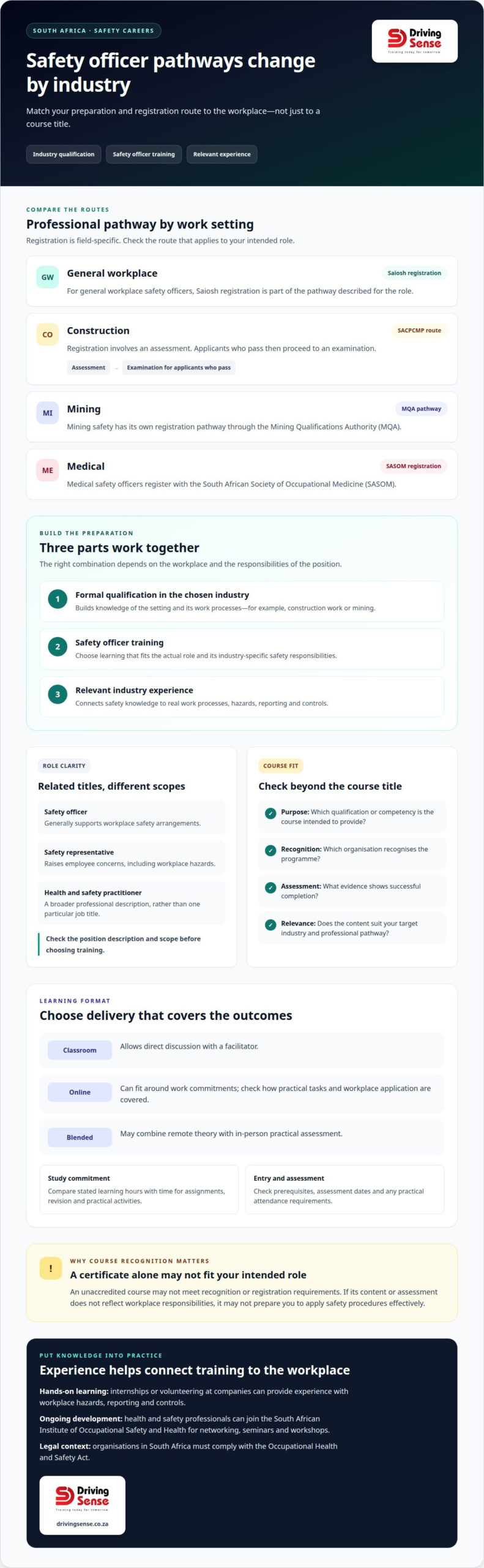
For general workplace safety officers, Saiosh registration is part of the pathway described for the role. Construction safety officers follow a separate route through SACPCMP. These examples show why a certificate labelled “safety” should be assessed against the actual role, not treated as a universal qualification.
Industry experience and qualifications
A safety officer’s preparation combines a formal qualification in the chosen industry, safety officer training and experience in that industry. This combination matters because hazards and work processes differ by setting, and safety decisions need to reflect the operation being overseen.
For example, a construction role calls for familiarity with construction work, while mining safety has its own registration pathway through the Mining Qualifications Authority (MQA). Medical safety officers register with the South African Society of Occupational Medicine (SASOM). Relevant industry qualifications and experience connect safety knowledge to the setting where it will be applied.
Practical experience can help learners understand how procedures work beyond coursework. Internships or volunteering at companies offer ways to gain hands-on experience and learn how workplace hazards, reporting and controls are handled. For professional development, health and safety professionals can join the South African Institute of Occupational Safety and Health to network and access seminars and workshops.
Legal training requirements
Legal training requirements relate to the knowledge needed to support workplace compliance and perform a particular safety role. Organisations in South Africa must comply with the Occupational Health and Safety Act, so role preparation should reflect workplace risks and assigned responsibilities.
The pathway described here centres on an industry qualification, safety officer training and relevant experience, rather than one course for every sector. Registration also varies by field: general workplace officers register with Saiosh, construction applicants follow the SACPCMP assessment and examination route, and mining and medical roles use MQA and SASOM respectively.
A practical next step is to match the intended job to its industry pathway, then align formal learning and experience with the role. First-aid learning can also cover workplace topics such as CPR, wound care and incident response. This distinguishes broad safety preparation from training for a specific workplace responsibility.
Certification
A certificate records learning or assessment, while professional registration is a separate status. Understanding the distinction helps applicants plan qualifications for their intended role and know what each document demonstrates.
Course certification usually shows that a learner completed specified training or met its assessment requirements. Its value depends on whether the content relates to the workplace and professional pathway. A certificate in general safety principles, for example, may not demonstrate specialist competence in construction or mining. Read it alongside the course outcomes and the position’s responsibilities.
Professional registration recognises a person’s standing within a relevant professional pathway. It does not automatically prove every workplace skill, just as completing a course does not mean a person is registered. Keep certificates, assessment outcomes and supporting records together to show what learning was completed and which professional process was followed.
How do you become a registered health and safety practitioner with SACPCMP? Construction safety officer applicants register with SACPCMP and complete an assessment; those who pass then sit an examination. These steps are part of the registration route and are not interchangeable with a training certificate.
Understanding safety officer training requirements in South Africa means identifying the relevant registration pathway, reviewing its assessment process and organising evidence of qualifications and experience. The evidence should match the role and industry. A construction applicant, for instance, should distinguish construction-related training from broader workplace safety learning when compiling records.
Employers also need to interpret certificates carefully. A certificate documents completion, but does not by itself explain a learner’s practical experience or registration status. During recruitment, compare the course title and stated outcomes with the job description. If the role requires industry familiarity, consider the candidate’s relevant work history alongside formal learning.
- Course certificate: evidence of completed learning or assessment, such as a safety course.
- Professional registration: a separate status linked to a professional pathway, such as SACPCMP registration.
- Supporting record: documents that help demonstrate qualifications, assessment and relevant experience.
These distinctions support clearer training and recruitment decisions. A manager hiring for a construction safety position can assess a candidate’s training, industry experience and SACPCMP progress separately. South Africa’s safety officer training requirements make it useful to compare each document with the role, rather than assume one certificate covers every requirement.
Certification is one part of professional preparation. Match each document to what it demonstrates, organise assessment records, and relate the evidence to the duties of the intended safety role.
Hazard identification and risk assessment
Hazard identification and risk assessment connect workplace conditions to practical decisions about controls. For a safety officer, they turn observations into documented priorities for action.
Identifying workplace hazards
Hazard identification is the systematic recognition of anything that could cause harm. A hazard missed during routine work may remain uncontrolled. A warehouse walk-through, for example, could reveal obstructed walkways, damaged shelving or poorly stored materials. Speaking with workers can uncover risks a brief visual inspection may miss.
Consider work activities, equipment, substances and the environment rather than relying on a single inspection method. Maintenance may involve moving parts, stored energy and restricted access; cleaning may involve wet floors or chemical exposure. Record where the hazard occurs, who may be affected and which task creates exposure. This context helps distinguish a general concern from a specific workplace issue.
Workers can provide useful information because they perform tasks and encounter changing conditions directly. Ask how work is done in practice, including what happens during equipment faults or urgent repairs. Compare these observations with written procedures. If the team’s actual process differs from the procedure, the gap may reveal an overlooked hazard or control.
Assessing workplace risks
Risk assessment considers how likely harm is and how serious its consequences could be. It helps workplaces prioritise controls according to exposure and potential impact. A loose cable across a busy passage, for instance, presents a different concern from an isolated defect. The assessment should explain why a risk needs attention and what action could reduce it.
Start with the hazard and the people exposed, then consider how contact could occur. For a slippery floor, assess foot traffic, the source of moisture and the possible consequences of a fall. Identify existing controls, such as warning signs or access restrictions, and consider whether they address the cause. A sign alone may not resolve a recurring leak or cleaning issue.
Record findings in clear language that workers and managers can act on. Include the hazard, affected task, existing controls, further action and the person responsible for follow-up. For example, a machine-related finding should identify the equipment and unsafe condition, rather than simply say “machinery risk”. Specific records make control decisions easier to communicate and track.
Review the assessment when work processes, equipment or workplace conditions change. A new chemical, altered storage layout or different maintenance method can introduce hazards that an earlier review did not cover. Risk assessment training helps safety officers gather relevant observations, distinguish hazards from risks and communicate practical controls. These skills support consistent decisions as workplace tasks change.
What are the legal health and safety training requirements for safety officers in South Africa?
Organisations in South Africa must comply with the Occupational Health and Safety Act. Safety officer training should be understood in this workplace compliance context, not as a certificate that automatically covers every role or risk.
The appropriate learning depends on the work and responsibilities involved. A safety officer supporting a warehouse, for example, needs to understand its activities and hazards. Someone in another industry will encounter different processes and risks. Align role preparation with the actual workplace instead of relying on a generic course title.
In practice, separate three questions: what the role requires, what training supports those responsibilities, and what evidence records the learning. A course certificate can show completion, while professional registration follows its own pathway. For a construction role, the SACPCMP registration process includes an assessment and an examination for applicants who pass. Do not treat these steps as substitutes for one another.
Organisations can turn the Act’s compliance context into a clear training plan by connecting learning to workplace tasks. Identify the officer’s safety responsibilities, consider the hazards they will address, and select training that develops relevant knowledge. A role involving incident response, for instance, calls for preparation related to workplace emergency procedures and the officer’s responsibilities.
Records help demonstrate how training supports operational responsibilities. Keep course certificates and assessment evidence alongside role descriptions and relevant workplace procedures. If an officer changes industry or takes on different tasks, review whether existing learning still fits the new scope. A record showing the course and its learning outcomes is more useful than a document filed without context.
Training also needs to connect with workers’ everyday activities. An officer should be able to communicate procedures, recognise concerns during a task and guide staff towards relevant workplace controls. For example, handling a hazardous substance requires training that relates to the substance and task, rather than general awareness alone.
For employers, the practical priority is to map training to the organisation’s work, the officer’s assigned function and the risks that need attention. This supports workforce preparation under the Occupational Health and Safety Act while keeping course completion, workplace competence and professional registration distinct.
Organisations aligning staff learning with their workplace procedures can explore compliance training as part of their safety programme.
Driving Sense: Emergency Safety Training
Driving Sense provides Emergency Safety Training for organisations seeking structured preparation for workplace emergencies. It is a relevant option when staff need training to support emergency readiness alongside wider workplace safety arrangements. Compliance Training can also address learning needs linked to operational procedures.
When planning training, consider employees’ tasks, workplace emergencies and the responsibilities assigned to staff. This helps align learning with practical needs, rather than treating a course as a substitute for role-specific qualifications or professional registration.
To discuss training for your organisation, visit drivingsense.co.za.
Make your next training decision count
Use South Africa’s safety officer training requirements to align workforce development with actual responsibilities. Identify where your organisation needs stronger capability, whether in staff preparedness, compliance learning or another operational area. Training is more useful when it reflects employees’ work and supports consistent safety practices across teams.
Driving Sense offers Emergency Safety Training, Driver Training and Compliance Training for organisations seeking structured learning in these areas. Identify the most immediate training need, then connect it to the relevant roles and workplace procedures. This provides a clear starting point for workforce development without treating one course as a substitute for role-specific qualifications or registration.
For a practical discussion about your organisation’s training needs, contact Driving Sense to discuss training. A considered next step can help you build a more capable, safety-conscious workforce.
Frequently Asked Questions
What qualifications are required to become a safety officer in South Africa?
A safety officer needs a formal qualification in their chosen industry, safety officer training and experience in that industry. The combination should fit the intended workplace, since construction, for example, involves different operations from a general workplace. Match course content and prior experience to the job description, then consider the professional registration pathway for that sector.
Which South African institutions offer accredited safety officer courses?
The QCTO is South Africa’s sole accrediting body for occupational and trades-related qualifications, while training providers deliver courses. The appropriate provider depends on the qualification and sector you are targeting. Someone preparing for a construction safety role, for example, should distinguish course delivery from SACPCMP registration. Compare the course’s stated qualification and assessment with the professional pathway, rather than relying on the provider’s name or course title alone.
How long does safety officer training take in South Africa?
Training time depends on the syllabus, learning format, assessments and practical components. Introductory programmes and specialised industry qualifications have different learning demands and schedules. When planning around work, consider coursework, revision and assessment preparation. Practical experience is also part of career preparation, but comes from workplace exposure rather than course study alone.
What certificates or registration are needed for safety officers in South Africa?
The relevant evidence depends on the sector: course certificates document learning, while professional registration is separate. General workplace safety officers register with Saiosh; construction applicants follow SACPCMP’s assessment and examination route. Mining safety officers register with the Mining Qualifications Authority, and medical safety officers with SASOM. Keep training records separate from registration documents so employers can see what each demonstrates.
What experience and education are required for construction safety officers in South Africa?
Construction safety officers need a formal qualification relevant to their industry, safety officer training and construction experience. They also follow the SACPCMP registration process, which includes an assessment and an examination for applicants who pass. Practical exposure helps connect training to site activities and procedures. Internships or volunteering at companies can help prospective officers gain relevant hands-on experience.
