

Employee wellness is a practical part of workplace productivity and safety, not a separate concern. The employee wellness impact on productivity and safety is reflected in how physical and mental wellbeing shape focus, participation and the ability to work safely. Supporting wellbeing also means paying attention to workplace conditions and emerging hazards.
Organisations already recognise that fatigue, stress and disengagement can affect day-to-day performance. The challenge is to connect employee support with the safety processes that identify and manage risk, rather than treating wellness as a standalone initiative.
This article explains what workplace wellness involves, how it can influence productivity and safe work, and why stress management and employee engagement matter. It also explores how to incorporate wellness into safety meetings and hazard assessments, making wellbeing part of an ongoing approach to operational safety.
Key Takeaways
- Connect employee wellbeing with everyday safety processes so that emerging risks can be recognised and discussed earlier.
- Make mental health support accessible, and consider how it can help employees sustain focus and participation at work.
- Review shift patterns, overtime, workload and recovery time as part of a structured approach to fatigue management.
- Give employees a meaningful voice in wellness initiatives to strengthen engagement and encourage shared responsibility.
- Use safety meetings, toolbox talks and hazard assessments to bring wellbeing considerations into routine workplace planning.
How do wellness programs increase employee productivity?
Wellness programmes can support productivity by addressing physical and mental wellbeing alongside everyday workplace risks. Their value is clearest when employees can access support and apply healthy practices in their ordinary work.
In South Africa, workplace safety is governed by the occupational health and safety framework; wellbeing initiatives complement, rather than replace, hazard controls. Employers should link employee support with practical risk management.
Wellness programme costs depend on workforce needs, delivery format and the support provided. Scope and delivery requirements shape the cost, which is set out after a quote request.
Wellness programmes can support safer work by helping employees raise hazards early, contribute to safety discussions and follow procedures consistently. These behaviours strengthen prevention, although they do not establish a specific reduction in injuries.
South African workplaces can use employee assistance programmes, counselling, physical activity initiatives, nutritional advice and health examinations. The right combination depends on employee needs and identified workplace risks.
Mental health resources and employee support
Mental health resources include employee assistance programmes, counselling and supportive conversations about stress or emotional wellbeing. They matter because employees who can raise concerns and access support may be better placed to sustain concentration and participate at work.
Managers can make support more accessible by explaining available resources, discussing them without stigma and responding respectfully to concerns. For example, if a supervisor notices a change in an employee’s focus, they can arrange a private conversation and direct them to counselling support. Clear referral pathways help employees understand what to do next.
Healthy habits, breaks and performance
Healthy habits include regular movement, hydration, nutritious food and appropriate breaks. They matter because work performance partly depends on employees’ ability to maintain attention and manage physical demands across tasks.
Employers can make healthy practices easier by allowing short movement breaks, keeping drinking water accessible and encouraging balanced food choices. In a desk-based workplace, a brief walk between tasks can interrupt prolonged sitting. In a physically demanding role, scheduled pauses can give employees time to recover. Managers should consider the task and work setting when planning suitable breaks.
Wellness programmes are most useful when linked to occupational health and safety initiatives, rather than treated as separate benefits. A workplace team can review hazard assessments alongside employee feedback and identify whether fatigue, workload or workstation design needs attention. For example, repeated reports of workstation discomfort can prompt a review of task layout and working practices.
Practical initiatives can include:
- Offering confidential counselling or employee assistance support.
- Encouraging regular movement, hydration and suitable breaks.
- Discussing wellbeing during safety meetings and supervisor conversations.
- Using employee feedback to identify concerns that need follow-up.
When integrated into routine workplace planning, wellbeing measures can inform practical decisions. Leaders can review participation, recurring concerns and follow-up actions, then adjust support to address the needs employees raise.
How fatigue, stress, and burnout can affect workplace safety
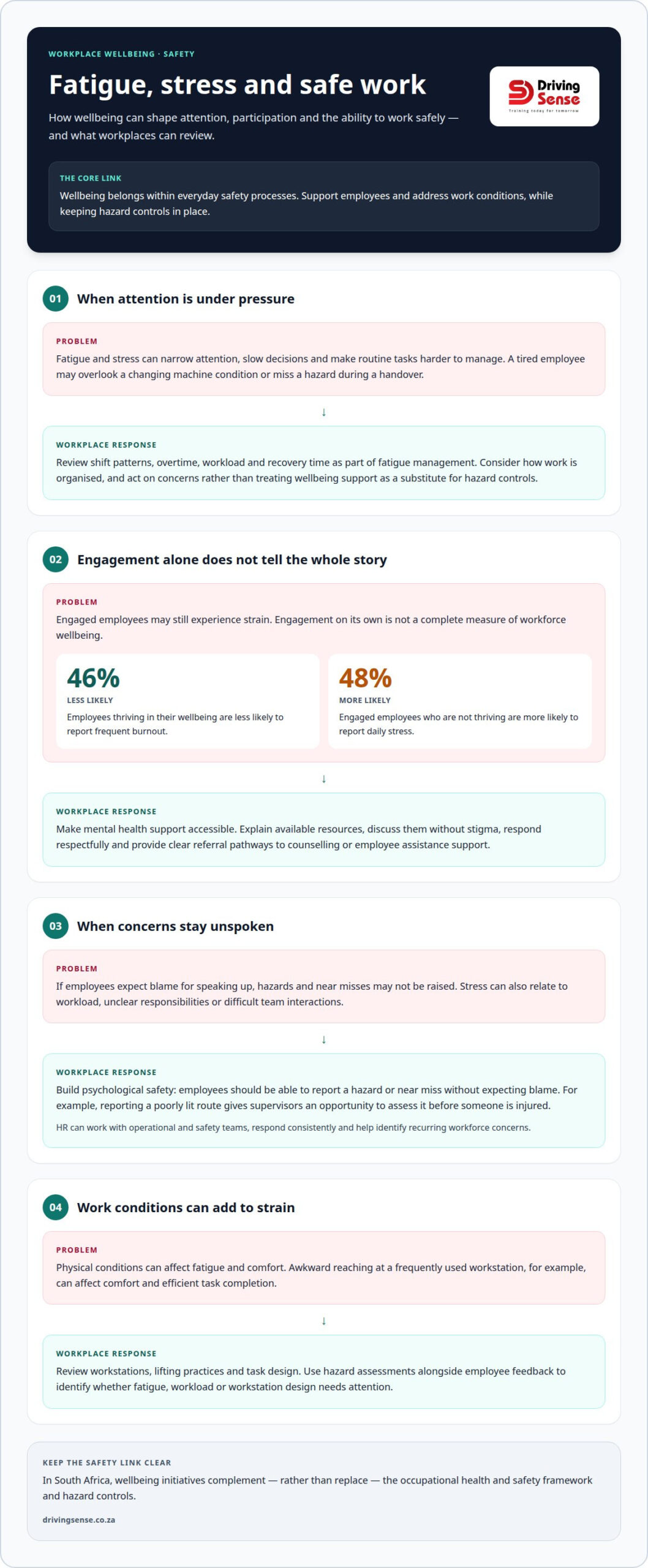
Fatigue and stress can narrow attention, slow decisions and make routine tasks harder to manage. A tired employee, for example, may overlook a changing machine condition or miss a hazard during a handover. Burnout can also reduce the concentration and participation needed for consistent safe work.
Employees thriving in their wellbeing are 46% less likely to report frequent burnout. By contrast, engaged employees who are not thriving are 48% more likely to report daily stress. These patterns underline why engagement alone is not a complete measure of workforce wellbeing; safety leaders should also consider strain and available support.
The interventions with the greatest practical value combine fatigue controls, accessible mental health support and a workplace culture where employees can raise concerns. Their effect is stronger when managers act on reports and address the underlying work conditions, rather than treating wellbeing programmes as a substitute for hazard controls.
Psychological safety means employees can raise a hazard or report a near miss without expecting blame for speaking up. A worker who reports a poorly lit route, for example, gives supervisors an opportunity to assess it before someone is injured. HR can support this process by helping managers respond consistently, directing employees to appropriate support and identifying recurring workforce concerns.
HR should work with operational and safety teams because stress may relate to workload, unclear responsibilities or difficult team interactions. A practical review can compare employee feedback with incident reports, absence patterns and hazard observations. This helps distinguish an individual support need from a work-design issue that requires broader action.
Physical working conditions also influence fatigue and comfort. Clean, well-lit, ergonomically designed workspaces can reduce physical strain, while improvements to workstations, lifting practices and task design can help address musculoskeletal risks. Reviewing a frequently used workstation, for instance, may reveal awkward reaching that affects comfort and efficient task completion.
Evaluation makes wellness programmes more accountable. Employers can set a clear objective, such as improving hazard reporting, then review participation, employee feedback and follow-up actions over time. Regular safety inspections help identify physical hazards, while preventive evaluations can surface emerging concerns and prompt timely follow-up.
Programmes have limitations: participation may be low if employees distrust confidentiality, cannot access support during work or see no response to concerns. Wellness activities also cannot fix unsafe equipment or poorly designed tasks on their own. HR and safety teams should review access, employee feedback and workplace controls together, then adjust the programme when findings reveal gaps.
Why is stress management essential for increasing productivity?
Stress management supports concentration, sound judgement and steady work output. Organisations can address stress through workload controls, recovery time, manager behaviour and relevant training.
Fatigue, shifts and recovery time
Fatigue management means reviewing shifts, overtime, staffing, workload and recovery time together. Repeated demands without adequate recovery can make it harder to sustain attention. For example, managers can compare planned shifts with overtime patterns and identify teams facing recurring extended hours. They can then review staffing and task allocation, rather than relying only on employees to manage fatigue themselves.
Recovery time should be considered when arranging schedules and handovers. If a team repeatedly carries unfinished tasks into overtime, leaders can examine whether priorities or staffing need adjustment. These reviews treat fatigue as a work-design concern, not simply an individual weakness. The right response depends on the work, shift pattern and demands placed on employees.
Stress management and resilience training
Stress management and resilience training help employees recognise pressure and practise constructive responses. Mindfulness exercises, for example, can provide a structured pause before a demanding task or difficult conversation. Training matters when its approaches fit employees’ work, rather than offering general advice disconnected from daily responsibilities.
Training can also help teams recognise when professional or organisational support is needed. A session might explore how to identify emotional strain, communicate concerns and use available support resources. These activities should complement workload and work-design improvements. They cannot remove stress caused by unreasonable demands if management leaves those conditions unchanged.
Manager practices that support wellbeing
Managers support wellbeing through visible, consistent practices: setting clear priorities, discussing workload and encouraging reasonable breaks. Their behaviour matters because employees take cues from how leaders handle pressure. A supervisor who takes breaks and communicates openly can make it easier for a team to adopt those practices.
Regular check-ins can help managers identify changing demands before work becomes difficult to sustain. A manager, for example, can ask which tasks are competing for attention, then agree on priorities with the employee. Leaders should discuss available support without stigma and model responsible work habits. These actions make wellbeing part of ordinary team management.
Stress management and work output
Stress management combines individual support with organisational practices that help employees handle work demands. It matters for productivity because sustained pressure can interfere with concentration, communication and task completion. A team facing conflicting deadlines, for example, may benefit from clearer priorities and a workload review.
Organisations can assess the effects of changes by reviewing employee feedback, workload patterns and work quality. If employees report persistent pressure, managers can investigate the causes and adjust processes. Mindfulness or resilience training may support coping, but should not replace practical workload changes. A considered approach connects emotional wellbeing with the conditions shaping everyday performance.
Employee engagement and productivity
Engagement describes employees’ involvement and commitment in their work. It can influence how consistently people contribute, communicate and manage routine responsibilities. Employees who are thriving in their wellbeing are 2.2 times as likely to be engaged at work as employees who are struggling or suffering. This relationship makes engagement useful to monitor alongside wellbeing, rather than treating it as a standalone performance measure.
Employees who strongly agree that their organisation cares about their overall wellbeing are 4.6 times as likely to be engaged at work. That finding highlights the importance of visible, credible support. For example, leaders can ask employees what would improve their working experience, then report which suggestions will be acted on. Clear follow-through helps show that participation is meaningful, not merely a survey exercise.
Engagement also connects with retention and advocacy. Employees who strongly agree their organisation cares about their wellbeing are 54% less likely to watch for or actively seek a new job. They are also 6.2 times as likely to strongly advocate for their organisation as a place to work. These associations give leadership reasons to examine how daily management practices shape employees’ experience.
Wellbeing and engagement should be considered together when interpreting employee feedback. Thriving employees are twice as likely to strongly agree they would recommend their organisation as a great place to work, compared with employees who are struggling or suffering. Team feedback can help leaders identify where working conditions, communication or support may need attention.
Engagement alone does not mean employees are free from stress or burnout. Engaged employees who are not thriving are 61% more likely to experience frequent burnout. They are also 66% more likely to experience daily worry and twice as likely to report daily sadness and anger. These figures show why a positive engagement result should not end a wellbeing review.
Leaders can make engagement more substantive by giving employees a voice in workplace programmes. Invite staff to identify barriers, contribute ideas and take ownership of suitable initiatives. For example, a team could suggest changes to a safety discussion format, then review whether participation improves. This connects employee input with practical organisational decisions.
To assess progress, leaders can review engagement feedback alongside workload concerns, employee participation and recurring safety observations. If employees report strong commitment but continuing strain, investigate the conditions causing that gap. Considering the employee wellness impact on productivity and safety alongside engagement can help distinguish motivation from wellbeing and guide practical decisions.
For South African organisations, sustained dialogue and follow-through are practical priorities. Communicate what feedback revealed, assign responsibility for agreed actions and review outcomes with employees. Conversations about the employee wellness impact on productivity and safety help make engagement a useful input into productivity planning, rather than a score considered in isolation.
Integrating wellness into safety meetings and hazard assessments
Wellbeing becomes operational when safety processes consider how work affects people. Safety meetings, toolbox talks and hazard assessments can connect physical hazards with fatigue, stress and workload. This helps teams consider both the task and the conditions affecting employees’ ability to complete it safely.
A toolbox talk can include a prompt about factors affecting safe work that day. Employees might identify a rushed handover, unclear task allocation or difficulty concentrating. Supervisors can record relevant concerns, consider immediate controls and assign follow-up. Keep the discussion focused on practical risks, without requiring employees to disclose private health information.
Hazard assessments can include questions about how work is organised and experienced. When reviewing a repetitive task, assessors might examine workstation layout, lifting practices, task design and employee feedback. If workers describe discomfort or difficulty maintaining focus, the team can investigate contributing conditions and consider suitable changes. This brings mental and physical wellbeing into risk discussions.
Safety meetings can also make employee input more consistent. A chairperson can invite observations from different roles, summarise recurring themes and record actions alongside existing safety items. For instance, a team reporting repeated interruptions during a hazardous task can examine communication and task sequencing. An agreed action, responsible person and follow-up point help prevent concerns disappearing after discussion.
Workplace wellbeing can be incorporated into several existing safety activities:
- Toolbox talks: discuss work pressures or fatigue that could affect a task.
- Hazard assessments: consider task design, physical demands and employee feedback.
- Incident investigations: examine workload, communication and conditions surrounding an event.
- Safety observations: note obstacles that make procedures harder to follow.
- Committee discussions: track recurring concerns and agreed follow-up actions.
These activities can foster a culture where employees raise concerns early. Leaders should respond respectfully, explain what action will follow and communicate when an issue has been reviewed. If workers identify poor lighting, for example, the responsible team can assess the area and report its findings. Consistent responses show employees that speaking up contributes to prevention.
Evaluation keeps the process useful. Review meeting records, hazard reports, employee feedback and completed actions together. If fatigue concerns recur in one work area, examine shift arrangements, workload and recovery opportunities. If employees repeatedly report discomfort, revisit workstations or task design. This helps distinguish isolated feedback from patterns that need broader attention.
To strengthen this connection, consider workplace safety training that supports consistent hazard awareness and effective safety discussions.
Driving Sense: Emergency Safety Training
Driving Sense provides Emergency Safety Training for organisations seeking to strengthen workplace preparedness. It can be a practical next step when safety discussions identify a need for structured training alongside wellness and hazard management. Organisations can also consider Compliance Training, Driver Training or Dangerous Goods training when these fit their workplace requirements.
Training complements, rather than replaces, ongoing hazard assessments, employee support and management action. Connecting workforce preparedness with risks identified through safety processes helps organisations make training relevant to their operational context.
Contact Driving Sense to discuss Emergency Safety Training for your organisation.
Make wellbeing part of ongoing operational planning
Wellbeing initiatives are most useful when they inform decisions about work, rather than remaining separate from them. Leaders can take a practical next step by reviewing employee feedback alongside current safety priorities, then assigning responsibility for agreed improvements. This keeps attention on the conditions shaping employees’ work and makes follow-through visible.
The employee wellness impact on productivity and safety depends on how consistently organisations connect support with everyday operations. Driving Sense offers Emergency Safety Training, Driver Training and Compliance Training to help organisations address relevant training needs as part of this wider approach.
If your organisation is ready to develop its workplace wellness approach, contact Driving Sense to discuss workplace wellness. A considered plan can help turn employee feedback into practical action and support a more resilient, safety-conscious workplace.
Frequently Asked Questions
What Is Workplace Wellness?
Workplace wellness is the intentional support of employees’ physical, mental, emotional and social wellbeing at work. In practice, it can include counselling, health examinations, opportunities for movement and clear processes for raising concerns. A South African office might review workstation comfort alongside employee feedback, while a warehouse could consider physical demands and task organisation. Measures should reflect employees’ work and the conditions affecting them.
How can organizations start integrating wellness into safety?
Organisations can begin by adding wellbeing prompts to existing safety activities, rather than immediately creating a separate process. A toolbox talk, for example, can ask whether workload, fatigue or task changes could affect safe work that day. Record relevant actions, assign responsibility and revisit unresolved concerns at the next meeting. Keep discussions focused on working conditions and risk controls, while protecting employees’ privacy around personal health matters.
How do elevated health risks and unhealthy behaviors affect productivity?
Elevated health risks and unhealthy behaviours can make it harder to sustain attention and complete work effectively. In a study described in the research findings, employees with an unhealthy diet were 66% more likely to have high presenteeism than employees regularly eating whole grains, fruit and vegetables. Employees who did little exercise were 50% more likely to have high presenteeism than regular exercisers. These findings indicate potential performance concerns, not individual predictions.
What Is Employee Wellbeing?
Employee wellbeing is a person’s overall physical, mental and emotional health, together with their experience of work and life. It is broader than whether someone is ill or absent. An employee may attend work but struggle with concentration, pressure or social connection. Organisations can understand wellbeing more fully by considering employee feedback alongside working conditions and access to appropriate support.
What is the impact of unhealthy behaviors on workplace performance?
Unhealthy behaviours can affect performance by making concentration, energy and consistent task completion more difficult. The study described in the research findings found that employees who smoked were 28% more likely to have high presenteeism than non-smokers. Presenteeism means being at work while health or wellbeing concerns reduce effectiveness. Employers can respond constructively by making supportive resources accessible and considering workplace conditions, rather than making assumptions about individual employees.
How does employee wellness affect productivity and absenteeism?
Employee wellness can influence productivity by affecting employees’ capacity to focus, contribute and complete work; it can also relate to absence. Employees who frequently experience burnout are 63% more likely to be absent, according to the findings provided. For managers, a useful response is to look for patterns in absence and employee feedback, then assess whether workload, work design or access to support needs attention.
What is the return on investment of workplace wellness programmes?
Return on investment depends on programme costs and the outcomes an organisation tracks, so assess it against clearly defined objectives. Compare relevant measures over time, such as participation, absence patterns, retention, employee feedback and work performance. If a programme aims to improve access to support, for example, track whether employees can use it and whether feedback identifies remaining barriers. Avoid treating a single measure as proof of overall value.
How do mental health and stress affect employee performance and safety?
Mental health concerns and stress can affect concentration, communication and judgement, potentially influencing work quality and safe task completion. Pressure during a rushed handover, for example, can make it harder to absorb changing task information. Managers can make support easier to access by clearly discussing available resources and reviewing work conditions that contribute to strain. Employees should be able to raise work-related concerns without pressure to disclose private medical details.
