

The lower-cost option is not automatically in-house or outsourced. In South Africa, the total depends on how many drivers need training, how often training is required and what resources each approach uses. An in-house vs outsourced driver training cost analysis should go beyond the trainer’s fee: staff time, delivery arrangements and the value of training also affect the decision.
In-house training may cost less when a business has enough drivers to make regular sessions worthwhile. Outsourcing may be simpler when training is occasional. To compare the options properly, consider the full cost of delivery and the demands each approach places on your team.
This article explains how headcount, training benefits, hybrid delivery and outsourced pricing shape the calculation. It also offers a practical way to compare the options and identify an approach that fits your workforce and training needs.
Key Takeaways
- Factor in workforce size and how often training is needed before deciding whether to build internal delivery capacity or outsource.
- A hybrid approach can combine consistent core training with internal sessions focused on organisation-specific driving risks and procedures.
- Assess outsourced pricing against the full cost of in-house delivery, including trainer time, employee time away from work and administration.
- Include the value of training benefits in your comparison, rather than judging each option on its delivery cost alone.
- Compare trainer quality, flexibility and consistency alongside cost to identify the approach that best supports your operational requirements.
Scalability and changing headcounts
Headcount affects whether an internal trainer has enough work to justify dedicated time. A stable group of drivers can make recurring in-house sessions easier to organise, with the same trainer, vehicles and facilities available each time. If operations expand, contract or rely on seasonal drivers, outsourcing can offer more flexibility without requiring you to maintain training capacity internally.
For a larger group, compare the number of drivers to train with the sessions your operations can accommodate. An in-house trainer may need to split drivers into smaller groups to maintain access to vehicles and practical participation. An outsourced provider can organise training for the required cohort, but the schedule still needs to account for shifts, vehicle access and time away from duties.
In-house delivery requires suitable vehicles for practical instruction, an appropriate training space and any equipment needed for the planned activities. It also requires a trainer with relevant driver-training expertise who can deliver consistent instruction. The setup depends on the vehicles, course content and practical exercises, all of which affect both the initial commitment and ongoing workload.
Setup time is another operational cost. An internal programme requires someone to take responsibility, prepare materials, arrange vehicles and facilities, and establish a repeatable schedule. Outsourcing shifts much of the delivery planning to the provider, while your team coordinates attendance and operational access. When headcount changes, compare how easily each arrangement can adjust without disrupting work.
| Option | Capacity | Setup | Expertise | Headcount changes |
|---|---|---|---|---|
| In-house | Depends on internal resources | Requires internal preparation | Built and managed internally | May require schedule changes |
| Outsourced | Arranged through provider delivery | Coordinates external sessions | Accessed through the provider | Sessions can be adjusted |
| Hybrid | Shared across internal and external delivery | Requires role coordination | Combines internal knowledge and external expertise | Can divide delivery as needs shift |
Expertise affects scalability as much as trainer numbers. An internal trainer may know company routes, vehicles and procedures particularly well. An external trainer brings training expertise without requiring your organisation to build all delivery capacity itself. A hybrid arrangement can retain internal input on local risks and draw on external sessions when more capacity is needed.
The price depends on headcount, session frequency, delivery format, vehicle access and the resources required. A tailored quote gives the exact figure for your requirements, rather than relying on a generic estimate.
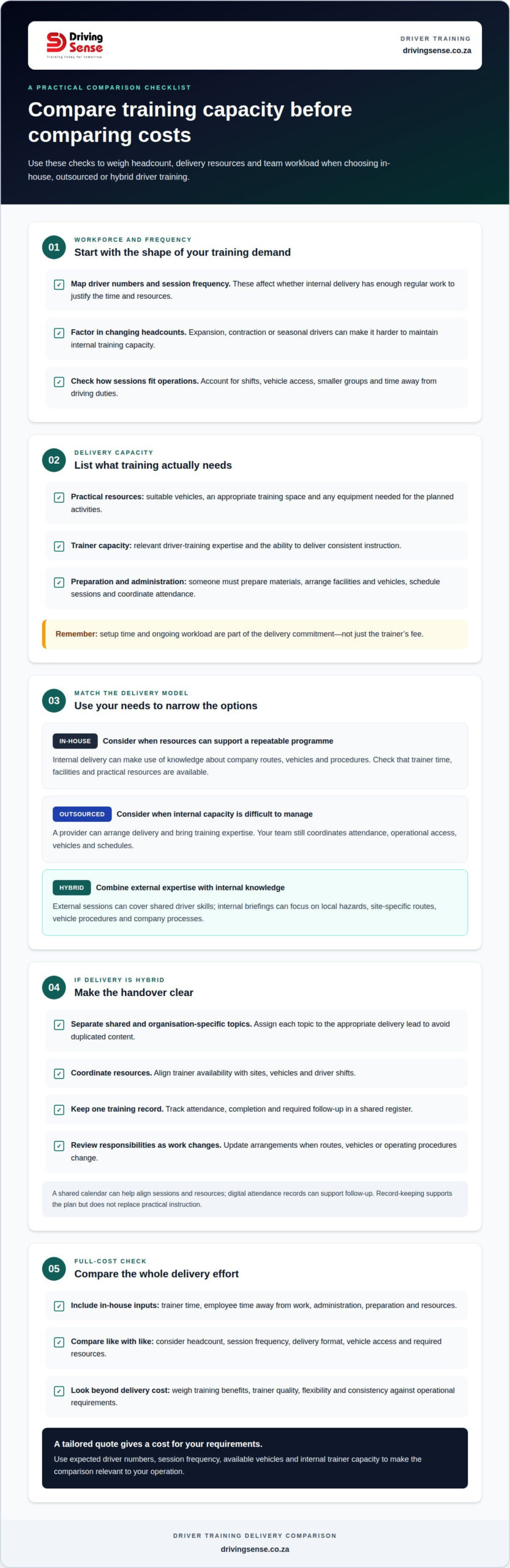
For a practical comparison, map expected driver numbers, session frequency, available vehicles and internal trainer capacity. Choose in-house delivery when those resources can support a repeatable programme. Consider outsourcing when changing headcounts make internal capacity difficult to manage. A hybrid model suits operations that need both internal knowledge and flexible training expertise.
Hybrid in-house and outsourced training
A hybrid model divides driver training between internal and external delivery. For example, an organisation might use an external trainer for structured instruction, then brief drivers internally on site-specific routes and vehicle procedures. This combines external expertise with operational knowledge held by supervisors. Define each party’s responsibilities before training begins.
Start by separating shared training needs from organisation-specific requirements. External delivery can cover common driver skills, while internal sessions address local hazards, schedules and company processes. Keeping these elements distinct helps avoid duplicated content and unclear accountability. A training coordinator can assign each topic a delivery lead, materials, attendance records and follow-up responsibilities.
Technology can support coordination, but it should serve the training plan. A shared calendar can align trainer availability, vehicle access and employee shifts. Digital attendance records can show who completed each session, while a central register can flag drivers who need follow-up. These tools help connect internal and external activity, but record-keeping cannot replace practical instruction.
- Define the split: assign general instruction and organisation-specific content to the appropriate delivery lead.
- Coordinate resources: align external trainer schedules with vehicles, sites and driver shifts.
- Keep one record: use a shared register for attendance, completion and required follow-up.
- Review the arrangement: update responsibilities when routes, vehicles or operating procedures change.
Consider a distribution operation with drivers working across different sites. An external trainer can deliver shared learning, while an internal supervisor explains site access, loading-area movement and reporting procedures. If a new route or vehicle changes the work context, the supervisor can update the internal briefing. The organisation can retain access to external expertise without creating every training resource itself.
The initial effort is defining the scope, dividing responsibilities and keeping materials consistent. Managers should also decide who schedules sessions, tracks completion and communicates changes. Without clear arrangements, employees may receive overlapping instruction or miss important topics. With clear ownership, the organisation can focus internal time on local context and use external delivery for broader training needs.
A hybrid approach is less suitable when no one can coordinate internal input or maintain training records. In that case, split delivery may add management work without improving consistency. For organisations with clear internal ownership, professional driver training can form the externally delivered part of a coordinated programme.
Outsourced support pricing and cost predictability
Outsourced driver training costs depend on the agreed scope, delivery format and number of participants. A tailored quote gives the exact figure for the training, schedule and delivery arrangements. To compare it with in-house delivery in South Africa, also account for internal trainer time, administration and employee time away from normal duties.
Providers may charge per participant, making the total depend on attendance and group size. This can help with budgeting for a planned session, but the amount may change if participant numbers change. Before setting a budget, define the drivers and topics involved, the delivery location and whether practical activities are included.
What are the risks and hidden costs of outsourcing driver training in South Africa? Training that does not match workplace routes or procedures may require supplementary internal instruction. Travel, venue arrangements, vehicle access, schedule changes and time away from operations can also add costs beyond the training fee.
Clear scope makes these costs easier to manage. For example, a distribution business can identify its driver group, sites and practical requirements before agreeing on a programme. It can then assign an internal coordinator to manage attendance, vehicle access and communications. This can reduce avoidable scheduling changes and help the external provider plan for actual operating conditions.
- Define the scope: list the driver groups, topics, locations and practical components.
- Clarify the delivery basis: establish whether the quote reflects participants, sessions or another agreed arrangement.
- Map operational costs: account for staff time, travel, site access and vehicle availability.
- Plan for changes: understand how revised attendance or scheduling affects the agreed delivery.
Outsourcing can offer flexibility without hiring an internal trainer, particularly when training is occasional or headcount varies. It does not eliminate internal coordination. A specialised course may also need organisation-specific context, so managers should include the time required to brief drivers on local procedures.
To assess cost predictability, compare the quoted scope with the complete delivery plan, rather than treating the training fee as the only cost. Record participant numbers, schedule, location, vehicle needs and internal coordination time. This gives finance and operations teams a consistent basis for comparing outsourced delivery with in-house provision and makes potential hidden costs visible before training begins.
Some outsourced IT support providers offer pay-as-you-go or tiered pricing for changing or occasional needs; fees or retainers commonly provide a set monthly cost. Maintenance estimates put costs at approximately 1.5x in-house cost per repair event.
Benefits and training expenses
Compare training models by including the full delivery cost and the value provided. In-house safety training can involve fixed trainer salaries and benefits, while outsourced training is generally charged per participant. This affects how costs change with attendance: internal costs continue between sessions, while participant-based charges respond to the group being trained.
An in-house team may also need dedicated time to prepare materials, arrange vehicles and facilities, record attendance and manage follow-up. These responsibilities have an operational cost, even without a separate invoice. For example, include the time a supervisor spends scheduling drivers and maintaining records in the in-house calculation.
Employee time matters in both models. Drivers attending training are not performing their usual duties, so operations may need to adjust shifts or arrange cover. Record each participant’s training hours, then assess the effect on schedules and workload. This cost is separate from the trainer’s fee or salary.
To estimate the scale of employee time, model a scenario using eight training hours per employee annually. This is a calculation example, not a recommended duration for South African driver training. Multiply the planned hours by the number of participants, then consider the effect on staffing, vehicle use and operational continuity.
- Trainer expenses: include salary, benefits and preparation time for internal delivery.
- Participant expenses: compare outsourced charges with attendance and the agreed training scope.
- Operational impact: account for driver time, shift planning and any required cover.
- Administration: include scheduling, records, materials and follow-up responsibilities.
Assess training benefits alongside expenses. Consider whether the learning addresses driving risks and procedures relevant to your operations. Track completion, employee feedback, audit outcomes and incident patterns over time. These measures can help show whether a delivery model supports safer behaviour and consistent practice, rather than simply counting sessions.
For instance, a business that frequently onboards drivers may value a repeatable internal programme, if it can sustain the trainer and administrative workload. An organisation with occasional training needs may prefer per-participant delivery, avoiding the need to maintain internal capacity between sessions. A hybrid model can reserve internal resources for local procedures and use external delivery for shared learning needs.
Make a like-for-like comparison: use the same participant group, learning scope and period for each model. Then total trainer and employee time, benefits, administration, delivery charges and operational adjustments. The result shows which expenses are fixed, which vary with attendance, and where the benefits justify the resources committed.
How do in-house and outsourced driver training compare?
Trainer quality, flexibility and consistency depend on how each model is managed. An in-house trainer can tailor learning to company vehicles, routes and workplace risks. An outsourced trainer brings external expertise, but may need internal sessions to explain company-specific procedures. A useful in-house vs outsourced driver training cost analysis weighs instructional quality alongside how drivers apply learning in daily operations.
Assess trainer quality by looking at relevant experience, subject knowledge and the ability to make instruction practical. Internal trainers may know daily operations closely, while external trainers can offer a broader training perspective. Neither approach is automatically stronger. A trainer might explain a vehicle procedure clearly yet overlook a local loading-area risk, leaving an important gap.
Flexibility depends on who controls scheduling and content. An internal team can adapt briefings when routes, sites or vehicle procedures change, if it has the time and expertise. Outsourced sessions provide delivery capacity without assigning an employee to train, though schedules and content still need coordination. A hybrid model can use external instruction for shared topics and internal briefings for changing local conditions.
Consistency requires documented learning objectives, materials and completion records. An in-house programme can use the same materials across sessions, but the trainer must keep them current. An external provider can deliver a structured programme, while managers connect it with workplace practice. A shared attendance register and follow-up process can identify drivers who need further instruction.
- Compare trainer capability: review how each model addresses practical driving skills and workplace risks.
- Test flexibility: consider how quickly content can reflect a changed route, vehicle or site procedure.
- Set a consistency process: use clear learning objectives, attendance records and follow-up responsibilities.
- Assess outcomes: track cost per employee, time to completion, compliance audit outcomes, incident rates and employee satisfaction.
These measures make the comparison operational rather than impressionistic. For example, if audit outcomes improve but employee satisfaction falls, managers can review delivery methods and practical relevance. If completion takes longer than operations can accommodate, scheduling or session design may need adjustment. A sound in-house vs outsourced driver training cost analysis compares these measures with delivery costs to identify whether differences stem from the trainer’s approach, coordination or programme design.
Choose in-house delivery when internal expertise can maintain relevant content and consistent instruction. Choose outsourced delivery when external expertise and delivery capacity better match the organisation’s needs. Select a hybrid model when company-specific risks require internal context alongside external instruction. To arrange structured driver training for your organisation, take the next step with a programme aligned to your operational requirements.
Driving Sense: Driver Training
Driving Sense provides Driver Training for organisations seeking structured instruction for their workforce. If your comparison points to outsourced or hybrid delivery, this can be a practical next step: training can address shared driver needs while your organisation communicates its site-specific procedures.
Driving Sense also offers Emergency Safety Training, Compliance Training and Dangerous Goods training. These can complement driver development when relevant to workplace operations. Consider external training when internal capacity is limited, driver training needs change or outside expertise could support a consistent programme. The right approach depends on your drivers, operating context and training requirements.
Contact Driving Sense to discuss your organisation’s driver training needs.
Turn your comparison into a practical training plan
Make the next step an operational decision, not simply a choice between budget lines. Use the in-house vs outsourced driver training cost analysis to decide who will manage delivery, how training will fit around daily work and how you will assess whether it meets your organisation’s needs.
Before implementation, document the agreed approach, responsibilities and measures of success. This gives managers a clear basis for coordinating training and deciding when delivery needs to change. As routes, vehicles, workforce needs or internal capacity evolve, review the arrangement and adjust it where necessary. The model should work for both the people delivering training and the drivers taking part.
If you would like to discuss how external driver training could fit your organisation’s requirements, contact Driving Sense about driver training. A considered conversation can help you define a suitable next step for your training plan.
Frequently Asked Questions
Cost Analysis of In House vs Outsourcing: Which Saves More?
Neither model is automatically less expensive. The lower-cost option depends on training demand and internal capacity. A business with regular training needs may spread internal trainer costs across repeat sessions, while one that trains drivers occasionally may avoid maintaining that capacity. Compare both options over the same planning period and for the same learning scope, including operational costs alongside delivery expenses.
Decision Making Framework: Which Should You Choose?
Choose the model your organisation can deliver consistently without compromising operational requirements. Consider how often training is needed, whether internal staff can manage content and administration, and how much external expertise the programme requires. Then decide who will coordinate attendance, assess completion and update materials as work practices change. A suitable model has clear responsibilities and fits your workforce, schedule and safety objectives.
Hybrid Approach: Best of Both Worlds?
A hybrid approach can suit organisations that need external instruction alongside internal oversight. For example, an external trainer can deliver shared learning, while a designated manager checks how it applies to company procedures. Assign responsibility for coordinating sessions, maintaining records and communicating changes. Without clear ownership, split delivery can create duplication or gaps between formal instruction and daily practice.
What costs should be included in an in-house versus outsourced driver training analysis?
Include internal trainer pay and benefits, preparation, administration, learning materials, facilities and vehicle use. Add the operational effect of drivers and supervisors spending time in training. For outsourced delivery, include the agreed training fee, travel or venue arrangements, schedule changes and internal coordination. In South Africa, record each amount in rand and use the same participant group, training scope and period for both options.
How can a South African business calculate the break-even point for in-house versus outsourced training?
Compare annual in-house fixed costs with outsourced costs at different participant volumes. A simplified break-even volume is internal fixed costs divided by the difference between outsourced cost per participant and internal variable cost per participant. Use actual rand figures for trainer capacity, administration, facilities and delivery, and include only costs attributable to training. The result estimates when internal delivery becomes less costly, assuming comparable scope and quality.
