

At 6:00am, drivers are 20 times more likely to fall asleep at the wheel than at 10:00pm. Professional driver fatigue management training in South Africa helps drivers recognise warning signs, use practical strategies to manage tiredness and respond appropriately when fatigue affects a journey.
Fleet teams know that safe schedules and capable drivers matter, yet fatigue risks can still arise across shifts, routes and rest periods. Training is most effective when it supports drivers and the people who plan work, monitor risks and respond to incidents.
This article explains what fatigue management training covers, how it can support drivers and fleet teams, and how incident analysis can strengthen a fatigue management plan. It also outlines what to consider when arranging professional training for your organisation.
Key Takeaways
- Training can help fleet teams align work schedules and fatigue controls with the demands of driving and shift work.
- A fatigue risk management system connects scheduling, driver support and monitoring into a consistent operational approach.
- Recognising changes in alertness and behaviour helps drivers and supervisors respond before fatigue escalates.
- Practical alertness strategies can support safer decisions during a journey, while fatigue should be treated as a risk that requires an appropriate response.
- Reviewing fatigue-related incidents can reveal patterns and guide improvements to workplace plans and training.
How professional training helps fleets manage fatigue during driving and shift work
Driver fatigue management training in South Africa helps fleets connect driver awareness with scheduling, rest planning and operational decisions. It gives drivers and supervisors a shared process for recognising fatigue and responding before a journey becomes unsafe.
Training can examine route plans alongside shift timing, delivery pressure and opportunities for rest. For example, supervisors can learn to spot when a late finish followed by an early departure creates a fatigue risk. Drivers can practise reporting tiredness and following an agreed response instead of continuing just to meet a schedule.
To compare providers, assess whether their course addresses driving, shift work, warning signs and practical response procedures. Ask how learning is assessed and whether examples reflect your fleet’s routes and duties. Which accredited providers offer training? Choose a provider whose accreditation applies to the relevant programme; a general driving course alone does not demonstrate fatigue-training accreditation.
Rest Breaks and Work Limits in Professional Fatigue Management
Training should explain how rest breaks fit into duty planning and how work and rest limits apply to the fleet’s operating requirements. A useful course examines a realistic shift, including driving periods, non-driving duties and planned pauses, so teams can identify pressure points before dispatch.
Look for instruction that turns the schedule into a practical control: who reviews it, how changes are handled and what happens when a delay disrupts planned rest. These steps help supervisors make consistent decisions instead of relying on informal assumptions during a demanding shift.
Professional Strategies to Minimise Fatigue at Work
Effective strategies address the conditions surrounding a journey, not just the driver’s attention at the wheel. Training can cover how scheduling, workload, route demands and shift transitions affect alertness, then establish clear reporting and escalation procedures for drivers and supervisors.
For example, if a driver reports difficulty staying alert before departure, the response procedure should identify who receives the report and how the trip plan is reconsidered. Comparing providers means checking whether they teach these decisions through realistic fleet scenarios, rather than presenting fatigue as an individual problem alone.
Training Requirements for Drivers
Who should complete driver fatigue management training in South Africa? It is relevant for commercial drivers whose duties involve extended driving, shift work or schedules that can disrupt rest, as well as supervisors who plan or monitor those duties. This describes operational relevance, not a universal legal requirement.
Training should reflect each role: drivers practise recognising and reporting fatigue, while planners learn to consider rest when allocating work. Does the training qualify for SETA accreditation or professional credits? Course completion alone does not establish either status; the relevant programme must carry the applicable recognition.
When assessing a course, review its learning outcomes and assessment method, along with evidence for any claimed accreditation or credits. Professional fatigue management training is most useful when it connects driver decisions with scheduling controls, supervisor responsibilities and a defined response to fatigue at work.
Fatigue risk management systems
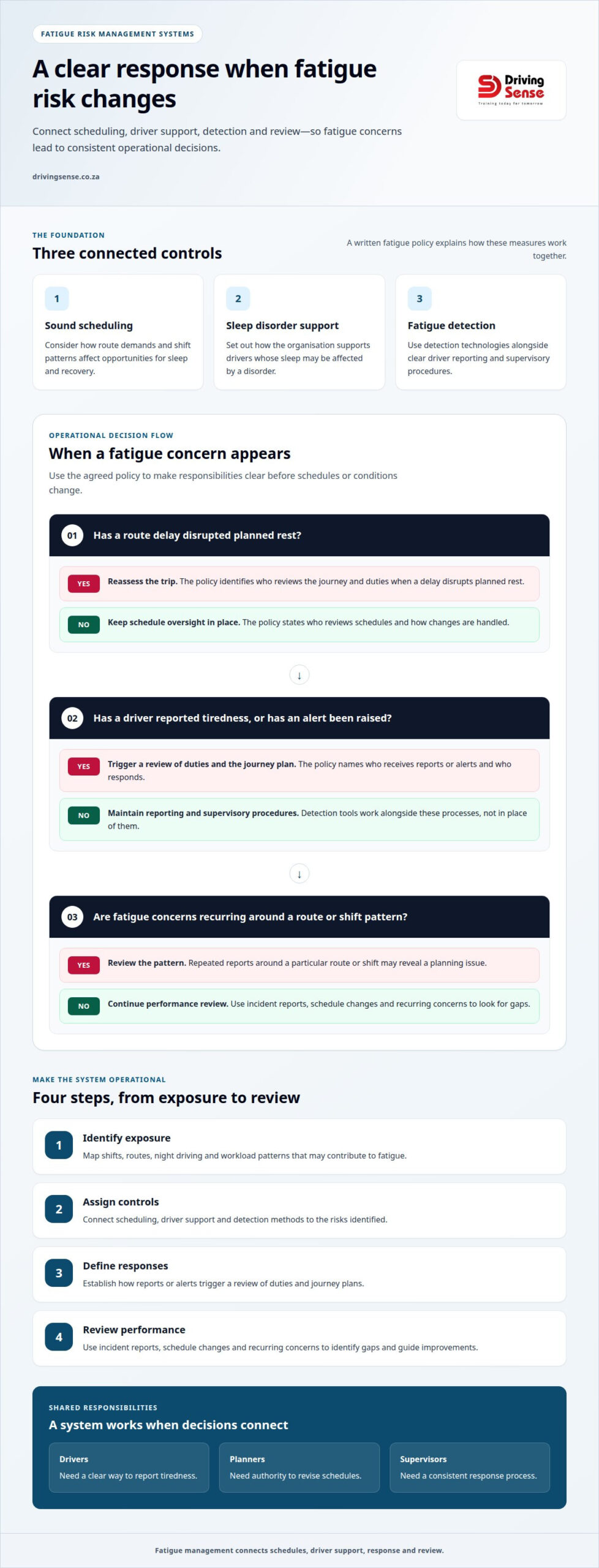
A fatigue risk management system brings separate safety measures together in an organised process for transport operations. It connects scheduling, driver support, fatigue detection and review, so potential causes are considered before a journey and addressed when operating conditions change.
Three elements provide a practical foundation: sound scheduling practices, a sleep disorder management programme and fatigue detection technologies. Scheduling considers how route demands and shift patterns affect opportunities for sleep and recovery. A sleep disorder management programme gives the organisation a defined way to support drivers whose sleep may be affected by a disorder. Detection technologies can provide another source of information, but work best alongside clear reporting and supervisory procedures.
A written fatigue policy should explain how these controls fit together. It can set out who reviews schedules, how drivers report concerns, who responds to alerts and how decisions are recorded. For example, if a route delay disrupts planned rest, the policy should identify who reassesses the trip, rather than leaving the driver to resolve the conflict alone.
Implementation is a sequence, not a document-only exercise:
- Identify exposure: map shifts, routes, night driving and workload patterns that may contribute to fatigue.
- Assign controls: connect scheduling, driver support and detection methods to the risks identified.
- Define responses: establish how reports or alerts trigger a review of duties and journey plans.
- Review performance: use incident reports, schedule changes and recurring concerns to identify gaps.
These steps also clarify responsibilities. Drivers need a way to report tiredness; planners need authority to revise schedules; and supervisors need a consistent response process. Without those connections, even a well-designed tool may generate information without changing operational decisions.
The system should account for the causes of fatigue, rather than treating every event as an isolated lapse. If reports repeatedly arise around a particular shift pattern or route, reviewing that pattern can reveal a planning issue. If concerns arise across different duties, the organisation may need to examine its reporting process or driver support arrangements.
Training helps staff understand how the policy works in practice, including what to report, who acts and how a decision is documented. A structured course can build this shared understanding across drivers and fleet supervisors. Explore fatigue management training as part of a broader approach that links learning with operational controls.
Review the system when routes, schedules or working arrangements change. This helps keep the policy relevant to actual transport operations, while records of decisions and recurring causes give managers a basis for refining controls over time.
Identifying and acting on signs of fatigue
Fatigue awareness depends on noticing changes in a driver’s alertness, behaviour and driving performance. Training gives drivers and supervisors a shared method for reporting those changes and responding before continuing becomes unsafe.
Recognising Driver Fatigue
Training can cover observable warning signs such as repeated yawning, heavy eyelids, difficulty concentrating and missing familiar turns. On the road, drifting within a lane or responding slowly to changing conditions can also prompt concern. Drivers may notice these changes first, while supervisors may hear about them during a check-in or handover.
Instruction should distinguish a single observation from a pattern that warrants action. For example, a driver who reports struggling to focus after a demanding shift needs a clear way to raise the concern. Teams should take reports seriously and not require drivers to prove their fatigue before responding.
Professional Strategies for Responding to Fatigue Signs and Risks
A response strategy should define what happens after a driver reports fatigue or a supervisor observes concerning behaviour. The immediate priority is to pause the journey safely and contact the designated supervisor. The supervisor can then assess the situation and decide whether the trip plan or work allocation needs to change.
Training should practise this sequence through realistic scenarios, such as a driver noticing repeated yawning before a long route or reporting poor concentration during a shift. This helps staff understand their responsibilities, use consistent language and escalate concerns without letting delivery pressure override a safety decision.
A practical response process can include these steps:
- Recognise: identify a change in alertness, behaviour or driving performance.
- Report: tell the nominated supervisor promptly, using the organisation’s reporting procedure.
- Pause and assess: stop driving when it is safe, then review the driver’s condition and immediate circumstances.
- Decide and record: determine whether duties or the journey plan should change, and document the action taken.
These steps need clear ownership. Drivers should know whom to contact, including when their usual supervisor is unavailable. Supervisors should know how to receive a report, assess the operational risk and communicate the decision to relevant colleagues. A consistent process also helps prevent conflicting instructions during a shift.
Training can prepare supervisors to consider context, including shift timing, recent work demands and the task still ahead. For instance, a driver reporting difficulty concentrating before a long remaining journey presents a different planning concern from a driver nearing a safe stopping point. The response should address the immediate risk, not treat the report as a routine scheduling inconvenience.
After an event, recording the warning signs, decision and outcome gives the organisation useful material for reviewing its procedures. If similar concerns recur during a particular shift or route, managers can examine whether existing controls address that pattern. Clear training reinforces that early reporting is part of fatigue management, not a failure of professional performance.
Practical Training for Staying Alert
Alertness depends on preparation, working conditions and timely decisions, not a single technique. Training can build practical skills for managing these factors and show drivers how personal wellbeing and fleet procedures support safer driving. For example, a driver preparing for a long-haul trip can plan for adequate sleep and know what to do if tiredness develops.
Drivers are advised to get a full night’s sleep before driving. Training can explain why this preparation matters and help drivers recognise when they have not rested enough. It should also make clear that alertness strategies during a journey do not replace sleep, and that drivers need a defined way to report concerns before fatigue affects their performance.
For long-haul trips, short naps can help drivers manage tiredness. Training should cover how a driver can use a planned pause, communicate with the fleet team and resume work in line with the organisation’s procedures. A nap is one practical measure, not a reason to ignore continuing fatigue or keep driving when alertness remains impaired.
- Prepare before departure: consider whether sleep and rest have supported readiness for the scheduled work.
- Plan a pause: identify suitable opportunities for rest during long-haul journeys.
- Report concerns: use the fleet’s established process when tiredness affects alertness.
- Reassess before continuing: follow the agreed procedure if a break has not resolved the concern.
Hydration is another practical consideration. A mildly dehydrated driver will make twice as many mistakes. Training can illustrate this risk with a driving example, such as reduced attention to route information or missing a change in traffic conditions. The emphasis should be on attending to basic needs, without presenting hydration as a cure for fatigue.
Lifestyle and health can also affect readiness for work. Training should address these subjects responsibly and practically, helping drivers understand when a health concern or poor sleep may affect safe performance. If a driver reports a recurring sleep problem, the appropriate response is to use the organisation’s support and reporting arrangements, rather than relying on personal coping strategies alone.
Professional alertness training can bring drivers and supervisors into the same process. Drivers practise communicating concerns, while supervisors learn to consider reports alongside scheduled duties and the remaining journey. For example, a driver who still feels tired after a planned pause should be able to raise the issue without receiving conflicting instructions about delivery expectations.
Employee wellness can complement this learning by supporting a workplace culture where health concerns are handled constructively. Training is most useful when it develops practical judgement, reinforces reporting procedures and links personal alertness with fleet planning. This helps teams respond to fatigue as an operational safety issue instead of expecting drivers to manage it alone.
Incident analysis and fatigue management plans
A fatigue-related incident should lead to more than an immediate response. A structured review examines what happened, which working conditions contributed and whether the organisation’s fatigue controls worked as intended. This makes incident analysis a practical basis for improving the fatigue management plan.
After a fatigue-related road accident, employers should document the event, preserve relevant operational records and review the controls involved. These are prudent incident-management actions; specific legal responsibilities depend on the circumstances and applicable South African requirements.
Begin the review by assembling a clear timeline. Record the driver’s assigned duties, route changes, reported concerns and relevant communications. For example, if a delivery delay altered the planned journey, note when the change occurred and how the revised plan was authorised. This helps separate the conditions surrounding the event from assumptions made afterwards.
A consistent analysis can follow these steps:
- Establish the sequence: record what occurred before, during and after the incident.
- Identify contributing conditions: examine work demands, schedule changes, rest arrangements and relevant reports.
- Review existing controls: determine whether the fatigue policy and response procedures were applied.
- Set corrective actions: assign responsibility for each change and record how implementation will be reviewed.
Look for patterns across records, rather than treating each case as unrelated. For example, repeated fatigue concerns associated with the same type of shift may point to a weakness in how work is allocated. More than 1/3 of men involved in fatigue-related accidents are under the age of 30, a reminder that incident reviews should examine the circumstances and work system, not rely on assumptions about an individual driver.
A fatigue management plan should turn findings into assigned actions. If a review identifies unclear escalation arrangements, the plan can specify who receives a concern, who makes the operational decision and how that decision is recorded. If it identifies gaps in staff understanding, training can reinforce the relevant procedure and clarify responsibilities.
Implementation requires follow-through. Managers can track whether assigned changes have been completed, whether staff understand revised procedures and whether similar concerns arise again. An incident record that ends with a recommendation but no assigned owner cannot show whether the control changed in practice.
Reviewing a plan after an incident also helps keep it aligned with actual working arrangements. Use the findings to update procedures, communicate relevant changes and incorporate lessons into future training. Discuss fatigue management training to support incident learning and more consistent workplace practice.
Employers should document the incident and relevant operational records, then assess whether fatigue controls were applied and effective. Specific legal duties depend on the circumstances and applicable South African requirements.
Driving Sense: Driver Training
Driving Sense provides Driver Training to help organisations strengthen driver capability and workplace safety. For fleets putting fatigue awareness into practice, training can help drivers recognise risks, follow reporting procedures and make safer decisions at work. It can also help managers connect driver conduct with broader safety and compliance requirements.
This is a practical next step when your fleet needs structured learning that reflects its operating procedures and fatigue-related risks. Training can complement existing scheduling, reporting and incident-review processes, helping teams apply consistent expectations across driving duties.
To discuss Driver Training for your organisation’s needs, contact Driving Sense.
Build Fatigue Controls into Everyday Fleet Practice
Make fatigue management part of routine fleet decisions, rather than treating it as a stand-alone training topic. Clear responsibilities, consistent reporting and planned reviews can keep procedures connected to the way work is organised.
Driving Sense offers Driver Training, Emergency Safety Training and Compliance Training to support workplace learning. For a fleet developing its approach, training can be considered alongside current operating procedures, staff responsibilities and lessons from incident reviews.
Driver fatigue management training in South Africa is most useful when its learning objectives reflect the organisation’s work. Define which roles need training, the situations drivers and supervisors must handle, and how the learning will fit existing fleet processes. This gives the organisation a clear basis for planning the next stage of its safety programme.
Discuss training with Driving Sense and take a considered next step towards strengthening fatigue management across your fleet.
Frequently Asked Questions
What is driver fatigue management training in South Africa?
Driver fatigue management training in South Africa teaches fleet staff to recognise fatigue risks and respond through agreed workplace procedures. It can help drivers understand how work patterns affect alertness, while helping dispatchers and supervisors incorporate fatigue considerations into operational decisions. For example, dispatchers can learn how to escalate a driver’s report of poor alertness before assigning another journey.
Which South African laws and regulations govern driver fatigue and working hours?
Requirements depend on the vehicle category, the work being performed and the applicable South African rules. Fleets should consider relevant road-traffic requirements alongside workplace health and safety obligations when setting fatigue controls and working-hour procedures. A single course should not be treated as a universal statement of every legal limit. Training can help staff follow the organisation’s procedures, which should reflect the rules relevant to its operation.
What topics are covered in a driver fatigue management course?
A course can cover factors that contribute to fatigue, how to recognise changes in alertness, and how drivers should report concerns. It may also address roster planning, rest arrangements, organisational policies and incident learning. Practical exercises can use scenarios such as a route change affecting a planned break, allowing drivers and supervisors to practise their roles and communication before facing a similar situation at work.
How can professional training help employers assess and manage driver fatigue?
Professional training can give employers a consistent way to review fatigue-related information and decide what action is appropriate. For example, managers can compare planned and actual duties, review fatigue reports, and consider whether route changes or workload contributed to a concern. Training also clarifies who records findings and assigns follow-up actions, so an assessment leads to a documented operational response rather than an informal discussion.
What are the warning signs and risks of driver fatigue for commercial drivers?
Warning signs may include difficulty maintaining a steady speed, overlooking familiar road features or reacting late to changing traffic. For commercial drivers, these changes can affect judgement and vehicle control, particularly when road or workload demands require close attention. Drivers who notice a change should use the fleet’s reporting procedure; supervisors should treat the report as relevant safety information, not simply a performance issue.
