

What should you look for in an advanced driving course for your fleet? The right programme is not necessarily the one with the most time behind the wheel. It is the one that addresses the risks your drivers actually face. Rising insurance premiums, avoidable collisions and occupational safety compliance gaps make driver training an operational priority, but a generic programme may not address the behaviours or vehicle-use patterns contributing to those risks.
Compare courses by their learning objectives, relevance to your fleet and the information they provide after training. This helps you assess value beyond completion records. This guide explains how to match training to your fleet’s risk profile, compare course providers and decide what evidence to track when reviewing driver behaviour, collisions and compliance documentation.
Driving Sense provides corporate safety and driver training across South Africa, with more than 20 years of experience and tailored courses for organisations. The practical criteria below can help you select a programme that supports safer driving, operational planning and documented safety standards.
Key Takeaways
- Assess an advanced driving course by how well it addresses your fleet’s specific risks, not by course format alone.
- Look for training that develops hazard perception and situational awareness alongside consistent vehicle-control practices.
- Compare defensive and advanced driving approaches, then check whether specialist modules suit your vehicles and operations.
- Ask providers about relevant credentials, instructional experience and how course content relates to your organisation’s safety framework.
- Use a tailored training approach to connect driver development with practical risk management and organisational continuity.
Defining the Strategic Value of an Advanced Driving Course
For a corporate fleet, advanced driving is not a performance hobby or simply a higher level of vehicle control. It is a structured way to develop safer decisions in the conditions drivers encounter at work, from changing traffic and weather to time pressure and competing demands on attention. A useful programme connects practical driving skills with the organisation’s vehicles, journeys and risk profile.
This makes driver development part of responsible operational governance. A collision can take a vehicle out of service, disrupt scheduled work and require time for reporting and follow-up. By strengthening hazard awareness and decision-making, an advanced driving course can support risk reduction and operational continuity. Outcomes depend on the quality and relevance of the training, as well as how consistently safe practices are applied.
The Evolution of Professional Driver Standards
A driving licence confirms that a person has met the applicable requirements to drive. It does not, on its own, demonstrate readiness for every commercial journey, vehicle or work-related pressure. Corporate leaders can use driver development to address risks before they contribute to an incident. The Defensive driving principles of anticipating hazards and planning for the unexpected provide a useful foundation.
Effective instruction also considers behaviour: how drivers manage distraction, respond to pressure and judge their own capability. Practice and feedback can help drivers make safer responses more consistently. When reviewing a course, ask how these skills are taught and whether the exercises reflect situations employees face in their roles.
Measurable ROI: Beyond the Safety Narrative
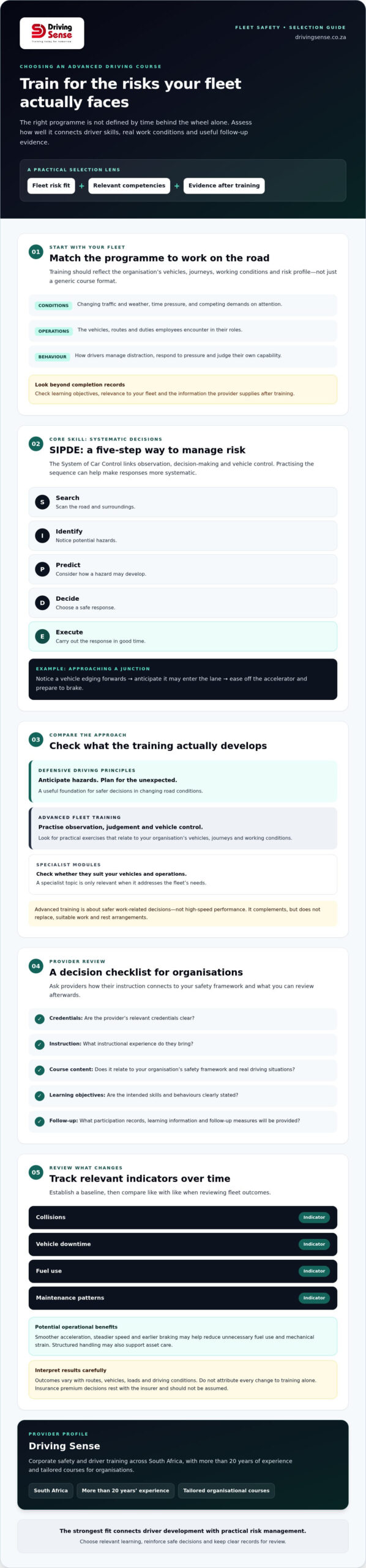
To assess value, establish a baseline and track relevant indicators over time, such as collisions, vehicle downtime, fuel use and maintenance patterns. Smoother acceleration, steadier speed and earlier braking may help reduce unnecessary fuel use and mechanical strain, but results vary with routes, vehicles, loads and driving conditions. Compare like with like and avoid attributing every change to training alone.
Structured vehicle handling can also support asset care by reducing avoidable harsh manoeuvres and associated wear. For insurance discussions, keep clear records of course participation, learning objectives and follow-up measures. This evidence may help demonstrate a systematic approach to fleet risk, but any premium decision rests with the insurer and should not be assumed.
Core Competencies: What Separates Advanced Training from Basic Lessons
For a corporate driver, advanced training is not simply more practice with a vehicle. It develops repeatable methods for noticing hazards, judging risk and responding appropriately, so safe decisions rely less on instinct alone. The curriculum should connect observation and planning with vehicle handling, using scenarios relevant to the organisation’s vehicles, journeys and working conditions. These are practical tools for managing everyday driving risks, not techniques for high-speed performance.
A well-designed programme also helps organisations set consistent expectations for driver behaviour. Look for clear learning objectives that relate to work duties and include opportunities to practise. Training should reinforce sound judgement in varied conditions, whilst recognising that driver capability is only one part of an effective safety system.
The System of Car Control (SIPDE)
The System of Car Control is a framework for reducing driving risk through structured observation, decision-making and vehicle control.
SIPDE breaks that process into five practical steps: Search the road and surroundings; Identify potential hazards; Predict how they may develop; Decide on a safe response; and Execute that response in good time. For example, on approach to a junction, a driver might notice a vehicle edging forwards, anticipate that it could enter the lane, ease off the accelerator and prepare to brake.
Practising this sequence can make observation and response more systematic, reducing reliance on last-minute reactions. Familiar routines may also make it easier to process foreseeable situations, although they do not remove fatigue or replace suitable work and rest arrangements. Managers can check whether course exercises help drivers apply the sequence to situations they actually encounter.
Mastering Vehicle Dynamics
Advanced instruction should explain how a vehicle responds during braking, steering and changes of direction. Weight shifts forwards under braking and sideways through a turn. Abrupt inputs, particularly on a slippery surface, can reduce stability. Tyres also have limited grip to share between braking, steering and acceleration, so demanding too much at once can compromise control.
Controlled practice can help drivers understand these principles and apply them safely. If skid-control or emergency-braking exercises are included, ask how they are conducted, what learning objectives they address and whether they relate to the fleet’s vehicles. The purpose is not to encourage risky manoeuvres, but to help drivers recognise vehicle limits, maintain space and respond progressively.
Observation completes the process: scan well ahead, check mirrors and blind spots, plan a suitable position and speed, then carry out a manoeuvre only when safe. Risk managers can discuss how corporate driver training may be tailored to their fleet’s vehicles and operational risks.
Comparing Advanced Driving Methodologies for Commercial Fleets
Commercial fleets rarely have a single training requirement. A delivery driver, a long-distance operator and an employee transporting dangerous goods may face different exposures. Course selection should begin with the work being performed, not a generic label such as “advanced”. Defensive driving generally centres on anticipating hazards and avoiding preventable incidents. Advanced driver training may extend into more demanding vehicle-control skills and scenarios. Since providers use these terms differently, compare the learning objectives rather than relying on the course name.
Consider vehicle type, journey profile, driver experience and the potential consequences of an incident. Specialist content may be relevant to heavy vehicles, high-occupancy transport or dangerous goods operations. Confirm that the provider’s scope, instructor experience and learning activities genuinely match those requirements. A course designed around performance driving, for example, may not address the routine risks of a commercial journey.
Tiered Training Frameworks
A tiered approach can help allocate training according to role and exposure. These levels are a planning framework, not a universal certification structure:
- Foundation: Defensive driving principles for employees who drive as part of their work, with emphasis on shared expectations and common road risks.
- Role-specific development: More in-depth training for high-mileage operators, shaped by their vehicles, journeys and relevant incident or behaviour patterns.
- Specialist requirements: Targeted learning for higher-risk duties, such as transporting dangerous goods or operating heavy vehicles, after confirming applicable competence and compliance needs.
This structure supports proportionate investment. Broad foundations establish a consistent safety baseline, while targeted modules focus attention where operational exposure is greater.
Selecting the Right Format for Your Organisation
On-site workshops may reduce travel and make it easier to discuss organisation-specific procedures, provided the location and activities suit the learning objectives. Facility-based sessions may be more appropriate when specialist equipment or a controlled practice area is required, such as for skid-control exercises. Confirm what each session includes, what facilities are used and whether practical activities reflect the fleet’s vehicles and conditions.
Pre-employment screening can help identify experience or role-related factors that warrant further assessment. It should inform, not replace, a considered training plan. Compare providers using practical questions: Does the content match actual duties? Is the format workable for the operation? Can the provider adapt modules to the organisation’s risk profile? A bespoke advanced driving course should make these connections clear before delivery, rather than rely on a one-size-fits-all syllabus.
The Corporate Decision Matrix: Evaluating Training Providers
Selecting an advanced driving course provider requires more than comparing course descriptions. Procurement and risk teams should establish whether the provider can demonstrate relevant instructional experience, explain how its training relates to the organisation’s safety and compliance framework, and supply records that support internal oversight. Ask what accreditation or recognition applies to the specific course, who delivers the instruction and how driver competency is assessed.
For a fleet operating across South Africa, delivery capacity also matters. Confirm how the provider will maintain consistent course objectives, communicate with managers and report completion across the operation. Driving Sense provides services nationally and has more than 20 years of experience in tailored corporate safety and driver training, with a focus on occupational safety, compliance and risk mitigation.
Compliance and Legislative Alignment
Rather than accepting a broad claim that training is “compliant”, ask the provider to explain how course content supports your organisation’s obligations and procedures. This may include discussing the Occupational Health and Safety Act and the National Road Traffic Act in relation to the work drivers perform. Course attendance alone does not establish compliance. Your organisation should confirm legal interpretation and requirements through its appropriate compliance advisers.
For audit and governance purposes, agree in advance what records will be supplied. Useful documentation may include attendance, course objectives, assessment outcomes and recommendations for follow-up, where these are part of the provider’s service. Clear records can help show how driver development fits into broader safety management and corporate responsibility processes.
Quality Indicators in Driver Education
Practical training depends on meaningful opportunities to practise and receive feedback. Ask about the student-to-instructor ratio, how much individual observation is possible and how instructors adapt activities when a driver needs further support. A low ratio may allow closer supervision, but the appropriate arrangement depends on the course design and practical exercises.
Reporting should give fleet managers more than a list of attendees. Ask whether results identify strengths, development needs and suggested next steps, and how that information will be handled. Refresher training can be considered when duties change, risk patterns recur or skills need reinforcement. Its timing should suit the organisation’s needs rather than rely on an unsupported universal interval.
For information about how tailored driver training can relate to fleet operations and compliance priorities, see Driving Sense’s corporate driver training.
Institutional Excellence: The Driving Sense Approach to Professional Development
Driver development is most useful when it forms part of an organisation’s wider approach to occupational safety, compliance and risk mitigation. Driving Sense provides tailored corporate safety and driver training across South Africa and has more than 20 years of experience. Its approach helps organisations consider how training can support their operational priorities. The aim is not to apply the same programme to every fleet, but to shape relevant learning around the risks and duties identified by the organisation.
A tailored advanced driving course can complement existing safety processes by helping drivers build skills relevant to their work, whilst giving managers a clearer basis for ongoing development. For a fleet with varied roles, consider vehicle types, journey demands and known areas of concern before deciding which training objectives are appropriate. Consistency across a national operation also matters: agree how shared standards will be maintained whilst allowing for different operating conditions.
A Consultative Partnership for Risk Managers
Risk managers can begin by reviewing available information, such as incident records, driver feedback, vehicle-use patterns and existing safety procedures. These details may help identify where additional driver development could be useful, but decisions should be grounded in the organisation’s evidence rather than assumptions about its workforce.
Pre-employment screening and ongoing training have different purposes. Where screening information is available and appropriate to use, it may provide context for a driver’s development needs. It should not replace assessing role requirements or delivering relevant instruction. Agree in advance what course records or assessment information the provider can supply. This documentation can be considered alongside internal compliance and insurance reporting requirements, without assuming it will determine an insurer’s decision.
Tailored training can fit more coherently with an established safety culture when its objectives reflect the organisation’s procedures and expectations. Driving Sense offers corporate compliance and risk mitigation training, with course needs discussed in relation to organisational priorities rather than a generic syllabus.
Next Steps in Fleet Optimisation
Start by defining the fleet’s main safety concerns, reviewing the information already available and identifying the roles that may require focused attention. Then consider how driver training could sit alongside existing employee wellness initiatives. Fatigue-related concerns, for example, can be considered as part of broader workplace wellbeing discussions, without treating driver instruction as a replacement for appropriate organisational controls.
For information about training options for a fleet operating across South Africa, see Driving Sense’s fleet safety programme.
Build a Safer, More Resilient Fleet
Choosing an advanced driving course is a strategic decision, not simply a training purchase. A suitable course reflects your fleet’s actual risks, develops practical observation and decision-making skills, and provides clear information for ongoing safety oversight. Evaluate course content, provider capability and reporting together to make driver development more relevant and its contribution easier to assess.
The process should continue beyond course completion. Use what you learn about fleet needs to guide future training priorities and reinforce consistent safety practices across roles. Driving Sense provides corporate safety and driver training nationally, with a focus on occupational health and safety compliance and risk mitigation.
To discuss a tailored driver training programme for your organisation, contact Driving Sense about fleet risk management.
Frequently Asked Questions
What is the primary difference between a defensive driving and an advanced driving course?
Defensive driving focuses on anticipating hazards and avoiding preventable incidents, whilst an advanced driving course may develop broader or more demanding skills in observation, decision-making and vehicle control. Providers do not always use the terms consistently, so compare the actual learning objectives, practical exercises and assessment methods. For a corporate fleet, the most suitable programme addresses the risks drivers face in their specific roles and vehicles.
How long does a typical corporate advanced driving course take to complete?
There is no single standard duration for a corporate advanced driving course. It depends on the syllabus, practical elements, group arrangements and the organisation’s needs. Ask the provider for a course schedule showing the time allocated to instruction, practice and assessment. This helps fleet managers plan driver availability and operational cover, whilst checking that the programme gives delegates sufficient opportunity to work towards its learning objectives.
Can advanced driving training really lower our company’s fleet insurance premiums?
Training may contribute to a broader safety programme, but a reduction in fleet insurance premiums is not guaranteed. Insurers make decisions based on their own criteria and assessment of the organisation’s risk. Ask your insurer whether driver training is relevant to policy discussions, and retain suitable course and safety records. Evaluate training on its wider operational value too, including driver development, risk management and compliance documentation.
Is advanced driving training suitable for drivers of all types of vehicles?
Training can be relevant to drivers of different vehicle types, but the course content and practical activities should match the vehicles and duties involved. A programme designed for one type of fleet may not address the handling considerations or operational risks of another. Before enrolling drivers, give the provider details of vehicle types, typical journeys and specialist tasks, then confirm which elements can be adapted to suit those requirements.
How often should employees undergo refresher advanced driving training?
There is no universal refresher interval that suits every organisation or role. Review the need for further training when duties or vehicles change, internal monitoring identifies recurring risks, or incidents indicate that existing skills may need reinforcement. Fleet managers can also use driver feedback and assessment records to identify development priorities. Set a review process that reflects operational risk and organisational requirements, rather than relying on an unsupported fixed timetable.
Does advanced driving training help with OHS Act compliance in South Africa?
Driver training can support an organisation’s occupational health and safety efforts by helping employees develop relevant knowledge and practical skills, but completing a course does not by itself establish compliance with the Occupational Health and Safety Act. Organisations should assess their own obligations and controls with appropriate compliance advisers. Ask providers how course objectives relate to workplace risks and what attendance or assessment records they can supply for internal review.
What kind of certification do delegates receive upon successful completion?
The certificate or other completion record depends on the provider and the specific course. Before booking, ask whether delegates receive a certificate of attendance, evidence of assessment or another document, and confirm what successful completion means. Check who issues the record, which competencies it covers and whether it has formal recognition relevant to your organisation. Do not assume that course completion represents a professional licence or statutory qualification unless this is clearly verified.
Can training be conducted on-site at our corporate premises?
Yes, Driving Sense can schedule sessions as on-site corporate workshops or at dedicated training facilities. The appropriate format depends on the learning objectives, group arrangements and whether practical exercises require a suitable controlled environment. Before confirming an on-site session, discuss the available space, facilities and vehicle requirements with the provider. This helps determine whether the location supports the planned activities and allows the organisation to consider driver availability and operational continuity.
