

What if the first step in how to reduce fleet accidents isn’t another training session, but a clearer picture of where risk is building? When incidents are recorded differently across drivers, routes and vehicles, recurring patterns can be hard to spot. That makes it harder to decide whether training, monitoring or operational changes should come first.
A consistent prevention programme starts with evidence, applies practical controls and checks whether they are working as intended. This article explains how to use incident and near-miss information to prioritise risks, choose responses that address driver behaviour, vehicle condition and operating conditions, and review progress over time.
You’ll find a structured way to move from incident review to targeted action, without treating any single intervention as a complete solution. The aim is to help your organisation make informed decisions, strengthen driver capability and maintain safety practices across a working fleet in South Africa.
Key Takeaways
- Learn how to reduce fleet accidents by comparing incidents and near misses with suitable measures of fleet exposure.
- Match prevention controls to identified risks across driver readiness, vehicle condition, journey planning and management oversight.
- Use targeted driver training to address specific capability gaps, while recognising that training alone cannot resolve every operational hazard.
- Build an action plan with clear ownership, review dates and escalation steps for controls that are overdue or ineffective.
- Consider how tailored driver training and professional evaluations can support your organisation’s documented driver and operational needs.
How to reduce fleet accidents by identifying the risks behind them
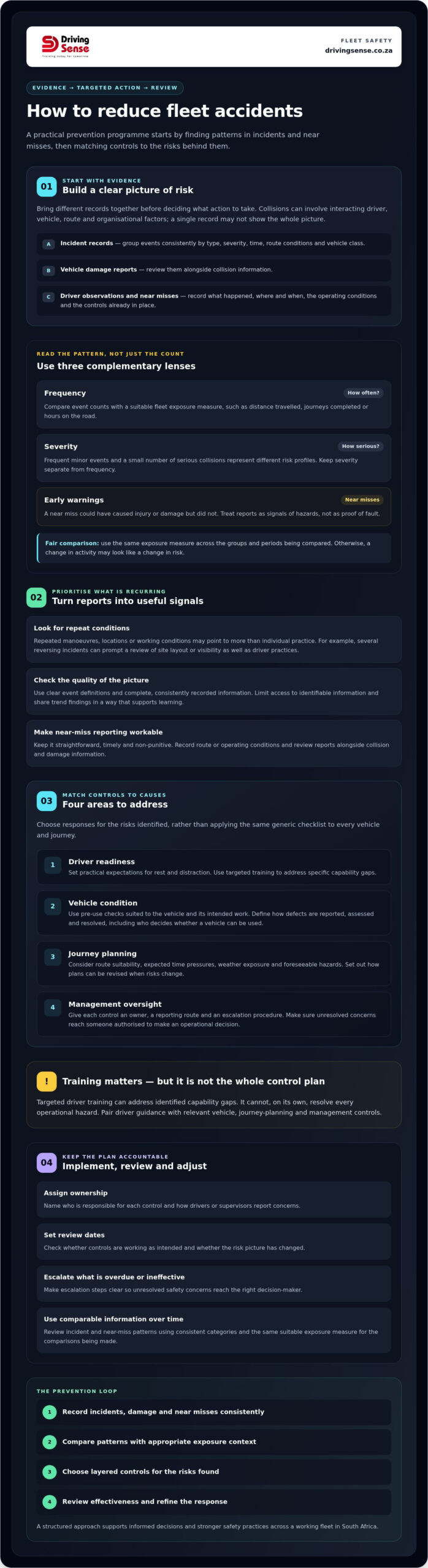
Collisions rarely have a single cause. Driver behaviour, vehicle condition, route characteristics and organisational decisions can interact, so focusing on one factor may hide the conditions that contributed to an incident. Bring incident records, vehicle damage reports and driver observations together. Look for recurring patterns before deciding what action to take or assigning blame.
Separate collision frequency from severity: frequent minor events and a small number of serious collisions represent different risk profiles. Near misses offer an early-warning perspective, while exposure provides context for fair comparisons. For example, comparing event counts with distance travelled can help distinguish a higher underlying rate from a fleet that simply completes more journeys. These connected human, vehicle and road factors are also reflected in broader road traffic safety principles.
Which fleet incident patterns should managers examine first?
Group events using consistent categories, such as event type, severity, time, route conditions and vehicle class. Then compare counts with a suitable exposure measure, such as distance travelled, journeys completed or hours on the road. Use the same measure across the groups and periods being compared. Otherwise, an apparent change may simply reflect a different level of fleet activity.
Look for repeated manoeuvres, locations or working conditions. Several reversing incidents, for instance, may point to a site layout or visibility issue as well as a need to review individual practices. Check that records describe events consistently and are complete enough to support comparisons. Limit access to identifiable information and share trend findings in a way that supports learning.
How can near misses reveal preventable fleet risks?
Make near-miss reporting straightforward, timely and non-punitive. A near miss is an event that could have caused injury or damage but did not. Treating it as an early warning can help reveal a hazard before it results in a collision. The aim is to understand contributing conditions, not to assume fault.
Record what happened, where and when it occurred, the relevant route or operating conditions, and which controls were already in place. Consistent records make it easier to compare reports and spot recurring signals, such as restricted visibility, a difficult manoeuvre or time pressure. Review these reports alongside collision and damage information, since each source may reveal a different part of the risk picture.
To determine how to reduce fleet accidents, managers need information that is comparable and detailed enough to guide action. Clear definitions, complete records and appropriate confidentiality safeguards create a reliable basis for prioritising risks in the next stage of prevention.
Which fleet safety controls prevent collisions before journeys begin?
Once priority risks are clear, choose controls that address their causes instead of applying a generic checklist to every vehicle and journey. Organise the response around four areas: driver readiness, vehicle condition, journey planning and management oversight. If incident reviews raise fatigue concerns, for example, review scheduling and rest expectations alongside driver guidance. If reports identify recurring vehicle defects, strengthen pre-use checks and the process for resolving reported issues.
Give every control an owner, a reporting route and an escalation procedure. Drivers should know who to contact about a defect or unsafe route. Supervisors should know how to respond, and unresolved concerns should reach someone authorised to make an operational decision. Layered controls are more resilient because if one safeguard is missed, another may still prevent the risk from reaching the road.
How should vehicle and journey risks be controlled?
Use pre-use checks suited to the vehicle and its intended work. Record the findings and provide a clear, prompt process for reporting defects. Decide who assesses a reported concern and how the organisation determines whether the vehicle can be used. Don’t leave that decision to informal assumptions. If a safety issue remains unresolved, establish an escalation route before the journey proceeds.
Journey planning should account for route suitability, expected time pressures, weather exposure and foreseeable hazards. A planned route is not automatically a safe route. For instance, a delivery schedule with no allowance for delays may create pressure to continue despite changing conditions. Set out how drivers can report concerns and how managers can revise plans when risks change.
How can managers support safer driver decisions?
Set practical expectations for rest, distraction management and prompt hazard reporting, then reinforce them through consistent supervision. A written policy has limited value if drivers fear blame for reporting a concern or if schedules make safer decisions difficult. Supervisors should follow up reports, document decisions and check whether agreed controls were applied, rather than simply confirming that a policy exists.
For organisations reviewing external guidance, the Federal Motor Carrier Safety Administration publishes US commercial motor vehicle information. It is not a substitute for checking which requirements apply to operations in South Africa. Keep local compliance checks distinct from operational controls, and ensure both are reviewed by the appropriate responsible personnel.
Driver capability is one part of this framework. Where identified risks point to a skills or behaviour gap, organisations can consider tailored driver training alongside appropriate vehicle, route and supervisory controls. The next step is to assess whether training alone addresses the risk pattern or whether wider changes are also needed.
Does driver training alone reduce fleet accidents?
No. Driver training can build knowledge and practical capability, but it can’t resolve every hazard created by vehicle condition, route design, unrealistic schedules or unclear procedures. If an organisation responds to every collision with a course, it may overlook the operational conditions that contributed to the event. Training is most useful as one control in a wider prevention programme, selected in response to evidence and reinforced at work.
This distinction matters when deciding how to reduce fleet accidents: attendance records show who completed training, not whether driving behaviour changed or underlying risks were controlled. The US Occupational Safety and Health Administration’s guidance on workplace motor vehicle safety offers a workplace perspective. Organisations in South Africa should assess local requirements separately and avoid treating overseas guidance as local legal advice.
When is driver training an appropriate fleet risk control?
Start with the observed gap. If incident trends point to difficulty with a recurring manoeuvre, instruction can focus on the relevant skills. If work requirements or vehicle types change, learning may need to address those demands. Broad awareness can establish shared expectations, while practical, role-specific development can help drivers apply them to their duties.
Refresher learning or individual coaching may suit a pattern that persists after initial instruction, but first check for system-level contributors. A professional driver evaluation can help assess competency and identify individual development needs, giving managers a more specific basis for selecting support than course attendance alone.
What should reinforce training after the course?
Managers and supervisors have an ongoing role. Use structured conversations and documented observations to reinforce expected behaviours, answer questions and identify where further support may be needed. Follow up consistently and focus on learning, not only on recording non-compliance.
Check whether the working environment supports what the training asks drivers to do. Safe decisions may be difficult to sustain, for example, if schedules leave no room to respond to delays or if hazard-reporting procedures are unclear. Review relevant processes and equipment as well as driver practice, so that unchanged operational pressures don’t undermine a skills intervention.
Track participation, planned follow-up and relevant risk indicators, such as recurring incident types or near-miss reports. Interpret these measures cautiously: a change after training doesn’t, by itself, prove that training caused it. Compare trends over time, consider other operational changes and record whether agreed actions were completed. This helps the organisation judge whether learning is being reinforced and whether further controls are needed.
How to implement and measure a fleet accident-prevention plan
A prevention plan needs a defined starting point, clear accountability and regular review. Make it practical by working through four stages: establish a baseline, prioritise risks, assign controls and assess progress. Use a consistent reporting period and record which vehicles, routes or work groups are included, so later comparisons remain meaningful.
- Establish a baseline: compile available collision, near-miss and exposure information, and note gaps in the records.
- Prioritise risks: select patterns that warrant action, considering both event severity and how often drivers encounter the relevant conditions.
- Assign controls: record each action, its accountable owner, due date, reporting route and escalation point.
- Review progress: check implementation, examine indicators and document whether controls should be retained or revised.
Set review dates when actions are assigned rather than waiting for the next incident. If a control is overdue, escalate it to someone able to resolve the delay. If it has been implemented but the risk remains, record that finding and reassess the response.
Which fleet safety indicators are useful to monitor?
Separate implementation measures from outcomes. Implementation measures show whether planned work is happening, such as training participation, completed follow-up actions, reporting completeness or corrective actions closed by their due dates. Outcomes show what is happening on the road, including collision frequency and severity and near-miss patterns.
Where reliable mileage or journey data is available, compare incident counts with a consistent exposure measure. Keep definitions and reporting periods stable, and treat small data sets cautiously: one event can substantially alter a short-term rate. A change after introducing a control does not, on its own, establish that the control caused the change.
How can managers turn review findings into action?
Include drivers, supervisors and relevant operational stakeholders in periodic reviews, since each group may see different barriers to putting controls into practice. Ask what was completed, what remains outstanding and whether procedures or working conditions are undermining the intended change. Retain suitable controls, revise weak measures and document the reasons so future decisions have a clear evidence trail.
Review findings can also inform a structured corporate fleet safety training programme, with learning needs linked to observed risks rather than assumed in advance. If driver capability is a priority in your plan, discuss tailored driver training as one part of a broader prevention approach.
How Driving Sense can support safer fleet driving
Once an organisation has documented its driver and operational needs, it can choose support that addresses specific priorities rather than relying on a generic course. Driver training is most useful when its objectives reflect evidence, such as an observed competency gap, a recurring incident pattern or a change in work requirements. It should complement, not replace, appropriate vehicle checks, journey controls, supervision and incident review.
What should organisations clarify before selecting driver training?
Identify the fleet roles involved, the competency concerns to address and any relevant incident or near-miss patterns. Then define what the learning or assessment should help the organisation understand or improve. A broad awareness objective, for example, differs from a practical development need connected to a particular vehicle or work task. Clear objectives make it easier to select relevant support and decide whether follow-up is required.
Discuss how training or evaluation can fit operational requirements, including how participation will be arranged and what follow-up managers can provide. Don’t treat course completion as proof that risk has changed. Instead, consider how supervisors will reinforce learning and how the organisation will review relevant indicators afterwards.
How can driver training fit a wider prevention programme?
Training can build driver capability, while professional evaluations can give an organisation a clearer view of individual competency and potential development needs. These measures work best alongside practical controls: checking vehicles, planning journeys, supporting safe decisions and reviewing incidents consistently. If a risk stems from operational pressure or a vehicle issue, training alone won’t resolve it.
Driving Sense provides tailored driver training and professional driver evaluations to organisations nationally across South Africa, drawing on more than 20 years of experience. Organisations can use documented needs to guide a discussion about appropriate support, without assuming that training will guarantee a particular safety outcome.
Before taking the next step, confirm the priority risk, identify the drivers or roles involved, set a clear learning or assessment objective, and decide how follow-up will be reviewed. If your organisation is considering driver training as part of its prevention programme, discuss driver training for your organisation.
Make fleet safety a consistent operational priority
Reducing collisions starts with understanding the risks behind them, then applying controls that address driver capability, vehicle condition, journey demands and management practices. Reliable incident and near-miss records help organisations identify priorities, while assigned responsibilities and regular reviews keep prevention actions moving. Training can strengthen driver capability, but it should support a wider programme rather than stand in for operational controls.
A practical approach to how to reduce fleet accidents is to use evidence to guide decisions, follow up on agreed actions and assess indicators over time. This gives your organisation a clearer basis for refining its prevention programme without assuming that one intervention will address every risk.
Driving Sense provides tailored driver training and professional driver evaluations to organisations nationally across South Africa, drawing on more than 20 years of experience. If your findings point to a driver capability need, discuss tailored driver training and evaluations for your organisation.
With clear priorities and consistent follow-through, your organisation can continue strengthening safer fleet practices across its operations.
Frequently Asked Questions
What is the most effective way to reduce fleet accidents?
The most effective approach is an evidence-led programme that combines controls for drivers, vehicles, journeys and management practices. Review collision and near-miss information to identify recurring risks, then assign specific actions with owners and review dates. For fair comparisons, use consistent definitions and consider exposure, such as distance travelled. Monitor whether controls are implemented and whether risk indicators change, rather than relying on one intervention or a short-term result.
Can driver training reduce fleet accidents on its own?
No. Driver training can build capability, but it can’t resolve every hazard. A course may address an identified skills or knowledge gap, while unsafe schedules, unclear procedures, vehicle concerns or difficult route conditions may require separate controls. Match training to observed needs, then reinforce learning through supervisor conversations and practical follow-up. Attendance confirms participation, not necessarily a change in behaviour or a reduction in risk.
How can fleet managers identify the main causes of accidents?
Fleet managers can identify likely contributing factors by reviewing incident records, vehicle damage reports and driver observations together. Classify events consistently by type, severity, time, route conditions and vehicle class, then look for repeated patterns without assuming an individual is at fault. Compare incident counts with distance travelled or another reliable exposure measure. Check record completeness and confidentiality before using the information to prioritise controls.
What should a fleet incident investigation include?
A fleet incident investigation should establish what happened and identify contributing conditions, rather than focus solely on assigning blame. Record the event’s time, location, type and severity, gather relevant driver observations, and review vehicle damage, route or weather conditions and existing controls. Note information gaps and protect personal details appropriately. Consistent records help managers compare events, identify system-level concerns and decide which corrective actions need an owner and follow-up.
How often should fleet drivers receive safety training?
There isn’t one interval that suits every fleet. Set training frequency according to documented needs, work requirements and changes in risk. Consider targeted instruction when records or evaluations identify a competency gap, and review whether refresher learning is appropriate when procedures, vehicles or duties change. Managers should also use follow-up observations and conversations to check how learning is applied. Don’t treat a fixed schedule or course attendance alone as evidence of safer driving.
Which fleet safety indicators should an organisation monitor?
Monitor whether prevention actions are being completed and whether risk outcomes are changing. Useful measures include collision frequency and severity, near-miss reports, incident-record completeness, training participation and corrective actions closed by their due dates. Where reliable mileage or journey data is available, use it to calculate exposure-based rates. Keep definitions and reporting periods consistent, and interpret small data sets cautiously: a short-term change doesn’t establish that a control caused the outcome.
How can near-miss reporting help prevent fleet accidents?
Near-miss reporting can reveal hazards before they result in injury or damage. Encourage timely, non-punitive reports and use a consistent format to record what happened, where and when, contributing conditions and controls already in place. Reviewing these reports alongside collision information can expose recurring risks that incident counts alone may miss. Protect confidentiality, use findings to assign practical actions, and check whether those controls were implemented and remain suitable.
