

What if a hazchem certificate proves a driver has completed training but does not, on its own, authorise them to transport dangerous goods? In South Africa, the term commonly refers to training evidence. This is distinct from the government-issued Professional Driving Permit for Dangerous Goods (PrDP-D). Confusing the two can leave drivers and employers unsure whether the required documentation is in place.
The requirements can seem difficult to untangle because a driver’s training and permit are only part of the picture. Obligations may also depend on the vehicle and the load. This article explains what a Hazchem certificate generally means, how it relates to dangerous goods transport, and what to review before a journey is authorised.
You’ll also learn how to approach training and keep compliance records organised. Driving Sense provides dangerous goods training nationwide, supporting workforce competence as part of a wider process that includes checking applicable permit, vehicle and load requirements.
Key Takeaways
- A hazchem certificate commonly refers to evidence of dangerous goods training. It is distinct from the relevant driving authorisation.
- Identify the driving role and load, then verify current requirements before arranging training and assembling documentation.
- Assess compliance across the driver, vehicle, load documents and employer records, rather than relying on one certificate alone.
- Use a pre-transport check to confirm that required documents and load-specific preparations are in place.
- Driving Sense delivers dangerous goods training nationwide, with a focus on building competence as part of a wider compliance process.
What does a Hazchem certificate mean in South Africa?
In South Africa, a hazchem certificate commonly means a document showing that a person has attended or completed dangerous goods training. The term is used inconsistently, so do not treat it as the formal name of a permit or as proof that every requirement for a particular journey has been met.
In common usage, a Hazchem certificate is evidence of dangerous goods training, not a driving permit, although the exact meaning depends on how the term is being used. Hazchem also refers to a warning system used to communicate information about hazardous substances. This is separate from a course document: the Hazchem warning system uses an Emergency Action Code and UN number to convey information relevant to responding to an incident.
Is a Hazchem certificate the same as a PrDP D?
No. A training certificate records learning or course completion, depending on what the document states. A Professional Driving Permit (PrDP) is a separate driving authorisation, and a dangerous goods category may apply to particular driving duties. The documents serve different purposes: one records training evidence, while the other relates to permission to drive in applicable circumstances.
Drivers and employers should verify the applicable PrDP category against current official requirements before arranging transport. Do not assume the same requirements apply to every journey. They can depend on the driver’s role, the vehicle, the load and the rules that apply to that movement.
What does a dangerous goods training certificate show?
Read the document itself. Depending on its wording and the provider’s records, it may show participation in training or successful course completion. It is not proof of a permit, and its title alone does not confirm that every legal or operational requirement has been met.
For employers, training documents can form part of workforce records. They help track who has undertaken relevant learning and support ongoing competence and compliance processes. Record the document’s details consistently, then review them alongside the driver’s authorisation and the transport arrangements. A course document does not replace applicable vehicle provisions or the documentation required for the load.
The practical distinction is simple: training evidence shows what learning a document records; a permit addresses driving authorisation where required; and vehicle and load obligations need separate consideration. Keeping these elements distinct helps prevent a familiar label from being mistaken for complete transport clearance.
How does a driver obtain the relevant Hazchem training and documentation?
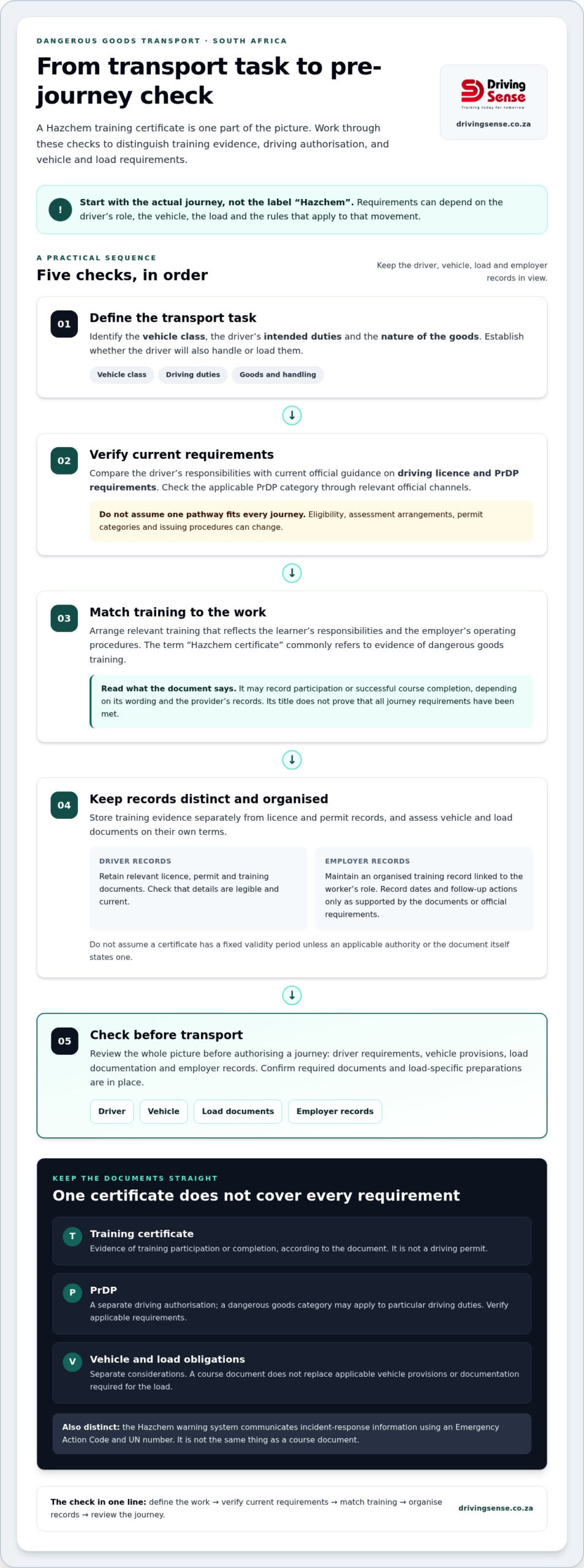
Start with the work the driver will actually perform, rather than booking a course based only on the phrase “Hazchem”. The relevant training and documents depend on the driving role, vehicle, goods and current requirements. A practical sequence is to define the transport task, verify the rules, arrange relevant training, then check that the resulting records and authorisations are in order.
What should drivers check before booking training?
Before arranging training, identify the vehicle class, intended duties and nature of the goods. Establish whether the driver will also handle or load them. The employer and driver can then compare those responsibilities with current official guidance on driving licence and PrDP requirements. Eligibility, assessment arrangements, permit categories and issuing procedures can change, so verify them through the relevant official channels rather than relying on a course advertisement or another operator’s process.
Training should match the learner’s responsibilities and the employer’s operating procedures. For an overview of the standards and institutional roles underpinning South African dangerous goods transport, consult the Chemical and Allied Industries’ Association’s Regulatory Framework for Dangerous Goods. Requirements may differ according to the load and journey, so do not treat one course pathway as a universal rule.
What records should learners and employers retain?
Keep training evidence separate from driving licence and permit records so each document can be checked for its intended purpose. Record course completion dates and any renewal dates only as shown on the relevant document or required by current official guidance. Do not assume a certificate has a fixed validity period unless that period is stated by an applicable authority or on the document itself.
- Driver: Retain the relevant licence, permit and training documents. Check that the details are legible and current.
- Employer: Maintain an organised training record linked to the worker’s role, and note follow-up actions supported by official requirements or the records themselves.
- Transport planning: Keep the driver’s records distinct from vehicle and load documentation, which must be assessed separately.
Booking steps, course formats and administrative processes can vary. A provider’s schedule is not, by itself, a national standard. For further certificate context, see the article on the dangerous goods certificate in South Africa. Once the relevant requirements are clear, dangerous goods training for workplace competence can support an organisation’s wider compliance process alongside verification of permits and transport duties.
Which dangerous goods transport requirements should drivers and employers distinguish?
Dangerous goods transport involves separate checks for the driver, vehicle, load and employer’s records. The applicable controls can depend on how the goods are classified, the quantity being carried, the vehicle and the journey. Avoid applying one checklist to every consignment. Verify the current South African rule and its scope for the specific movement before dispatch.
The table below provides a review framework, not a substitute for checking the legislation and standards that apply. For each item, establish who is responsible operationally and confirm the current requirement through official guidance.
| Area | Responsibility to establish | What to verify before transport |
|---|---|---|
| Driver authorisation | The employer or transport operator should match each driver to the assigned duties; the driver should hold the relevant documents. | Check the current licence and any applicable PrDP category against official requirements for the role, vehicle and load. |
| Training evidence | The employer should maintain records, and the driver should be able to produce the relevant course evidence where required. | Confirm what the certificate records and whether current rules require specific training for the duties. A hazchem certificate alone does not establish full transport compliance. |
| Vehicle provisions | The vehicle operator is responsible for determining whether the vehicle is suitable and correctly prepared for the task. | Verify applicable vehicle, marking, placarding and equipment requirements against current rules and the vehicle’s use. |
| Load documentation and controls | The parties responsible for preparing and carrying the consignment should establish which documents and controls apply. | Check the goods’ classification and quantity, required emergency information, packaging and any compatibility controls against current requirements for that load. |
| Employer records | The employer should maintain traceable records and assign responsibility for resolving gaps. | Review training, driver, vehicle and consignment records together, recording the source used to verify each applicable requirement. |
How do driver, vehicle, and load responsibilities differ?
Driver readiness concerns authorisation and relevant competence. Vehicle preparation concerns whether the vehicle meets applicable requirements. Load controls concern the particular goods and consignment. Check placards, emergency information, equipment and compatibility against the actual load and current rules, rather than assuming they apply identically in every case.
Training documentation alone cannot establish full transport compliance, because the driver, vehicle and load each require separate, applicable checks.
What should an employer include in a compliance review?
Match each employee’s assigned duties with current licence, permit and training records. Then review vehicle and consignment documentation against the goods and journey. Keep an action log that identifies the gap, the person responsible, the follow-up date and the evidence used to close it. If a legal or technical point is uncertain, verify its current wording and scope before authorising transport.
How can drivers and employers check Hazchem compliance before transport?
A pre-transport review brings the driver’s records, vehicle preparation and consignment information together for the specific journey. Use the checklist below as an operational prompt, then verify each regulatory or technical item against current official requirements. The checks can differ according to the goods, their classification and quantity, the vehicle and the driver’s assigned duties.
What should be checked before a journey begins?
- Driver documents and training: Match the driver’s licence, any applicable permit and training evidence to the duties assigned. Verify current requirements for the driver, role and load rather than assuming one certificate or category applies to every journey.
- Load identification and information: Confirm that the goods and their classification are correctly identified, and that required accompanying and emergency information is available. Verify current documentation requirements for that consignment.
- Vehicle provisions: Review the vehicle’s suitability and any applicable markings, placards or equipment. Verify the current rules for the vehicle and load; do not treat any single feature as universally required.
- Unresolved issues: Escalate uncertain classifications, missing documents or inconsistencies through the organisation’s compliance process. Hold assignment of the relevant transport duty until the gap has been resolved and recorded.
Safe dangerous goods transport depends on competent drivers, correct documents and preparation matched to the specific load.
How should employers manage training and permit records?
Maintain an organised record for each relevant employee, with access limited to staff who need the information for operational or compliance purposes. Keep course evidence distinct from licence and permit records. Use dates printed on authoritative documents or specified by current official requirements when scheduling reviews. Do not assume a standard renewal interval where the applicable document or rule does not establish one.
Before assigning duties, compare the employee’s records with the work they will undertake. If evidence is missing, unclear or no longer supports the role, assign someone to obtain or verify the required documentation and record the follow-up. Where a practical skills gap is identified, consider whether further instruction or assessment is appropriate, then document the action taken.
For a wider organisational training framework, consult a dangerous goods training buying guide alongside your internal compliance process. Driving Sense provides dangerous goods training to support workplace competence as part of that wider process, not as a replacement for checking permits or transport requirements. Explore dangerous goods training for your organisation.
How can Driving Sense support dangerous goods training and workplace competence?
Dangerous goods training is most useful when it reflects employees’ work and the organisation’s safety requirements. It can help staff understand their responsibilities and build relevant competence, while formal compliance processes establish which permits, vehicle provisions and load documents apply. Training supports that framework; it does not replace legal checks or authorisation.
Driving Sense was founded in 2006 and delivers training nationwide across South Africa. Founder Natalie Rodrigues brings 11 years of experience at Super Group’s Truck Rental Division, providing a transport-sector perspective on the operational context in which drivers and employers work. The organisation’s approach places compliance alongside practical competence, without treating a course document as proof that every transport obligation has been met.
Why connect compliance training with practical competence?
Employees need to understand more than which records are required. Depending on their responsibilities, they may need to recognise load information, follow workplace procedures and understand how their actions fit into safe transport operations. Relevant instruction can reinforce this understanding, while employers continue to manage permits, vehicle readiness, load documentation and record-keeping through their compliance processes.
For example, an organisation can consider whether drivers’ training relates to their assigned duties and whether staff involved in preparing or handling consignments understand the procedures relevant to their roles. Reviewing these needs alongside current requirements helps employers identify where further instruction or a record review may be appropriate. A hazchem certificate should be considered in that context, not as a stand-alone measure of workforce readiness.
What is a sensible next step for an organisation?
Begin by reviewing the transport activity: the roles involved, the goods carried and the processes used to prepare and document each consignment. Compare those responsibilities with current requirements, relevant employee records and the organisation’s safety procedures. This helps identify training needs and documentation to review before an employee is assigned a relevant duty.
Driving Sense’s dangerous goods training can form part of this structured approach to workforce competence. Keep the purpose clear: training supports learning, while the employer remains responsible for verifying applicable permits and transport requirements. To explore training for your organisation, explore dangerous goods training with Driving Sense.
Put a clear dangerous goods compliance process in place
A hazchem certificate generally provides evidence of dangerous goods training. It does not replace applicable driving authorisation or checks on the vehicle and load. Match training and records to each person’s duties, then verify current requirements for the specific transport activity before assigning the work.
For employers, keeping training evidence, permits and journey-specific documents organised makes responsibilities easier to review and gaps easier to address. Training should support both compliance and practical competence as part of the organisation’s wider safety process.
Driving Sense was founded in 2006 and delivers training nationwide across South Africa. Founder Natalie Rodrigues brings an 11-year transport-sector background, and the company’s training approach emphasises compliance alongside competence. Explore dangerous goods training with Driving Sense as a considered next step in strengthening your workforce’s preparedness.
With clear records, relevant training and current checks in place, your organisation can take a more structured approach to dangerous goods transport.
Frequently Asked Questions
What is a Hazchem certificate in South Africa?
A Hazchem certificate commonly refers to evidence that a person has attended or completed dangerous goods training, although the term is used inconsistently. Check what the specific document records rather than assuming its title confirms a permit or full compliance. Training evidence is one part of the picture; applicable driver authorisation, vehicle provisions and load documentation must be considered separately under current requirements.
Who needs a Hazchem certificate to transport dangerous goods?
Whether a driver needs dangerous goods training depends on the current rules for the transport activity, including the goods, quantity, vehicle and driver’s role. Do not assume every journey has identical requirements or that the phrase “Hazchem certificate” identifies a universal legal document. Employers should assess the specific task, then verify applicable training and permit requirements through current official guidance before assigning the duty.
How do you get a Hazchem certificate in South Africa?
First identify the driver’s duties, vehicle and goods, then verify current training and permit requirements. Arrange relevant dangerous goods training that corresponds to the work, and retain the resulting course evidence. Next, check any required driving authorisation and the separate vehicle and load documentation. Eligibility, assessment, issuing and renewal processes can vary, so confirm current details through the relevant official authority and applicable documents.
Does a dangerous goods training certificate expire?
Do not assume a single expiry period applies to every training document. Check the certificate for any stated validity or review date, and verify whether current official requirements specify refresher training for the driver’s duties. Keep course evidence separate from permit records, since a permit’s review or renewal requirements may differ. Employers should schedule follow-up using authoritative documents, not an assumed standard interval.
Can you transport dangerous goods with a course certificate alone?
No. A course certificate alone should not be treated as authorisation to transport dangerous goods. It may provide evidence of training, but the journey may also require an applicable driving permit, vehicle provisions, load information and other documentation. The precise requirements depend on the transport activity and current rules. Before dispatch, the employer should verify the driver, vehicle and consignment separately.
What documents should an employer check before assigning dangerous goods transport?
Review the driver’s licence, any applicable PrDP and relevant training evidence, then check vehicle records and the documents accompanying the specific load. Verify requirements for classification, placarding, emergency information and other provisions against current rules for that consignment. Keep these records clearly identifiable, note any gaps, assign responsibility for resolving them and retain evidence of follow-up before the relevant duties are assigned.

Pingback: HAZCHEM Training South Africa: What Employers and Learners Need to Know – Driving Sense