
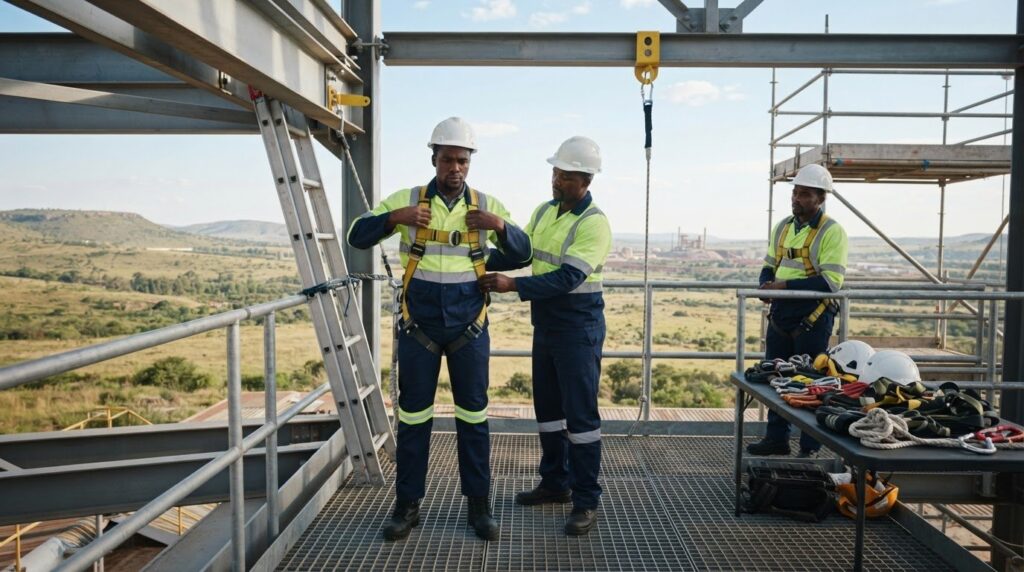
A two-year expiry is not a universal rule for working-at-heights certificates in South Africa. SAQA Unit Standard 229998 does not establish a universal two-year expiry period, although a South African client or principal contractor may require renewal every two years as a site-access condition. The working at heights certification requirements in South Africa therefore involve more than checking a date: the training scope and the certificate details also matter.
For employers and workers, the practical question is what working at heights certification requirements in South Africa mean for safe work. Training should prepare workers to use fall-protection systems and equipment and follow site rescue arrangements. The right course depends on the work being done.
This article explains core training topics, differences between fall-arrest, ladder and scaffolding courses, and which certificate details to review. It also explains how South African requirements relate to fall-protection planning and why site renewal conditions may differ from a universal expiry rule.
Key Takeaways
- Understand how fall-protection planning connects training, equipment controls and rescue arrangements.
- Identify when a worker’s task or a change in work conditions may call for refresher training or a competence reassessment.
- Distinguish between fall-arrest, ladder and scaffolding training by the work each course is intended to address.
- Know which certificate and training-record details to review when assessing renewal needs.
- Separate a site’s certificate-renewal condition from a universal expiry rule.
Fall-protection plans, equipment controls and rescue arrangements
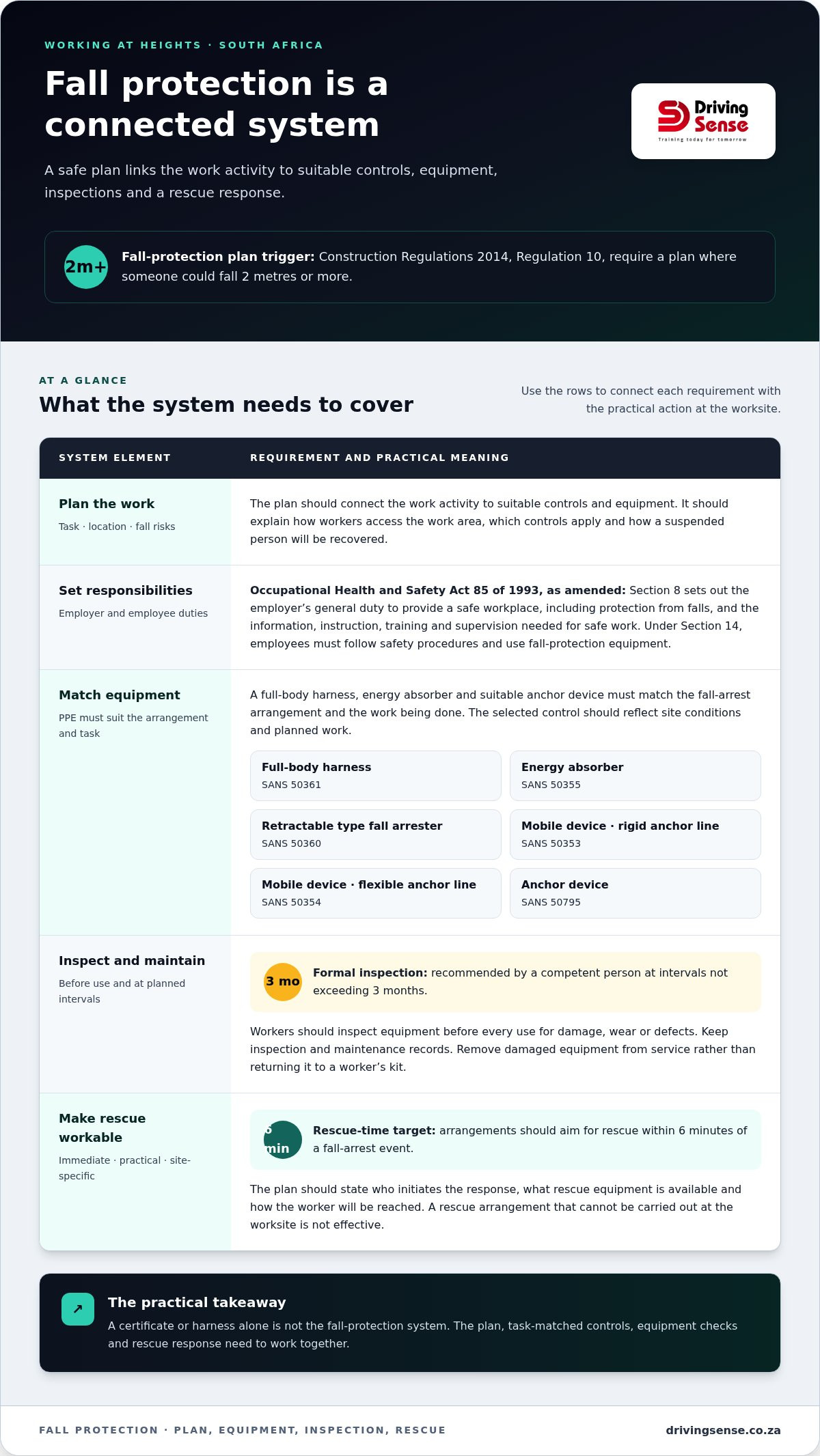
South Africa’s Construction Regulations 2014, Regulation 10, require a fall-protection plan where someone could fall 2 metres or more. The plan must connect the work activity to suitable controls, equipment and a rescue response. This makes fall protection a coordinated system, rather than a certificate or harness alone.
According to the South African Qualifications Authority (SAQA), the Occupational Health and Safety Act (Act 85 of 1993 and its amendments) governs work-at-height safety. Section 8 sets out the employer’s general duty to provide a safe workplace, including protection from falls. Employers must provide the information, instruction, training and supervision needed for safe work. Under Section 14, employees must follow safety procedures and use fall-protection equipment.
An effective fall-protection plan addresses the task, work location and foreseeable fall risks. For construction work, it includes equipment inspection and maintenance, as well as a rescue plan that can be carried out immediately. The plan should explain how workers access the work area, which controls apply and how to recover a suspended person. A rescue arrangement that cannot be implemented at the worksite is not effective.
Personal protective equipment forms one part of that system. A full-body harness, energy absorber and suitable anchor device must match the fall-arrest arrangement and the work being done. The selected control should reflect the site conditions and planned work.
- Full-body harnesses: SANS 50361 is the identified standard.
- Energy absorbers: SANS 50355 is the identified standard.
- Retractable type fall arresters: SANS 50360 is the identified standard.
- Mobile devices on rigid anchor lines: SANS 50353 is the identified standard.
- Mobile devices on flexible anchor lines: SANS 50354 is the identified standard.
- Anchor devices: SANS 50795 is the identified standard.
Workers should inspect fall-protection equipment before every use, looking for damage, wear or defects that could affect safe operation. Formal inspection by a competent person is recommended at intervals not exceeding 3 months. Inspection and maintenance records help show whether equipment remains suitable for use. Damaged equipment should be removed from service rather than returned to a worker’s kit.
Rescue arrangements must be practical, immediate and suited to the equipment in use, aiming for a rescue-time target within 6 minutes of a fall-arrest event. A plan should set out who initiates the response, which rescue equipment is available and how the worker will be reached. These arrangements, combined with training and regular equipment controls, turn a written plan into a workplace procedure.
What Does Working at Heights Training Cover?
Course content should prepare workers for hazards, controls and equipment relevant to their tasks. A certificate records training, but competence also depends on applying that learning safely at work.
Training content and worker qualifications
Working-at-heights training helps workers recognise fall hazards, follow safe work procedures and use relevant protective equipment. Workers need to understand how planned controls apply to their task, not simply hold a certificate.
Training can address hazard identification, equipment use, safe access and emergency procedures. SAQA Unit Standard 229998 was at NQF Level 1 and carried 2 credits. Its registration end date was 30 June 2023, its last enrolment date was 30 June 2024, and its last achievement date is 30 June 2027. The official SAQA record lists no replacement unit standard.
Training threshold and competence reassessment
South Africa’s Construction Regulation 10 uses a potential fall of 2 metres or more as the trigger for a fall-protection plan, not as a universal certificate threshold. Training needs arise from the task’s fall risks and the controls workers must use.
Refresh training or reassess competence when work methods, equipment or site conditions change, or when a worker cannot demonstrate safe practice. This helps employers identify gaps between past course attendance and current task requirements.
Working-at-heights training commonly covers hazard recognition, safe procedures, protective equipment and responses to incidents. The emphasis should reflect the work: accessing a roof involves different practical decisions from using a platform or working near an unprotected edge.
Working-at-heights certification is distinct from rope-access and rescue training. General training covers safe work at height and relevant controls. Rope-access training focuses on specialised access methods, while rescue training focuses on recovering people in an emergency.
South African requirements sit within occupational-safety law and task-specific regulations. The Occupational Health and Safety Act and Construction Regulations set workplace duties and fall-protection requirements; the General Safety Regulations also address roof work and ladder use. These rules do not make every course interchangeable.
Penalties depend on the breach and applicable legal provision. Employers should treat inadequate instruction, supervision or fall controls as compliance failures, not view certification as paperwork alone.
A practical route to certification is to identify workers’ tasks, select training that matches the risks, complete the course and retain the record. Employers should track who completed training and which activities it covers, so work assignments reflect demonstrated preparation.
For group bookings, align the participants’ work tasks and experience before selecting course content. This helps keep examples relevant across the group. Training location also affects practical relevance: the setting should support learning about the equipment and work conditions participants will encounter. A suitable working-at-heights training course can help organisations structure that learning around their workforce’s operational needs.
Fall arrest, ladder and scaffolding courses
Select a course to match the access method, fall hazard and equipment workers use. Fall-arrest, ladder and scaffolding training address different situations, so do not assume one course covers every task.
Fall-arrest training
Fall-arrest training covers equipment and procedures used to stop a worker’s fall. It should relate to the equipment and activities workers will encounter, including how to use the system and what to do after a fall is arrested. A harness alone does not explain the full procedure.
Rescue arrangements are a critical part of fall-arrest planning. A worker suspended after a fall-arrest event can develop suspension trauma within 5-20 minutes. Training should therefore connect the equipment response with a practical rescue procedure, rather than treating arrest as the end of the incident. The relevant rescue arrangements depend on the workplace plan and the equipment in use.
Ladder and scaffolding training
Ladder training addresses safe use of portable and fixed ladders. Regulation 13C of South Africa’s General Safety Regulations sets requirements for their safe use. Workers need training relevant to the ladder type and task, such as accessing a work area or carrying out work from a ladder. A ladder course is not the same as fall-arrest training.
Scaffolding provides a different means of access from a ladder or personal fall-arrest system. Training should address the work performed from the scaffold and the procedures that apply at the site. The requirements call for training programmes and records for employees working in fall-risk positions, but do not make ladder, scaffold and fall-arrest courses interchangeable.
Construction regulations require a training programme and training records for employees working in fall-risk positions. Employers can use these records to link completed training to assigned activities. For example, a record should distinguish a worker trained for ladder use from one assigned to a task requiring fall-arrest equipment. This supports appropriate work allocation and helps identify training gaps.
Choose courses by mapping each role to its work-at-height tasks. A worker using a fixed ladder, working from scaffolding or relying on fall-arrest equipment may need different learning outcomes. If duties change, review whether existing training still applies, especially if the change involves another access method, equipment or fall-risk position.
Course records also support site planning by showing which workers completed training and which work situations it covered. Keep records aligned with the training and assigned tasks, rather than treating a course title as proof of competence for every type of work at height.
Certificate and provider details to check before renewal
Before arranging renewal, compare the existing certificate with the worker’s current duties and site requirements. This helps show whether the record reflects the training needed for the work now assigned.
Certificate details to check before renewal
A certificate records completed training, so its details should show what the worker studied. A general title alone may not demonstrate preparation for a particular activity.
Review the worker’s name, course title, completion date and any named unit standard or learning programme. For example, distinguish a record for fall-arrest training from one describing ladder use. Compare the course scope with current tasks and note any mismatch before assigning work.
SAQA Unit Standard 229998 is one identifier that may appear in this context. Its status and dates matter when interpreting a certificate linked to that standard. A certificate’s completion date does not, by itself, show that its scope matches changed duties or a site’s access conditions.
Keep the certificate with its training record, which can show the course completed and who attended. If a site requires renewal as an access condition, record that separately from the course details. This helps prevent a site rule from being mistaken for a universal expiry date.
Provider qualifications and accreditation
Assess provider credentials against the specific course and qualification route instead of relying on a generic accreditation label. Fall-arrest, ladder and other work-at-height courses address different tasks.
South Africa’s SAQA Unit Standard 229998 provides a named reference point, but the course title and certificate should still be read together. Compare the provider’s stated training scope with the worker’s intended duties, and establish whether the assessment and record relate to that scope.
Before enrolling workers, review the programme, assessment and certificate information. Check that the certificate clearly identifies the learner and course, and that the stated learning outcomes fit the work. These are practical due-diligence steps, not a claim that one accreditation label applies to every course.
For organisational records, retain certificates alongside attendance and assessment documentation. Map each worker’s completed course to assigned tasks, such as ladder access or fall-arrest work. If the work changes, reassess the match before renewal. This makes records more useful for planning and avoids relying on a course name alone.
Whether South African working-at-heights certificates have a universal expiry date
No universal two-year expiry period applies to working-at-heights certificates in South Africa. SAQA Unit Standard 229998 does not establish a universal two-year expiry, although a client or principal contractor may require renewal every two years as a site-access condition. This distinction is central to working at heights certification requirements in South Africa: site access rules and certificate expiry are separate matters.
A site rule can control access to that site, but it is not a universal expiry rule for every certificate. For example, a worker may need renewed training to meet one principal contractor’s entry requirements, while the certificate records training completed. Keep these decisions distinct when reviewing work assignments and training documents.
Separate three questions in your records: what the certificate covers, whether the worker remains competent for the assigned task, and whether the site requires renewal. The certificate describes training; a competence review considers current performance; a site rule determines access under that site’s requirements. Each informs a different operational decision.
Compare course scope with the worker’s current duties. Someone moving from ladder access to fall-arrest work may need different training, even if the existing certificate has no stated expiry date. Changes to equipment, work methods or site conditions can also affect whether previous learning remains suitable. These task-based considerations are part of working at heights certification requirements in South Africa, alongside any applicable site-access condition.
If a principal contractor requires renewal every two years, record the condition and the site where it applies. Do not treat that interval as a universal expiry date across South Africa. This distinction helps managers explain why one worker faces a renewal deadline at a particular site, while another certificate is assessed by its training scope and the worker’s current competence.
Unit Standard 229998 also has registration dates that should not be confused with a learner’s certificate expiry. Its registration end date was 30 June 2023, its last enrolment date was 30 June 2024, and its last achievement date is 30 June 2027. Those dates concern the unit standard’s registration and achievement arrangements, not a universal period for renewing every certificate.
For an operational review, identify the worksite condition, compare the certificate scope with assigned duties, then assess whether the worker can apply the relevant procedures. Record the reason for any refresher or reassessment, such as changed equipment or a new task. This gives managers a clear basis for decisions without confusing site access with certificate expiry. To plan a relevant working-at-heights training refresh, review course needs against the work your team performs.
Driving Sense: Emergency Safety Training
Driving Sense provides Emergency Safety Training for organisations preparing for workplace incidents. After reviewing fall-protection training and site procedures, employers can consider how emergency readiness fits into their wider safety arrangements.
Driving Sense also offers Compliance Training to support organisations managing wider workplace compliance alongside task-specific safety controls. Emergency Safety Training can help organisations review how employees respond to incidents, while Compliance Training addresses broader compliance needs. These services complement workplace risk management without replacing work-at-height training or site-specific rescue arrangements.
For organisations reviewing safety and compliance training needs, visit drivingsense.co.za to learn more about Driving Sense.
Make training decisions part of ongoing safety planning
At your next safety-planning review, connect each role to the work it actually involves. Map tasks, equipment and site procedures, then record why training or reassessment is needed. This gives managers a practical basis for assigning work and identifying changes that could affect competence, rather than relying on a certificate title alone.
The working at heights certification requirements in South Africa are best managed as part of an organisation’s wider operational controls. Driving Sense offers Working@heights and fall arrest training for organisations reviewing workforce preparation for these tasks. Its Emergency Safety Training and Compliance Training can also support broader workplace readiness and compliance needs.
Consider the training needs alongside current work activities and your organisation’s safety arrangements. Contact Driving Sense about training to discuss the next step for your team.
Frequently Asked Questions
Do I Need a Medical to Work at Heights?
A working-at-heights certificate records training, not medical fitness. Medical health assessments are particularly relevant to safety for lifting-equipment operators. For height work, relate any fitness assessment to the worker’s duties and risk profile, such as climbing access equipment or wearing a harness. Keep medical evidence separate from training records so each document serves its distinct purpose and supports clear workplace decisions.
Can a construction site refuse an older certificate?
Yes. A construction site can make certificate renewal an access condition. A South African client or principal contractor may require renewal every two years, but that does not create a universal legal expiry period. For example, a worker may need renewed training to meet one site’s entry rules. Record the requirement separately from the certificate’s training scope and any assessment of current competence.
Does a Working at Heights certificate legally expire every two years?
No, South Africa has no universal two-year expiry period for these certificates. SAQA Unit Standard 229998 does not establish that interval as a standard certificate expiry. A site may still impose a two-year renewal condition for access. Keep the distinction clear in training records: a site condition governs access to that site, while the certificate describes the training completed.
Does an Old Certificate Automatically Make an Employee Non-Compliant?
No. An older certificate alone does not establish non-compliance. Consider whether its course scope matches the employee’s current duties, whether the site requires renewal and whether the employee can apply the relevant procedures. A change from ladder access to fall-arrest work, for example, may require different preparation. Record the reason for reassessment so work allocation reflects current tasks.
Who needs working at heights training in South Africa?
Workers assigned to fall-risk positions need training relevant to their work and the controls they must use. South African construction regulations require a training programme and records for employees working from fall-risk positions. Construction Regulation 10 requires a fall-protection plan where a person could fall 2 metres or more. Employers should connect each worker’s training record with the tasks they are assigned.
What does a South African working at heights course cover?
Course content can cover recognising fall hazards, following work procedures, using relevant equipment and understanding emergency responses. The practical emphasis should match assigned work: ladder access, scaffolding and fall-arrest tasks involve different equipment and procedures. A course record is more useful when its title and learning scope show the preparation completed, rather than being treated as proof for every height-related task.
How long does working at heights certification take and how long is it valid in South Africa?
Course duration depends on its scope, practical components and assessment requirements, so no single duration applies to every course. Certificates also have no universal two-year expiry period in South Africa. A site may set its own renewal condition, while employers assess whether training remains relevant to assigned duties. Keep course records and site-access rules distinct when planning renewal.
What working at heights risk assessment and fall protection plan does South African law require?
For construction work where someone could fall 2 metres or more, Construction Regulation 10 requires a fall-protection plan. The plan should address the work, fall hazards, protective controls, equipment inspection and maintenance, and an immediately executable rescue plan. A useful assessment connects those arrangements to the actual task, access method and equipment, so workers understand which controls apply at the worksite.
