
For company fleets, an AARTO infringement can affect more than the fine: it can also affect the responsible driver’s record and ability to drive. The system is an administrative process for road traffic offences, and managing AARTO demerit points for company drivers means linking each notice to the person responsible and tracking the effect on their licence. Accumulating 15 points results in licence suspension.
Employers need a clear process when a company vehicle is involved, particularly if an infringement notice is sent to the business. This article explains how demerit points, licence suspensions, employer liability, unpaid fines and compliance records can affect drivers and fleet operations in South Africa.
The sections ahead cover the records to maintain, how points can affect a driver’s licence, where employer responsibilities arise, how unpaid fines can complicate administration, and what the AARTO rollout means for company vehicles. Together, they offer a practical framework for driver accountability and operational continuity.
Key Takeaways
- Keep an auditable record of who is assigned to each company vehicle, so infringement notices can be linked to the responsible driver.
- Set clear procedures for monitoring licence status and responding if a driver’s ability to drive is affected.
- Assign responsibility for traffic notices and vehicle compliance to reduce the risk of unresolved matters disrupting fleet operations.
- Plan how unpaid fines and administrative delays could affect vehicle use, driver allocation and operational continuity.
- The National Department of Transport states that AARTO implementation has been deferred to 1st of July 2026; review how your fleet’s driver-allocation and compliance processes will accommodate the rollout.
1. Compliance records and audit trails
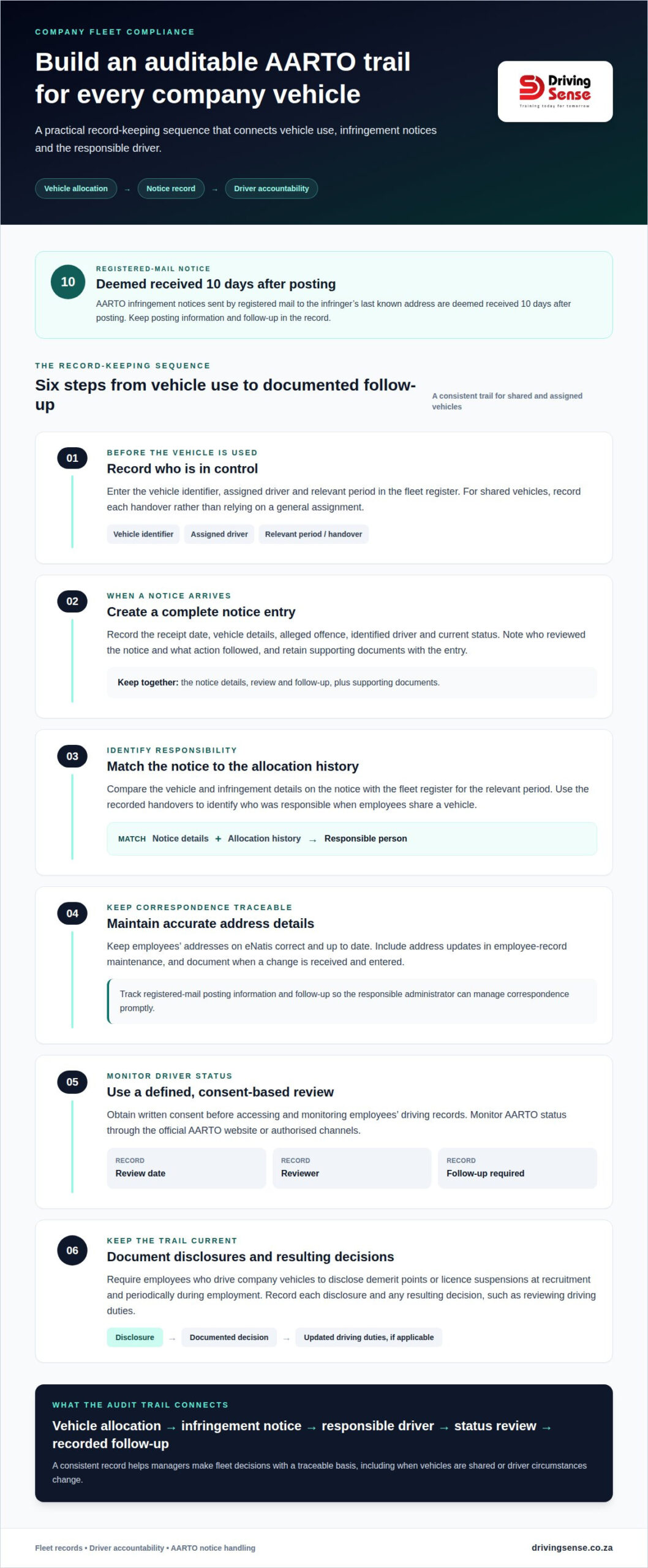
Employers can manage AARTO notices and driver records through a controlled fleet register. Record who has control of each vehicle, link each notice to the responsible person, and track follow-up. A documented process for managing AARTO demerit points for company drivers connects vehicle use with individual accountability. Before a company vehicle is used, employers should record who will be driving or in control.
Make allocation records detailed enough to reconstruct vehicle use. Include the vehicle identifier, assigned driver and relevant period. For shared vehicles, record each handover instead of relying on a general assignment. When a notice arrives, compare its vehicle and infringement details with the allocation history. This provides a consistent basis for identifying who was responsible, particularly when employees share a vehicle.
For each notice, record its receipt date, vehicle details, alleged offence, identified driver, and current status. Note who reviewed it and what action followed, then retain supporting documents with the entry. AARTO infringement notices sent by registered mail to the infringer’s last known address are deemed received 10 days after posting. Tracking posting information and follow-up helps the responsible administrator manage correspondence promptly.
Accurate address details are part of sound recordkeeping. Keep employees’ addresses on eNatis correct and up to date so notices can reach the appropriate person. Include address updates in employee-record maintenance, and document when a change is received and entered. This creates a traceable process for keeping driver contact details aligned with notice handling.
Monitoring driving records also requires a defined, consent-based process. Obtain written consent before accessing and monitoring employees’ driving records, and monitor AARTO status through the official AARTO website or authorised channels. Record the review date, who conducted it and any follow-up required. This approach keeps access accountable and helps identify issues early.
Include driver disclosures in the same audit trail. Employers are advised to require employees who drive company vehicles to disclose demerit points or licence suspensions at recruitment and periodically during employment. Record the disclosure and any decision that follows, such as reviewing driving duties. A consistent process links vehicle allocation, notices, status reviews, and employment disclosures, giving managers a practical record for fleet decisions and internal accountability.
2. Demerit points and driver licence suspension
AARTO points affect an individual driver’s authority to drive, so fleet decisions need to account for each person’s status. The stated thresholds describe two outcomes: accumulating 15 points results in licence suspension, while under the Aarto Act a driver is no longer allowed to drive after receiving 13 demerit points. These figures should not be treated as interchangeable; the consequences stated are different.
For an employer, the practical control is to connect a driver’s status to vehicle allocation. If a driver reports a suspension or reaches the 13-point restriction, record the change and prevent further allocation to driving duties. A replacement driver may be needed to keep a delivery, site visit or scheduled route covered. Procedures should also explain how the organisation considers alternative duties when an employee cannot drive.
Keep AARTO records separate from vehicle documentation. A driver’s demerit record relates to the person, while an operator card or vehicle licence is a separate fleet compliance record. Use separate fields in the fleet register for driver status, operator card details and vehicle licence details. This prevents a current vehicle document from being mistaken for evidence that its assigned driver is permitted to drive.
For each vehicle, record the relevant operator card and vehicle licence information, including the responsible administrator and any recorded expiry or renewal date. Match those details to the vehicle identifier used in allocation records. If a vehicle changes drivers, for example, update the driver allocation without overwriting the vehicle’s documentation history. Keeping the records separate makes it easier to identify whether a restriction concerns the driver or the vehicle.
Review driver status through the monitoring process described earlier, and record the review date and outcome. If a driver discloses points or a licence restriction, document the disclosure, the resulting decision and any change to their duties. Make possession of a valid driving licence a condition of employment, and establish procedures for employees whose licences are suspended or cancelled. This gives managers a defined response instead of leaving dispatch decisions to informal judgement.
Make the control process usable by dispatch and line managers. Fleet records should show whether a driver is currently allocated, needs a status review or has been removed from driving duties. The review should also distinguish AARTO points from operator card and vehicle licence records. These controls support consistent decisions across shifts, particularly when a vehicle is reassigned or a driver’s circumstances change.
3. Employer liability for employee traffic offences
Traffic offences committed during work duties can create exposure for both the driver and employer. South African employers may face fines up to three times higher if they neglect responsibilities for employee traffic offences. Clear assignment of administrative responsibility is therefore important. Designate a responsible person to manage licensing, roadworthiness and traffic-fine matters, and support compliance with the National Road Traffic Act and Aarto Act.
Give the responsible person a defined process for each notice, rather than leaving decisions to individual managers. On receipt, record the notice, identify the vehicle and work-related journey, then establish who was driving. Use the vehicle allocation record to support that identification. Escalate unclear cases to the appropriate internal decision-maker, and document the outcome so subsequent actions follow a consistent process.
Camera infringement notices may be posted to a company and include the responsible person’s name and ID number. That representative should route the notice promptly to the person handling traffic matters, while preserving its arrival date and accompanying details. A notice addressed to the company should not be left in general post or treated as an ordinary vehicle document. Assign it an owner and a traceable next step.
Timing matters. An AARTO infringement notice posted by registered mail to the infringer’s last known address is deemed received 10 days after posting. Record the posting or receipt information and the response deadline stated on the notice. Assigning a follow-up date helps prevent correspondence from being overlooked during staff changes, leave, or vehicle handovers. The notice itself should guide the specific action and timing.
For work-related offences, keep the operational context with the notice. A route schedule, vehicle allocation or assignment record can help establish who controlled the vehicle. Record whether the driver was acting during work duties, who reviewed the information and what action followed. This does not replace the required process, but gives the responsible person an organised basis for handling the matter and escalating it internally.
Clear responsibilities also support continuity. The person overseeing roadworthiness may identify a vehicle issue, while the traffic-fine administrator tracks notices and driver attribution. Establish a clear route for sharing relevant information between these roles. If a notice arrives after a vehicle changes assignments, for example, the administrator can review the allocation history before directing it to the appropriate driver. This structured approach helps the employer address offences without confusing company correspondence with individual accountability.
4. Risks of unpaid fines and fleet downtime
An unpaid traffic fine creates an unresolved administrative task, not an automatic licence suspension. Keep fine status separate from AARTO demerit points, which relate to the driver’s record. For example, a fleet manager reviewing a vehicle file should be able to distinguish an outstanding notice from a driver restriction. This supports accurate decisions about vehicle allocation and follow-up.
Use a simple status workflow for each notice: received, assigned, action pending and resolved. Record who is responsible and the next follow-up date, then update the entry when correspondence or payment is processed. Escalate unresolved notices to the designated traffic-fine administrator. This helps prevent an overlooked item from resurfacing during a later review or vehicle handover.
Fleet downtime can arise when a driver cannot continue driving, even if the vehicle remains roadworthy. A manager may need to reassign a route, allocate another eligible driver or adjust a delivery schedule. Link contingency arrangements to driver availability rather than treating every delay as a vehicle fault. Separating driver status from vehicle condition helps dispatch make practical decisions.
Driver education can reduce confusion about notices and responsibilities. Explain how company vehicles are allocated, why drivers must report infringement notices and whom to notify. A scenario-based briefing could follow a driver who receives a camera notice after a work journey: the driver reports it promptly, and the fleet administrator records the details. Clear instructions help employees understand what is expected of them.
Fleet technology can support this process when it reflects the organisation’s actual workflow. A fleet platform, shared register or controlled spreadsheet can connect vehicle allocation, notice status, the assigned administrator and follow-up dates. For example, a manager can filter open notices before completing a vehicle handover. Technology should make responsibilities visible, but it does not replace reviewing notices or identifying the responsible driver.
Set fleet policies that connect driver training with fine administration. Specify how employees report notices, who records them, how outstanding actions are escalated and how driving status affects vehicle allocation. Include a process for updating records when an employee changes vehicles or duties. Managers can then follow the same procedure across shifts, while drivers receive consistent instructions about reporting and follow-up.
5. AARTO rollout and company drivers
AARTO’s implementation has been deferred to 1st of July 2026, according to the National Department of Transport. In South Africa, employers should treat the rollout as a fleet-planning issue: the relevant municipality and implementation status affect when processes need to accommodate the system. AARTO is an administrative framework for road traffic offences, so company procedures should connect notices to the drivers responsible.
The rollout matters because company vehicles can be involved in infringements, and the responsible person must be identified. Appoint a proxy to manage company vehicles and maintain a clear process for allocating each notice to its driver. A company representative cannot lose demerit points on a driver’s behalf. Instead, representatives are responsible for ensuring points accrue to the person who committed the infringement.
That distinction should guide the company’s day-to-day process. When a camera notice arrives addressed to the company, the proxy should use the vehicle assignment record to identify the driver. The proxy then routes the notice through the company’s established process without treating the company representative as the driver. This preserves individual accountability and helps prevent points being attributed to the wrong person.
Employment documentation can support this process. Include an AARTO clause in contracts for employees subject to the demerit system, allowing access to the employee’s demerit history. Require drivers to disclose points or licence suspensions at recruitment and periodically during employment. Written consent and a consistent review process support responsible monitoring.
Address records are another consideration during the rollout. Keep employees’ addresses on eNatis correct and up to date so infringement notices can reach the appropriate person. A proxy can make address administration part of routine employee-record updates, alongside vehicle assignment changes. This is particularly relevant when a driver moves between work locations or changes roles, as outdated information can disrupt notice handling.
Plan for the operational effect of a driver losing the ability to drive. Employers are advised to consider duty reassignment or hiring additional drivers, so essential routes and vehicle tasks remain covered. A fleet plan can identify which duties require a driver and which may be reassigned. Training can also help drivers understand reporting expectations and the importance of accurate allocation under AARTO. Review driver readiness for AARTO as part of your rollout planning.
Driving Sense: Driver Training
Driving Sense provides Driver Training to help organisations strengthen driver capability and align practical instruction with workplace requirements. The training can complement a fleet’s AARTO procedures by clarifying expected driving practices, notice-reporting routes and the importance of following company vehicle policies.
Consider Driver Training when your organisation is reviewing driver responsibilities, updating fleet procedures or addressing recurring training needs. Training supports operational readiness, while employer records and administrative processes remain essential for managing notices and driver status. For fleets handling specialised transport, Dangerous Goods training may also be relevant to the work drivers perform.
Contact Driving Sense to discuss Driver Training for your organisation.
Make driver accountability part of everyday fleet management
AARTO readiness is strongest when driver accountability is part of routine decisions, rather than a separate administrative task. Assign clear ownership for maintaining procedures, communicate expectations to drivers, and review how the process works when responsibilities or vehicle assignments change. A consistent approach to managing AARTO demerit points for company drivers can connect compliance practices with operational planning.
If your next step is to strengthen workforce capability, Driving Sense offers Driver Training, Compliance Training and Emergency Safety Training. These services can support organisations in developing driver awareness and reinforcing workplace procedures, alongside the internal controls needed to manage fleet responsibilities.
Contact Driving Sense for support with training needs that fit your organisation’s requirements. A practical, well-understood process gives your team a stronger foundation for responsible fleet operations.
Frequently Asked Questions
What Is the AARTO Demerit System?
AARTO is South Africa’s administrative system for adjudicating road traffic offences. It links infringements to demerit points recorded against responsible drivers and sets out procedures for handling infringement notices. For a business, the practical distinction is between the company’s role in administering a notice and the individual driver’s record. A company vehicle does not, by itself, make the company representative the person who committed the infringement.
How does South Africa’s AARTO demerit points system work for company drivers?
For company drivers, an infringement must be linked to the person responsible, not automatically treated as part of the company’s driving record. A company proxy or representative can manage vehicle-related administration, but points should accrue to the driver who committed the infringement. When several employees use one vehicle, for example, reliable assignment information helps identify who was responsible for a particular journey.
How are AARTO demerit points assigned to drivers and operators of company vehicles?
AARTO demerit points are associated with the person who committed the infringement. They are not transferred to a company representative simply because the vehicle belongs to a business. The company’s role is to identify the responsible driver and allocate the notice accordingly. An operator or fleet administrator should use vehicle assignment records and available notice details to support identification, keeping driver records distinct from company vehicle records.
What are the AARTO demerit point thresholds for warnings, suspensions and cancellations?
The stated figures distinguish two consequences: accumulating 15 points results in licence suspension, while the Aarto Act states that a driver may no longer drive after receiving 13 demerit points. These statements describe different outcomes, so employers should not treat either figure as a warning threshold or assume it defines cancellation. For an individual driver, use the notice and official record to establish the applicable status before assigning driving duties.
Who is legally liable for an AARTO infringement involving a company vehicle?
The responsible driver should be identified for an infringement, while the employer may face increased fines if it neglects responsibilities for offences committed during work duties. This does not mean every notice involving a company vehicle automatically makes the employer the driver. The business should establish who was using the vehicle and ensure the notice reaches the person managing traffic-fine matters for appropriate handling.
How can a company identify and nominate the driver responsible for an AARTO infringement?
Use the vehicle’s assignment history to identify who had control when the infringement occurred, then follow the company’s process for allocating the notice to that driver. A notice may be posted to the company and include a responsible person’s details; those details support administration but do not replace identifying the driver. Retain the relevant assignment record and document the decision, especially when employees share vehicles.
What are the deadlines and steps for paying, contesting or making representations against an AARTO infringement notice?
Follow the response route and deadline shown on the individual infringement notice, whether paying or making representations. An AARTO notice posted by registered mail to the infringer’s last known address is deemed received 10 days after posting. Record the notice, its arrival or posting details, the responsible person and the action taken. Do not rely on an assumed deadline; use the instructions provided for that notice.
How can drivers and companies check AARTO infringement notices and demerit point records?
Monitor AARTO status through the official AARTO website or authorised channels, and obtain written consent before accessing and monitoring employees’ driving records. Drivers should promptly share relevant notices with the designated company contact. Record each review and any follow-up so the employer can distinguish a notice awaiting action from a change affecting a driver’s ability to work.
