

A framed compliance certificate will not mitigate an operational crisis when real workplace hazards escalate. With the Compensation Fund reporting over 127,000 occupational injury claims nationally, procuring strategic emergency safety training south africa demands far more than a generic tick-box exercise.
Most corporate risk managers already recognise the friction of managing disparate safety standards across nationwide facilities, where repetitive off-the-shelf courses drain valuable working hours without building decisive frontline capabilities. Meeting strict statutory duties under the Occupational Health and Safety Act shouldn’t mean enduring costly operational downtime or settling for superficial compliance that leaves your organisation exposed.
This guide shows you how to structure, evaluate, and procure enterprise-grade emergency safety training that satisfies statutory mandates and genuinely protects your workforce. Across the following sections, we outline how to benchmark vendor competencies, unify multi-site response protocols, and embed panic-free operational resilience that safeguards institutional continuity.
Key Takeaways
- Structuring enterprise emergency safety training south africa around statutory OHS mandates transforms compliance from an administrative vulnerability into an active operational safeguard.
- Robust emergency architectures require multi-tiered responses covering medical, structural, and operational crises tailored directly to your organisation’s real risk profile.
- Evaluating providers on their capacity to deliver customised on-site workshops significantly mitigates operational downtime whilst reinforcing site-specific response behaviours.
- Long-term readiness demands a closed-loop governance cycle comprising baseline hazard assessments, realistic simulation drilling, and continuous statutory auditing.
- Unifying facility emergency procedures with commercial transport safety creates comprehensive risk governance across multi-site national operations.
The Corporate Mandate for Emergency Safety Training in South Africa
Corporate emergency readiness is fundamentally an institutional risk strategy rather than an administrative routine. When enterprise operations stall due to an unexpected crisis, generic compliance paperwork offers zero protection against catastrophic liability or prolonged operational cessation. Robust emergency safety training south africa provides the structural architecture required to maintain business continuity, align disparate multi-site facilities, and protect personnel across national commercial operations.
Statutory Compliance Under the South African OHS Act
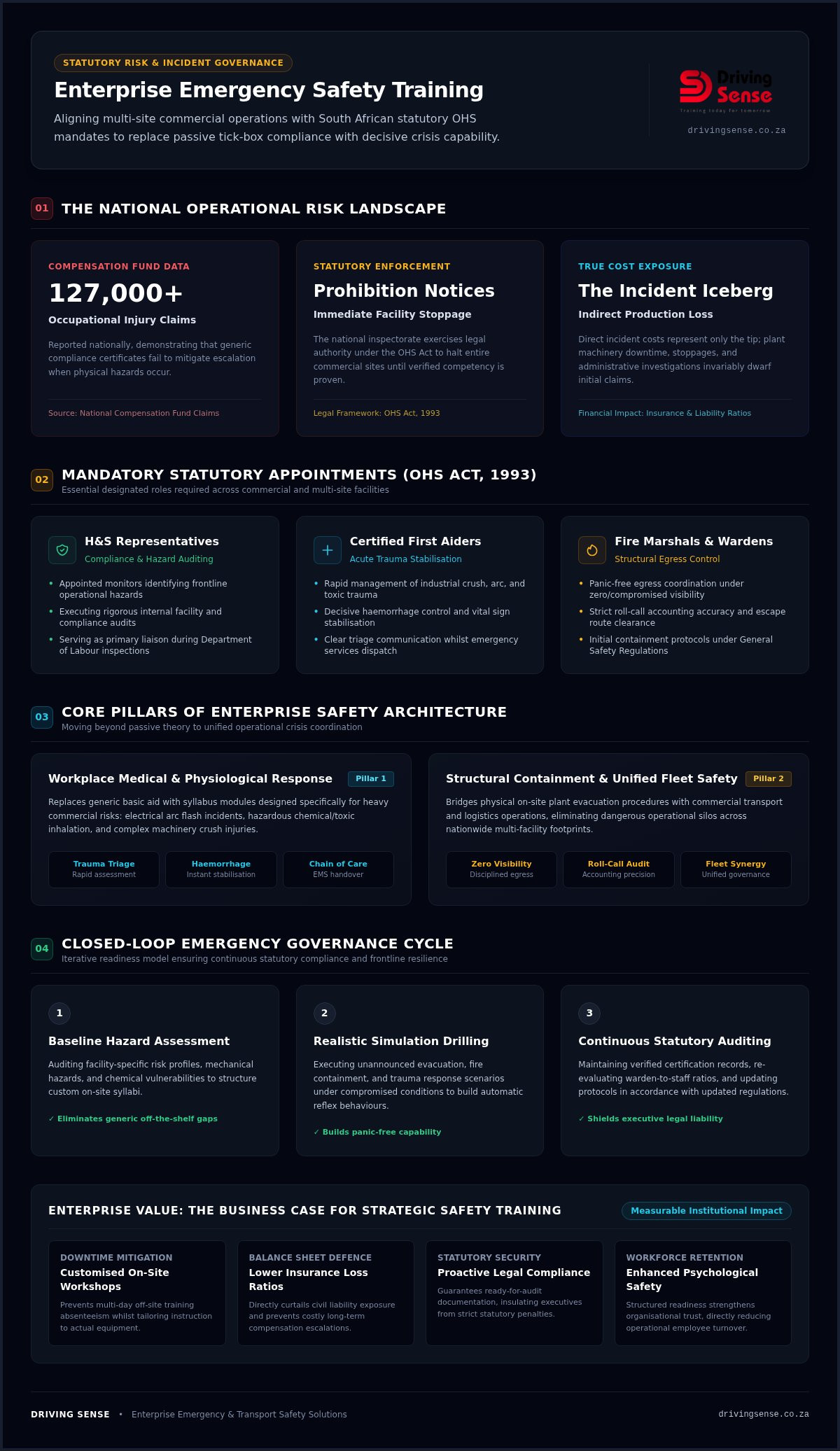
Executive liability in commercial operations rests heavily upon mandatory employer duties codified within the Occupational Health and Safety Act, 1993. With the national inspectorate scaling enforcement capacity to tens of thousands of inspectors, statutory scrutiny has intensified significantly. Inspectors possess the legal authority to issue immediate prohibition notices, halting facility operations until verified competency is demonstrated.
Satisfying rigorous corporate governance standards requires documented, up-to-date certifications across essential statutory roles:
- Health and Safety Representatives: Appointed monitors tasked with identifying hazards and executing internal facility audits.
- Certified First Aiders: Designated personnel trained to stabilise acute medical trauma and occupational injuries.
- Fire Marshals and Evacuation Wardens: Structural responders responsible for orderly site egress under amended General Safety Regulations.
The Measurable Return of Workplace Incident Prevention
Direct incident costs represent merely the visible tip of corporate risk exposure. The indirect overheads of an unmanaged workplace accident, including prolonged production stoppages, plant machinery downtime, and complex administrative investigations, invariably dwarf the initial crisis. Prepared organisations avoid these cascading operational bottlenecks.
Proactive incident management directly protects corporate balance sheets by lowering insurance loss ratios and mitigating exposure to civil liability claims. Beyond balance-sheet resilience, structured emergency capability establishes psychological safety across the enterprise. When employees see a coherent, rehearsed safety strategy enacted across their daily work environment, organizational trust strengthens, leading to enhanced engagement and lowered operational turnover. Procuring professional emergency safety training south africa turns compliance friction into genuine competitive stability.
Core Pillars of an Enterprise Emergency Safety Programme
Enterprise resilience collapses when safety protocols remain confined to isolated operational silos. Too many organisations treat crisis readiness as passive classroom theory, detaching physical facility protocols from transport operations. In contrast, comprehensive emergency safety training south africa establishes an adaptable response architecture that coordinates medical intervention, structural protection, and commercial logistics under a single, unified standard.
Emergency Medical Response and Workplace First Aid
Industrial environments generate specific physiological trauma that generic first-aid syllabi fail to address adequately. Effective workplace medical readiness structures instruction around tangible operational risks, ranging from electrical arc incidents and toxic inhalation to severe machinery crush injuries. Designated personnel must master rapid haemorrhage control, vital sign stabilization, and clear triage communication chains. This methodical approach ensures that critical patient stabilization occurs instantly whilst external emergency healthcare providers are dispatched.
Fire Protection, Containment, and Orderly Evacuation
Safe egress depends on disciplined human command rather than passive reliance on exit signage. Under statutory General Safety Regulations governing fire precautions and means of egress, organisations must establish dedicated warden networks trained to coordinate panic-free evacuations under compromised visibility. Preparedness drills must rigorously test roll-call accounting accuracy, verify unblocked escape pathways, and equip designated teams with decisive containment techniques for chemical, flammable liquid, and electrical fires before minor incidents escalate into structural disasters.
Integrated Fleet and Transport Emergency Protocols
Corporate risk does not stop at the perimeter gate. Enterprise workforces managing commercial vehicles face acute roadside breakdowns, transit collisions, and dangerous goods spillages that facility-focused plans often neglect. Modern safety programmes bridge this divide by integrating mobile drivers into overarching enterprise crisis frameworks, linking on-board telematics triggers directly to centralised crisis desks. Commercial organisations can coordinate facility and transport preparedness through trusted advisors like Driving Sense for tailored emergency safety training, ensuring seamless risk containment nationwide.
Evaluating Corporate Safety Providers: The Enterprise Buyer Framework
Selecting an enterprise training partner requires looking far beyond standard accreditation certificates and generic course catalogues. When evaluating emergency safety training south africa, corporate procurement teams must weigh the full operational impact of delivery methodologies, instructional depth, and contextual relevance. An inadequate assessment framework risks wasting training budgets on disengaging classroom lectures that fail to instil decisive frontline competence.
On-Site Corporate Workshops Versus Public Training Centres
Dispatching personnel to off-site public training centres incurs significant hidden overheads. Factoring in transport expenses, subsistence costs, and extended lost production hours, off-site courses inflate the true cost of compliance substantially. More critically, external classrooms detach trainees from the exact physical infrastructure they are appointed to safeguard.
In contrast, structured on-site corporate workshops deliver tangible logistical and educational benefits:
- Asset Familiarisation: Responders drill directly with your facility’s specific fire suppression equipment, shut-off valves, and designated egress paths.
- Operational Continuity: Instruction schedules can be staggered across operational shifts, preventing plant shutdowns and preserving continuous commercial output.
- Contextual Hazard Application: Drills reflect actual workplace layouts, staging medical or structural scenarios within high-risk processing or loading zones.
Facilitator Competency and Regulatory Accreditation
Accreditation under national education frameworks provides a necessary baseline, yet statutory recognition alone does not guarantee instructional quality. Enterprise buyers should rigorously examine the real-world background of the vendor’s facilitation team. Instructors with extensive field backgrounds in emergency medical response, commercial vehicle risk, and industrial crisis management translate dry regulations into actionable, calm response capabilities during critical workplace incidents.
Bespoke Curriculums Versus Off-the-Shelf Packages
Off-the-shelf course fatigue remains a persistent barrier to institutional safety performance. Standardised syllabuses delivered without regard to sector-specific variables foster disinterest and superficial learning. High-calibre corporate providers tailor their practical scenarios to reflect an enterprise’s distinct operational footprint, integrating the organisation’s proprietary emergency action plans directly into practical simulations. Securing bespoke emergency safety training south africa ensures your statutory investment actively protects corporate continuity and satisfies institutional risk governance.
Implementing and Auditing a Corporate Emergency Readiness Strategy
Acquiring certificates marks the beginning of an operational safeguard, not its conclusion. Emergency competencies naturally decay when left untested between multi-year renewal dates. To preserve operational continuity and satisfy institutional risk governance, enterprises must implement a continuous cycle comprising baseline audits, stress-testing simulations, and structured administrative tracking. This methodical framework ensures emergency safety training south africa translates into decisive, panic-free action during high-consequence incidents.
Conducting Pre-Training Risk and Capacity Audits
Effective safety programmes begin with an uncompromising physical audit of current operating conditions. Risk teams must verify the integrity of emergency escape paths, evaluate specialized fire containment apparatus, and map designated assembly locations across every operational facility. Audits must also account for shift patterns, high-hazard machinery zones, and solitary working arrangements to establish appropriate ratios of appointed safety personnel throughout 24-hour production schedules.
Executing Realistic Drills and Crisis Simulations
Theoretical examinations cannot replicate the physiological stress of an escalating workplace emergency. Real resilience develops through unannounced crisis simulations designed to test organizational agility and communication chains under pressure. High-impact operational drills systematically introduce variable complications:
- Route Obstructions: Block designated primary egress points to force wardens to deploy alternate evacuation paths.
- Communications Failures: Silence public address networks to evaluate radio discipline and runner relay systems.
- Simulated Casualties: Stage realistic trauma injuries requiring immediate first-aid intervention and stretcher evacuations.
Every drill requires an immediate executive debrief to record procedural delays, address friction points, and correct unsafe response behaviours before an authentic crisis occurs.
Maintaining Governance Records and Refresher Cycles
Defensible compliance hinges upon precise documentation protocols. When industrial incidents trigger departmental investigations or corporate liability claims, retrospective safety logs serve as vital legal evidence. Organizations must maintain centralized digital records tracking certification expirations, scheduled drills, equipment service intervals, and corrective action logs across all operating units.
To systematically structure your enterprise readiness cycle and ensure continuous statutory alignment, partner with Driving Sense for corporate compliance and emergency training programmes designed around your national operating footprint.
Partnering with Driving Sense for National Emergency Safety Excellence
Building an enterprise-grade safety culture requires an advisory partner capable of translating statutory obligations into measurable operational stability across complex commercial footprints. Rather than acting as a transactional course broker offering generic certificates, Driving Sense operates as a dedicated corporate advisor, providing accredited emergency safety training south africa to commercial organisations nationwide. Our methodology links physical facility protocols directly to fleet operations, eliminating regulatory blind spots and establishing uniform resilience across all operating units.
Decades of Proven National Corporate Expertise
With over twenty years of dedicated corporate safety experience, Driving Sense understands the structural friction enterprise leaders face when managing disparate facilities across the country. Inconsistent training quality across branches often weakens compliance and leaves executive leadership exposed during departmental audits. Our seasoned facilitators resolve this inconsistency by delivering standardized, high-calibre instruction directly at your operational sites. We design tailored on-site corporate workshops around your distinct operating schedules and shift rotations, significantly reducing operational downtime while ensuring every employee masters the exact safety equipment installed in their facility.
Integrated Fleet, Workplace, and Compliance Solutions
Enterprise liability rarely stops at the physical premises. Commercial logistics, transport operators, and mobile personnel confront dynamic risks that factory-floor safety protocols cannot address. Driving Sense bridges this gap by unifying workplace emergency response, commercial driver education, and compliance and legislation advisory into one comprehensive framework. We equip your operational workforce to handle complex industrial crises, while concurrently training fleet personnel to manage roadside collisions, transit breakdowns, and dangerous goods transport incidents with disciplined composure.
Our complete service scope extends beyond basic emergency intervention, incorporating pre-employment screening and employee wellness to reinforce organizational stability from recruitment through daily operations. By consolidating workplace safety, driver competency, and statutory auditing under a single national advisory partner, your enterprise achieves robust risk containment and defensible governance. Protect your operational continuity and human capital with targeted corporate safety training solutions from Driving Sense.
Elevating Corporate Safety from Statutory Obligation to Strategic Advantage
Enterprise emergency preparedness demands shifting from passive administrative checkboxes to integrated operational governance. Ensuring defensible compliance across distributed facilities requires structured on-site instruction, realistic simulation drills, and unified protocols that bridge physical premises with transport logistics. When organisations replace disjointed course bookings with a cohesive safety architecture, they eliminate critical operational vulnerabilities and safeguard their personnel against unpredictable crises.
Achieving this level of resilience requires an experienced corporate advisor rather than a transactional course vendor. Backed by over twenty years of dedicated corporate safety and risk mitigation expertise, Driving Sense delivers accredited emergency safety training south africa across commercial networks nationwide. Our integrated capabilities align workplace emergency response, professional fleet driver training, and statutory compliance into a single, cohesive framework designed to minimise operational downtime. To protect your workforce, mitigate corporate liability, and maintain uncompromising audit standards, consult with Driving Sense to structure your national corporate emergency safety programme today.
Frequently Asked Questions
What are the legal requirements for emergency safety training for businesses in South Africa?
The Occupational Health and Safety Act mandates that employers designate and adequately train competent personnel to handle workplace hazards. Legal requirements dictate appointing certified health and safety representatives, trained first aiders, and evacuation marshals proportional to workforce size and facility risk. Ensuring compliant emergency safety training south africa prevents statutory penalties, corporate liability exposure, and operational prohibition notices during inspections by the Department of Employment and Labour.
How often must corporate emergency safety and first aid certifications be renewed?
Statutory first aid and specialized safety competencies generally require formal recertification every three years to maintain legal validity. However, enterprise best practice recommends scheduling structured internal refreshers and simulation drills at least annually. Skill degradation occurs rapidly between regulatory cycles; regular practical rehearsals guarantee that appointed responders retain decisive, panic-free execution when an authentic workplace emergency arises.
Can corporate emergency safety training be conducted on-site at our commercial facilities?
Yes, delivering corporate workshops on-site represents the preferred approach for enterprise risk mitigation. On-site instruction eliminates delegate travel expenses, avoids accommodation costs, and allows shift-based scheduling that preserves continuous commercial output. Crucially, personnel learn by interacting directly with their actual working environment, drilling with facility-specific egress routes, shut-off systems, assembly areas, and local fire suppression apparatus.
How does integrating driver training improve overall corporate emergency response capabilities?
Integrating professional driver education extends organisational safety governance beyond physical facility perimeters to mobile personnel. Commercial drivers face acute transit vulnerabilities, including roadside collisions, mechanical breakdowns, and hazardous cargo incidents. Bridging fleet driver training with standard workplace crisis management connects vehicle telematics directly to centralised escalation teams, establishing unified emergency response protocols across both mobile and facility-based staff.
What is the recommended ratio of trained emergency personnel to regular workplace staff?
Statutory baselines under general safety regulations typically require at least one certified first aider for every 50 employees in low-hazard environments, or one per 20 workers in industrial settings. However, robust enterprise governance requires higher ratios to account for multiple shifts, staggered operating hours, planned leave cycles, and high-hazard processing zones across distributed commercial facilities.
How do bespoke corporate safety modules differ from standard public safety courses?
Standard public courses deliver generic theory within sterile classroom environments disconnected from actual company operations. Bespoke corporate modules adapt syllabuses directly to an organisation’s specific operational hazards, physical layouts, and internal standard operating procedures. Tailoring emergency safety training south africa ensures simulation scenarios reflect authentic workplace machinery, chemical inventories, and sector-specific emergency escalation protocols.
What documentation must employers retain following workplace emergency safety training?
Employers must retain verified competency certificates, detailed attendance registers, signed appointment letters, and facilitator accreditation records for statutory compliance reviews. In addition, organisations should document practical drill evaluations, post-simulation debrief notes, and updated risk assessment files within a centralised governance repository to defend against Department of Employment and Labour inquiries or corporate liability claims.

Pingback: 2026 South Africa OHS Training: Corporate Buying Guide – Driving Sense