

What if the standard compliance checklist is actually obscuring your enterprise’s true operational risk? Enterprise leaders frequently face the quiet frustration of maintaining pristine statutory audit records whilst preventable incidents continue to disrupt daily workflow. When frontline personnel hesitate to report near-miss occurrences and supervisors suffer fatigue from constantly policing routine procedures, standard induction models have reached their limit. Implementing comprehensive safety culture training workplace frameworks bridges this critical divide, transforming passive administrative sign-offs into authentic, behaviour-based risk mitigation across every operational level.
Discover how structured safety culture training transforms standard regulatory compliance into an enduring, organisation-wide operational discipline. In the analysis that follows, we examine proven operational methodologies to replace supervisory fatigue with universal peer accountability, equip team leaders to conduct constructive behavioural risk reviews, and secure measurable reductions in lost-time incident frequency. Ultimately, you will learn how aligning executive safety commitments with floor-level decision-making protects governance standing and ensures sustainable business continuity.
Key Takeaways
- Transition from passive administrative compliance to operational discipline by aligning statutory requirements with core workforce behaviours.
- Learn how institutionalising safety culture training workplace initiatives combines human risk psychology with technical standards to replace constant policing with active peer accountability.
- Identify and arrest operational drift before informal shortcuts and daily production pressures compromise enterprise governance.
- Implement a structured, phased rollout that utilises diagnostic incident assessments to construct practical, scenario-driven operational workshops.
- Establish proactive leading indicators such as near-miss transparency to assess long-term safety maturity and protect commercial business continuity.
Defining Workplace Safety Culture: Moving Beyond Passive Compliance
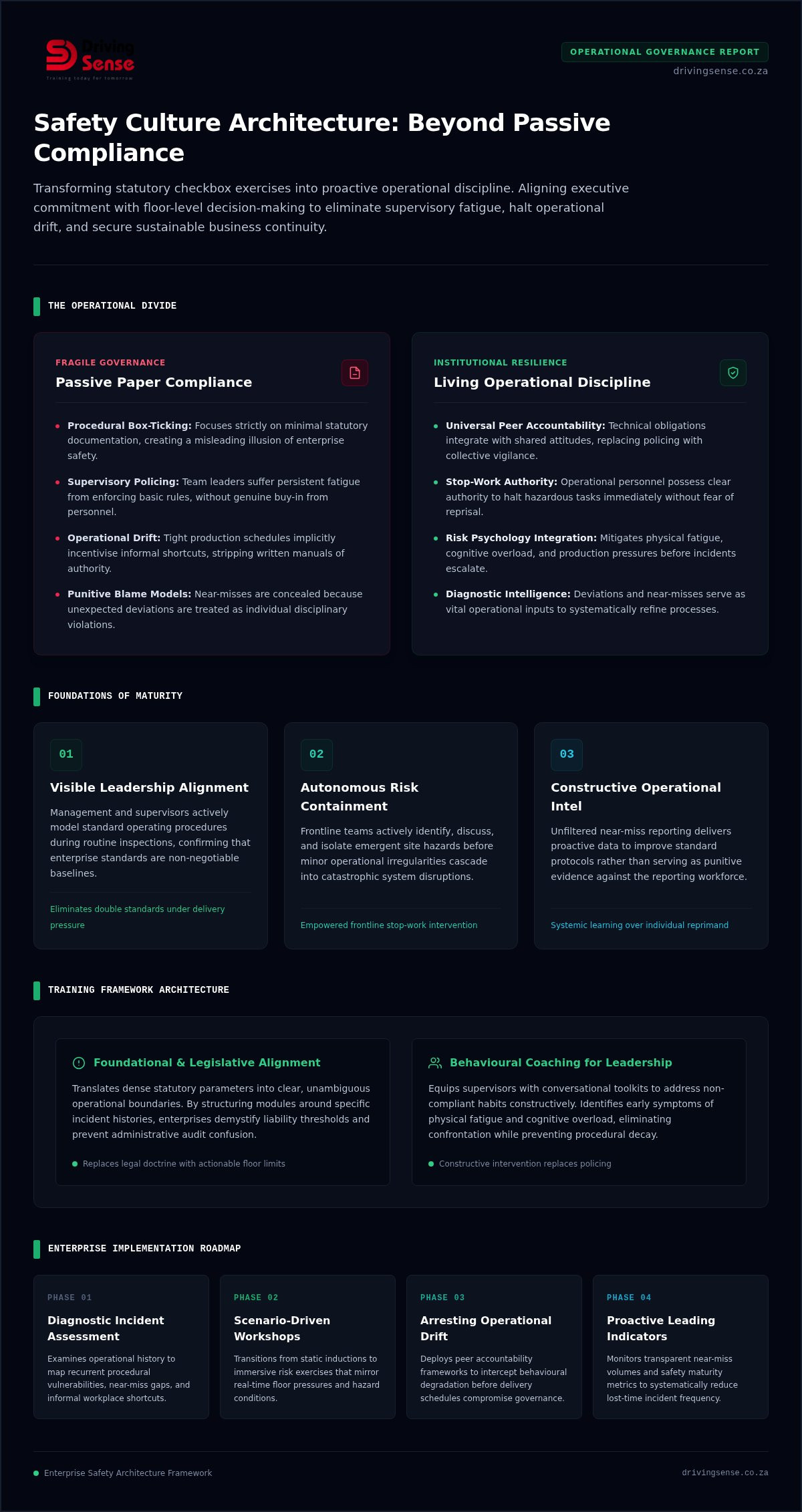
When evaluating high-risk enterprise environments, defining workplace safety culture requires distinguishing between procedural box-ticking and daily operational reality. Passive regulatory compliance merely satisfies minimal statutory documentation, creating a fragile illusion of control while leaving frontline personnel exposed. True institutional resilience, conversely, reflects the shared attitudes, operational values, and habitual working practices embedded across every tier of the workforce. Implementing targeted safety culture training workplace initiatives transforms statutory mandates into an active operational discipline. Teams don’t just follow checklists; they possess the operational authority to halt hazardous tasks without fear of reprisal, securing long-term business continuity.
The Contrast Between Paper Compliance and Living Culture
Administrative induction manuals often fail to influence high-pressure floor decisions. Under tight delivery schedules, supervisory conduct quickly reveals an organisation’s authentic priorities. If leadership implicitly rewards production speed over verified safety barriers, written procedures lose all practical authority. Moving past this vulnerability demands a transition from reactive blame structures toward transparent, systemic risk identification. When an enterprise treats unexpected deviations as diagnostic opportunities rather than individual disciplinary matters, frontline workers engage openly with risk containment instead of concealing vital operational friction.
Core Attributes of a Mature Safety-Centred Workplace
High-reliability organisations systematically translate formal governance policies into instinctive site behaviours through clear, consistent markers:
- Visible Leadership Alignment: Management and floor supervisors visibly model standard operating procedures during routine operational inspections, confirming that safety standards aren’t negotiable compromises.
- Autonomous Risk Containment: Operational personnel actively identify, discuss, and isolate emergent hazards before minor irregularities cascade into serious disruptions.
- Constructive Operational Intelligence: Near-miss occurrences serve as proactive intelligence to refine procedures, functioning as valuable learning inputs rather than punitive evidence against personnel.
Embedding these principles through sustained safety culture training workplace sessions bridges the dangerous divide between formal corporate manuals and day-to-day floor practice, establishing consistent institutional reliability.
Pillars of an Effective Safety Culture Training Framework
Constructing an enduring operational discipline requires moving past isolated slide presentations. A robust framework integrates technical compliance with behavioural science, ensuring that risk controls withstand commercial delivery pressures. As global benchmarks like the Pillars of an Effective Safety Culture Training Framework illustrate, institutional readiness demands active competencies rather than passive statutory awareness. High-reliability operations systematically replace lecture-based inductions with immersive scenario exercises, directly linking human risk perception to procedural containment.
Foundational Knowledge and Legislative Alignment
Statutory occupational health mandates often fail when presented as dense legal doctrine. Structured safety culture training workplace programmes translate complex legislative obligations into clear operational boundaries for frontline teams and executive management alike. Demystifying statutory parameters establishes transparent governance standards, clarifying liability thresholds and structuring modules around specific incident histories, which prevents administrative confusion during audits or high-risk tasks.
Behavioural Coaching and Frontline Leadership
Frontline supervisors represent the primary operational defence against informal procedural drift. Developing mature behavioural coaching equips supervisors with the conversational frameworks required to address unsafe practices constructively rather than through confrontation. When supervisors learn to identify early signs of physical fatigue, cognitive overload, and routine shortcuts, they foster the mutual trust needed to surface near-miss reporting before minor oversights escalate into reportable incidents.
Emergency Readiness and Practical Reflex Development
Theoretical procedures consistently unravel when emergency reflexes haven’t been drilled in realistic settings. Immersive situational simulations bridge the gap between static response plans and physical equipment deployment, embedding rapid, methodical coordination under stress. Following each exercise, collaborative reviews help teams identify operational bottlenecks and implement systemic procedural refinements. Enterprises seeking to embed these behavioural disciplines across regional operations often engage specialised corporate compliance training partners to align frontline execution with overarching governance standards.
Achieving cross-departmental alignment ensures identical safety standards govern every operational division. When procurement, operations, and logistics maintain unified risk thresholds, the enterprise establishes structural stability that withstands sudden commercial pressures.
Overcoming Organisational Traps: The Gap Between Policy and Reality
Operational drift rarely manifests overnight. Instead, it develops incrementally when minor deviations from protocol fail to trigger an immediate negative consequence. When frontline personnel experience repeated success while bypassing secondary safeguards, those shortcuts subtly become the accepted standard of work. If commercial production targets directly contradict stated executive safety commitments, workforce cynicism deepens rapidly. Safety systems collapse when operational staff perceive formal rules as cosmetic public relations designed solely to protect enterprise liability. Bridging this systemic divide requires targeted safety culture training workplace interventions that reconcile output expectations with uncompromising operational controls.
Dismantling the Normalisation of Operational Deviance
Why do experienced operators deliberately bypass safety interlocks? In most industrial environments, workers don’t act out of malice; they act to solve immediate production bottlenecks. When unpenalised repetition transforms an informal workaround into standard practice, disaster becomes a statistical certainty. Identifying these subtle compromises requires organisations to deploy non-confrontational peer reviews that examine operational friction directly. Rather than disciplining operators for adaptation, cross-functional teams assess why the official procedure was discarded, redesigning workflows so that safe execution remains the most efficient path forward.
Transforming Punitive Cultures into Just Environments
Replacing silence with proactive operational reporting requires leadership to establish a definitive, practical boundary between blameless human fallibility and reckless conduct:
- Blameless Slip or Lapse: Inadvertent errors resulting from physiological fatigue, ambiguous control interfaces, or complex operational environments. These require system redesign and procedural refinement rather than disciplinary sanctions.
- At-Risk Operational Drift: Bypassing safety parameters under the assumption that the risk is minimal or justified by production pressure. This necessitates peer coaching and supervisory alignment.
- Reckless Disregard: Conscious, deliberate violation of critical life-safety controls with full awareness of the substantial hazards involved. This demands direct management intervention.
Protecting personnel who report near misses and systemic oversights preserves the transparent flow of risk data across the organisation. When your safety culture training workplace strategy instils genuine psychological security, frontline personnel raise operational concerns early, eliminating critical vulnerabilities long before they manifest as severe occupational trauma.
Implementing Safety Culture Training Across Enterprise Operations
Operational transformation cannot occur through uncoordinated, one-off seminars. Successfully embedding an enduring operational discipline requires a structured, five-phase deployment strategy that progresses systematically from diagnostic assessment to institutional habit. Generic, off-the-shelf courses routinely fail because they ignore the distinct production pressures present within varied industrial workflows. By executing a planned rollout, organisations ensure that safety culture training workplace programmes address verified operational vulnerabilities rather than abstract administrative generalisations.
Diagnostic Assessment and Needs Analysis
Every effective cultural intervention begins with an unvarnished audit of internal incident logs, near-miss documentation, and workforce sentiment. Dissecting these operational records exposes recurring behavioural vulnerabilities, demonstrating whether errors stem from physiological fatigue, ambiguous handovers, or conflicting commercial deadlines. Evaluating employee trust levels confidentially enables risk managers to measure psychological safety and frontline faith in executive governance. This diagnostic baseline allows safety directors to formulate bespoke educational frameworks tailored directly to the organisation’s precise risk profile.
Structured Rollout and Champion Enablement
With diagnostic insights established, the instructional rollout proceeds through targeted phases that respect continuous operational commitments:
- Phase 1 (Diagnostic Assessment): Map historical incident data and assess workforce risk perception to establish clear cultural baselines.
- Phase 2 (Curriculum Customisation): Adapt training modules to mirror real operational bottlenecks and site-specific operational conditions.
- Phase 3 (Targeted Modular Delivery): Roll out interactive workshops across high-risk operational tiers and supervisory levels without halting production schedules.
- Phase 4 (Safety Champion Mentorship): Select and mentor vocal operational personnel as dedicated internal champions who model standard operational behaviours on-site.
- Phase 5 (Governance Audits and Refreshers): Implement structured operational audits and practical refresher drills to prevent behavioural drift and ensure procedural adherence.
Integrating concise tabletop crisis simulations into periodic team shift huddles keeps emergency reflexes sharp and reinforces mutual accountability across all departments. To design and deploy an integrated behavioural intervention across your facilities, contact Driving Sense to schedule an enterprise compliance training consultation. Consistent auditing and ongoing operational reinforcement solidify these practices, protecting corporate governance standing and securing enduring business continuity.
Evaluating Long-Term Cultural Evolution and Safety Maturity
Relying strictly on historical lost-time injury statistics creates a perilous sense of security. Lagging data measures yesterday’s failures. A zero-incident record doesn’t prove the absence of risk; often, it merely indicates good fortune. True institutional resilience demands proactive oversight. Implementing structured safety culture training workplace programmes enables leadership to assess organisational maturity through daily frontline vigilance rather than retrospective incident files. Regular diagnostic evaluations protect corporate longevity, sustain employee morale, and safeguard commercial productivity.
Balancing Leading and Lagging Performance Indicators
A mature safety framework balances statutory reporting requirements with dynamic leading indicators. Tracking the velocity and thoroughness of corrective actions demonstrates that management takes workforce notifications seriously. When personnel submit voluntary hazard reports regularly, it validates psychological safety across shifts. Over time, these proactive interventions yield measurable enterprise gains, significantly reducing machinery downtime, secondary asset damage, and risk-related operational losses.
- Resolution Velocity: Measuring the practical turnaround time between hazard identification and engineering remediation.
- Reporting Volumetrics: Monitoring voluntary near-miss disclosures across operational shifts as evidence of workforce trust.
- Operational Reliability: Correlating increased reporting frequency with sustained equipment uptime and lower disruption costs.
Institutionalising Ongoing Organisational Development
Sustaining high-reliability operations demands continuous refinement. Workflows shift as technical processes advance; instructional safety curricula must adapt accordingly. Periodic refresher modules prevent cultural regression, rapidly assimilating new personnel into established behavioural expectations. Partnering with seasoned compliance advisors provides essential external objectivity, testing procedural defences against real-world vulnerabilities.
Embedding periodic safety culture training workplace evaluations guarantees that risk containment remains an active corporate discipline. By maintaining rigorous behavioural audits, enterprises convert baseline compliance mandates into an enduring, organisation-wide operational asset.
Securing Long-Term Operational Resilience Through Behavioural Excellence
Achieving high-reliability performance requires moving beyond static audit checklists to cultivate daily operational discipline. When leadership dismantles punitive barriers and equips supervisors with constructive coaching tools, frontline personnel actively surface emergent vulnerabilities rather than concealing them. Embedding structured safety culture training workplace programmes transforms statutory mandates into genuine peer accountability, safeguarding your workforce while securing vital operational continuity.
With over two decades of corporate safety and professional risk mitigation expertise, Driving Sense delivers tailored on-site corporate workshops and comprehensive enterprise-wide safety curricula. Backed by nationwide delivery spanning occupational compliance, emergency response, and employee wellness, our structured interventions bridge the divide between executive governance and floor-level execution. Partner with Driving Sense to embed an enduring safety culture across your organisation and establish a resilient operational environment where workforce welfare and commercial productivity reinforce each other every day.
Frequently Asked Questions
What is the primary difference between safety compliance training and safety culture training?
Compliance training focuses strictly on statutory adherence and minimal legal mandates, whereas safety culture training workplace programmes address human behaviour and operational values. Compliance courses verify whether workers know the official rules; cultural training ensures they actually execute those standards under commercial production pressures. By examining psychological risk factors alongside physical controls, cultural training builds universal peer accountability rather than administrative sign-offs.
How can management accurately evaluate the current safety culture within their organisation?
Management evaluates safety culture by assessing leading operational metrics alongside confidential workforce perception diagnostics. Relying solely on historical lost-time injury rates is insufficient. Leadership must examine near-miss reporting frequencies, the speed of corrective action implementation, and whether frontline staff feel psychologically secure raising procedural concerns. Regular behavioural audits across shifts reveal whether daily floor-level practices match corporate governance commitments.
Why do employees frequently hesitate to report operational hazards or minor near misses?
Employees hesitate to report hazards primarily out of fear that management will respond punitively rather than constructively. When investigations focus on assigning individual blame rather than identifying systemic design flaws, frontline workers quickly conceal minor deviations. Production pressure also plays a significant role; workers don’t want to cause operational delays or draw scrutiny to colleagues when reporting processes feel excessively bureaucratic.
What practical role do frontline supervisors play in sustaining an authentic workplace safety culture?
Frontline supervisors act as the primary operational bridge between executive safety governance and floor-level execution. Because daily operational priorities are interpreted through supervisory behaviour, team leaders dictate whether safety procedures remain non-negotiable standards or become compromised for speed. Equipping supervisors with constructive coaching tools allows them to identify physical fatigue, arrest operational drift, and conduct non-punitive intervention dialogues in high-pressure environments.
Can workplace safety culture training measurably reduce operational insurance premiums and downtime?
Yes, embedding comprehensive safety culture training workplace frameworks directly reduces operational downtime and commercial risk exposure. Proactive hazard containment prevents severe machinery damage, emergency shutdowns, and unplanned maintenance interruptions that erode operational margins. Over time, sustained reductions in recordable incidents and formal liability claims improve an enterprise’s risk profile, positioning the business for negotiated reductions in corporate indemnity and worker compensation premiums.
How often should enterprise-level organisations conduct safety culture refresher workshops for staff?
Enterprise organisations should conduct structured cultural refresher workshops at least annually, complemented by brief operational scenario drills during weekly shift briefings. While statutory compliance certificates often remain valid for multi-year periods, behavioural habits degrade much faster under constant production strain. Regular modular engagements ensure that new personnel assimilate corporate risk standards quickly and prevent informal, unapproved shortcuts from taking root across operational facilities.
What defines a just culture within corporate occupational health and safety governance frameworks?
A just culture is an organisational environment that clearly distinguishes between honest human mistakes and deliberate procedural violations. Frontline staff are actively encouraged to report operational hazards and unintended errors without fear of discipline, allowing management to rectify systemic flaws. Deliberate recklessness and conscious non-compliance remain subject to firm administrative accountability, ensuring that high behavioural standards and operational transparency support one another.
