

Viewing commercial fleet safety as a simple compliance exercise is often the exact reason enterprise incident rates refuse to decline. If you’re managing escalating vehicle repair bills, costly operational downtime, and the mounting legal complexities of employer duty of care under evolving national legislation, you aren’t alone. Fleet managers and risk officers frequently struggle to measure tangible value from external development initiatives whilst handling inconsistent driver performance across national transport corridors. Implementing structured corporate driver training South Africa wide transforms commercial transport operations from an unpredictable liability into an auditable operational risk control.
Discover how to evaluate, select, and commission professional corporate driver training programmes across South Africa to minimise risk, ensure statutory compliance, and protect fleet assets. By integrating rigorous on-site workshops with dedicated facility assessments, enterprise leaders can systematically safeguard personnel whilst protecting vital capital investments. This enterprise guide details the essential benchmarks for vetting provider capabilities, aligning on-road safety standards with statutory corporate governance, and delivering measurable reductions in fleet operating overheads.
Key Takeaways
- Understand how occupational safety governance and statutory employer obligations transform fleet safety from a routine administrative task into an essential risk control.
- Audit provider operational capabilities to commission corporate driver training South Africa wide through flexible on-site workshops and dedicated testing facilities.
- Identify core modular interventions, including defensive driving techniques, dangerous goods compliance, and pre-employment evaluations, to address distinct operational risk tiers.
- Quantify tangible financial returns by linking preventative behind-the-wheel habits to reduced insurance claims, lower maintenance expenditure, and minimal vehicle downtime.
- Establish seamless nationwide rollout strategies that integrate structured driver development into enterprise shift rosters without disrupting daily operational schedules.
Evaluating Corporate Driver Training: Core Organisational Imperatives
Commercial road transport represents one of the most substantial unmanaged liabilities confronting modern enterprises. Fleets operate daily across high-density corridors where external hazards, mechanical wear, and human fallibility converge into considerable financial exposure. When an incident occurs, the disruption ripples far beyond mechanical repair; it paralyses critical supply chains, derails service delivery schedules, and places irreplaceable human capital at risk. Commissioning comprehensive corporate driver training south africa wide shifts workforce psychology from casual commuting to systematic asset preservation, transforming commercial transit into a disciplined, auditable operational control.
Corporate Governance and Statutory Duty of Care
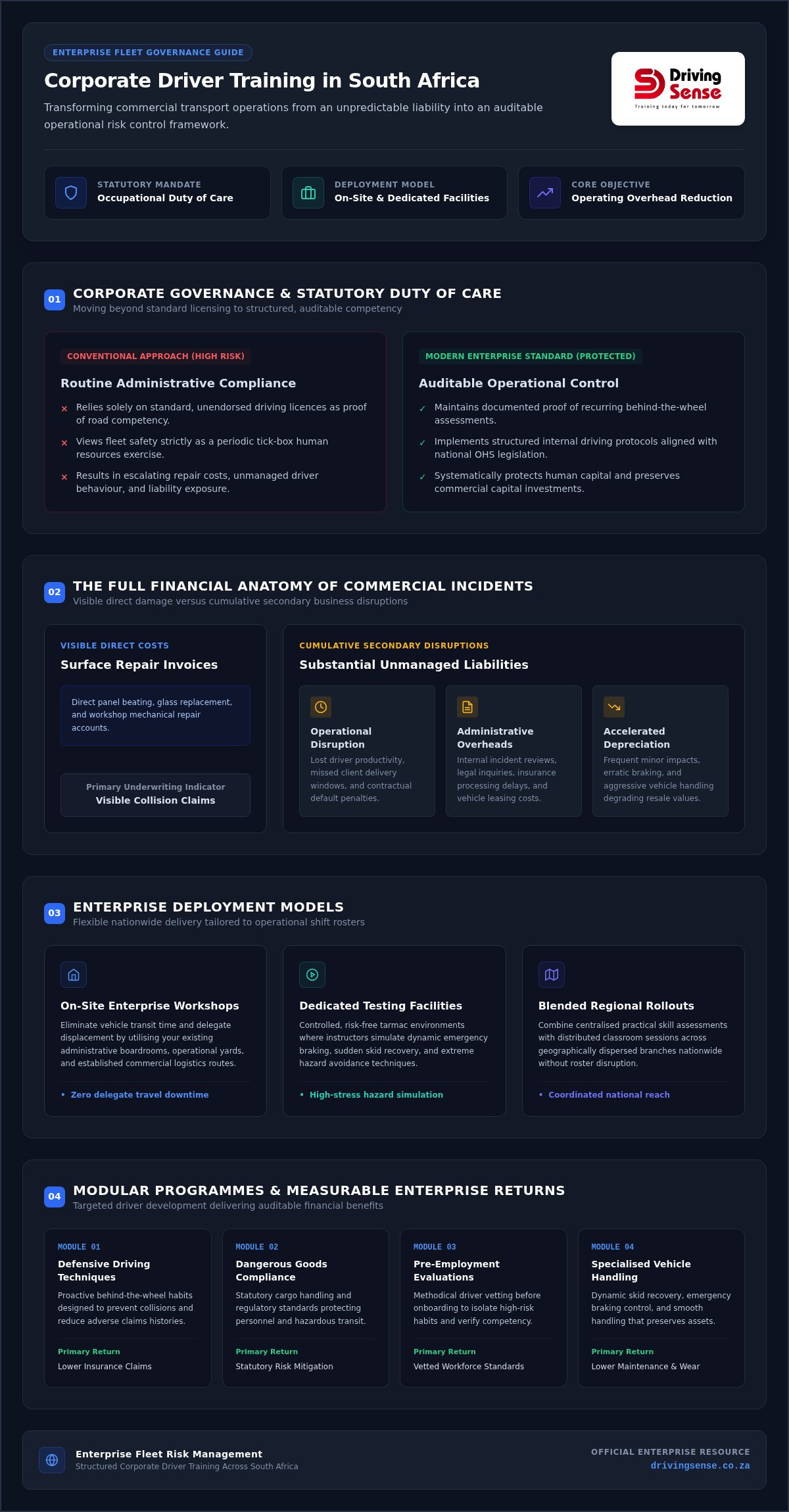
Organisational accountability does not stop at company perimeters; it follows personnel directly onto public thoroughfares whenever they conduct business operations. National occupational health and safety training in South Africa frameworks impose a strict statutory duty of care upon enterprise leadership to mitigate foreseeable operational hazards. Simply possessing an unendorsed driving licence doesn’t demonstrate sufficient competency under modern compliance standards. Robust corporate governance requires employers to maintain documented proof of recurring behind-the-wheel assessments, unambiguous internal driving protocols, and structured interventions that proactively reduce transport liability across all operational divisions.
The Escalating Total Cost of Commercial Fleet Incidents
Direct panel beating and mechanical invoices represent merely the visible tip of collision losses. The true financial impact surfaces through cumulative secondary disruptions that drain enterprise profitability:
- Operational disruption: Lost driver productivity, missed client delivery windows, and contractual default penalties.
- Administrative overheads: Internal incident investigations, legal inquiries, insurance processing delays, and temporary vehicle leasing costs.
- Accelerated depreciation: Frequent minor impacts, erratic braking, and aggressive vehicle handling that permanently degrade resale values across enterprise fleets.
Instituting structured defensive driving methodologies curtails these preventable losses before adverse claims histories compromise commercial insurance underwriting terms or inflate mandatory deductibles.
Essential Criteria for Auditing Corporate Driver Training Providers
Procuring external safety training requires far more scrutiny than purchasing generic off-the-shelf employee courses. While luxury track experiences and standard industrial workshops dominate general search listings, neither provides an adequate framework for enterprise fleet risk mitigation. Evaluating prospective partners demands a methodical audit of instructional methodologies, nationwide operational reach, and institutional credentials. Engaging an enterprise partner for corporate driver training south africa wide ensures that safety interventions translate into auditable operational governance rather than momentary classroom exercises.
On-Site Corporate Workshops Versus Dedicated Training Facilities
Operational flexibility represents a critical audit benchmark. High-performing providers deliver adaptable deployment options tailored to business realities:
- On-site enterprise workshops: Eliminate vehicle transit time and delegate displacement by utilising your existing administrative boardrooms, yards, and established commercial logistics routes.
- Dedicated testing facilities: Offer controlled, risk-free tarmac environments where instructors simulate dynamic emergency braking, sudden skid recovery, and extreme hazard avoidance techniques.
- Blended regional deployment: Combine centralised practical skill assessments with distributed classroom sessions across geographically dispersed branches nationwide.
Curriculum Customisation and Sector-Specific Alignment
Off-the-shelf driver coaching fails to account for the actual operational pressures commercial operators endure daily. Generic consumer curricula overlook payload dynamics, route fatigue, tight loading dock logistics, and regional infrastructure variations. Enterprise training partners must tailor syllabus modules around your specific vehicle assets, whether your operations deploy light utility bakkies, executive passenger saloons, or heavy multi-axle freight hauliers. Incorporating practical adult learning principles ensures seasoned commercial drivers abandon entrenched bad habits without resistance.
Instructor Credentials and Institutional Track Record
The efficacy of any corporate fleet programme hinges directly upon facilitator authority and institutional pedigree. Enterprise procurement teams should verify that prospective educators possess verified qualifications across advanced collision prevention, occupational transport safety, and specialised legislative adherence. Organisations seeking structured risk reduction often partner with established advisors like Driving Sense, drawing upon over two decades of specialised corporate driver training experience to embed sustainable safety standards across diverse commercial operations.
Core Modular Programmes: Defensive Driving, Compliance, and Specialised Handling
Fragmented training initiatives rarely produce lasting behavioral shifts across enterprise transport teams. Effective fleet development relies on cohesive, modular architectures designed to mitigate risk across distinct operational tiers. Rather than viewing instructional courses as isolated events, high-performing transport operations implement progressive learning pathways that target specific risk categories. By integrating advanced collision avoidance, regulatory alignment, and pre-placement screening into an overarching framework, corporate driver training south africa wide delivers measurable improvements to fleet safety governance and day-to-day vehicle reliability.
Advanced Defensive Driving and Hazard Anticipation
Situational awareness forms the bedrock of commercial crash prevention. Advanced defensive driving modules equip drivers with systematic scanning techniques to identify developing hazards long before emergency interventions become unavoidable. Practical instruction focuses on space management, adverse weather adjustments, and dynamic skid control, training personnel to maintain vehicle stability under critical traction loss. Consistently applying smooth control inputs preserves expensive mechanical components, lowers fuel burn, and eliminates the erratic driving habits that precipitate roadside collisions.
Dangerous Goods Handling and Compliance Certification
Transporting hazardous materials demands rigorous compliance with national safety statutes. Dedicated dangerous goods modules prepare drivers to manage chemical, flammable, and toxic consignments safely across long-haul and regional distribution corridors. The curriculum covers vital procedural disciplines:
- Correct statutory placarding and transport documentation verification.
- Safe loading, load securing, and segregation techniques for mixed hazardous substances.
- Immediate containment and emergency response protocols to curb environmental contamination during accidental releases.
Structured recertification ensures compliance continuity, insulating organisations against severe statutory penalties, legal liability, and brand impairment.
Pre-Employment Competency Screening and Risk Profiling
Mitigating fleet risk begins well before an employee takes possession of company vehicle keys. Practical pre-employment screening assesses applicant driving capabilities, historical violation patterns, and fundamental road craft under realistic operating conditions. Structured psychometric and behavioural evaluations highlight hidden propensities toward aggressive driving, high stress susceptibility, or mobile device distractions. Delivering detailed candidate risk profiles empowers talent acquisition teams to hire trustworthy operators. Partnering with Driving Sense allows enterprises to seamlessly merge thorough pre-employment screening with targeted, ongoing developmental modules tailored to operational risk profiles.
Quantifying Enterprise Value: Lowering Fleet Expenses and Incident Volumes
Commissioning external fleet coaching is frequently mischaracterised as an unrecoverable operational overhead. In practice, enterprise-level instruction functions as an immediate financial lever that protects operating margins across multiple balance sheet entries. When organisations systematically elevate driving standards, initial expenditures are swiftly offset by sustained reductions in collision damage, fuel burn, and mechanical wear. Integrating professional corporate driver training south africa wide establishes an auditable framework that converts road safety into tangible capital retention and improved asset lifecycle values.
Negotiating Favourable Insurance Underwriting Terms
Commercial fleet insurers actively calibrate premiums and deductibles against historical risk exposure and documented safety controls. Underwriters look favourably upon enterprises that substantiate claims histories with verifiable workforce training transcripts. Documenting consistent defensive coaching across all transport divisions equips executive leadership to negotiate lower loss deductibles, reduced excess obligations, and preferred renewal rates. Structured training logs also provide crucial legal evidence to counter third-party liability claims following catastrophic highway incidents.
Fuel Conservation and Mechanical Preservation
Erratic driving habits severely drain fleet operational budgets. Aggressive acceleration, prolonged idling, and harsh late braking inflate fuel consumption whilst placing excessive stress on running gear. Instilling smooth, proactive vehicle management yields measurable operating dividends:
- Direct fuel savings: Anticipatory throttle application and steady momentum preservation visibly lower fleet-wide fuel expenditure.
- Component longevity: Measured braking and cornering extend the service life of consumable parts, including tyres, brake pads, and suspension components.
- Asset uptime: Mitigating mechanical abuse prevents premature drivetrain failures, keeping revenue-generating transport active on assigned routes.
Workforce Wellness and Fatigue Management
Endurance behind the wheel exacts a heavy toll on cognitive processing and physical responsiveness. Sustained fatigue remains an underlying catalyst in commercial incidents, particularly toward the conclusion of long transport shifts. Comprehensive driver development integrates employee wellness education, equipping personnel with practical strategies concerning hydration, ergonomic posture, and structured rest timing. Alert, healthy operators exhibit shorter reaction latencies and improved hazard perception. To lower operational overheads and secure auditable safety gains, partner with Driving Sense to protect your fleet through structured modular development programmes.
Commissioning Nationwide Corporate Training: Deployment with Driving Sense
Coordinating an enterprise safety initiative across multiple operational hubs requires exceptional logistical discipline. Complex supply chains can’t pause for workforce education; training programmes must integrate seamlessly into daily operations without interrupting delivery windows or client SLAs. Selecting a partner capable of executing corporate driver training south africa wide ensures that consistent, high-calibre instruction reaches every depot, branch, and distribution hub without operational friction.
Conducting Initial Fleet Safety Audits and Needs Scoping
Successful enterprise rollouts begin with objective diagnostic evaluations. Rather than administering generic coaching indiscriminately, instructional specialists examine your historical telematics records, internal loss registers, and incident trends. This data-driven scoping identifies specific risk profiles across operational units:
- Targeted cohort allocation: Pinpoints high-risk operators and severe-duty routes requiring immediate defensive intervention.
- Vehicle-specific customisation: Aligns coursework to distinct operational profiles, ensuring heavy haulage drivers, field sales personnel, and light utility operators receive contextually relevant training.
- Policy reinforcement: Embeds internal enterprise safety rules directly into classroom and in-cab learning objectives.
National Scheduling and Operational Continuity
Logistical adaptability makes widespread corporate coaching viable. Enterprise programmes accommodate staggered shifts, rotational rosters, and seasonal volume demands to preserve complete operational continuity. Highly qualified instructors deploy directly to enterprise yards and regional depots to conduct focused on-site workshops, eliminating travel overheads and unnecessary vehicle transit. When advanced vehicle dynamics or high-risk handling exercises are required, dedicated off-site facilities host controlled practical assessments. Detailed milestone tracking gives risk managers real-time oversight of national completion rates, certification status, and audit readiness.
Partnering with an Established Industry Authority
Sustained risk reduction calls for deep institutional expertise. Bringing over twenty years of specialised experience in commercial fleet development, Driving Sense delivers an integrated corporate offering that unifies pre-employment screening, dangerous goods certification, employee wellness, and accredited compliance training under a single national standard. Transparent per-module or per-delegate billing models simplify enterprise procurement, while measurable behind-the-wheel improvements immediately protect personnel and capital assets across every commercial corridor.
Transforming Fleet Risk into Sustainable Operational Advantage
Managing commercial road exposure demands far more than reactive policy updates; it requires proactive, disciplined governance. Investing in structured corporate driver training south africa wide establishes an auditable safety benchmark that fulfils statutory duty-of-care obligations whilst protecting enterprise operating margins. By systematically coupling rigorous pre-employment screening with modular defensive coaching and regulatory certifications, organisations successfully eliminate high-risk behaviours before they compromise balance sheets or company reputation.
Elevating fleet performance across diverse operating environments is entirely achievable with the right instructional framework. Backed by over two decades of specialised safety expertise, Driving Sense provides comprehensive national delivery through flexible on-site enterprise workshops and dedicated facility assessments. When drivers treat asset preservation as an operational discipline, incidents decline and commercial fleets thrive. Take decisive action to protect your mobile workforce, contain transport liabilities, and partner with Driving Sense to implement corporate driver training across South Africa today.
Frequently Asked Questions
What modules are typically included in corporate driver training in South Africa?
Comprehensive programmes feature modular curricula addressing specific enterprise risk profiles. Standard modules encompass advanced defensive driving, dynamic hazard avoidance, pre-trip vehicle inspections, and driver fatigue wellness. Regulated transport sectors also integrate certified dangerous goods handling alongside broader legislative compliance modules, ensuring drivers operate within strict national occupational safety frameworks.
Can corporate driver training be conducted on-site at our enterprise premises?
Yes, providers routinely deploy qualified instructors directly to company premises to deliver corporate driver training South Africa wide. Hosting theoretical presentations and initial yard assessments at enterprise depots minimizes staff travel downtime and respects complex shift rosters. Where dynamic skid recovery or advanced handling evaluations are required, practical sessions transition seamlessly to dedicated closed-circuit training facilities.
How does professional driver training reduce corporate fleet insurance premiums?
Commercial underwriters calibrate policy terms against demonstrable fleet risk management. Providing verifiable training transcripts proves that an organisation actively mitigates preventable road hazards, which historically yields lower accident frequencies. Insurers reward this improved loss profile by offering more competitive annual premium adjustments, reduced compulsory deductibles, and preferential underwriting terms during policy renewal negotiations.
Why is pre-employment driver screening essential prior to permanent recruitment?
Pre-employment evaluations prevent high-risk operators from entering commercial operations before placement occurs. Standard driving licences merely confirm basic legal eligibility, not commercial vehicle competency. Practical behind-the-wheel assessments and behavioural risk profiling expose erratic driving habits, aggressive tendencies, and poor situational awareness, enabling enterprise human resource teams to appoint reliable drivers with confidence.
What regulatory compliance standards govern corporate transport safety in South Africa?
Commercial transport operations fall under national occupational health and safety statutes alongside statutory road traffic regulations. Employers hold a legal duty of care to maintain safe operating conditions, which directly encompasses personnel driving during working hours. Furthermore, managing enterprise compliance under the administrative demerit framework requires auditable driver performance records, making corporate driver training in South Africa an essential governance control.
How often should commercial fleet drivers complete defensive refresher courses?
Corporate risk governance standards generally recommend scheduling structured refresher courses every 12 to 24 months. Over prolonged intervals, even experienced operators develop complacency and unmonitored driving shortcuts. Regular intervention reinforces proactive following distances, restores emergency hazard avoidance reflexes, and updates staff on evolving road safety rules across commercial corridors.
Can corporate driver training curricula be tailored for specific commercial vehicle types?
Bespoke training programmes are specifically structured around an enterprise’s distinct fleet composition. Curriculum modules adapt to reflect the distinct handling dynamics of light delivery bakkies, corporate passenger saloons, or heavy multi-axle freight hauliers. Aligning course material with vehicle specifications ensures drivers master accurate braking distances, payload balance dynamics, and blind-spot mitigation for their assigned transport assets.
