

What if a valid driving licence doesn’t establish whether a driver can meet the demands of a particular role? Employers searching for “driver evaluation services south africa” are often looking for a consistent way to assess role-specific competence before making a placement decision. A licence is essential, but it may not answer every operational question.
A professional evaluation can help by considering a driver’s competence and risk profile in relation to the work involved. It supports informed decision-making, rather than replacing management judgement or guaranteeing future performance. It’s also distinct from training, which develops skills, and history screening, which adds background information.
This guide explains the purpose and scope of driver evaluation, what role information to prepare, and how to interpret findings as one part of a structured placement process. It also covers when evaluation may sit alongside driver history screening or training, so your organisation can apply a consistent approach to assessing suitability and managing operational risk.
Key Takeaways
- Use driver evaluation services south africa to assess a candidate’s suitability against the responsibilities of a specific driving role.
- Define the role, establish the evaluation purpose, review findings against consistent criteria and determine next steps.
- Distinguish evaluation from driver training and history screening, then combine these inputs where they support a more informed placement decision.
- Prepare relevant role information in advance and assign a decision-maker to interpret findings against the organisation’s requirements.
- Driving Sense provides driver training, profiling and assessment services to help organisations consider suitability before placement.
What Driver Evaluation Services in South Africa Help Employers Establish
A driving licence confirms that a person is authorised to drive the relevant class of vehicle, but it doesn’t, by itself, show how well that person’s capabilities and experience align with a particular job. When placing a driver in a role involving a heavy vehicle, regular deliveries or other defined duties, employers need to consider the demands of the work, not just the licence held.
A professional driver evaluation assesses a driver’s competence, risk profile and driver history in the context of a proposed role. This gives an employer structured information to support a placement decision. It doesn’t replace management judgement or guarantee how someone will perform in future.
What does a professional driver evaluation assess?
An evaluation brings together distinct dimensions, each of which answers a different question. Competence concerns the driver’s ability in relation to the responsibilities under consideration. A risk profile helps the employer consider relevant risk factors, while driver history provides background information that may inform the overall assessment. Consider these dimensions together, without treating any single finding as a complete measure of suitability.
Role context matters. The requirements for a driver undertaking routine company travel may differ from those for a position involving commercial transport, a specific vehicle type or particular operating conditions. Identify the actual duties before interpreting findings. This supports a fairer, more consistent comparison between the role’s needs and the information gathered, without relying on an assumed universal pass threshold or a one-size-fits-all definition of competence.
Licensing status and role-related evaluation serve different purposes. A licence is relevant to whether a person is authorised to drive a particular class of vehicle; an evaluation considers how the driver’s competence, risk profile and history relate to the responsibilities the employer is considering. Keeping these questions distinct gives employers a more complete basis for a placement decision.
When should an employer consider evaluating a driver?
The central use case is before placement, when an organisation is deciding whether a candidate appears suited to a particular driving position. An evaluation can bring relevant evidence into that decision, especially where a valid licence alone leaves questions about the candidate’s competence or risk profile. It informs the decision; the employer remains responsible for considering the role requirements and broader context.
Evaluation is not the same as a general driving lesson or training course. Training develops knowledge or skills, whereas evaluation assesses suitability against defined responsibilities. If findings indicate an area for development, an employer may consider whether driver training is an appropriate next step rather than treating assessment and training as interchangeable.
Organisations may also review existing drivers when responsibilities change or when they need to consider suitability against current role requirements. In either case, a clear purpose helps ensure findings are interpreted consistently and used as one input to a reasoned placement or review decision.
How to Conduct a Driver Evaluation: A Role-Based Process
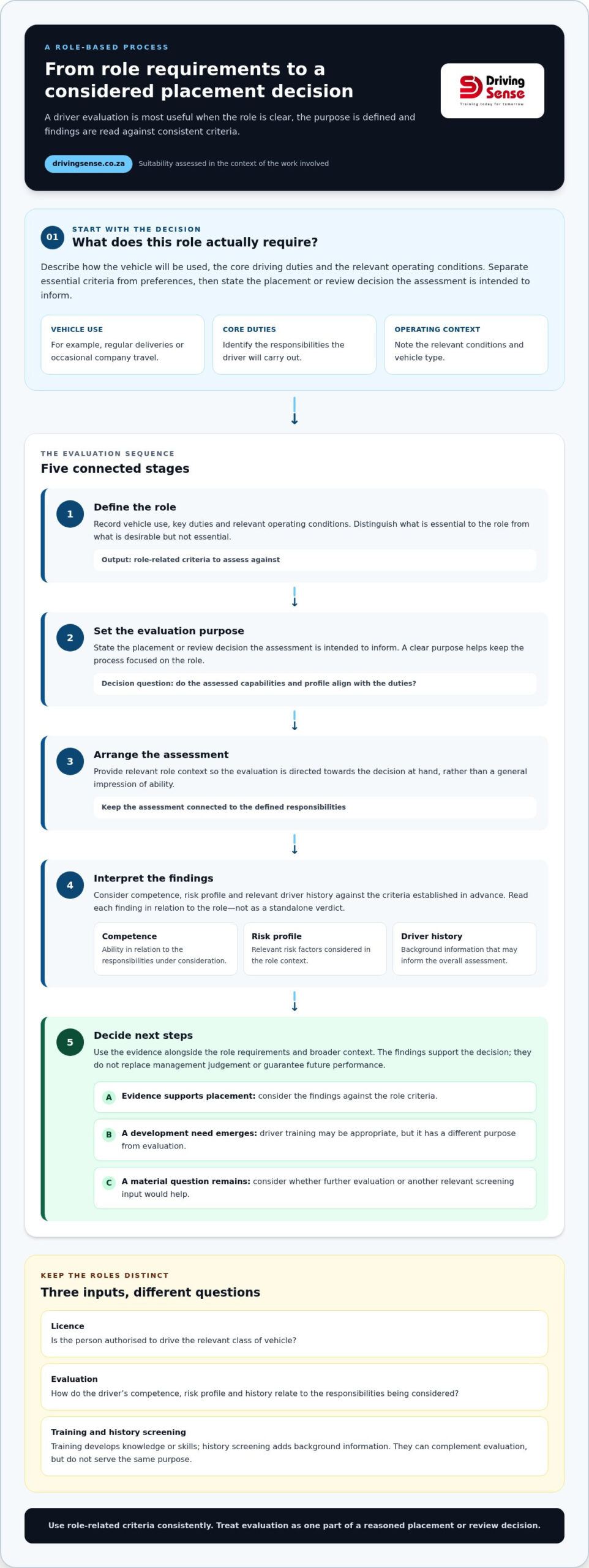
A useful evaluation begins before an assessment is arranged. First establish what the driving role requires and what decision the findings must support. This prevents a general impression of ability from being mistaken for evidence of suitability, and gives everyone involved a consistent basis for considering candidates against the same role-related criteria.
Define the driving role and evaluation purpose
Describe how the vehicle will be used, the core driving duties and the operating context. For example, a position involving regular deliveries may place different demands on a driver from one involving occasional company travel. Separate criteria essential to performing the role from preferences that are desirable but not essential. Then frame the decision question, such as whether the candidate’s assessed competence and profile align with the duties involved.
Use this sequence to organise the process:
- Define the role. Record the vehicle use, key duties and relevant operating conditions.
- Set the evaluation purpose. State the placement or review decision the assessment is intended to inform.
- Arrange the assessment. Provide relevant role context so the evaluation is directed towards the decision at hand.
- Interpret the findings. Consider competence, risk profile and relevant history against the criteria established in advance.
- Decide next steps. Determine whether the evidence supports placement, suggests development needs or calls for another relevant screening input.
Interpret findings alongside placement requirements
Read the findings against the role criteria, rather than treating them as a standalone verdict. An area of concern may have different implications depending on whether it relates directly to an essential duty or to a secondary preference. If the evidence leaves a material question unanswered, consider whether further evaluation or a separate screening input would help. Where a development need emerges, driver training may be a relevant next step, but it serves a different purpose from assessing suitability.
This approach makes the outcome more useful for consistent decision-making. The employer can explain which requirements were considered, how the available findings relate to them and why a particular next step was selected. The driver competency assessment guide provides further context on assessing capability in relation to business needs.
For organisations considering driver evaluation services south africa, a defined role and decision question help keep the assessment relevant without turning it into a guarantee of future performance. Driving Sense provides driver training, profiling and assessments for organisations across South Africa. Explore Driving Sense’s driver assessment services as part of a structured placement process.
Driver Evaluation, Training and History Screening: What Is the Difference?
These services can all contribute to a more informed placement decision, but they answer different questions. Evaluation considers whether a driver’s competence and risk profile align with a role; training develops capability; history screening adds background information. Treating them as interchangeable can leave gaps in an employer’s assessment. Using them for distinct purposes helps clarify what each finding can and cannot establish.
| Input | What it helps establish | What it does not replace |
|---|---|---|
| Driver evaluation | How assessed competence and risk relate to the responsibilities of a proposed role. | Training or background checks. |
| Driver training | Knowledge or skills that may be developed or improved. | An assessment of employment or driving history. |
| Driver history screening | Relevant background context for a placement decision. | An assessment of current role-related competence. |
Driver evaluation versus driver training
An evaluation assesses current capability in relation to defined driving responsibilities; training focuses on learning and development. For instance, if an evaluation identifies a capability that needs attention, the employer can consider whether training is an appropriate response. Training may help address a development need, but completing a course does not, by itself, establish that a driver’s background has been screened or settle every placement question. A corporate driver training guide can help employers consider training as a distinct part of workforce capability development.
Driver evaluation versus history and risk screening
Assessment findings about competence and risk relate to a driver’s suitability for particular responsibilities; history screening contributes background context. Neither substitutes for the other. A driver’s history may raise points for consideration without showing how they perform against current role requirements, while an assessment of competence does not, by itself, establish a full history.
For a pre-placement decision, employers can consider these inputs together, interpreting each according to its purpose and relevance. This supports a more complete view without assuming that one result guarantees future performance. Practical guidance on driver history verification can inform the background-screening process, while a fleet driver risk profiling guide offers further context on considering risk profiles.
For organisations reviewing driver evaluation services south africa, the practical distinction is straightforward: evaluate to inform suitability, train to develop capability and screen history to add background context. Then weigh relevant findings against the role’s requirements and decide whether placement, development or further review is appropriate.
How Employers Can Prepare for a Driver Evaluation
Preparation helps ensure that an evaluation is relevant to the decision an organisation needs to make. Organise accurate role information, identify who will interpret the findings and clarify how driver information will be handled. This groundwork makes it easier to apply the same expectations consistently across candidates for comparable positions.
Information to organise before assessment
Provide a concise description of the position, focusing on its actual driving responsibilities and vehicle context. A clear outline helps distinguish essential requirements from preferences and gives the assessment appropriate workplace context. Organise information through the organisation’s established processes, keeping it relevant to the role and decision.
- Role summary: Note the vehicle type and how it will be used, along with the core driving duties and relevant operating context.
- Decision purpose: State whether the evaluation will inform a pre-placement decision or a review of suitability for existing responsibilities.
- Role criteria: Identify requirements central to the work, and separate them from additional preferences that are not essential to performing the role.
- Relevant information: Gather driver and role information using the organisation’s established processes, avoiding unrelated material that won’t assist the decision.
- Information handling: Follow the organisation’s applicable policies for access, use, storage and retention of driver information.
Keep preparation proportionate. A focused role summary and a clearly stated decision question are more useful than an expansive description that mixes essential duties with general expectations. If the role differs between candidates, record those differences so that any variation in the assessment context is understood.
Turning findings into a consistent employer decision
Assign a decision-maker before the findings are received. This person should understand the role criteria and consider the assessment in context, rather than allowing expectations to shift after results are known. If an organisation uses a panel or more than one reviewer, agree how the decision will be recorded under internal procedures.
After assessment, document how relevant findings relate to the requirements identified in advance. The purpose isn’t to treat an evaluation as an automatic hiring decision, but to make the employer’s reasoning clear and consistent. A brief record can capture which criteria were considered, any material gaps and the rationale for the next step.
If the findings point to a development need, driver training may be appropriate. If background context remains relevant, additional screening may help address that separate question. Where more information is needed about role-related capability, consider whether another assessment input is suitable. Keep these responses distinct, and handle information in line with internal policies.
For employers preparing to use driver evaluation services south africa, a defined role, prepared information and clear decision ownership make findings easier to apply fairly. Explore Driving Sense’s driver assessment services to support a structured approach to placement decisions.
Choosing Driver Evaluation Services in South Africa: Driving Sense’s Approach
For an employer, an evaluation is most useful when it contributes relevant evidence to a defined placement decision. Driving Sense provides driver training, profiling and assessments for organisations across South Africa. Its screening and assessment services evaluate competency, risk profiles and driver history before placement. Considered together, these dimensions give employers several relevant perspectives, while leaving the final decision with the organisation.
Employers looking for driver evaluation services south africa can consider how assessment and profiling fit their placement process: what the role requires, which information can help assess suitability and how findings will be interpreted alongside internal criteria. This connects evaluation to a practical organisational need rather than treating it as an isolated result.
A nationwide service informed by transport-sector experience
Driving Sense was founded in 2006 and delivers training nationwide across South Africa. For organisations operating across the country, this nationwide capability can support planning a consistent approach to driver-related training and assessment.
Founder Natalie Rodrigues brought 11 years of experience at Super Group’s Truck Rental Division. That transport-sector experience provides context for the background to Driving Sense’s work. It is distinct from an individual driver’s assessment findings, however, and should not be read as a promise about a particular candidate’s performance or the outcome of an evaluation.
Integrating evaluation into a placement decision
Assessment is one evidence input within an employer’s placement process, not a substitute for the organisation’s own judgement. Competency findings can be considered against the driving responsibilities of the position; a risk profile can add another perspective for the employer to weigh; and driver history can provide relevant background context. Each answers a different question, so combining them can support a more considered view than relying on any single input alone.
The value lies in relating those findings to the role and applying them consistently. Employers can use assessment information to inform placement, identify an area that may warrant development or decide whether another screening input would clarify an outstanding question. Findings should inform the decision, not be treated as a guarantee of future performance.
Driving Sense’s driver training, profiling and assessment services support organisations seeking a structured way to consider driver suitability before placement. To discuss your organisation’s driver evaluation requirements, discuss driver evaluation requirements with Driving Sense.
Make Your Next Placement Decision More Deliberate
Use your next driver appointment as an opportunity to strengthen how your organisation defines suitability. A clear, role-based evaluation approach can help decision-makers apply consistent criteria, identify where further development may be appropriate and make their reasoning more transparent. As responsibilities evolve, reviewing those criteria can also help keep placement decisions aligned with the work drivers are expected to perform.
For organisations considering driver evaluation services south africa, the practical next step is to connect assessment needs with the roles and decisions your business manages. Driving Sense supports organisations with driver profiling, assessments and training as part of a considered approach to driver placement.
Explore driver assessment support with Driving Sense and take a considered next step towards more consistent placement decisions.
Frequently Asked Questions
Does a valid driving licence prove that someone is suitable for a specific job?
No. A licence establishes permission to drive, but it doesn’t show whether a person’s competence and experience align with every role’s demands. For example, an employer comparing candidates for different driving positions should consider each role’s responsibilities, rather than assuming that the same licence indicates equal suitability. Professional evaluation findings can add role-specific evidence to the placement decision, alongside other relevant information, without determining the outcome on their own.
How is a driver evaluation different from a driving lesson?
A driver evaluation considers existing capability for an employer’s decision, while a lesson or training programme aims to develop knowledge or capability. If an assessment identifies a skill area relevant to a particular duty, the employer can consider whether training would help address it. The distinction matters because attending training doesn’t, by itself, answer whether the driver’s current capability aligns with the role or resolve a separate background-screening question.
Can driver evaluations be used for existing employees as well as candidates?
Yes. An employer may consider an evaluation for an existing employee if driving responsibilities change or there’s a need to review suitability for assigned duties. For example, taking on a role with different driving tasks may prompt the organisation to consider whether the employee’s assessed capability aligns with those responsibilities. Define the reason for the review beforehand, and interpret findings in context. They inform the employer’s judgement; they can’t guarantee future performance.
What information should an employer prepare before arranging a driver evaluation?
Prepare the current role description, a clear account of its driving duties and vehicle context, and the decision the organisation needs to make. If the written role description no longer reflects actual responsibilities, note the relevant changes so the assessment context is accurate. Organise driver and role information through established internal processes, and identify who will review the findings. This helps prevent outdated or overly general job expectations from shaping the decision.
Does a driver evaluation replace driver history verification?
No. Evaluation addresses role-related competence and risk considerations, while history verification provides background context. A favourable history alone doesn’t establish capability for the responsibilities of a position, and assessment findings don’t provide a complete account of a driver’s background. For driver evaluation services south africa, employers can treat these as separate inputs, consider the relevance of each to the role and avoid allowing one result to stand in for information it doesn’t assess.
What happens if an evaluation identifies a development need?
The employer can consider what response best fits the identified gap and the requirements of the role. Relevant training may be appropriate where the issue concerns a capability that can be developed; additional screening may help if a separate background question remains. The organisation can then record its reasoning in line with internal procedures. An identified development need doesn’t automatically decide placement, and employers should avoid treating findings as a pass-or-fail result unless established assessment criteria support that approach.
