

A wellness initiative that overlooks the realities of commercial driving may support employees in principle but leave important workplace priorities unaddressed. For employers considering driver wellness programs corporate teams can use, the central question is whether the approach responds to the pressures of the role, including fatigue, stress and irregular schedules, alongside broader wellbeing needs.
For professional drivers, wellbeing is connected to working conditions and the safety responsibilities of the role. A useful approach links relevant education and training with job-specific training, rather than treating wellness as a standalone activity. Employers should decide what the programme is meant to address, who it needs to reach and how its components fit together.
This guide sets out a practical framework for assessing driver wellness approaches in South Africa. It covers how to identify workforce priorities, connect wellbeing education with driver training and operational safety, and plan follow-through across dispersed teams. Driving Sense provides employee wellness alongside driver training, profiling and assessments, giving organisations a work-informed way to consider their workforce and safety objectives.
Key Takeaways
- Distinguish a coordinated driver wellness programme from a one-off clinic visit, campaign or training session before deciding what your workforce needs.
- Set priorities using drivers’ roles and operating conditions, then group them into health access, relevant education, safety capability and routes to further support.
- Compare driver wellness programs corporate teams are considering by workforce reach, role relevance, delivery context and clarity of responsibilities.
- Plan in stages: assess needs, set aims, assign responsibilities and define process measures before launch.
- Connect employee wellness with driver training, profiling and assessments to support a programme informed by the demands of the work.
What Are Corporate Driver Wellness Programmes in South Africa?
A corporate driver wellness programme is an employer’s planned approach to supporting drivers’ wellbeing in the context of their duties and working conditions. It can bring together relevant education, training and access to appropriate support, with responsibilities and delivery arranged as part of the organisation’s workforce plans.
A single clinic visit, awareness campaign or training session may contribute to a programme, but it does not by itself make a continuing plan. A structured programme identifies priorities, decides how support will be delivered and considers whether it reaches the drivers it is intended to serve. For example, an employer might review which driver groups can attend a training session during working hours and how other forms of support will be communicated to those who cannot.
That distinction matters in South African road transport, where driving roles and operating arrangements vary. A long-haul driver, a local delivery driver and a driver on a fixed company schedule may have different duties and opportunities to access workplace support. A considered approach to Occupational Safety and Health recognises that employee wellbeing sits alongside the conditions and responsibilities of work. The programme should reflect the actual workforce rather than assume everyone has the same needs.
In practical terms, employers can treat a programme as a framework that connects:
- identified driver wellbeing priorities;
- work-relevant education and training;
- clear routes to further support where needed; and
- assigned responsibilities for planning and delivery.
Not every employer needs the same mix. To choose the right structure, consider the roles involved, how work is organised and what support is already available. A simple role-by-role review can highlight where needs overlap and where a distinct approach is required.
How Does Driver Wellness Differ from General Employee Wellness?
A general employee programme may address shared workplace needs, but professional driving duties add context to the choice and delivery of support. Consider drivers’ responsibilities, work patterns and opportunities to take part. This helps avoid assuming that drivers have the same schedules, access requirements or priorities as office-based colleagues, or that every driver in a fleet needs identical support.
Why Do Employers Consider Driver Wellness Programmes?
Employers may use a programme to give appropriate attention to workforce wellbeing while supporting responsible operations and continuity. Its aims might include making relevant information accessible, connecting education with job demands and clarifying where employees can seek further support. These are programme aims, not guarantees of improved safety or productivity. When assessing “driver wellness programs corporate” options, check whether the approach is organised around drivers’ work rather than limited to a one-off activity.
Start by stating what the programme is intended to address and how it relates to the workforce. That gives employers a sound basis for comparing components and assigning responsibility for planning, delivery and review.
Which Wellbeing Needs Should a Corporate Driver Programme Address?
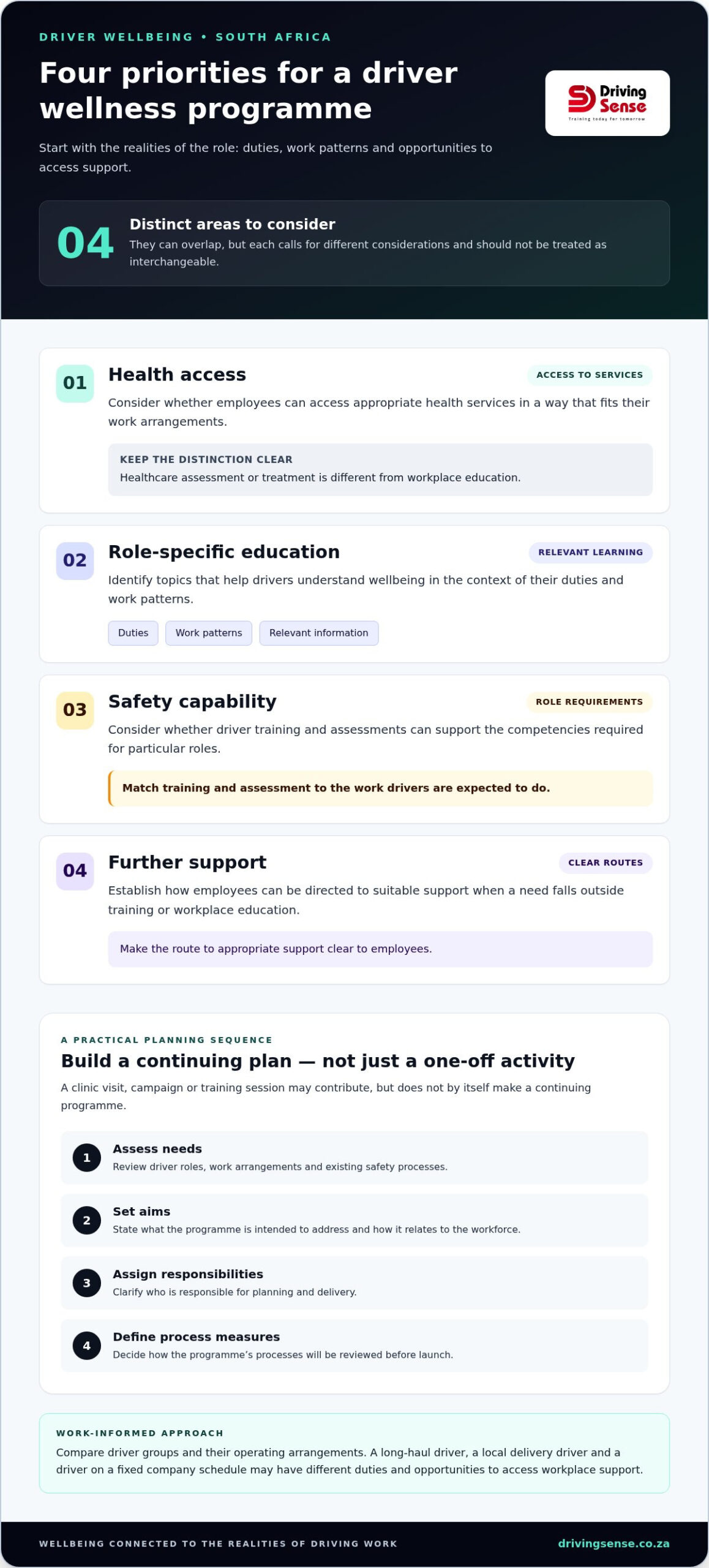
Base programme priorities on the work drivers actually do, not assumptions about what everyone needs. A useful starting point is to separate four areas: access to health services, education relevant to the role, safety capability and routes to further support. The areas can overlap, but they involve different responsibilities and should not be treated as interchangeable.
Assess needs before selecting a programme. This helps employers choose support that reflects drivers’ roles and operating conditions, instead of choosing activities first and looking for a fit afterwards.
- Health access: Consider whether employees can access appropriate health services in a way that fits their work arrangements. Healthcare assessment or treatment is distinct from workplace education.
- Role-specific education: Identify topics that help drivers understand wellbeing in the context of their duties and work patterns.
- Safety capability: Consider whether driver training and assessments can support the competencies required for particular roles.
- Further support: Establish how employees can be directed to suitable support when a need falls outside training or workplace education.
South African road safety guidance provides context for considering driver fitness. The Arrive Alive Driver Fitness Guidelines can inform an employer’s understanding of why fitness is relevant to road use. A workplace programme should still be tailored to the organisation’s responsibilities and workforce.
How Can Employers Identify Drivers’ Workplace Needs?
Begin with a structured review of job roles, work arrangements and existing safety processes. Compare duties across driver groups, note what training and assessments are already in place, and consider how employees can access support during their working patterns. Appropriate feedback from drivers and internal review can reveal practical barriers or priorities that written procedures may not show.
Use information proportionately. Employers should not collect or publish personal health information without a suitable, lawful process. For programme planning, role-level observations and appropriately gathered feedback can help identify shared needs without treating individual medical details as general workforce information.
Where Do Training and Health Services Fit?
Driver training, profiling and assessments can contribute to work-related competence and safety by connecting learning with the demands of a driver’s role. They are not clinical assessment or treatment, and should not be presented as substitutes for healthcare. Health services are a separate programme component, with their own delivery and professional responsibilities.
Define who arranges training, who is responsible for any health service and how employees are directed to further support. Clear boundaries help prevent gaps or confusion while allowing relevant components to sit within a broader plan. Driving Sense provides driver training, profiling and assessment support that organisations can include in a work-informed approach.
How Do Corporate Driver Wellness Programme Approaches Compare?
Employers can compare three broad approaches: healthcare access, employer-led education and training, or a coordinated programme combining distinct components. Healthcare initiatives focus on access to care; training develops relevant knowledge or competence; a combined model links selected support around identified workforce needs. None is a universal solution, and no approach guarantees fewer incidents.
In South Africa, The Health Foundation and the Road Accident Fund describe a mobile model that provides primary healthcare and eye care for drivers. Trucking Wellness describes mobile and roadside centres for road freight and logistics workers. These examples focus on healthcare access, rather than offering a complete template for every employer’s programme. The comparison below sets them alongside general criteria for assessing workforce fit.
| Approach | Purpose and delivery context | What employers should assess |
|---|---|---|
| Healthcare-access initiative | Provides access to health services, potentially through mobile or roadside models such as those described by The Health Foundation and Trucking Wellness. | Consider whether the service is accessible to the relevant workforce and how clinical responsibilities, follow-up and employer responsibilities are defined. |
| Employer-led education and training | Builds role-relevant knowledge or competence through education, driver training or assessments connected to work duties. | Assess relevance to driver roles, how delivery fits work arrangements and how learning relates to existing safety processes. It does not replace healthcare. |
| Coordinated multi-component programme | Brings selected training, education and health services together under a planned approach, while keeping each component’s purpose distinct. | Review reach across the workforce, suitability for different roles, practical access and accountability for delivery, referrals and review. |
What Are the Differences Between Healthcare and Training-Led Approaches?
Healthcare services address access to care, while training supports knowledge or work-related competence. A mobile health service may bring care closer to drivers, whereas employer-led training can focus on role-specific learning. One does not replace the other. Assess each against the need it is intended to address, its delivery context and the responsibilities involved.
When Might a Combined Programme Suit a Corporate Workforce?
A combined approach may suit an organisation with different driver roles, dispersed teams or varied opportunities to access support, provided each component addresses an identified need. Employers can define separate responsibilities for driver training and assessments, internal coordination and external health services, then plan how these fit together without confusing education with clinical care.
For organisations comparing driver wellness programs corporate options, the appropriate model is the one that fits assessed needs, workforce reach and operating arrangements, not a fixed ranking of approaches. Clear responsibilities keep the programme coherent while preserving the distinct purpose of each service.
How Should Employers Plan and Evaluate a Driver Wellness Programme?
A practical programme needs a defined scope, clear ownership and a review process to check whether planned support is being delivered as intended. Make these arrangements before launch, so employee communication, access and privacy are considered alongside programme content. A structured planning sequence can turn broad wellbeing priorities into manageable actions without assuming one model suits every fleet.
Evaluation is useful when it compares documented delivery and appropriate feedback with the programme’s original aims.
- Assess needs. Review the driver roles, work arrangements and existing safety processes in scope. Use suitable employee feedback and internal information to identify priorities, and avoid collecting personal health information without a suitable, lawful process.
- Set aims. State what the programme is intended to address, such as making relevant education accessible or connecting drivers with appropriate support. Make aims specific enough to guide decisions, but do not frame them as guaranteed safety or productivity outcomes.
- Select components. Choose training, assessments, health-service access or other support according to the needs identified. Distinguish education from clinical services, and consider how different driver roles may affect participation and relevance.
- Assign responsibilities. Record who coordinates the programme, delivers each component, communicates with employees and manages routes to further support. Clear ownership helps prevent gaps between planned activities.
- Plan review. Decide before launch which process measures to record, such as whether planned activities took place and which workforce groups were reached. Set review questions that relate to the aims, rather than adopting targets without a suitable basis.
What Should Employers Define Before Launch?
Document the workforce groups included, the needs identified and the programme’s intended scope. Specify how employees will hear about available support, how they can participate in ways that fit their work arrangements, and who handles questions or referrals. Set review questions in advance, such as whether planned components were delivered and whether communications reached the intended groups. Apply appropriate privacy safeguards to information gathered during planning and delivery.
How Can Employers Review Programme Relevance Over Time?
Review participation and delivery records alongside appropriate employee feedback. Then consider whether the selected components still relate to current roles and working conditions. Changes in duties or work arrangements may affect access or relevance, so keep the programme open to adjustment. Use findings to refine its scope or delivery. Limited evidence should not be treated as proof that the programme caused a change in safety or performance.
Driving Sense provides employee wellness alongside driver training, profiling and assessments. These services can inform a work-related programme while keeping training distinct from clinical healthcare. Discuss a driver wellness programme with Driving Sense to explore how training and assessment can contribute to your organisation’s approach.
How Can Driving Sense Support Corporate Driver Wellness Through Training?
Driving Sense provides employee wellness and driver training, profiling and assessments for organisations. Founded in 2006, the company delivers training nationwide across South Africa, supporting employers whose drivers work across dispersed locations.
Within a wider programme, training and assessments can address work-related knowledge and capability, while health services and any clinical assessment or treatment remain separate components with their own responsibilities. This distinction helps employers build a coherent approach without presenting training as healthcare or promising particular health or safety results.
How Can Driver Training and Assessments Complement Wellness?
Driver training, profiling and assessments can help employers consider capability in relation to the duties and expectations of different driving roles. They can sit alongside separately defined wellness support, helping employers distinguish needs related to job-relevant learning from those requiring another form of assistance. For further guidance on structuring workplace learning for fleets, see this guide to corporate driver training in South Africa.
What Is a Practical Next Step for South African Employers?
Prepare a concise outline of the workforce groups involved, the needs identified, the programme aims and any practical requirements that affect participation. This gives a training partner a clear basis for considering how driver training, profiling or assessments fit alongside other support, without blurring responsibilities.
Driving Sense’s nationwide training coverage can support a consistent approach across dispersed workforces. Employers can use the planning discussion to clarify:
- which driver roles and employee groups are in scope;
- what training or assessment needs relate to those roles;
- how these activities should align with separately arranged wellness support; and
- what delivery and review responsibilities the organisation needs to manage.
These points turn broad priorities into a practical discussion about programme design, while leaving room to adapt the approach to the organisation’s operating context. A clearly defined training remit can contribute to a work-informed programme without replacing healthcare services.
To discuss how driver training and wellness needs could be addressed within your organisation, Discuss corporate driver training and wellness needs with Driving Sense.
Turn Programme Priorities into a Practical Next Step
A driver wellness programme can become part of how an organisation plans for its workforce, rather than remaining an isolated initiative with no clear place in operational decisions. Selecting driver wellness programs corporate teams can maintain starts with a realistic view of who the programme serves, how its components fit existing responsibilities and what would prompt a review when work arrangements change.
For a useful next step, prepare a short outline of the driver roles involved, the training or assessment needs under consideration and how these relate to other wellness support. This gives the planning discussion a clear purpose while leaving room to shape the approach around the organisation’s operating context. A work-informed training partner can help employers consider how driver training, profiling and assessments may contribute, without confusing those activities with clinical care or promising particular outcomes.
Driving Sense works with South African organisations on employee wellness and driver-related training and assessments. Plan your driver training and wellness approach with Driving Sense, and take a considered step towards a programme grounded in your workforce’s needs.
Frequently Asked Questions
What is a corporate driver wellness programme?
A corporate driver wellness programme is an employer-organised approach to supporting drivers’ wellbeing in relation to their work. For example, a transport company might coordinate relevant learning with information about where to seek additional support, while keeping the purpose of each activity clear. The programme is shaped by the workforce and its operating context, rather than offering the same benefit to every employee regardless of role.
Why should companies consider driver wellness programmes?
Companies may consider them to address wellbeing as part of responsible workforce planning and to make relevant support easier to understand and access. For employers searching “driver wellness programs corporate”, the key is to connect programme aims to actual work needs, rather than assume a wellness activity will automatically improve safety or productivity. Clear planning also helps managers understand what support is intended to do and who is responsible for it.
What should a driver wellness programme include?
Components should reflect the needs identified within the workforce. They might include role-relevant driver education, training or assessments, information about accessing health services, and clear directions for seeking further support. For example, an organisation can distinguish learning about a work procedure from a health concern requiring clinical attention. Define the scope of each component so employees understand what it provides and where its boundaries lie.
How can employers measure a driver wellness programme?
Start by tracking whether planned activities were delivered and whether the intended employee groups could participate. Depending on the programme’s aims, records might include attendance, completion of planned sessions or feedback on the relevance of the content to drivers’ duties. Review this information against the original objectives. Participation data describes delivery, but does not by itself show that a programme caused changes in health, safety or performance.
Can driver training form part of an employee wellness programme?
Yes. Driver training can contribute when it addresses knowledge or capability relevant to employees’ driving roles and forms part of the organisation’s wider support plan. It remains distinct from clinical assessment and treatment: completing training does not establish someone’s health status or replace healthcare. Make this distinction clear in programme communications, so drivers know which activities provide workplace learning and which routes are for health-related support.
How can a company support drivers working across South Africa?
Set a consistent programme framework, then plan how information and activities will reach drivers in different roles and work arrangements. Use clear, repeatable communications, consider suitable delivery arrangements for the workforce, and review participation records by relevant employee group. This can help identify uneven access without assuming every team has the same needs. Keep the programme’s core aims consistent while adapting implementation to operational circumstances.
Are driver wellness programmes the same as roadside wellness services?
No. Roadside wellness services are a way of delivering particular support, often through facilities or mobile services positioned for drivers. A corporate programme is an employer’s broader plan for addressing workforce needs and may coordinate different forms of support, including services delivered elsewhere. Roadside provision may be one component where relevant, but it does not automatically cover workplace education, driver training, programme responsibilities or evaluation.
