
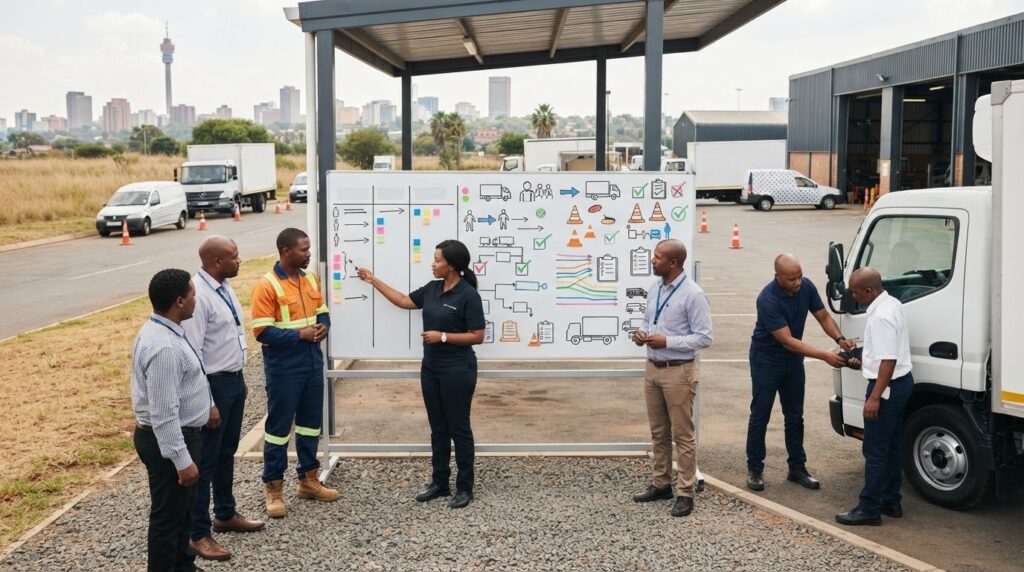
What if the most important part of fleet safety training programs isn’t the course itself, but how its lessons are applied and reviewed on the job? For South African employers, deciding what to prioritise across different drivers, vehicles and responsibilities can be difficult, especially when operational risks and compliance requirements also need attention.
A training session can build knowledge, but it won’t by itself establish consistent safe driving behaviour. A practical plan connects identified needs with driver capability, relevant training or assessment, clear ownership and follow-up. That structure helps employers make decisions that relate to their operations and can be reviewed over time.
This article provides a reusable planning template to help you prioritise driver training, assign responsibilities and set review points. It also explains how driver training, profiling and assessments can work together as part of a fleet plan. Drawing on experience in South African road transport, Driving Sense provides organisations with nationwide training capability and support for connecting compliance priorities with practical skill development.
Key Takeaways
- Build fleet safety training programs around identified role requirements and operational needs, rather than relying on course bookings alone.
- Use driver training, profiling and assessments for distinct purposes when setting priorities and identifying capability needs.
- Assign clear ownership and decide what evidence to review so training actions can be followed up over time.
- Use the template to record each role, identified need, learning action, responsible owner and review point.
- Consider how a training partner’s driver training, assessment experience and nationwide capability fit your fleet’s operational needs.
Why fleet safety training programmes need more than a course booking
A course booking can address a defined learning need, but it doesn’t establish how that need was identified, who is responsible for applying the learning or when the organisation will review whether its approach remains relevant. Effective fleet safety training programs are planned around the work drivers do and the conditions in which they operate, rather than treated as isolated events.
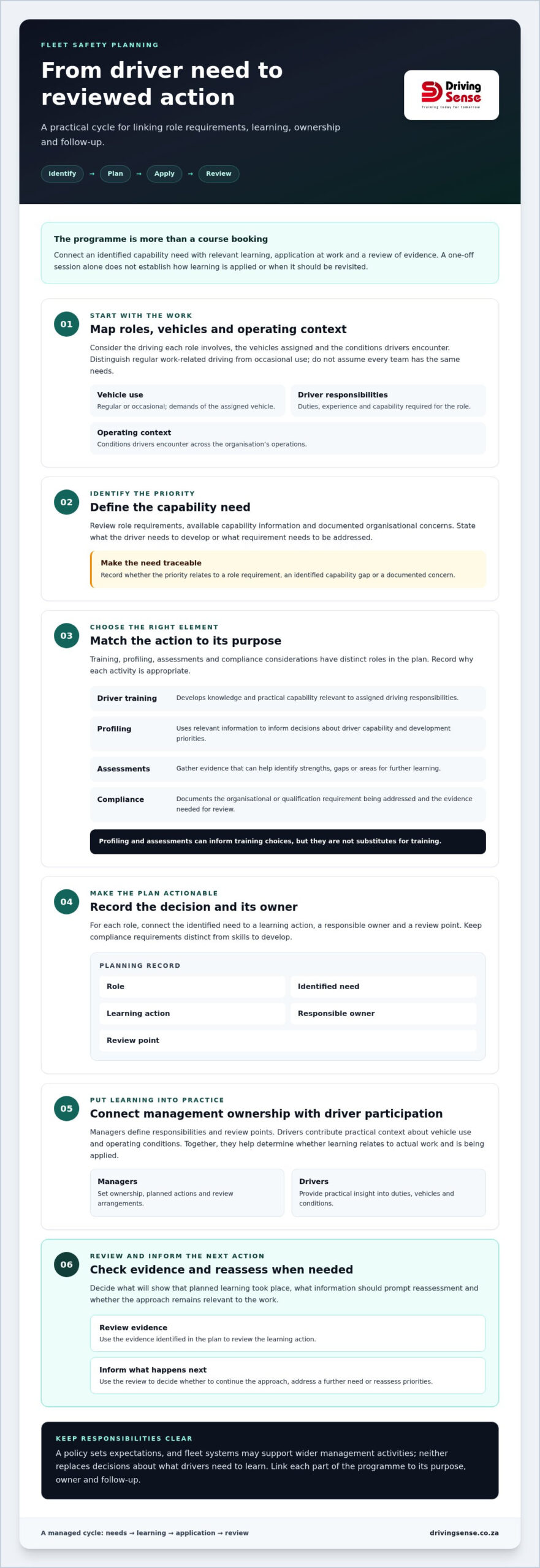
A fleet safety training programme is a managed cycle of identifying capability needs, providing relevant learning, supporting its application at work and reviewing evidence to inform the next action. The difference between a programme and a once-off course is the connection between learning, operational responsibilities and follow-up.
A policy sets expectations, but does not by itself develop or assess driver capability. A fleet management system may support wider activities such as driver management, health and safety and telematics, as outlined in What is Fleet Management?, but technology does not replace decisions about what drivers need to learn. Training, policy and systems can each contribute to fleet safety, but they serve different purposes and need clear ownership.
What should a fleet safety training programme achieve?
Set aims that relate to identifiable needs: building a driver’s capability for assigned duties, establishing consistent operating expectations across teams, or addressing a learning requirement identified through an assessment. These aims help managers prioritise training based on documented needs, without relying on unsupported promises about future performance.
Management ownership turns priorities into planned actions, while driver participation helps ensure that learning relates to actual work. Managers can define responsibilities and review points; drivers can provide practical context about vehicle use and operating conditions. Together, these inputs help determine whether learning has been applied and what should happen next.
Which organisations need a structured fleet approach?
Road transport businesses and freight operators may have drivers with different vehicle responsibilities, routes and day-to-day tasks. Corporate organisations using work vehicles also need to consider how driving fits each role, even if vehicle use is only one part of an employee’s duties. A common plan can provide oversight while tailored priorities reflect those differences.
To identify relevant priorities, consider:
- Vehicle use: distinguish regular work-related driving from occasional use, and identify the demands of the vehicles assigned.
- Driver responsibilities: account for the duties, experience and capability required for each role.
- Operating context: consider the conditions drivers encounter across the organisation’s operations, without assuming one team’s needs apply to all.
- Review evidence: decide what will show that the planned learning took place and what information should prompt reassessment.
This approach gives employers a consistent planning framework across national operations without assuming every driver needs the same intervention. It also provides a basis for connecting training priorities to relevant roles, responsibilities and review arrangements.
Which training, assessment and compliance elements belong in the programme?
A useful plan does not assign the same intervention to every driver. It links each activity to a role, an identified capability need or an organisational requirement, then records why that activity is appropriate. This helps distinguish a learning priority from a general concern and shows how each part of the programme supports the fleet’s operations.
Driver training develops knowledge and practical capability relevant to assigned driving responsibilities. Profiling and assessments serve different planning purposes: they help employers understand driver suitability or capability and inform decisions about learning needs. They can guide the choice of training, but aren’t substitutes for it. Record compliance considerations separately so the plan distinguishes requirements to address from skills to develop.
- Driver training: select learning that responds to a role-specific skill or knowledge need.
- Profiling: use relevant information to inform decisions about driver capability and development priorities.
- Assessments: gather evidence that can help identify strengths, gaps or areas requiring further learning.
- Compliance considerations: document the organisational or qualification requirement being addressed, and the evidence needed for review.
How should employers identify relevant driver training needs?
Start with the work, not a course catalogue. Review driver roles, vehicle use, available capability information and documented organisational concerns. A driver responsible for regular work-related journeys may have different learning needs from an employee who drives only occasionally. Base the plan on actual responsibilities rather than assuming one course suits both.
Use profiling and assessments to inform the decision, then state the specific need each learning activity is intended to address. For example, note whether an activity responds to an identified capability gap, a role requirement or a documented concern. This creates a traceable link between the information considered, the proposed action and the review that follows. For a structured approach to identifying and responding to driver risks, see this driver risk assessment checklist for corporate fleets.
How do South African qualifications fit into planning?
South Africa’s occupational qualification landscape is moving towards the QCTO framework. The Quality Council for Trades and Occupations (QCTO) is the sole accrediting body for occupational and trades-related qualifications. Employers should distinguish qualification accreditation from training provision: the existence of a qualification or a reference to the framework does not establish a particular provider’s accreditation status.
Requirements can depend on the qualification and its current framework arrangements. Before including a qualification in a training plan, verify the applicable qualification, assessment and provider requirements against current authoritative QCTO and relevant SETA information. This avoids treating older references to SETA accreditation as a complete guide to present requirements. International resources such as NAFA Fleet Management Association Resources can offer broader fleet-management perspectives, but South African qualification decisions should be grounded in South African sources.
For employers connecting driver capability with compliance planning, driver training, profiling and assessments can be considered as complementary inputs to the programme.
Is driver training alone enough to manage fleet safety?
No. Driver training supports knowledge and capability, but it cannot take the place of clear programme ownership, operational controls or ongoing review. A driver may complete relevant learning, for example, while managers still need to clarify procedures, follow up on responsibilities and address operational issues that sit outside the scope of a course.
Well-designed fleet safety training programs distinguish these functions instead of treating every action as training. The comparison below shows what each contributes, who may own it and what evidence can support review. These activities help an organisation manage its approach; none should be presented as a guarantee of fewer accidents or lower costs.
| Element | Purpose | Typical owner | Evidence for review |
|---|---|---|---|
| Training | Develop knowledge or capability for a driver’s role | Training or fleet manager | Attendance and relevant learning records |
| Profiling and assessment | Inform understanding of capability and development needs | Fleet or human resources manager | Assessment findings and documented follow-up |
| Operational controls | Set expectations and guide work practices | Responsible operational manager | Current procedures, assigned responsibilities and follow-up records |
| Monitoring | Review relevant information about how the programme is being applied | Designated manager | Recorded observations, review notes and assigned actions |
Training versus assessment: what does each contribute?
Training is a learning intervention that supports the knowledge and practical capability required for a relevant driver role. Profiling and assessments provide information that can help an employer understand competency and decide where development may be appropriate. An assessment may inform a training decision, but it doesn’t deliver the learning itself. Completing training, in turn, does not automatically show how capability is applied in the workplace.
Neither function on its own forms a complete fleet safety management system. Employers still need ownership, clear expectations and a process for reviewing whether planned actions took place. For course-selection considerations, the corporate driver training guide provides a related reference.
How do non-training controls complement learning?
Management controls make responsibilities actionable. Documented procedures can explain expected practices, while follow-up gives managers a way to address questions or gaps after learning has been delivered. Vehicle maintenance and incident response are also relevant operational controls, but they are distinct from driver training and need their own accountable owners and records.
Wellness and fatigue considerations may also be relevant to how work is organised and supported. Their specific treatment belongs in a broader employee wellness approach, rather than being assumed to be resolved by a driving course. The driver wellness guide explores that subject further. Reviewing these elements together helps managers see what training addresses, what requires operational action and what evidence should inform the next review.
How to complete a fleet safety training programme template
A planning template is useful when it records why an action is needed, who is accountable and what will be reviewed afterwards. Keep it simple enough for managers to maintain, but specific enough to show how each activity relates to a driver role or an identified organisational need.
At minimum, the template should record the driver role, identified need, planned learning or assessment action, accountable owner, completion evidence and review prompt. These fields give fleet safety training programs a traceable structure without prescribing a fixed format or delivery schedule.
What fields should the fleet training plan contain?
Begin with the scope of the plan: which teams, roles or vehicle uses it covers, and what information was considered. Record each priority separately so a need affecting one role isn’t automatically applied to every driver. Profiling and assessment findings can inform each entry, alongside documented organisational concerns and role requirements.
- Driver role and context: identify the role, relevant vehicle use and the operating responsibilities that shape the need.
- Identified need: describe the capability or organisational requirement the plan is intended to address.
- Planned action: note the relevant training or assessment activity, distinguishing learning from information-gathering.
- Accountable owner: name the internal role responsible for arranging the action and maintaining the record.
- Completion evidence: specify what record will show that the activity took place, using a format suited to the organisation.
- Review prompt: state what the owner should consider when reviewing the original need and the action taken.
How should employers prioritise and review planned activity?
Prioritise documented operational needs and role relevance before selecting an activity. This helps managers distinguish a clearly identified capability need from a general preference and gives them a reasoned basis for deciding what to address first. Keep delivery arrangements adaptable to the organisation’s operations; the template needn’t assume a fixed duration, group size or schedule.
Complete the plan in sequence:
- Set the scope: record the roles, vehicle uses and operating context covered.
- Establish a baseline: review existing capability information, assessments and documented concerns relevant to those roles.
- Set priorities: link each identified need to an appropriate training or assessment action, and assign an owner.
- Arrange delivery: record how the action will fit operational requirements, leaving timing and format flexible.
- Review and update: examine completion evidence and feedback against the original need, then revise priorities when operations, responsibilities or identified capability needs change.
A review should ask whether the planned action was completed and whether the evidence or feedback addresses the need recorded at the outset. If it doesn’t, clarify the need or reconsider the action rather than simply repeating it. This keeps the plan responsive and provides a clear record of decisions.
Information about Driving Sense’s driver training, profiling and assessments can help employers consider how these services relate to their planning priorities.
Choosing a fleet safety training partner and putting the plan into action
Once priorities and review responsibilities are recorded, decide how to support the plan’s learning and assessment actions. A suitable approach should relate to the needs identified in your register and support the organisation’s operating footprint. A course catalogue alone is not enough; the support should make sense for the driver roles and capability requirements set out in the plan.
What should employers consider when selecting training support?
Use your documented priorities to assess the fit of driver training, profiling and assessments. Consider how these activities relate to the needs identified, whether training capability can support operations across the organisation’s national footprint, and whether the compliance context is explained accurately. Keep qualification requirements distinct from a provider’s status: references to a qualification framework should not be treated as proof of accreditation or a promise of a particular outcome.
- Relevance: connect the proposed learning or assessment approach to an identified role or capability need.
- Coverage: consider whether delivery capability suits the organisation’s national operations.
- Clarity: look for a clear distinction between training, assessment and compliance considerations.
- Reviewability: ensure the plan can record what was completed and how it relates to the original priority.
These considerations help employers compare an approach with their own plan, rather than selecting an activity simply because it is familiar or readily available. They also support consistent planning when teams or driver roles have distinct needs.
How can Driving Sense support a fleet training plan?
Driving Sense provides driver training, profiling and assessments to South African organisations, with nationwide training capability. These services can be connected inputs to a fleet plan: profiling and assessments can inform understanding of driver capability and development needs, while training can support relevant skill development. This brings practical skills and compliance considerations into the same plan without treating them as interchangeable.
Driving Sense was founded in 2006. Founder Natalie Rodrigues brought 11 years of prior experience at Super Group’s Truck Rental Division, giving the business experience in the South African road transport sector. This context may be relevant to employers considering training support for operations across the country, while the organisation’s identified needs should remain the basis for planning.
Use the completed template to guide a focused discussion about the roles, priorities and review evidence in your plan. Discuss your fleet training plan with Driving Sense and consider how driver training, profiling and assessments can support your organisation’s priorities.
Put your fleet training priorities into action
The value of a planning template lies in how consistently it informs decisions after it has been completed. Use it as a working record: assign responsibility for the next action, retain the evidence supporting each decision and revisit priorities when roles or operating conditions change. This keeps fleet safety training programs connected to the work they are intended to support, rather than letting the plan become a static document.
Start with a manageable next step. Select a clearly documented need, agree how it will be addressed and identify who will review the result. This gives managers and drivers a shared point of reference and helps the organisation refine its approach as new information becomes available.
Where additional driver training, profiling or assessments would support your priorities, work through your fleet training priorities with Driving Sense. A considered plan gives your team a sound basis for taking the next step towards consistent, accountable fleet safety practice.
Frequently Asked Questions
What is a fleet safety training programme?
A fleet safety training programme is a repeatable way to plan and manage learning in response to an organisation’s driver capability and operational needs. Unlike a single course, it gives employers a basis for deciding who needs support, what activity is relevant and how to revisit the decision. For example, a change in vehicle responsibilities can prompt a fresh review rather than reliance on an old course record. This makes fleet safety training programs part of ongoing workforce planning.
Is driver training enough to improve fleet safety?
No, training is one contribution, not a complete management approach. A driver may complete learning, while managers still need to communicate responsibilities, maintain relevant procedures and consider assessment information. If a team’s responsibilities change, for instance, a manager can review whether existing learning remains applicable and record any follow-up. This does not guarantee a particular safety outcome, but it helps keep training connected to the work and the organisation’s oversight process.
How should an employer identify fleet driver training needs?
Begin by grouping drivers according to their actual duties, then review available capability information and documented operational concerns for each group. A concern related to one role should not automatically become a fleet-wide training requirement. Record what information prompted the proposed action, such as an assessment finding or a change in assigned duties, and identify what further information would help determine whether the need has been addressed.
Can fleet safety training be tailored to different driver roles?
Yes. Employers can plan around differences in responsibilities, vehicle use and the driving demands associated with each role, without assuming that every driver needs the same learning. For example, regular work-related driving and occasional use of a company vehicle may call for different planning considerations. Define the capability required for each role, then align appropriate training or assessment activity to that need rather than assuming a particular course format or specification.
What is the difference between driver profiling and driver training?
Driver profiling provides information that can help an organisation understand a driver’s capability or development needs; driver training is a learning activity intended to develop relevant knowledge and skills. An employer might use profiling to inform a decision about appropriate learning, then review whether the selected activity responds to the identified need. Profiling does not itself deliver instruction, and training should not be treated as an assessment of capability unless that is specifically part of the activity.
Does QCTO accredit every fleet safety training provider in South Africa?
No. QCTO is South Africa’s sole accrediting body for occupational and trades-related qualifications, but that does not mean every provider is accredited or that every fleet course falls within that framework. Employers should distinguish a qualification’s status from a provider’s status, and refer to current QCTO information about the specific qualification and applicable provider requirements. A general reference to occupational qualifications is not, by itself, evidence of accreditation.
How can a national organisation plan fleet safety training across South Africa?
Use a consistent central planning record while allowing teams to document differences in responsibilities and operating conditions across the organisation. This supports common oversight without assuming that each operation faces identical demands. Set out who coordinates the plan, how team-level information reaches that owner and how delivery arrangements fit work requirements. Review whether the approach remains relevant when teams, vehicle use or organisational responsibilities change, rather than relying solely on a national standard.
