

A fleet’s greatest driver risk may be a capability gap that has not yet been identified. For South African organisations, a driver risk assessment corporate fleet teams can apply consistently should look beyond a tick-box exercise and consider relevant evidence, including driver competency, risk profile and history.
Assessment findings are useful when they inform operational decisions. The practical challenge is deciding what to assess, what information to gather and how to respond proportionately, without creating a process that sits apart from day-to-day fleet operations.
This checklist sets out a structured way to identify driver risks that warrant attention and select an appropriate next step, such as further assessment or targeted training. It explains what evidence to consider, how to interpret findings and how to connect them to practical action. Driving Sense provides driver training, profiling and assessments to organisations across South Africa, helping them make more considered decisions about driver capability and development.
Key Takeaways
- Use competency, risk profile and relevant driver history to structure an assessment, with its scope shaped by the role’s driving duties.
- Match the response to the decision: use an evaluation to consider competency, screening to inform a placement decision, or training to address a development need.
- Make a driver risk assessment corporate fleet process practical by defining its purpose, assigning coordination and record-keeping, and setting out how findings will be reviewed.
- Turn findings into proportionate next steps rather than treating assessment as a compliance exercise on its own.
- Driving Sense’s driver assessments, profiling and training can support informed driver decisions for organisations across South Africa.
Why corporate fleets need a structured driver risk assessment
A driver risk assessment is a structured evaluation of an individual’s competency, risk profile and relevant history in relation to their driving responsibilities. For a corporate fleet, the purpose is to bring relevant evidence together so decisions are consistent and explainable, rather than relying on assumptions, informal impressions or a single incident.
Driver-level assessment is one part of fleet risk management, not a substitute for considering vehicle condition, routes, work schedules, operating procedures or fleet policies. These factors can interact. A driver may be competent, for example, while a demanding route or unclear procedure presents a separate operational concern. Fleet management covers a broader set of responsibilities, including driver management and safety, so assessment findings should be considered alongside the organisation’s wider controls.
What does a corporate fleet driver risk assessment evaluate?
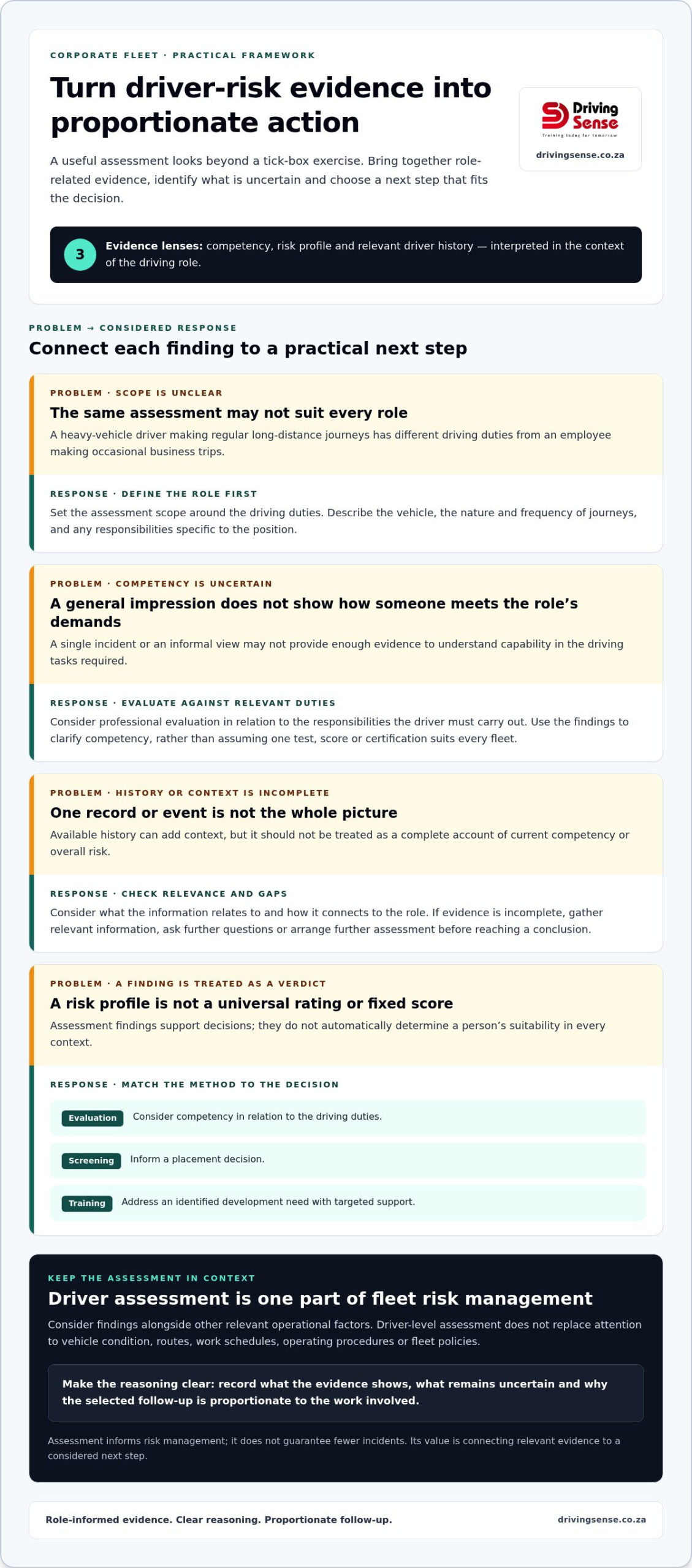
Three areas provide a useful starting point. Shape the assessment around the role rather than applying a universal test:
- Competency: the driver’s ability to carry out the driving tasks required by the position.
- Risk profile: relevant considerations that may affect the driver’s suitability or support needs in the context of the work.
- Driver history: available, relevant information that helps the employer understand previous driving experience and decide whether further questions are needed.
The evidence relevant to a person driving a heavy vehicle on regular long-distance journeys may differ from what matters for an employee who makes occasional business trips. Define the role and its duties first. This helps set an appropriate scope without assuming that one method or scoring system will suit every fleet.
What can an employer use assessment findings for?
Findings are decision-support evidence, not an automatic verdict on a person. They can help an employer decide whether a further evaluation would clarify a concern, whether driver training could address a development need, or whether relevant information should inform a placement decision. Follow-up should relate to the evidence and the work involved. Record the reasoning clearly enough to explain why a particular action was selected.
For example, if an evaluation indicates that a driver would benefit from support with a task relevant to their role, targeted development may be more proportionate than treating the finding as proof of general unsuitability. If the evidence is incomplete, gather relevant information or arrange further assessment before reaching a conclusion. This keeps the process focused on informed decisions instead of creating a record with no practical use.
Driver assessment also sits within a broader view of people at work. Workload, wellbeing and other human factors may be relevant to an organisation’s planning, but they are distinct from an assessment of driving competency. Employers considering those wider factors can explore workplace wellness programmes as part of their broader workforce approach.
A structured driver risk assessment corporate fleet process can support consistent decisions, while recognising that assessment informs risk management rather than guaranteeing fewer incidents. Its value lies in connecting relevant evidence to a considered next step.
What to assess: driver competency, risk profile and history
A useful assessment separates what is observed or recorded from what the organisation concludes. Start with the role and its driving duties, then consider evidence under three headings: competency, risk profile and driver history. This structure helps decision-makers identify what they know, what remains uncertain and whether further evaluation or support is appropriate.
A driver risk profile is a role-informed summary of relevant factors that may affect a person’s driving responsibilities, not a universal rating or fixed score. Interpret it alongside the available evidence and the demands of the position, rather than treating it as a label that defines a driver in every context.
Driver competency and role-related evidence
Professional evaluation can help an employer understand whether a driver’s competency is appropriate to assigned duties. Before interpreting findings, describe the driving context: the type of vehicle used, the nature and frequency of journeys, and any specific responsibilities connected with the role. The relevant questions for regular long-distance work may differ from those for occasional business travel. This role-first approach keeps the assessment focused without assuming one test, score or certification suits every fleet.
Prepare by identifying the responsibilities the driver must carry out and the evidence that would help inform the decision. Consider an evaluation in relation to those duties, rather than in isolation. Driving Sense provides driver training, profiling and assessments to help organisations consider competency in the context of their operational requirements.
Driver history and risk-profile context
Relevant driver history can add context to an evaluation, but one record or event should not be treated as a complete account of current competency or overall risk. Consider what the information relates to, how it connects to the role and whether further context or assessment is needed before deciding on follow-up. At the selection stage, screening can contribute to placement decisions; the pre-employment driver screening guide explores that process in more detail.
- Competency evidence: information relevant to the driving duties and responsibilities assigned to the role.
- Risk-profile context: factors that may be relevant to suitability or support needs in that specific work setting.
- Driver history: relevant available background information considered alongside, not instead of, competency evidence.
Keep the assessment record clear about what was gathered, what it indicates and what remains unknown. These are separate stages: evidence describes the information considered; a conclusion explains its relevance to the role; and a recommendation identifies a proportionate next step, such as further evaluation or driver development. Separating them makes it easier to review decisions consistently and reduces the risk of treating an isolated detail as a definitive judgement.
For wider fleet-safety planning, NAFA Fleet Safety Resources provide industry guidance beyond individual driver assessment. Organisations seeking role-relevant assessments can also explore Driving Sense driver assessments as part of a considered process.
Choose the right response: assessment, screening or driver training
The right intervention depends on the decision the organisation needs to make. A professional evaluation helps answer questions about competency and risk profile; screening informs candidate placement decisions; driver training addresses development needs. These options can complement one another, but they are not interchangeable: training does not replace an evaluation, and screening does not itself develop driving skills.
Use this distinction when deciding what to do after identifying a concern or planning for a role:
| Response | Best suited to | How it informs action |
|---|---|---|
| Professional driver evaluation | Questions about a driver’s competency or risk profile in relation to assigned duties. | Provides structured information to guide decisions about further evaluation, support or role-related follow-up. |
| Pre-employment screening | Selection-stage decisions about a candidate being considered for a driving position. | Brings relevant background information into the placement decision, considered alongside the role’s requirements. |
| Driver training | Development needs or the need to strengthen skills relevant to driving responsibilities. | Supports learning and safer work practices; it should address an identified need rather than stand in for assessment. |
When a professional driver evaluation fits
Choose a professional evaluation when the organisation needs a structured view of competency or risk profile, rather than an assumption based on a single event or informal observation. Driving Sense provides driver training, profiling and assessments, supporting employers as they consider competency in relation to driving duties. Findings can inform proportionate follow-up, but they do not dictate an automatic employment decision. Consider the evidence in relation to the person’s responsibilities and the decision at hand.
When screening or training addresses a different need
At recruitment or placement stage, screening provides relevant background context for considering a candidate. For an existing driver, training is more appropriate where the need is to build or refresh skills related to the work. If a screening finding raises a competency question, an evaluation may be a useful next step. If an evaluation identifies a development need, training may form part of the response. Let the evidence guide the sequence instead of applying a blanket rule.
A driver risk assessment corporate fleet process is most useful when its findings lead to a suitable decision. Assessment describes and informs; screening supports selection; training supports development. None of these alone guarantees a particular outcome, and broader operational controls remain relevant to fleet safety. Keeping the purpose clear helps prevent an intervention from becoming a procedural exercise without practical value.
Once the organisation has identified the appropriate response, it can plan development consistently. A fleet safety training programmes template can help employers structure that planning around relevant needs. Where a professional evaluation is appropriate, Driving Sense’s driver assessment services can support a considered approach.
Corporate fleet driver risk assessment checklist for employers
A repeatable process helps employers prepare relevant information, arrange an assessment and make decisions that can be explained later. It need not be complicated, but each stage should have a clear purpose and an owner. Adapt the following sequence to the organisation’s fleet, driving roles and internal procedures.
Before the assessment: define scope and prepare information
Start by clarifying the decision the assessment should inform, such as understanding competency for an assigned role or considering a candidate before placement. Identify the driving roles in scope and describe their operational context so the evaluation relates to the responsibilities involved. Prepare available information that is relevant to the driver and role, and explain why the assessment is taking place and how findings may inform next steps.
- Define the purpose. State the question the organisation needs answered and the decision the evidence will support. Avoid treating the assessment as a general exercise with no intended use.
- Scope the roles. Identify which driving duties are relevant and whether the process applies to a particular position, a selection decision or an existing driver’s development needs.
- Gather relevant information. Organise role details and available driver information that can support a consistent evaluation. Keep observations or records distinct from assumptions and conclusions.
- Arrange the assessment. Select an approach that fits the decision required and ensure the person coordinating it understands the role context and purpose.
- Review findings and decide follow-up. Consider what the evidence indicates, what remains uncertain and whether evaluation, training or additional screening is the proportionate next step.
After the assessment: document findings and decide follow-up
Before the process begins, assign a coordinator to organise information, track progress and ensure decisions are recorded. This is a practical governance measure, not an assertion that a particular role is legally required. After the assessment, document the findings, the reasoning behind the decision and any follow-up in a format that fits the organisation’s internal process. A clear record helps maintain consistency when similar decisions arise.
Follow-up should reflect the identified need. A competency question may warrant further evaluation; a development need may point to driver training; a selection-stage decision may call for relevant screening information. If findings raise broader human-factor considerations, include them in appropriate workforce planning, and use the driver wellness guide for South African employers as a related resource.
Set review triggers in your own procedures, such as a change in driving duties, a material change in available information or a concern that warrants reassessment. These are organisational prompts, not universal rules. Review the process periodically and refer to current official guidance when considering applicable requirements, rather than relying on an assumed fixed interval.
A driver risk assessment corporate fleet checklist is a repeatable decision process that connects relevant evidence to proportionate follow-up, not a guarantee of any particular outcome. For professional driver assessments, profiling and training, explore Driving Sense’s driver assessment services.
How Driving Sense supports corporate fleet driver assessments
Once an organisation has defined what it needs to assess and how findings will inform decisions, professional support can help bring consistency to the process. Driving Sense provides driver training, profiling and assessments for South African organisations. Its assessment services help employers consider driver competency, risk profile and relevant history in relation to operational requirements.
For organisations planning a driver risk assessment corporate fleet process, the value lies in matching the evaluation to the decision at hand. A question about an existing driver’s competency differs from a selection-stage decision or a need to develop skills. A structured approach can clarify the evidence required and inform appropriate follow-up, without treating any assessment as a guarantee of a particular outcome.
A nationwide, quality-focused assessment partner
Driving Sense was founded in 2006 and provides training nationwide across South Africa. Its quality-focused approach supports organisations operating in different locations while keeping the assessment connected to each employer’s requirements. Driving Sense is a 100 % B‑BBEE, Level Four contributor.
Founder Natalie Rodrigues brings 11 years of experience at Super Group’s Truck Rental Division, providing relevant sector experience in transport and fleet operations. This background informs an understanding of why employers need assessment information that relates to real driving responsibilities and can contribute to considered organisational decisions.
Agree an assessment approach suited to fleet requirements
A useful starting point is to define the purpose of the assessment, the roles involved and the decision the organisation needs to inform. Outline relevant driving duties and the questions the evaluation should address, then consider how driver profiling, professional evaluation or training may fit those needs. This keeps the process tailored to the organisation rather than applying a generic solution to every driver or fleet.
Driving Sense’s quality-focused approach keeps assessments connected to the requirements identified by the organisation and the evidence gathered. Findings can inform a considered next step, whether that is further evaluation or driver development. Training is delivered nationwide across South Africa, supporting organisations with fleet operations in different locations without requiring a one-size-fits-all approach.
To discuss corporate driver assessments with Driving Sense, discuss your fleet’s driver assessment needs.
Make your next fleet decision evidence-led
Make driver assessment part of how your organisation makes and reviews fleet decisions, rather than treating it as a standalone exercise. A driver risk assessment corporate fleet framework can support that approach when its purpose is clear and findings lead to considered action. As roles, operating conditions and organisational priorities change, review whether the information you gather still helps answer the decisions your team faces.
Begin with a practical question: what driver-related decision would benefit from clearer evidence? Defining that need can help your organisation determine whether professional evaluation or training is the appropriate starting point, and how to apply findings consistently across relevant roles. The aim is not to add process for its own sake, but to strengthen the quality of decisions that support fleet operations.
Driving Sense works with South African organisations on driver assessments, profiling and training. Discuss your corporate fleet driver assessment requirements and take a considered next step towards a process that fits your organisation.
Frequently Asked Questions
What is a driver risk assessment for a corporate fleet?
A driver risk assessment corporate fleet process is a structured evaluation of a driver’s competency, risk profile and relevant history, intended to inform employer decisions. It considers an individual in relation to driving responsibilities, not against a universal risk score. A complete fleet risk assessment has a wider scope and may also consider vehicles, work activities and operational controls. A driver-level finding alone cannot establish whether a vehicle or route is appropriate.
How is a driver risk assessment different from driver screening?
Driver evaluation and screening support different decisions. An evaluation considers a driver’s competency and risk profile in relation to driving duties; pre-employment screening supports consideration of a candidate before a placement decision. For example, reviewing an applicant’s background addresses a different question from whether an existing employee’s capability aligns with an assigned role. The organisation’s purpose determines which process is relevant. The two can complement one another, but neither replaces the other or guarantees future performance.
Can a driver risk assessment predict whether a driver will have an accident?
No assessment should be presented as a certain prediction of whether a driver will have an accident. It provides information about competency, risk profile and relevant history, which employers can consider alongside the circumstances of the role. A finding may prompt a closer review of a particular driving responsibility, for example, but it cannot establish what will happen on a future journey. Use the evidence to guide proportionate decisions, not to claim certainty.
What information should an employer prepare before an assessment?
Prepare a clear description of the driving role, its operational context and the decision the assessment is intended to inform. Relevant details might include whether driving is central to the position or occasional, and what responsibilities the employee carries on journeys. Organise pertinent information about the driver and role, then explain the assessment’s purpose. The information needed will depend on the role and the decision being made.
Should every fleet driver receive the same assessment?
Not necessarily. An organisation can use a consistent process while adapting its scope to the responsibilities of each role. For example, the questions relevant to a driver who regularly transports goods may differ from those for an employee who drives occasionally between work sites. Define what the organisation needs to understand for each position instead of applying a fixed evaluation to everyone. The process should not assume a single model or mandatory frequency.
What should an employer do after receiving assessment findings?
Review the findings in the context of the driver’s role, record the reasoning behind the decision and select follow-up that matches the identified need. Further evaluation may help clarify an unresolved competency question; training may be appropriate when development is indicated; screening can inform a candidate placement decision. Keep observations separate from conclusions, and treat assessment as one input to organisational decisions, not as a promise of a particular safety outcome.
