

What if the first step towards controlling fleet costs is not cutting another budget line, but finding out whether driving behaviour contributes to avoidable losses? For organisations considering commercial fleet defensive driver training south africa, that distinction matters. Training can address specific driver needs, but it should not be presented as a guaranteed saving.
Fuel use, vehicle damage, incident-related downtime and traffic infringements can all affect operating costs, although not every expense is within a driver’s control. Use fleet records to distinguish evidence from assumptions, then decide whether training is appropriate and which behaviours or capabilities it should address.
This guide sets out how to review cost categories that may be influenced by driving, use fleet-specific information to set training priorities, and assess results without relying on unsupported savings claims. It also explains how driver training, profiling and assessments can support a measured response. The aim is a practical process that keeps safety, accountability and cost control in view.
Key Takeaways
- Separate driving-related costs, such as fuel use and incident disruption, from expenses that training is unlikely to influence directly.
- Use consistent fleet records to identify recurring patterns before selecting a training priority or setting review measures.
- Compare driver training with maintenance controls, route planning and fleet monitoring. These options can complement one another.
- For commercial fleet defensive driver training south africa, base the case on fleet-specific evidence and clear objectives, not assumed savings.
- Driving Sense provides driver training, profiling and assessments nationwide to support a considered response to identified driver needs.
South Africa fleet driver training: cost-control planning
Fleet costs rarely have a single cause. A rise in fuel use, for example, may coincide with changes in routes, loads, traffic, vehicle condition or driving practices. Before choosing a training intervention, identify which cost patterns occur in your operation and whether drivers could plausibly influence them. This diagnostic step gives commercial fleet defensive driver training south africa a practical foundation without assuming that training will deliver a fixed saving.
Definition: Defensive driver training is structured development that builds on baseline licence competence and helps drivers apply safer, more considered practices in the conditions and responsibilities of their work. Defensive driving principles provide general context. Fleet training priorities should reflect the organisation’s vehicles, routes and operating risks.
Which fleet operating costs may relate to driver behaviour?
Review fuel use, vehicle wear, collision-related disruption and vehicle downtime as separate cost categories. Practices such as harsh acceleration, late braking, unnecessary idling or limited anticipation may be relevant to some patterns, but they do not prove the cause. Road conditions, congestion, load, vehicle maintenance and operating schedules can also affect these outcomes.
Start with your own records rather than industry averages. Fuel-card transactions and distance records can show where consumption varies. Maintenance work orders may reveal recurring wear or damage, while incident reports, repair records and dispatch logs can help establish the operational effect of collisions or unavailable vehicles. Use consistent definitions and compare like with like, such as similar vehicle types or routes. Otherwise, an apparent driver-related pattern may simply reflect different operating conditions.
Why basic licensing is not a complete fleet risk-control plan
A driving licence establishes permission to drive the relevant class of vehicle, but it does not by itself demonstrate competence for every workplace task or operating environment. A driver moving goods on familiar routes may face different demands from one handling heavy loads, travelling long distances or working to tightly coordinated delivery schedules. Assess the actual role, vehicle and route requirements before deciding what additional development is relevant.
This assessment can help distinguish a knowledge or skills gap from a process issue, such as unrealistic scheduling, inadequate vehicle maintenance or a route that routinely creates pressure. Training is a more defensible response when the evidence points to a driver capability that can be developed. It is less likely to address costs arising from factors outside the driver’s control. For a broader framework for aligning training with organisational needs, the corporate driver training guide considers how organisations can approach fleet training decisions.
Record the cost pattern, the evidence for a possible connection to driving, and the alternative explanations considered. This gives you a clear basis for deciding whether driver assessment or training is appropriate, and for reviewing that decision later against the same operational measures.
How defensive driver training can influence fleet costs without promising fixed savings
Once a fleet has identified a cost pattern, consider whether driving practice could reasonably be one contributing factor. Treat this connection as a hypothesis to investigate, not a conclusion: fuel use, vehicle wear and disruption can each reflect several interacting conditions. A sound review links a possible driver behaviour to an observable operational measure, considers other explanations, then determines whether training is relevant.
Fuel use, vehicle wear and operational disruption
Smoother, more consistent driving may be relevant when reviewing fuel consumption. For example, repeated rapid acceleration or unnecessary idling could be considered alongside route, traffic and load information when investigating unusual fuel patterns. The aim is not to assume that a driver caused the variation, but to establish whether a particular practice is worth addressing and whether the measure can be compared consistently before and after training.
Review vehicle wear in a similar way. Maintenance records may show recurring issues that warrant further investigation, while incident reports can help identify whether specific driving situations are associated with vehicle damage. Neither record alone proves that training would have prevented the expense. Vehicle condition, maintenance standards, road surfaces and vehicle suitability also matter.
Direct expenses may include fuel, repairs and damage-related costs. Indirect effects can include a vehicle being unavailable, a replacement vehicle needing to be allocated, or dispatch plans being adjusted. Record these operational consequences separately from repair costs. This helps decision-makers see the wider disruption without assigning it an unsupported monetary value.
Where training has limits as a cost-control measure
Training may influence driving practices, but it cannot directly correct a poorly maintained vehicle, an unsuitable route, an unrealistic schedule or a mismatch between vehicle capability and operating demands. These factors can also shape fuel use, wear and incident exposure. Fleet controls such as maintenance procedures, route planning, load management and vehicle selection therefore remain essential, whether or not driver training is introduced.
Training may influence cost-related outcomes where driving behaviour contributes to a pattern, but it cannot guarantee savings or establish that behaviour was the sole cause. To assess whether an intervention is relevant, define the behaviour and measure in advance, record contextual factors, and review comparable operating periods using consistent data. If conditions change, such as the route or vehicle mix, note that too. Otherwise, any apparent movement may be difficult to interpret.
For technique-level detail, the defensive driving training guide provides a related overview. Where fleet evidence points to a driver capability need, Driving Sense’s driver training, profiling and assessment services can form part of a considered operational response.
Compare fleet cost-control options before choosing defensive driver training
A cost pattern does not automatically indicate a training need. The same increase in fuel use or vehicle downtime could point to driving practices, vehicle condition, route demands or scheduling pressure, and each calls for a different response. For commercial fleet defensive driver training south africa, make the decision by comparing possible controls against the evidence available, rather than treating training as the default solution.
| Option | Purpose | Evidence to review | Operational considerations |
|---|---|---|---|
| Driver training | Develop driving knowledge and practices relevant to identified fleet risks. | Incident reports, assessment findings, recurring driving-related patterns and role requirements. | Define objectives for the drivers’ vehicles and duties, then review relevant measures consistently. |
| Maintenance controls | Identify and address vehicle condition or maintenance issues. | Service records, inspection findings, repair histories and recurring defects. | Mechanical issues require maintenance action. Training is not a substitute for vehicle care. |
| Route planning | Review route choice, distance, road conditions and recurring delays. | Trip records, delivery schedules, route information and operating feedback. | Changes may affect journey time, access, load requirements and delivery coordination. |
| Fleet monitoring | Improve visibility of vehicle use and operational patterns. | Available vehicle, trip, fuel and incident records, using consistent definitions. | Information is useful only when interpreted alongside context and record quality. |
When driver training is a relevant intervention
Training is more relevant when recurring records, assessments or incident reviews point to a capability or behaviour that driver development can address. For example, if a pattern appears across similar duties and operating conditions, investigate whether a specific skill or decision-making requirement needs attention. Training objectives should reflect the documented need and drivers’ actual roles, rather than a generic cost-reduction target.
Driving Sense provides driver training, profiling and assessments to organisations across South Africa. These services can support a fleet’s response once it has identified a driver-related need, keeping the intervention connected to operational evidence.
When operational controls may need attention first
Maintenance records can reveal recurring mechanical issues that sit outside a training programme’s scope. Route conditions, tight scheduling or unsuitable vehicle allocation may also help explain a cost pattern, even when drivers are operating appropriately. Review these factors alongside driver-related evidence instead of assuming that training alone will resolve the issue.
Where several causes appear to contribute, combine controls and keep their purposes distinct. Maintenance action can address vehicle condition, a route or scheduling review can address operating constraints, and training can develop relevant driver capability. The appropriate mix depends on the cost pattern and the quality of the fleet information available. Documenting why each control was selected also gives managers a clearer basis for reviewing its relevance over time.
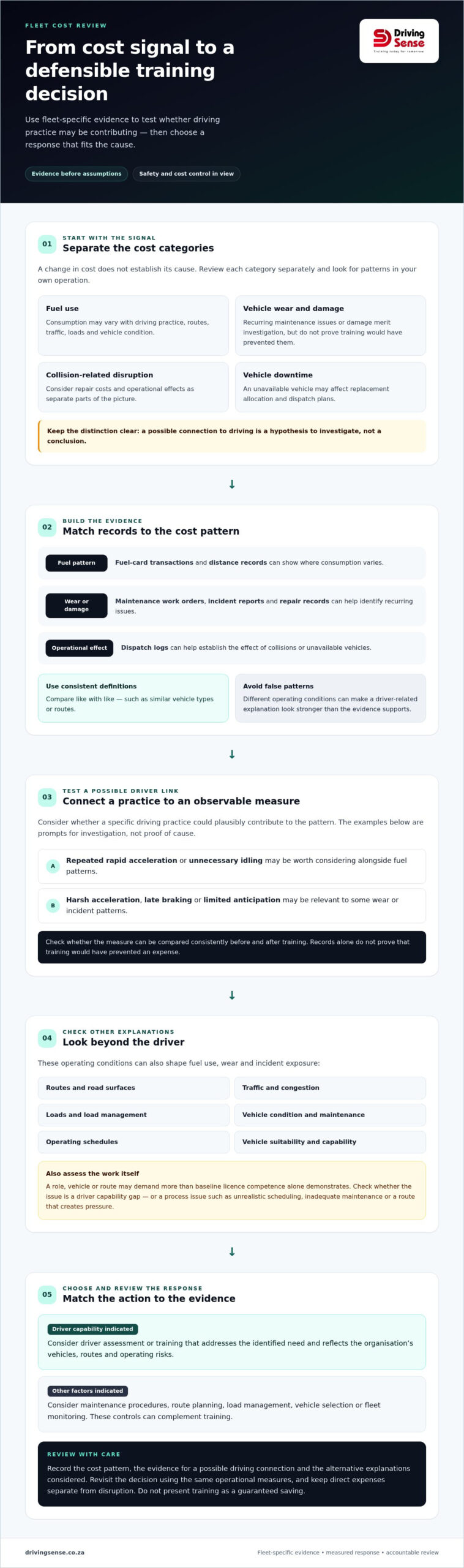
How to assess fleet costs and set up a defensible training review
A review is more useful when it explains why a training priority was selected, what was intended to change and how the organisation will interpret the results. For commercial fleet defensive driver training south africa, build the decision from existing records and keep the measurement approach consistent instead of starting with a savings target.
Build a usable fleet cost baseline
Before training, define the cost categories and fleet scope that will form the baseline. Use records your organisation already maintains, and document the period covered, the vehicles or roles included, and how each measure is defined. If fuel records are assessed per distance travelled, for instance, retain the same method for the later review and note gaps in the underlying data.
- Select relevant records. Bring together available fuel and distance information, maintenance and repair records, incident reports, and logs showing vehicle downtime or unavailability. Keep direct expenses distinct from operational effects, such as a vehicle being taken out of service.
- Define the comparison. Record which fleet segment, vehicle types, routes or driver roles are included, along with the period being reviewed. Avoid comparing unlike groups or changing the measure between baseline and follow-up.
- Note operating context. Document changes that could affect results independently of training, including route patterns, loads, vehicle allocation, maintenance activity, schedules or significant differences in operating conditions. This context helps prevent a change in the records from being automatically attributed to driver development.
Set objectives and review results responsibly
Once the baseline is clear, set training objectives around an observed need. An objective might focus on a specific driving capability identified through assessment or incident review, rather than a general promise to reduce fuel or repair costs. Keep the intended learning outcome separate from the operational measure: one records what drivers are expected to develop, while the other tracks a fleet pattern that may or may not respond.
- Prioritise the need. Connect the evidence to relevant driver roles and identify whether training, profiling or assessment can help address the capability in question.
- Record delivery and follow-up. Note which drivers or roles received the intervention and when, then review comparable records using the same definitions and fleet scope.
- Interpret with care. Describe observed changes, account for contextual differences, and acknowledge that a before-and-after comparison alone cannot prove training was the sole cause. Use the findings to refine future priorities, measures and follow-up.
This process gives managers a traceable rationale for action, including when the evidence does not support training or when other controls need attention. To align driver development with identified fleet needs, discuss driver training and assessment with Driving Sense.
Apply a national fleet training plan with Driving Sense
A practical fleet plan connects the cost pattern under review to relevant driver requirements, then selects an appropriate response. For commercial fleet defensive driver training south africa, move from operational evidence to driver assessment and clearly defined training objectives rather than assuming one programme will suit every role, vehicle or cost concern.
Driving Sense provides driver training, profiling and assessments to organisations nationwide across South Africa. Founded in 2006, the company brings transport-sector experience to this work. These services can help organisations understand driver needs and align development with the risks and responsibilities present in their fleet.
Match training and assessment to the fleet’s documented needs
Driver profiles and fleet operating requirements can help clarify where development may be relevant. Roles involving different vehicles, routes or operating demands may call for different priorities, so training decisions should reflect the duties drivers actually perform. Evidence already gathered, such as recurring incident themes or assessment findings, can help define those priorities without treating every cost pattern as a driver issue.
A quality-focused, evidence-led approach starts with the need and then sets suitable objectives. Driver training, profiling and assessments can contribute to this process, but the intervention should fit the fleet’s circumstances. It is not a substitute for maintenance, route or scheduling controls, or a universal solution to operating costs.
Agree practical next steps for a national organisation
Before planning a fleet-wide response, bring together information that makes the operating context clear. This helps establish what the organisation wants to address and which drivers or roles may be affected. For example, a concern recorded across a particular vehicle type or duty can be considered alongside the requirements of that work, rather than turned into a general training objective for every driver.
- Outline the fleet’s driver roles, vehicle types and relevant operating requirements.
- Summarise documented concerns and the records that indicate a possible driver-related need.
- Set out the training objectives the organisation wants to consider, separately from any cost measures it will review.
For organisations operating across South Africa, nationwide delivery can support a consistent training approach across locations, while priorities remain connected to the evidence and roles identified by the business. Driving Sense’s driver training, profiling and assessment services can form part of that considered plan. Keep review measures distinct from promises of savings or other guaranteed outcomes.
To discuss how corporate driver training can align with your fleet’s documented needs, discuss corporate driver training with Driving Sense.
Turn fleet evidence into a clear next step
Assign responsibility for maintaining the fleet review so emerging patterns can be assessed consistently, rather than only after a costly disruption. With a named owner, clear records and agreed training objectives, your organisation can make measured decisions about whether driver development is warranted and how it fits alongside other operational controls.
For organisations considering commercial fleet defensive driver training south africa, the priority is a response grounded in drivers’ roles and fleet requirements, not a promise of predetermined savings. A considered discussion can help translate identified needs into practical training and assessment priorities.
Discuss a driver training approach for your fleet with Driving Sense and take the next step towards a deliberate, evidence-led fleet plan.
Frequently Asked Questions
Can defensive driver training reduce commercial fleet operating costs?
It may help address costs where a specific driving practice contributes to an operational pattern, but savings are not guaranteed. For example, if records and assessment indicate repeated abrupt braking in a particular duty, training could address the relevant driving skill while the fleet reviews related maintenance or incident records. Interpret any change alongside route, vehicle and workload differences, rather than treating it as proof that training alone caused it.
How can a fleet identify which costs may be linked to driver behaviour?
Look for repeat patterns that can be compared fairly, then test whether they align with a driver task or behaviour. A fleet might examine whether fuel use varies between comparable vehicles on similar duties, or whether incident reports describe recurring manoeuvring challenges. These observations are prompts for investigation, not conclusions. Consider vehicle condition, traffic, load and scheduling before deciding whether driver behaviour is a plausible contributing factor.
What fleet records should businesses review before arranging driver training?
Review records that connect operational outcomes with vehicle and driver context, including fuel transactions, distance travelled, maintenance work orders, incident reports and vehicle availability logs. Dispatch or journey records can help explain route and schedule differences. Check that entries use consistent vehicle identifiers, dates and categories. For instance, classify repair events consistently. This helps reveal data gaps before selecting a training priority.
Is defensive driver training suitable for every commercial fleet?
No single training intervention is automatically suitable for every fleet. A business with varied vehicles or duties may have different driver-development needs across roles, while some cost concerns may be better addressed through maintenance, scheduling or vehicle allocation. Use evidence from the relevant fleet segment to determine whether a driver capability is involved. Profiling or assessment can help clarify where training may be appropriate and where another control is needed.
How should a business assess whether driver training made a difference?
Set the review method before training begins. Identify the driver group, operational measure and comparison period, then keep those definitions consistent during follow-up. Review learning or assessment information alongside relevant fleet records, and note changes such as new routes, vehicles or workloads. A favourable movement is useful evidence to consider, but a simple before-and-after comparison cannot establish that training alone caused it. Use the findings to adjust the next review.
Can driver training address vehicle maintenance and downtime costs?
Training can address relevant driver practices, but it cannot repair mechanical faults or replace maintenance controls. If a vehicle is repeatedly unavailable because of a recorded defect, use the maintenance history to guide the response. Driver development may be relevant where reports also point to a behaviour or skill that could be addressed. Keep repair causes and downtime information distinct so training is not credited with changes outside its scope.
What is the difference between defensive driver training and basic driver competence?
Basic driver competence concerns the ability to operate a vehicle and meet the requirements associated with driving it. Defensive driver training adds structured development for applying sound judgement to workplace driving demands, such as anticipating hazards or responding to changing road conditions. The appropriate focus depends on the person’s role and fleet context. An organisation can use assessment to identify whether additional development is relevant to the duties performed.
