

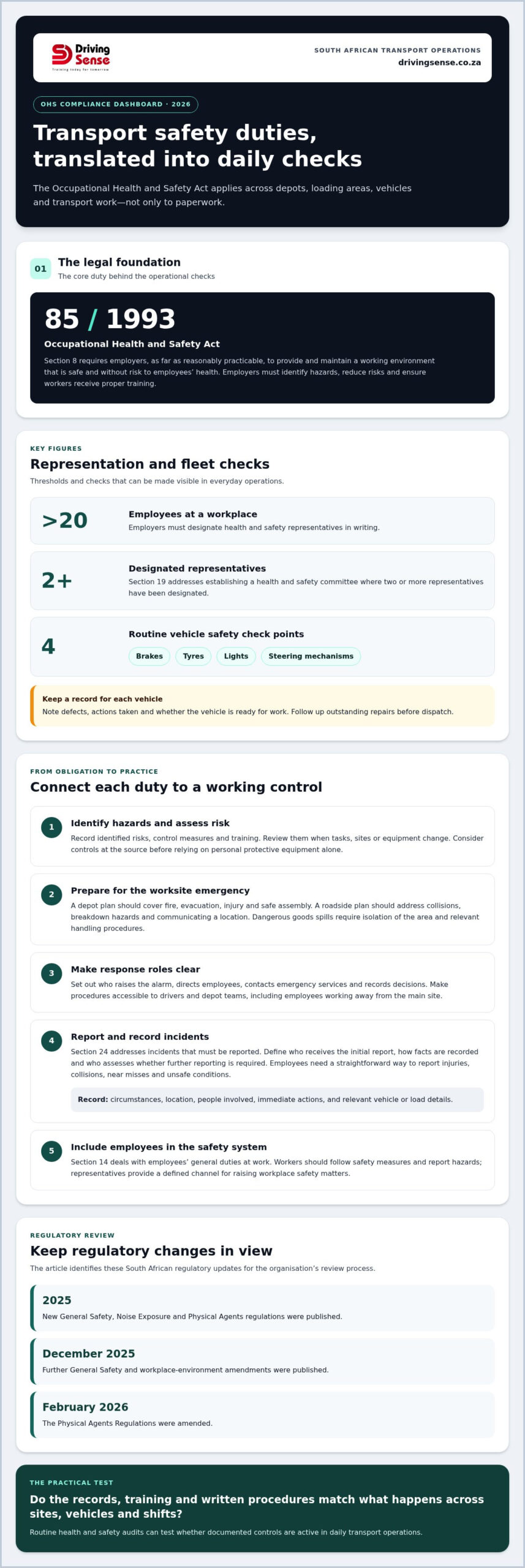
A transport company’s OHS compliance is tested in daily operations, not only in its paperwork. South Africa’s Occupational Health and Safety Act 85 of 1993 requires employers to provide and maintain, as far as reasonably practicable, a working environment that is safe and without risk to employees’ health. This OHS Act compliance checklist for transport companies in 2026 applies that duty to the practical realities of drivers, depots, loading areas and incident response.
Keeping vehicles and people moving safely takes more than having policies on file. Employers need to understand how their duties apply across the workplace, identify hazards, prepare for emergencies and maintain clear incident procedures, while ensuring employees understand their responsibilities.
This guide explains South African OHS duties relevant to transport operations and sets out practical employer checks, from risk assessments and workplace inspections to training, records and incident management. It also covers fatigue, loads and dangerous goods, showing how safety responsibilities connect across day-to-day operations.
Key Takeaways
- Apply the Occupational Health and Safety Act’s employer duties to transport work, including identifying hazards and reducing risks.
- Set out clear emergency and incident procedures so employees understand how to respond and how incidents are recorded and reported.
- Use routine employer checks to keep training, employee records, vehicle safety and workplace inspections connected to identified risks.
- Manage fatigue, driving hours, load handling and dangerous goods as linked operational safety concerns.
- Use emergency safety, driver, compliance or dangerous goods training to address relevant capability gaps in your workforce.
South African occupational health and safety legislation
South Africa’s Occupational Health and Safety Act (OHSA) is the primary legislation governing workplace health and safety. For transport operators, its duties apply across depots, loading areas and work activities, as well as to hazards employees may encounter.
Section 8 requires employers to provide and maintain, as far as reasonably practicable, a safe working environment without risk to employees’ health. The Act also requires employers to take steps to eliminate or reduce workplace hazards and ensure workers receive proper training.
Safety representatives and committees
Health and safety representatives are designated employees who represent colleagues on workplace safety matters, whilst committees provide a forum for representatives and employers to consider those matters. In South Africa, employers with more than 20 employees at a workplace must designate representatives in writing. Section 19 addresses establishing a health and safety committee where two or more representatives have been designated. Clear appointments help transport teams raise hazards through defined channels.
SME health and safety compliance
For a small or medium-sized transport business, compliance means putting the Act’s duties into working processes suited to its actual hazards and operations. Section 8(2)(d) is relevant to hazard identification and risk assessment: the Department of Employment and Labour has taken enforcement action against an employer for failing to conduct these activities. Record identified risks, control measures and training, then review them when tasks, sites or equipment change.
Section 8(2)(b) is cited in guidance on eliminating or mitigating hazards before relying on personal protective equipment. For example, assess a loading-area hazard and consider controls at its source before treating protective equipment as the only safeguard.
Fleet inspections and maintenance records
Commercial fleets should schedule routine vehicle safety checks covering brakes, tyres, lights and steering mechanisms. The National Road Traffic Act regulates road safety in South Africa, making roadworthiness a core operational consideration alongside workplace safety. Keep inspection and maintenance records for each vehicle, noting defects, actions taken and whether it is ready for work. These records help managers track recurring faults and follow up outstanding repairs before dispatch.
Penalties and enforcement risks
OHS Act non-compliance can expose a transport company to enforcement action, particularly where it fails to identify workplace hazards or assess risks. The Department of Employment and Labour has acted against an employer over a failure relating to section 8(2)(d). A single fine amount cannot describe every breach; the relevant provision and circumstances determine the consequences. Treat documented risk assessments, controls and training as evidence of active compliance, not paperwork alone.
Section 14 deals with employees’ general duties at work, so compliance also depends on workers following safety measures and reporting hazards. Regular health and safety audits can test whether written procedures match practice across sites and shifts. South Africa published new General Safety, Noise Exposure and Physical Agents regulations during 2025, amended the Physical Agents Regulations in February 2026, and published further General Safety and workplace-environment amendments in December 2025. Include these changes in the organisation’s regulatory review process.
Emergency preparedness and incident reporting
A transport emergency can begin at a depot, loading bay or roadside delivery point. A practical response plan should identify likely events, assign responsibilities and explain how employees communicate during a disruption. A vehicle collision, for example, may require isolating the traffic area, escalating the incident internally and coordinating with emergency responders. A dangerous goods spill requires a different response, including isolating the area and following relevant handling procedures.
Plan for the work your teams actually do. A depot plan should cover fire, evacuation, injury and safe assembly; a roadside plan should address vehicle collisions, breakdown hazards and communicating a location. Specify who raises the alarm, directs employees, contacts emergency services and records decisions. Make procedures accessible to drivers and depot teams, including employees working away from the main site.
Useful emergency arrangements typically identify:
- Alarm methods and the person responsible for raising an alert.
- Evacuation routes, assembly points and procedures for accounting for employees.
- First-aid arrangements and how injured people receive assistance.
- Steps for isolating hazards, including a load or vehicle involved in a spill.
- Internal contacts and the information employees must provide when reporting an emergency.
Incident reporting needs its own defined process. Section 24 of South Africa’s Occupational Health and Safety Act addresses incidents that must be reported. The company should make clear who receives an initial report, how facts are recorded and who assesses whether further reporting is required. Employees need a straightforward way to report injuries, collisions, near misses and unsafe conditions, even when an event causes no injury.
Record the circumstances, location, people involved, immediate actions and relevant vehicle or load details. A depot report about a reversing incident, for example, can note the task, visibility, pedestrian routes and controls in place. Keep records organised so managers can identify recurring hazards, assign corrective actions and track completion.
After an incident, preserve relevant information and review what happened before normal work resumes. Establish which controls were in place and whether work arrangements need to change. Share appropriate findings with affected teams, then update the plan or training if the review identifies a gap. Practise and review emergency procedures when routes, sites, duties or operational risks change, so drivers and depot staff understand their roles under pressure.
Practical employer compliance checks
A transport company can make safety duties part of routine workforce and operational checks. Review employee records, workplace policies, training needs and vehicle checks together to spot gaps between documented procedures and actual work. For example, a driver’s job description should match the duties performed on assigned routes.
Keep employee records accurate and current, including personal details, employment contracts, job descriptions, salary and benefits information. Assign responsibility for updating records when a worker’s role or employment details change. This gives managers a clearer basis for identifying which employees need role-specific instruction or information.
Use a simple review schedule to track these records and employee entitlements:
- Check that contracts and job descriptions reflect current transport duties.
- Track annual leave, sick leave and family responsibility leave.
- Keep salary and benefits information up to date in employee records.
- Make workplace policies accessible to employees, including leave, conduct, grievances and disciplinary procedures.
- Record completed training and identify employees who need further instruction.
Policies should explain how employees raise concerns and how managers respond. A driver reporting an unsafe loading practice, for example, needs a clear way to raise the concern, while the relevant manager needs a process for recording and addressing it. Review whether the policy remains workable when duties, sites or reporting arrangements change.
Training should reflect the hazards and responsibilities of each role. South African transport employers should provide training on road safety, hazardous materials handling, first aid, defensive driving and fatigue management. A driver carrying hazardous materials needs instruction relevant to that task, while depot staff may need guidance on safe loading practices. Keep records that connect training topics to job duties.
Organise these checks within a health and safety management system, then use regular audits to assess whether safety standards are being met. An audit can compare written procedures with workplace practice, such as whether employees can access the relevant policy or whether training records reflect assigned duties. Record findings, assign corrective actions and follow up outstanding items so audit results lead to operational changes.
For a practical review, group findings by location, role or issue, then identify who is responsible for each follow-up action. A depot may need a different response from a driver team, even when both findings relate to the same policy. This helps managers prioritise unresolved gaps and keep evidence of completed checks together.
Required workplace inspections
South African employers should complete safety assessments and required inspections as part of workplace health and safety compliance. At transport depots, workshops and loading areas, assess the facilities and controls against hazards identified in each work activity. The Occupational Health and Safety Act’s Section 8 duty is to maintain, as far as reasonably practicable, a safe working environment without risk to employees’ health.
No single inspection checklist suits every transport site. A depot with vehicle movements needs different checks from a workshop servicing vehicles or a loading area receiving dangerous goods. Walk through each work area during normal operations and observe how drivers, pedestrians, loaders and workshop staff interact. Compare actual work with the documented risk assessment, and record hazards the existing controls do not address.
For facilities and protective measures, inspect the conditions employees encounter and match controls to identified risks. Check access routes, lighting, housekeeping, welfare facilities and emergency arrangements. Assess whether PPE is appropriate to the hazard and available for the task. Under Section 8(2)(b), guidance cites eliminating or mitigating hazards before relying on personal protective equipment, so PPE shouldn’t be the only control where risks can be addressed at source.
A site checklist can help managers make observations consistent across shifts and locations. Include practical items such as:
- Clear pedestrian routes and visible separation from reversing vehicles.
- Housekeeping around loading bays, walkways and workshop work areas.
- Safe access to equipment and storage areas used during routine tasks.
- Condition and accessibility of emergency exits and response equipment.
- PPE suitability for the work activity and any identified exposure.
Record each finding with its location, the task involved and the control needing attention. For example, document a blocked walkway beside a loading bay, its cause and the action required. Assign someone to follow up, then record whether the obstruction was cleared and how recurrence will be prevented. This turns an inspection observation into a traceable corrective action.
Inspection findings should inform the next risk assessment and management review. If a workshop inspection identifies repeated spills, examine storage, handling and housekeeping arrangements instead of recording each spill in isolation. A health and safety audit can then assess whether revised controls are being used in practice. Keep inspection records together by site or work area so managers can identify recurring issues and outstanding actions.
Review the inspection approach when transport activities, equipment or site layouts change. A new loading process, for instance, may alter vehicle movements and pedestrian access, requiring the checklist to cover those interactions. Regular workplace inspections, clear records and follow-up help employers assess whether practical controls remain aligned with identified risks.
What are the OHS requirements for managing fatigue, driving hours, loads and dangerous goods transport?
Transport employers should manage fatigue by monitoring and limiting driving hours and ensuring drivers receive adequate rest. Connect journey planning with work schedules rather than treating rest as the driver’s responsibility alone. A delayed delivery, for example, should not automatically extend a shift without considering the driver’s hours and recovery time.
Set out how dispatchers record hours, identify fatigue concerns and respond when a driver reports being unfit to continue. Use route plans and delivery schedules to identify pressure points, such as repeated delays or extended waiting at customer sites. GPS tracking, telematics and automated alerts can help optimise routes, monitor driving patterns and support compliance with rest periods.
Load handling also requires operational controls. Assess the work involved in loading, unloading and transporting each type of cargo, then set procedures for the relevant hazards. Consider how the load is moved, who works nearby and whether the task exposes employees to falling items, manual handling strain or vehicle movement. A change in cargo or loading method should prompt a risk review.
- Plan work so drivers have adequate rest between driving periods.
- Monitor driving hours and respond to signs of fatigue.
- Coordinate delivery schedules with routes and expected delays.
- Assess loading tasks, work areas and interactions with moving vehicles.
- Keep dangerous goods procedures aligned with the cargo being carried.
In South Africa, the Road Traffic Act and Environmental Management Act regulate the transportation of hazardous materials. Transport companies handling dangerous goods should identify cargo-related hazards and ensure relevant employees understand the applicable handling procedures. Instructions should address employees’ tasks, including loading, transport and responding to an incident involving the load.
Keep operational controls clear for drivers, dispatchers and loading teams. Dispatchers, for example, need a way to respond when a route delay affects planned rest, while loading staff need to understand the risks and procedures for the cargo they handle. Review arrangements when routes, schedules, loads or work methods change. Record the review and any resulting changes to keep operational decisions traceable.
Digital monitoring can support oversight, but it doesn’t replace a practical fatigue-management process. Managers still need to respond to driving patterns and schedule pressures, while employees need a clear route to report fatigue or unsafe loading conditions. To strengthen role-specific capability, explore dangerous goods training for employees involved in handling and transporting hazardous materials.
Driving Sense: Emergency Safety Training
Driving Sense provides Emergency Safety Training for transport organisations building workplace response capability. The training supports employers whose teams need to understand emergency procedures, assigned responsibilities and safe responses at depots or during transport operations. Driver Training, Compliance Training and Dangerous Goods training address other role-related learning needs identified through workplace risk assessments.
Consider training when procedures change, employees take on different duties or reviews identify knowledge gaps. Match course selection to employees’ tasks, such as responding to an emergency or handling dangerous goods, and reinforce learning with clear workplace procedures.
To discuss training for your organisation, visit drivingsense.co.za.
Make safety capability part of operational planning
Use the OHS Act compliance checklist for transport companies in 2026 as a starting point for assigning ownership, setting review priorities and identifying where teams need further support. The next step is to embed those responsibilities in routine operational planning, so safety decisions remain connected to the work employees perform and the risks managers must control.
Where capability gaps affect emergency response, driver conduct or regulatory procedures, targeted training can help teams apply workplace requirements consistently. Driving Sense offers Emergency Safety Training, Driver Training and Compliance Training to support these organisational needs. Choose the focus that matches your workforce’s duties and the procedures they must follow.
For support in planning suitable training for your organisation, contact Driving Sense. A clear training plan can help your team move forward with greater structure and confidence.
Frequently Asked Questions
Quick Answer: What Is OHS Act Compliance in South Africa?
OHS Act compliance means managing workplace health and safety in line with South Africa’s Occupational Health and Safety Act 85 of 1993. For transport businesses, this means applying employer duties to driving, loading and depot work. A practical system connects hazards with controls, employee instruction and follow-up. Written policies support this work, but managers must also ensure that procedures are applied in day-to-day operations.
Does Every Workplace Need a Risk Assessment?
Employers need to identify workplace hazards and assess risks as part of managing health and safety. Assessments should reflect the work performed at each site, rather than rely on a generic office-based template. A depot assessment, for example, should consider vehicle movements and loading activities. Review the assessment when work, equipment or site arrangements change so hazards and controls remain relevant to operations.
What Does Section 8 of the OHS Act Require From Employers?
Section 8 requires employers to provide and maintain, as far as reasonably practicable, a working environment that is safe and without risk to employees’ health. For transport operations, consider how hazards arise during routine tasks and which controls can eliminate or reduce them. For example, assess whether a loading process can be changed to reduce exposure before relying only on personal protective equipment.
What Records Should an Employer Keep?
Keep organised records showing how safety responsibilities are managed and followed up. Relevant examples include employee and job information, training evidence, risk assessment findings, inspection records, incident reports and corrective actions. The OHS Act compliance checklist for transport companies 2026 can help managers organise these records around sites, vehicles, tasks and employees. A clear filing structure makes it easier to trace a finding through to its resolution.
What South African Laws and Regulations Govern OHS Compliance for Transport Companies in 2026?
The Occupational Health and Safety Act 85 of 1993 is South Africa’s primary workplace health and safety legislation, while the National Road Traffic Act regulates road safety. The Road Traffic Act and Environmental Management Act regulate hazardous materials transport. South Africa published new General Safety, Noise Exposure and Physical Agents regulations during 2025, amended the Physical Agents Regulations in February 2026, and published further General Safety and workplace-environment amendments in December 2025.
What Must a Transport Company’s OHS Policy and Risk Assessment Include Under the Occupational Health and Safety Act?
A useful policy explains who is responsible for safety matters, how employees raise hazards and how managers follow up. The risk assessment should describe work activities, identified hazards, affected employees and selected controls. For instance, document vehicle and pedestrian interactions at a loading area, then connect the controls to that task. Review both documents when operating arrangements change, keeping them practical for the workplace.
What Driver Fitness, Medical Surveillance, Training and Competency Records Must Transport Companies Maintain?
Maintain accurate employee records and role-related evidence of training and competency. For drivers, organise records around duties such as road safety, defensive driving, fatigue management, first aid and hazardous materials handling. Keep medical assessment records used to assign or manage work separate from training evidence, since each serves a different purpose. Make clear which employee and work responsibility each record relates to.
How Must Transport Companies Report, Investigate and Record Workplace Incidents and Occupational Injuries in South Africa?
Section 24 of the Occupational Health and Safety Act addresses incidents that must be reported. Establish an internal process for notification, fact gathering and assessing whether statutory reporting applies. Record the event’s location, circumstances, people involved, injury or damage, immediate response and follow-up actions. For a loading-area injury, include the task and site conditions, then document investigation findings and any changes made to prevent recurrence.
