

An estimated 10-20% of crashes worldwide may be caused by driver fatigue. Fatigue can leave commercial drivers tired and may affect how they think and respond physically. Managing driver fatigue in commercial fleets requires more than one intervention: training, sensible scheduling, rest and suitable monitoring all have a role.
Fleet managers must balance delivery demands with drivers’ ability to stay alert. A practical approach to managing driver fatigue in commercial fleets treats tiredness as a safety risk that can be identified and addressed, rather than solely as an individual driver’s responsibility.
This article covers common causes and warning signs, what fatigue management training can include, and how monitoring technology can support oversight. It also explains how sleep, breaks and healthy routines can strengthen fatigue management in South African operations.
Key Takeaways
- Build fatigue controls into fleet planning, recognising that reduced alertness can affect both road safety and operational performance.
- Train drivers to identify early warning signs and understand how sleep, wellbeing and long driving periods influence alertness.
- Use monitoring tools to support management oversight, while treating them as part of a wider fatigue management approach.
- Plan realistic schedules with adequate rest and regular breaks, and encourage healthy routines that support better sleep.
- Use Driver Training and Emergency Safety Training to strengthen practical skills and reinforce a consistent safety culture.
1. What is fleet driver fatigue?
Fatigue is exhaustion from prolonged driving without adequate rest, and it can impair physical and cognitive functions. A driver may struggle to concentrate, respond promptly, judge distances or make sound decisions. The effects can be serious: fatigue contributes to approximately 20% of all fatal crashes involving commercial vehicles. An estimated 10-20% of crashes worldwide may be caused by driver fatigue. These figures show why fleet safety policies must address alertness as well as vehicle condition and route planning.
Fatigue can affect productivity before an accident occurs. Reduced vigilance may lead to missed signs, inconsistent speeds, poor route choices, delays and overlooked vehicle checks. Incidents can disrupt schedules and bring repair and insurance claim costs; tired driving may also increase fuel use when drivers struggle to maintain a steady speed. Treat these operational effects as safety signals, not merely performance concerns, and avoid incentives that encourage drivers to continue when they feel unfit to drive.
In South Africa, commercial driving hours and rest periods must be managed in line with applicable road-transport and employment-law requirements. Fleet policies should cover both driving and working time, with clear procedures for rest, fatigue reporting and schedule changes. A single rule will not cover every situation.
For South African fleet operators, fatigue-related accidents can cause serious injury or death, disrupt operations and lead to insurance claims. An incident may also prompt questions about the adequacy of safety procedures, scheduling decisions and responses to reported fatigue. Clear records and consistent procedures support responsible risk management, but they cannot remove the danger of a fatigued driver on the road.
A supportive safety culture helps surface concerns before they become incidents. Encourage drivers to report tiredness without treating it as misconduct, then arrange a safe pause, relief driver or revised schedule. If reports repeatedly concern the same route or shift pattern, review the planning rather than blame individual drivers. Clear handover procedures help dispatch teams respond consistently.
Use fleet safety data to guide targeted coaching. Review fatigue reports alongside routes, shift times, near-misses, accidents and schedule changes, then identify recurring patterns. Coaching can address specific behaviours, such as continuing to drive after concentration slips, while broader safety programmes address scheduling and reporting. Review reported fatigue, fatigue-related incidents, near-misses and relevant driving patterns consistently over time. Document actions and use the findings to refine coaching and policy.
2. What does fatigue management training cover?
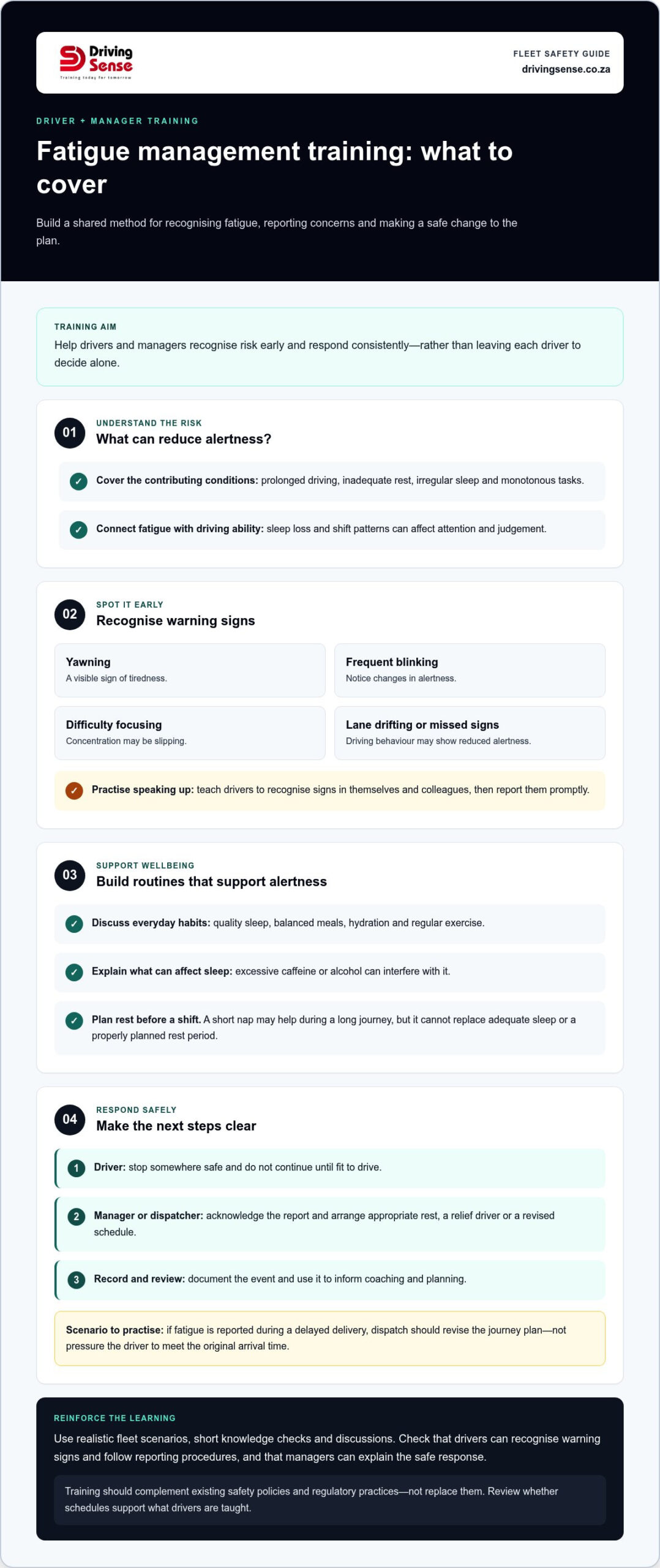
Effective fatigue training gives drivers and managers a shared method for recognising risk and responding early. It should explain how prolonged driving, inadequate rest, irregular sleep and monotonous tasks can reduce alertness. Drivers also need to recognise warning signs, including yawning, frequent blinking, difficulty focusing, lane drifting and missed signs. Practising how to report these signs helps turn awareness into a routine safety action, rather than leaving each driver to decide alone.
Wellbeing education should connect daily habits with fitness to drive. Cover quality sleep, balanced meals, hydration, regular exercise and how excessive caffeine or alcohol can affect sleep. Drivers can learn to plan rest before a shift instead of relying on alertness strategies after fatigue sets in. Clarify that a short nap may help during a long journey, but cannot replace adequate sleep or a properly planned rest period.
A practical course can cover:
- How sleep loss, shift patterns and prolonged driving affect attention and judgement.
- How to detect fatigue signs in oneself and colleagues, then report them promptly.
- How dispatchers and managers should respond and arrange a safe change of plan.
- How fleet procedures address rest, driving schedules and escalation of concerns.
If a driver shows signs of fatigue on the road, they should stop somewhere safe and not continue until fit to drive. Managers should acknowledge the report, arrange appropriate rest or relief, and record the event for review. For example, a report during a delayed delivery should prompt dispatch to revise the journey plan, not pressure the driver to meet the original arrival time.
Instructor-led Driver Training can make procedures practical through realistic fleet scenarios. Drivers might practise recognising reduced concentration, identifying whom to notify and explaining what dispatch should do next. Managers benefit from the same exercise: consistent responses help ensure fatigue reporting does not become a source of blame. Training should complement existing safety policies and regulatory practices, not replace them.
After each session, use short knowledge checks and scenario discussions to identify topics needing reinforcement. Review whether drivers can recognise warning signs, follow reporting procedures and explain the safe response. Refresher coaching can address observed gaps, while managers examine whether scheduling supports the training. Organisations can explore professional driver training as part of a broader fleet safety approach.
3. Fatigue management systems and monitoring technology
A fatigue management system brings together policy, driver reporting, operational data and appropriate technology. Monitoring tools can help managers identify patterns, but they do not replace rest, sound scheduling or direct communication. An alert about steering movement, for example, should prompt a review of the journey and the driver’s condition, not an automatic assumption about the cause.
Electronic logging devices automatically record driving time and engine hours. Managers can compare these records with planned schedules, reported rest and delivery patterns to identify shifts that may create fatigue pressure. Logging data supports oversight; on its own, it cannot establish that a driver is alert or adequately rested. Use it alongside fatigue reports and incident records as part of a wider process.
Some fatigue-monitoring systems use cameras and sensors to detect signs such as eye closure and steering deviations. Telematics and fleet-monitoring software can also help identify drivers who may need support. These indicators flag possible concerns, but context matters: a steering deviation, for instance, can have several causes. A trained manager should review the event, speak with the driver and follow the fleet’s agreed response process.
Effective monitoring depends on clear data practices. Before introducing a system, define what information it collects, who can access it, how alerts are escalated and how findings inform coaching. Explain to drivers what the system can and cannot detect. Transparent procedures encourage accurate reporting and reduce the risk that monitoring is seen only as disciplinary surveillance.
To make the system operational, establish a straightforward sequence:
- Record driving and engine activity through available logging tools.
- Review fatigue alerts alongside route, shift and driver reports.
- Contact the driver promptly when an alert raises a safety concern.
- Arrange a safe response, then document the event and any follow-up.
- Review recurring patterns and adjust coaching or scheduling procedures.
Fatigue can affect reaction and attention, while monitoring data can reveal recurring risks. Review trends across shifts and routes rather than judging performance from a single alert. Repeated alerts on a particular shift, for example, may warrant a review of its timing and workload. Also track whether reports receive timely follow-up and whether coaching addresses the issue identified.
For South African fleets, technology costs depend on the system, vehicle requirements, fleet size, installation, software integration and ongoing service arrangements. These factors shape the scope and price. Compare your operational needs with the system’s functions to avoid paying for monitoring features that do not support your fleet’s safety procedures.
4. Sleep, breaks, and healthy routines for drivers
Schedules should allow drivers to obtain 7-8 hours of quality sleep before driving. Long hours, insufficient rest between shifts and irregular sleep patterns can erode alertness. The effect can be particularly relevant around 6:00am, when drivers are reported to be 20 times more likely to fall asleep at the wheel than at 10:00pm. Where routes include early starts, managers should examine shift timing and rest opportunities together.
For South African truck and bus drivers, applicable hours and break requirements depend on the relevant vehicle, operating category and work arrangement. Build schedules around the rules that apply to your operations, rather than importing US, UK or Australian break intervals.
Plan breaks into each shift before dispatch, using journey stages and safe stopping opportunities to make rest practical. Regular breaks can help drivers rest and regain alertness, but they do not replace adequate sleep between shifts. If a driver feels sleepy, the UK Government advises stopping in a safe place. Managers should provide a clear reporting route and avoid pressuring drivers to continue towards a delivery deadline.
During a break, simple choices can support comfort and rest. Drivers can leave the cab for a meal, drink water and choose lighter snacks such as apples, walnuts, whole-grain crackers or cheese. Avoiding heavy meals may help prevent post-meal sluggishness. A short nap may be useful on a long-haul journey, while excessive caffeine can interfere with later sleep.
Build enough recovery time between shifts into fleet schedules, with a workable response to delays. If congestion or a loading hold reduces the time available for rest, dispatch should revise the plan rather than expect the driver to make up time by extending the journey. A backup driver or adjusted delivery sequence can help protect rest periods and maintain operational continuity.
- Set routes with planned rest stops and safe places to pause.
- Review shift sequences for early starts and irregular sleep opportunities.
- Provide a process for reporting tiredness and changing a journey safely.
- Encourage regular exercise, balanced meals and reduced alcohol use.
Healthy routines work best when fleet procedures support them. Regular exercise, a balanced diet, and avoiding excessive caffeine and alcohol can contribute to better sleep quality. Reinforce these practices through driver education and review schedules that repeatedly restrict rest. Regularly checking planned breaks, actual delays and driver feedback helps identify where the operating plan needs adjustment.
5. Definition and causes of commercial driver fatigue
Prolonged driving without adequate rest can leave commercial drivers fatigued and affect their physical and cognitive functions. It is more than boredom or needing a coffee. Alertness may decline gradually, making it harder to sustain attention, process hazards and respond appropriately. Long hours, insufficient rest between shifts, irregular sleep schedules and monotonous driving tasks can all contribute.
Recognising symptoms early gives drivers and managers a chance to act before judgement deteriorates. Watch for yawning, frequent blinking, difficulty keeping the eyes open or focused, and drifting between lanes or onto the shoulder. Missing traffic signs or exits can also signal reduced attention. A driver who cannot remember the last few miles may be experiencing a serious lapse in concentration, not merely a routine distraction.
Fatigue often has several contributing causes. An early start after disrupted sleep, a long, monotonous route and a delayed break can compound tiredness during a shift. Dehydration can add another practical risk: a mildly dehydrated driver is reported to make twice as many mistakes. Consider the route, shift pattern, rest opportunity, hydration and driver’s reported condition together, rather than treating one symptom as a complete explanation.
The effects extend beyond slower reactions. Reduced vigilance can lead to missed hazards, poor decisions and mistakes during driving or vehicle checks. NIOSH reports that being awake for 17 consecutive hours can result in impairment comparable to a blood alcohol concentration of .05; being awake for 24 hours can result in impairment comparable to .10. These comparisons underline why strategies should prevent fatigue accumulation, not rely on drivers pushing through symptoms.
When a driver notices warning signs, they should report the concern and stop driving somewhere safe. Dispatch can then arrange rest, relief or a revised journey plan. Once the immediate risk is addressed, review possible contributing factors: rest between shifts, route monotony, workload, break timing and repeated early starts. This can help distinguish an individual lapse from a planning pattern that requires wider action.
Use Driver Training to reinforce how to recognise symptoms, report fatigue and follow safe procedures. Practical discussion can help drivers connect warning signs with specific actions, while managers review whether operating plans support those actions. To strengthen this learning, explore practical driver training as part of a structured approach to fatigue awareness.
Driving Sense: Emergency Safety Training
Driving Sense supports organisations seeking to strengthen driver safety through Emergency Safety Training and Driver Training. These courses are relevant when fleet procedures need reinforcement, drivers need practical safety instruction, or fatigue awareness should form part of a broader workplace safety approach.
For operational teams, training can clarify how drivers report fatigue concerns and how managers respond consistently. Compliance Training and Dangerous Goods courses can also support organisations addressing related workforce responsibilities. Training should complement, not replace, suitable rest, scheduling and fatigue-management procedures.
To discuss training for your organisation, contact Driving Sense or visit drivingsense.co.za.
Make fatigue prevention part of everyday fleet decisions
Make fatigue prevention an operational responsibility, with clear ownership for reviewing schedules, responding to driver concerns and improving procedures. Managing driver fatigue in commercial fleets consistently also means assessing whether reporting routes are accessible, dispatch teams know how to act, and incident learning informs decisions.
Managing driver fatigue in commercial fleets depends on equipping people to apply procedures consistently. Driving Sense offers Emergency Safety Training, Driver Training and Compliance Training to support organisations strengthening workforce safety practices. These services can form part of a broader approach alongside suitable rest arrangements and clear internal policies.
Consider where your current procedures need reinforcement, then identify the training and operational changes that fit your fleet. Contact Driving Sense to discuss fleet fatigue and training support for managing driver fatigue in commercial fleets. A deliberate, practical approach can help your team build safer routines and strengthen accountability across fleet operations.
Frequently Asked Questions
What is fleet driver fatigue?
Commercial driver fatigue is a reduced ability to drive safely after insufficient recovery or sustained effort. It can build across shifts, so a driver may start a journey already affected, even if the route is short. A night delivery after disrupted daytime sleep, for example, presents a different risk from a familiar daytime trip after adequate rest. Assess fitness to drive, not distance alone.
What does fatigue management training cover?
Fatigue management training teaches drivers and supervisors to recognise risk, report it and respond consistently. A useful exercise might present a delayed delivery and ask a dispatcher to choose between revising the plan and pressuring the driver to continue. Practise handovers, escalation and recording decisions, then check understanding with scenario questions. This tests whether staff can apply procedures, not simply recall terminology.
What causes driver fatigue in commercial fleets and what are the warning signs?
Common causes include disrupted sleep, long or irregular shifts, insufficient recovery, monotonous roads and demanding workloads. Warning signs may include yawning, frequent blinking, difficulty focusing, drifting from a lane, missing a turn or struggling to recall recently driven sections. A cluster of signs deserves attention, particularly when a driver reports feeling unfit. Address the immediate safety concern before investigating contributing work patterns.
What are the best practices for scheduling routes and shifts to reduce commercial driver fatigue?
Build schedules around realistic journey times, planned rest opportunities and adequate recovery between shifts. Allow for loading delays, congestion and safe stopping places instead of treating every disruption as time a driver must make up. If a delay would squeeze planned rest, dispatch can revise the delivery sequence. Review recurring pressure points with drivers, whose route experience can reveal impractical planning assumptions.
How can fleet managers monitor driver fatigue using telematics, cameras and fatigue-detection systems?
Use telematics and vehicle data to flag patterns for review, while treating camera or sensor alerts as indicators, not a diagnosis. Before deciding what action is appropriate, a manager can compare an alert with route conditions, driver feedback and other relevant records. Set clear rules for access, escalation and record handling, and explain them to drivers. Monitoring is most useful when it prompts a supportive, documented safety response.
What fatigue-management training and sleep-health policies should commercial fleets provide?
Provide practical instruction on recognising fatigue, reporting concerns and following the fleet’s response process. A written policy should state who receives reports, how dispatch arranges a safe change to a journey, and how managers review recurring issues. Include sleep-health guidance and ensure scheduling supports recovery. Driving Sense offers Driver Training and Employee Wellness to support workforce learning as part of a wider safety programme.
