

Safer fleet operations can support discussions about insurance terms. In South Africa, reducing insurance premiums with fleet safety training starts with addressing preventable driving risks and keeping clear records of training, safety performance and incidents. This evidence can help an insurer assess fleet risk at renewal, while practical instruction helps drivers make safer decisions on the road.
Insurance costs reflect more than the number of vehicles in a fleet. Driver records, vehicle use and claims history can all shape how risk is assessed. Training is most useful as part of a consistent safety programme, rather than as a one-off response after an incident. This article explains how driver behaviour and operational risks can affect an insurer’s assessment, what evidence may support renewal discussions, and how practical defensive driving instruction can help address risks such as speeding and poor hazard awareness.
Key Takeaways
- Assess fleet risk through factors such as vehicle use, driver records, claims history and the type of cover, then prioritise the risks your operation can address.
- Prepare for renewal by documenting safety policies, training activity, incidents and progress, and review the programme at least once a year.
- Use practical defensive driving scenarios to help drivers anticipate hazards, manage speed and respond safely to other road users.
- Track driver performance and incident patterns over time so training can address specific behaviours rather than relying on one-off instruction.
- Present a consistent safety record and supporting evidence in renewal discussions to strengthen the case for favourable insurance terms.
2. Fleet insurance costs and risk factors
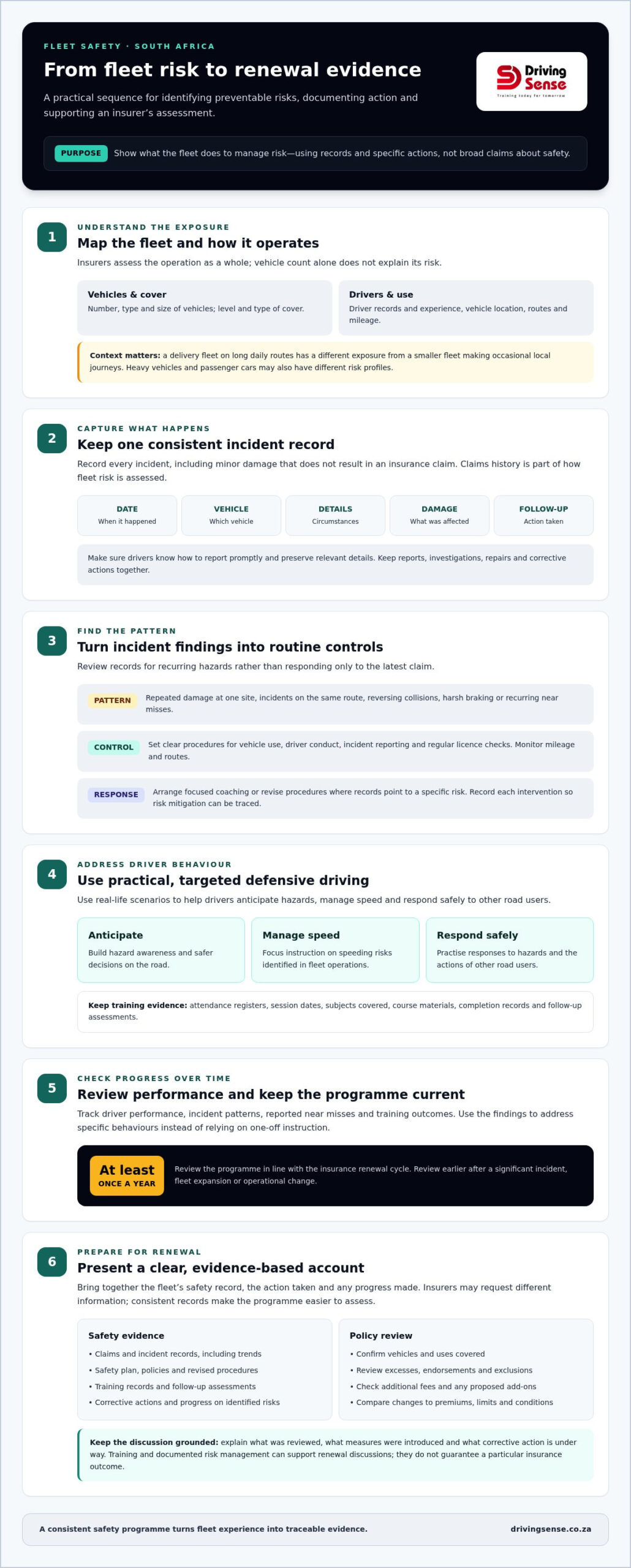
Fleet insurance combines cover for multiple vehicles and drivers under one policy. Its cost depends on the number, type and size of vehicles, driver records and experience, vehicle location and use, and the level and type of cover. For example, a delivery fleet operating long daily routes presents a different exposure from a smaller fleet making occasional local journeys. A mixed fleet may also have different risk profiles for heavy vehicles and passenger cars. These details help insurers assess the operation, rather than treating every vehicle as identical.
Claims history is another key part of that assessment. Insurers may compare a fleet’s accident rate with similar operations when evaluating risk. A manager should therefore record every incident, including minor damage that does not lead to an insurance claim. A reversing collision in a depot, for instance, may reveal a visibility issue or a gap in site procedures. Recording the date, vehicle, circumstances, damage and follow-up action gives managers a clearer basis for identifying recurring hazards.
Effective claims management starts with a consistent reporting process. Drivers should know how to report an incident promptly, preserve relevant details and notify the appropriate manager. The fleet team can keep a single record of reported events, investigations, repairs and corrective actions. Reviewing it may reveal patterns, such as repeated damage at one site or incidents on the same route. Managers can use those findings to target driver training or revise procedures, rather than responding only to the latest claim.
Preventive risk-management policies turn those findings into routine controls. Set out clear procedures for vehicle use, driver conduct, incident reporting and regular licence checks. Monitor mileage and routes, since high mileage increases exposure to road risks and may affect how vehicles are used. Where records identify harsh braking or repeated near misses, managers can arrange focused coaching and review whether schedules or routes contribute to unsafe decisions. Documenting each intervention creates a traceable record of risk mitigation.
At renewal, organise the evidence into a concise account of fleet activity and safety improvements. Include claims and incident records, training records, revised procedures and actions taken to address identified risks. If incidents cluster around reversing, for example, document changes to driver instruction and any subsequent monitoring. Ask the insurer to review the claims history for patterns and areas for improvement. This keeps the discussion grounded in the operation’s actual experience, not broad claims about safety.
Insurance costs are influenced by connected factors, including vehicle exposure, driver experience, claims and risk controls. Managers can improve oversight by assigning responsibility for incident records, scheduling reviews and tracking corrective actions. A documented programme also helps identify emerging risks before renewal. It cannot make every fleet comparable, but it provides a structured account of how the business manages risk and responds to evidence.
3. What Does an Insurance Underwriter Want to See?
At renewal, an underwriter needs a clear account of how the fleet manages risk. Some carriers require documented safety policies for cover, while formal programmes may improve a fleet’s prospects and qualify it for premium discounts. Present the safety record as evidence, not assertion: show what action followed an incident, how driver safety is addressed, and whether controls are being applied across vehicles.
Insurers may look for records showing who attended training, when sessions took place and which subjects were covered. Keep attendance registers, course materials, completion records and any follow-up assessments. Pair these with evidence of safety performance, such as incident trends, reported near misses and actions taken after recurring events. Insurers may request different information, but consistent records make the programme and its progress easier to assess.
Before renewal, gather the current safety plan and evidence of progress in addressing risk, then discuss it with the insurer. A useful renewal conversation covers changes to the fleet, driver training, claims experience and outstanding risk controls. If incidents have fallen in a particular operation, explain the period reviewed and the measures introduced. If they have not, describe the corrective action underway.
Review the policy schedule alongside the safety evidence. Confirm which vehicles and uses are covered, then examine excesses, endorsements, exclusions and any additional fees. A new vehicle type or change in operating pattern, for example, may affect the cover needed. Compare the renewal terms with the current policy to identify changes in premiums, limits or conditions. This also helps determine whether a proposed add-on addresses a real operational exposure or duplicates existing cover.
How should a business implement a fleet safety training programme to qualify for lower premiums? Start by identifying recurring risks in incident and claims records, then set a documented training plan with attendance and follow-up records. Review driver performance and training outcomes, address gaps with targeted instruction, and retain evidence of each action for renewal discussions.
How often should the programme be reviewed? Review it at least once a year, in line with the insurance renewal cycle. A significant incident, fleet expansion or operational change can prompt an earlier review so controls remain relevant to the vehicles and work being insured.
Assemble the renewal package in a consistent order: safety policy, training records, incident and claims summaries, corrective actions, and evidence of progress. This structure helps an underwriter connect each risk with its control. A practical fleet safety programme review can help organisations organise driver safety measures and supporting records for renewal.
4. Real-life defensive driving scenarios
Defensive driving training is most useful when it reflects situations drivers encounter in everyday fleet work. At a busy junction, for example, a driver can scan for turning traffic, ease off the accelerator and leave enough space to stop. This gives the driver more time to respond if another road user changes direction unexpectedly. Training should help make these decisions repeatable habits, not just explain rules in a classroom.
Speed management is another practical scenario. Drivers travelling more than 10–15% above the average speed of surrounding traffic are much more likely to be involved in an accident. In training, managers can discuss how a driver should adjust speed for traffic flow, visibility and road conditions. A delivery schedule should not encourage drivers to compensate for delays by travelling too fast. Clear operational expectations support safer decisions behind the wheel.
Following distance is another opportunity to practise anticipation. If the vehicle ahead brakes suddenly, a driver who has left a safe gap has more time to respond smoothly. Wet conditions or a heavy load can make stopping require particular care. Training can help drivers identify hazards early, reduce speed progressively and avoid abrupt steering or braking. These practical exercises connect defensive driving with situations that can lead to vehicle damage and claims.
Safe driving can also affect fuel use. Smoother acceleration and steady speed can improve fuel efficiency, while harsh acceleration and speeding waste fuel. A driver who sees a queue ahead, for example, can ease off early instead of accelerating towards it and braking sharply. Managers can use monitoring to identify repeated harsh driving events, then discuss specific journeys with drivers. This makes coaching more useful than a general reminder to drive carefully.
Set minimum driving standards in writing so drivers and supervisors share clear expectations. Include speed management, following distance, hazard observation, reversing and incident reporting. A depot reversing exercise, for instance, can assess whether a driver checks the surrounding area before moving. Supervisors can record observations, provide coaching and arrange follow-up practice where needed. Consistent standards also help managers compare performance across vehicles and routes.
Telematics and dashboard cameras can provide evidence of vehicle use, including speeding and sudden braking. Use these records to identify patterns, not to replace driver coaching or context. Sudden braking may indicate an unsafe following distance, but it can also reflect another road user’s actions. Reviewing an event with the driver helps establish what happened and what could reduce risk next time.
Insurers assess risk differently, so documented training and monitoring give fleet managers useful evidence for renewal discussions. Some insurers offer discounts for driver training, while others do not. Keep records of attendance, driving observations and corrective action, then present them alongside incident trends. This shows how practical instruction and consistent management support safer driving.
5. How safety programs affect insurance premiums
A safety programme affects insurance through two connected outcomes: fewer incidents and stronger evidence of risk control. Structured, measurable fleet programmes are associated with accident-rate reductions of 20 to 40 percent over time. Lower incident frequency can improve a fleet’s risk profile, whilst documented procedures show insurers that prevention is managed systematically. The financial benefit can therefore include both reduced claims exposure and more persuasive renewal discussions.
How much can a South African business save on fleet insurance after safety training? Some insurance companies offer discounts ranging from 10% to 30% to fleets with lower accident rates and enhanced safety programmes. This range describes potential insurer discounts, not an automatic reduction for every business or a fixed South African saving.
Keep accident-rate improvement separate from premium savings when assessing results. Fleets implementing comprehensive driver safety training programmes may reduce accident rates by up to 40%, but that does not mean premiums fall by the same proportion. Insurers set terms using their own assessment of claims, fleet characteristics and risk controls. A lower frequency of preventable incidents can strengthen the case for better terms, while a well-kept record helps substantiate that progress.
Set a clear evaluation plan before assessing financial returns. Establish a baseline from incident and claims records, identify recurring driving risks, then set training objectives linked to those patterns. Record attendance, practical assessments, follow-up coaching and subsequent incidents. If harsh braking recurs on a route, for example, targeted instruction can address following distance and speed management. Reviewing the same indicators over time helps show whether the programme is changing behaviour.
Regular safety meetings can reinforce training between formal sessions. Some companies may be offered insurance discounts for holding these meetings, and some insurers provide usage-based programmes that reward safe driving data with premium reductions. Keep records of meeting dates, attendance and actions. When telematics or event reports identify a concern, use a meeting to address it and document the response.
Logistics Warehouse Inc. reported a 0% insurance premium increase for two consecutive years after strengthening its safety programme. This example illustrates how a stronger programme can support renewal outcomes, but it does not establish a universal result. Managers should assess their own claims trend, training participation and risk controls when measuring financial impact.
At renewal, present the safety strategy alongside evidence of completed actions and incident trends. Ask the insurer to consider how driver training, regular meetings and documented controls relate to the fleet’s risk profile. Track premium terms and claims outcomes across renewal cycles, then adjust the programme where evidence identifies persistent risks. This disciplined approach connects safety investment with operational performance and supports a credible discussion about lower premiums.
5. How can fleet safety training reduce commercial vehicle insurance premiums in South Africa?
For South African fleets, reducing insurance premiums with fleet safety training begins with identifying preventable risks and addressing them consistently. Fleets with documented, recurring defensive driving programmes have reported reductions in at-fault collisions of up to 30 percent within the first year of implementation. Fewer preventable collisions can reduce claims exposure, while training records help show how the business manages driver risk. Insurers assess risk individually, so these improvements support renewal discussions rather than establish a standard premium reduction.
Start by reviewing incident records and driver performance to choose relevant learning priorities. Repeated harsh braking, for example, may point to a need for coaching on following distance and hazard anticipation. A route with dense urban traffic may call for practice identifying turning vehicles and other road users. Targeted instruction is more relevant to daily operations and helps drivers apply safer decisions in familiar working conditions.
Combine practical driving exercises with classroom instruction, then record attendance, learning objectives and follow-up actions. Practical exercises let drivers practise vehicle control and safe responses; classroom sessions can explore decision-making and incident scenarios. Assess performance after training and use the results to identify further coaching needs. Regular assessment helps managers see whether drivers apply the instruction during routine work, not just during a course.
Provide additional support when a driver does not meet the fleet’s safety standards. Online safety training or in-car tuition can address specific performance gaps. A driver who repeatedly accelerates sharply, for instance, can practise anticipating traffic flow and maintaining smoother control. In-cab coaching, harsh-event monitoring and driver behaviour analytics can also help managers identify concerning patterns and respond proactively.
Make the programme recurring, documented and responsive to evidence. Keep consistent records of sessions, monitoring findings, coaching and incident trends. Before renewal, explain how identified risks led to specific training or operational changes. This connects reducing insurance premiums with fleet safety training to day-to-day risk management. If an insurer offers a driver-training discount, records can help demonstrate participation; other insurers may assess training without offering a direct discount.
Assess financial outcomes alongside safety performance. Compare claims patterns, incident records and training activity over time, rather than treating one premium change as proof of success. Use the review to refine priorities and explain the programme’s value during renewal discussions. For support in applying this approach, arrange fleet driver training around the safety needs identified in your operation.
Driving Sense: Emergency Safety Training
Driving Sense can help organisations strengthen workplace preparedness through Emergency Safety Training and related safety instruction. For fleet managers, Driver Training can address behaviours identified through incident reviews, such as unsafe following distances or harsh braking, while Compliance Training and Dangerous Goods training can support relevant operational requirements.
Use structured training when incident records reveal recurring risks, driver practices need reinforcing, or you are preparing evidence of ongoing safety measures for renewal. Training supports risk management by building practical knowledge and consistent procedures, but it cannot guarantee a particular insurance outcome. The right focus depends on your fleet’s work, identified hazards and learning needs.
To discuss training for your organisation’s safety priorities, contact Driving Sense.
Make safety improvement part of your next renewal plan
Make training an operational commitment by assigning clear responsibility for turning identified risks into practical changes. Track actions, review driver performance and keep learning relevant as routes, vehicles and work demands change. This discipline makes reducing insurance premiums with fleet safety training a long-term risk-management objective, rather than a short-term response to renewal pressure.
Premium outcomes depend on the insurer’s assessment of the fleet and its risk profile. A well-managed programme can support safer behaviour and give your business a clear basis for discussing its approach to risk. Driving Sense provides Driver Training, Emergency Safety Training and Compliance Training to support organisational safety priorities.
Consider which driver behaviours or workplace procedures need attention next, then align training with those priorities. A measured, consistent approach can strengthen safety practice across your operation. Contact Driving Sense about fleet training to discuss a suitable next step for your organisation.
Frequently Asked Questions
Can SAFER Driver Training Lower Your Fleet’s Insurance Costs?
Yes. Driver training can help address risky driving and prevent avoidable incidents, which may support efforts to manage fleet insurance costs. Its value is strongest when instruction reflects the work, such as urban deliveries, long-distance transport or reversing in confined yards. Managers can assess relevance by comparing driver observations and incident patterns before and after instruction, then use those records to inform safety planning and renewal discussions.
What Does an Insurance Underwriter Want to See?
An underwriter needs credible evidence that safety measures operate in practice, not just a written policy. Keep training registers aligned with the current driver and vehicle roster, and record which risks each course addresses. If new drivers receive route-specific induction, for example, retain the induction record and related procedures. Clear, consistent records make it easier to understand how the fleet applies its safety controls across different roles and operations.
Do South African insurers offer discounts for driver training or fleet safety programmes?
Some insurers offer discounts for driver training or wider safety programmes, while others do not. Terms depend on the insurer’s approach and assessment of the fleet’s risk information. Distinguish a direct training discount from renewal terms that may reflect claims or risk controls. Keep evidence of completed training and operational changes, then include it in renewal discussions to show how the programme supports safer fleet management.
Can claims history or fleet size affect premium reductions from driver training?
Yes. Claims history and fleet size can both influence how an insurer assesses training and risk. A larger fleet may involve more vehicles, drivers and journeys, while repeated claims can point to risks training needs to address. Review incidents by vehicle, route and driver role to identify patterns. This helps managers target instruction and show how corrective action responds to the fleet’s own experience.
