

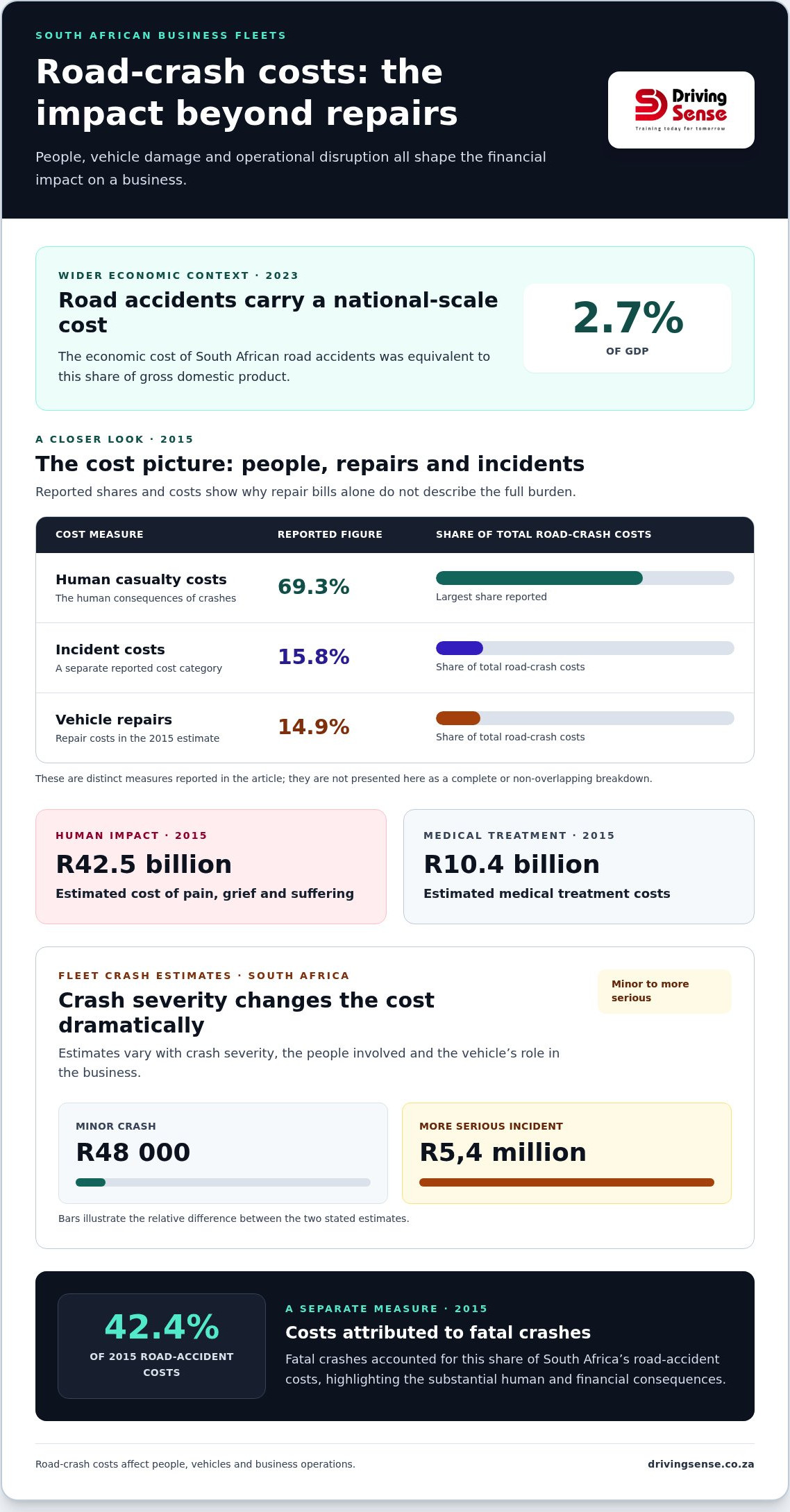
Road accidents cost South Africa the equivalent of 2.7% of gross domestic product in 2023, showing that the financial impact extends well beyond the damaged vehicle. For an individual organisation, the cost of vehicle accidents for South African businesses can include insurance and repair expenses, injury-related costs, lost productivity and vehicle downtime.
It’s understandable to focus first on an insurance claim or repair bill: those costs are visible and immediate. But the full operational impact can also include interrupted deliveries, staff time spent administering the incident and reduced capacity while a vehicle is unavailable.
This article explains how these costs affect South African businesses and why the total impact depends on the crash, the people involved and the vehicle’s role. You’ll learn how to look beyond direct expenses and assess the effect on business continuity, as well as how driver and safety training can form part of a structured approach to managing risk.
Key Takeaways
- Road crashes carried an economic cost equivalent to 2.7% of South Africa’s gross domestic product in 2023, while a business’s own losses also depend on disruption to its operations.
- Assess insurance and third-party cover alongside the costs that can follow a claim, including injury-related expenses and time spent managing the incident.
- Use the 2015 injury figures to understand why the impact on people can be a substantial part of the wider financial burden.
- Include vehicle downtime, interrupted work and replacement transport in your assessment, not only repair costs; South African fleet crash estimates range from R48 000 for minor crashes to R5,4 million for more serious incidents.
- Consider how Emergency Safety Training and Driver Training can support a structured approach to workplace and road-safety risks.
Economic cost of South African road accidents
South African road crashes carry costs beyond vehicle damage, affecting people, operations and the wider economy. In 2023, their cost was equivalent to 2.7% of gross domestic product.
Costs by vehicle type and accident severity
Accident costs vary with the severity of the crash, the people involved and the vehicle’s role in the business. South African fleet estimates place minor crash costs at R48 000 and more serious incidents at R5,4 million.
Vehicle type figures show exposure, not a separate repair price: in 2015, motor cars and station wagons made up 48.5% of vehicles involved in fatal accidents, compared with 18.4% for bakkies. These figures help businesses consider fleet mix alongside crash severity when assessing risk.
Costs across fleet sizes
Fleet cost is the combined effect of incidents across vehicles, including direct expenses and losses that disrupt operations. A medium-sized logistics company with ten accidents annually can incur millions in hidden losses, while indirect costs in certain industries can reach 20 times direct costs.
After a crash, employers need to protect affected people, record the incident and address applicable reporting and compensation obligations. The response should reflect the work context and the incident’s consequences, rather than treating vehicle damage as the only cost.
Repair and replacement vehicle costs
Repair costs include the work needed to return a damaged vehicle to service, while replacement transport can help maintain operations during downtime. The 2015 South African crash-cost estimate, based on a report by RTMC and CSIR, attributed 14.9% of total costs to vehicle repairs.
The financial impact also depends on whether the damaged vehicle supports deliveries, staff travel or specialist work. Replacement arrangements, missed work and disrupted schedules can add operational losses to repair expenses. Incident records should capture both repair costs and the time the vehicle is out of service.
Costs of injuries, fatalities and lost workdays
Human consequences form a substantial part of road-crash costs. In 2015, human casualty costs accounted for 69.3% of South Africa’s total road crash costs, and the estimated cost of pain, grief and suffering was R42.5 billion.
Fatal crashes accounted for 42.4% of road-accident costs in South Africa in 2015. Medical treatment costs were estimated at R10.4 billion that year, while the cost of lost workdays can also arise when injured employees cannot perform their usual duties or colleagues are diverted to manage the incident.
These figures show why the cost of vehicle accidents for South African businesses should be assessed across injuries, fatalities, repairs and operational disruption. In 2015, incident costs represented 15.8% of total road crash costs, alongside the 14.9% attributed to vehicle repairs.
Insurance premiums and third-party cover
Insurance can cover some accident-related costs, but it doesn’t eliminate operational losses or every liability. For South African businesses, policy wording, the excess, exclusions and claim circumstances determine which costs may be covered.
Separate the possible claim categories before assessing the financial impact. Damage to the insured vehicle, damage to another party’s property, employee injuries and downtime involve different processes and may not fall under the same cover.
How premiums and claims affect business costs
A premium is the amount paid for insurance, while an excess is the portion the business may have to pay towards a claim. Consider both when comparing the likely financial impact of a crash.
Insurers assess risk using factors such as vehicle use, operating locations, driver profiles and claims history. For example, a delivery vehicle regularly travelling on congested urban routes has different operating exposure from one used occasionally on a fixed site. Review your incident records for recurring locations, vehicle types or driver-related patterns.
A claim can also create administrative work, such as gathering incident details, repair assessments and supporting records. Prompt, consistent documentation helps the business explain what happened and distinguish insured expenses from costs it must manage directly. Any premium change after a claim depends on the policy and insurer’s assessment, so don’t treat one claim as a fixed future cost.
Third-party cover and employee compensation
Third-party cover generally addresses covered liability for damage or injury involving another party, subject to the policy’s terms. It differs from cover for damage to the business’s own vehicle, so managers should identify the relevant policy section before estimating their exposure.
COIDA is relevant when an employee is injured in a work-related vehicle accident. Record the circumstances, the employee’s work connection and the injury, then follow the applicable compensation process. Motor insurance and employee compensation address different aspects of the incident.
For example, a staff member injured while travelling on work duties may need an injury record and supporting incident information, alongside any vehicle claim documentation. Keeping these records together can help coordinate the business’s response, without assuming that one insurance claim resolves every employee-related matter.
Review policy wording against actual fleet use, including who drives each vehicle and the work undertaken. A documented response can also include practical care for affected staff; employee wellbeing support can form part of that consideration.
Injury numbers and types
Injury severity changes the human and operational consequences of a road crash. South Africa recorded 12,944 road traffic crash deaths in 2015 before adjusting for under-reporting; the estimate rose by five per cent, to 13,591 deaths. The same year, an estimated 62,520 people sustained serious injuries, while 202,509 sustained slight injuries.
An incident involving a fatality, serious injury or slight injury creates different practical demands for employers. A serious injury may lead to extended absence and temporary changes to work arrangements. A slight injury can still require care, documentation and time away from normal duties. A fatality can affect colleagues and call for a sensitive, coordinated workplace response.
What the injury figures mean for employers
The national figures describe road users overall, not only employees driving for work. However, they show why a business should record the injury outcome alongside vehicle damage. In 2015, drivers represented 27.0% of road-accident fatalities in South Africa. An estimated 71.2 per cent of road users injured in crashes were male.
A useful incident record for fleet managers includes the employee’s role, journey purpose, injury severity, time away from duties and any temporary work adjustments. These details help the organisation understand how an injury affects staffing and operational capacity. They also help distinguish medical and compensation processes from wider workforce effects.
Multiple injuries and length of care
A single casualty may sustain more than one injury, increasing the complexity of treatment and recovery. In a South African regional hospital study, 100 patients admitted after road traffic crashes sustained 197 injuries. Twenty-six patients had three or more injuries, and patients spent an average of 19 days in hospital.
The study also recorded 90 operations among those 100 patients. These findings illustrate how one crash can affect several people and require extensive care. For an employer, the practical impact may include coordinating absence cover, adjusting duties and supporting colleagues who are affected by the incident.
Assessing workplace impact
Injury records become more useful when linked to the work affected. For example, if an injured driver cannot complete scheduled duties, the business may need to reassign work or adjust delivery plans. The cost of vehicle accidents for South African businesses therefore includes the consequences of injuries, not just vehicle damage or insurance claims.
Record each affected person separately, including their injury category and work impact. Keep incident details aligned with absence and operational records, while handling personal information appropriately. The 2015 national estimates and hospital study provide context, but a business’s own records reveal which roles and tasks are most affected.
Lost productivity and vehicle downtime
A crash can interrupt work even when nobody is seriously injured and the vehicle is repairable. For a South African delivery fleet, an unavailable vehicle may delay a route, shift work to another driver and affect scheduled customer deliveries. The resulting loss depends on the vehicle’s role, available spare capacity and whether other tasks can be rescheduled. Recording these operational effects alongside repair and insurance details gives managers a fuller account of each incident.
Downtime starts when a vehicle can no longer perform its assigned work and continues until it returns to service or an alternative is arranged. A vehicle used for daily deliveries can have a different operational impact from a pool vehicle with several substitutes. Record when it became unavailable, which routes or duties were affected, and when normal work resumed. This helps distinguish repair time from the wider period of disruption.
Staff time can also be diverted after a crash. A supervisor may coordinate vehicle recovery, arrange shift cover, update customers and compile incident records. If a driver is absent, for example, another employee may need a different allocation of duties. Record these changes, including postponed work and tasks reassigned to colleagues, to identify where capacity was lost rather than attributing every delay to vehicle repairs.
Replacement transport can keep essential work moving, but requires decisions about suitability and scheduling. A substitute vehicle must meet the practical needs of the job, such as carrying the required goods or handling the route. If no suitable vehicle is available, the business may need to prioritise deliveries or rearrange appointments. Recording these decisions helps managers identify which operations depend on specific vehicles and where contingency planning could limit disruption.
Prevention can also influence future downtime. The Webfleet Road Safety Report 2024 estimated that implementing safety technology and training could reduce accidents by up to 80%. Treat this as a reported estimate, not a guaranteed result for each fleet. Businesses can use incident patterns, including recurring locations or driving behaviours, to inform safety measures and evaluate whether changes correspond with fewer disruptions over time.
A practical downtime review compares each incident’s repair period, employee absence, reassigned duties and interrupted work. Keep these categories distinct: a repair invoice won’t show the full operational impact, while a missed delivery alone won’t explain its cause. Reviewing fleet records helps identify vehicles that support critical tasks, available workarounds and recurring service disruptions. That evidence can guide operational planning and make accident-cost assessments more complete.
How much do vehicle repairs and replacement vehicles cost in South Africa?
There isn’t one repair price for every fleet vehicle in South Africa. The final amount depends on the damage, required parts, labour, vehicle specification and whether repairs restore the vehicle to safe working condition. A cracked light and damaged bodywork, for example, involve different work from damage affecting steering or the vehicle structure. The severity of the incident is central to budgeting.
The 2015 crash-cost report by RTMC and CSIR provides a basis for assessing fleet losses, but a business’s repair bill depends on the individual vehicle and incident. An assessment should separate parts, labour and any additional work required to return the vehicle to service. Vehicle age, model and parts availability can affect the repair process. For a fleet manager, keeping invoices with vehicle and incident records supports comparisons between actual repairs over time.
Replacement transport is a separate cost while the damaged vehicle is unavailable. The amount depends on the replacement vehicle’s class, how long it is needed and the work it must do. A small car, for example, may not suit a business that needs a bakkie to carry equipment. Consider operational suitability alongside the hire charge and any terms that affect vehicle use.
To assess the full cost of an incident, record the repair estimate and final invoice separately from replacement transport. Note when the vehicle became unavailable, when a substitute was arranged and when the repaired vehicle returned to service. This comparison distinguishes repair duration from the total disruption period and shows whether a suitable spare vehicle could have reduced the need for replacement transport.
South African fleet records can reveal whether particular vehicle types or operating tasks repeatedly lead to costly repairs. Compare incidents by vehicle, damage type and work function, rather than relying on one fleet-wide average. For example, repeated damage to vehicles used on the same delivery route may prompt a review of route conditions and driver practices. This analysis can inform budget planning without assuming every future crash will have the same repair cost.
For a more complete view, include repair work, replacement transport and operational interruption in the same incident review. The 2015 RTMC and CSIR report gives national fleet-cost context, while individual invoices and downtime records show the effect on a specific organisation. Businesses seeking to address driver-related risk can explore Driver Training as part of their prevention planning.
Driving Sense: Emergency Safety Training
Driving Sense provides Emergency Safety Training to help organisations prepare employees to respond appropriately to workplace incidents. For fleets, this training can support clear responsibilities and coordinated responses. Driver Training addresses driver capability and road-safety practices.
When accident reviews identify procedural gaps, Compliance Training can help reinforce relevant workplace processes. Organisations transporting dangerous goods can also use Dangerous Goods training to address risks associated with that work. These services support prevention and preparedness; they do not replace vehicle repairs, insurance cover or emergency medical services.
Contact Driving Sense to discuss training for your organisation’s fleet and workplace needs.
Turn fleet incident data into a practical safety plan
A useful next step is to treat each incident as evidence for improving how work is organised. Review record patterns, identify gaps in driver capability, emergency preparedness or compliance processes, and assign responsibility for addressing them. This creates a forward-looking framework for managing the cost of vehicle accidents for South African businesses, rather than treating every crash as an isolated event.
Driving Sense offers Driver Training, Emergency Safety Training and Compliance Training to help organisations develop this approach. The right focus depends on the risks identified in your fleet and the procedures employees need to follow. Training can form part of a broader safety plan, alongside incident reviews and operational controls.
Contact Driving Sense to discuss fleet safety and consider which training best supports your organisation’s next steps. A structured review can help your team move from recording incidents towards more deliberate safety planning.
Frequently Asked Questions
What is the average cost of a vehicle accident for a South African business?
There is no single average that represents every South African business accident. Fleet estimates range from R48 000 for minor crashes to R5,4 million for more serious incidents, reflecting differences in severity and consequences. Treat these figures as reference points, not a per-vehicle prediction. For budgeting, compare your own incident records by vehicle type, damage, employee impact and operational disruption, then use those patterns to inform fleet planning.
What direct costs do South African businesses incur after a vehicle accident?
Direct expenses can include vehicle repairs, an insurance excess, recovery or towing, replacement transport and costs associated with injured employees. Which costs apply depends on the incident and the relevant insurance and compensation processes. For example, a vehicle damaged during a work journey may involve both a repair claim and transport arrangements for ongoing duties. Record each expense separately against the incident so invoices and claim payments aren’t confused with indirect operational losses.
What indirect business costs result from fleet vehicle accidents in South Africa?
Indirect costs arise when an incident disrupts work beyond the immediate repair or claim. A delayed delivery may require rescheduling, while an absent driver can mean reallocating duties or using staff time for incident administration. In certain industries, indirect accident costs can be as high as 20 times direct costs. Track missed work, reassignments and customer service effects alongside vehicle records to see how crashes affect the cost of vehicle accidents for South African businesses.
How do vehicle accidents affect South African business insurance premiums and excess payments?
An excess is the amount the insured business pays towards a claim, while a premium is the cost of maintaining cover. How these apply depends on the policy wording and claim circumstances. An insurer may consider claims history and vehicle use when assessing risk and renewal terms, but the effect varies by policy. Review the schedule and excess for each fleet vehicle, then compare actual claim payments with renewal changes to understand the impact on your budget.
What steps can South African businesses take to reduce fleet accidents and related costs?
Start by reviewing incident records for recurring routes, vehicle assignments and driving behaviours, then address the risks they reveal. Set clear reporting procedures and ensure employees understand their responsibilities after an incident. Driver Training can support improved driving practices, while Emergency Safety Training and Compliance Training can strengthen response readiness and workplace procedures. Driving Sense provides these training options for organisations taking a structured approach to fleet safety.
