

Workplace substance abuse is the problematic use of alcohol or other drugs when it affects an employee’s safety, behaviour or ability to work. Workplace substance abuse awareness training in South Africa helps employees and managers recognise possible impairment, respond professionally and understand how workplace policies support safer decisions. Substance use at work is both a safety concern and an employee wellbeing issue.
Possible impairment can be difficult to distinguish from illness, fatigue or stress. Assumptions can undermine workplace safety and fair treatment. A clear, consistent response gives employees and managers a practical way to raise concerns without relying on stigma or guesswork.
This article explains what substance misuse at work can involve, which behavioural and physical signs may indicate impairment, and who can benefit from training. It also covers how stress and mental health can relate to substance use, and how policies and procedures can guide a responsible response in South African workplaces.
Key Takeaways
- Understand how alcohol and drug misuse can affect workplace safety, attendance, productivity and morale.
- Learn to notice changes in behaviour or physical symptoms that may indicate impairment, without treating signs alone as proof.
- Identify how employees, managers, supervisors and HR professionals can contribute to a consistent, professional response.
- Consider how stress and mental health may relate to substance use, and why supportive workplace practices matter.
- Use clear policies to guide safety decisions, medication considerations and workplace substance testing procedures.
What is substance abuse in the workplace?
Substance misuse at work means alcohol or drug use that affects an employee’s conduct, judgement, attendance or ability to perform tasks safely. It may begin before a shift, occur during work, or involve medication that affects a safety-sensitive duty. The key question is whether someone’s capacity or behaviour creates risk for themselves or colleagues, not whether they deserve blame. Workplace substance abuse awareness training in South Africa helps employees and managers recognise risks and respond consistently.
Workplace studies report clear effects on attendance and claims. Employees with alcohol and drug problems had absenteeism rates three times higher than other employees. They claimed sick benefits three times more frequently and made compensation claims five times more often. The same studies found that 20% to 25% of workplace injuries involved employees under the influence of alcohol. Drugs and alcohol supplied at work contributed to 15% to 30% of workplace accidents. These figures describe workplace risks, not proof that a particular employee is impaired.
For an individual, impairment can affect judgement, coordination, alertness and the ability to follow procedures. In a warehouse, for example, a worker who misjudges distance around moving equipment could endanger colleagues as well as themselves. In an office, missed deadlines, errors and conflict can disrupt team performance. Organisations may also face injuries, lost productivity, lower morale, legal and financial consequences, and reputational damage. The impact depends on the substance, task and work environment.
The cost of workplace substance abuse awareness training in South Africa depends on course scope, delivery format, participant numbers and workplace requirements; a price is provided after a quote request. Employers can identify concerns by recording observable changes, such as unusual behaviour or difficulty completing a familiar task, rather than relying on rumours or assumptions. To protect privacy, discuss observations discreetly with the appropriate manager and limit access to relevant information. Employers should obtain employees’ consent before conducting substance tests.
A written policy makes prevention and response more consistent. It can explain expected fitness for work, reporting procedures, testing processes, confidentiality and available support, while distinguishing observable impairment from allegations of misuse. Managers should follow the same documented steps for comparable incidents, record facts rather than labels, and consider the employee’s safety before assigning duties. Under South Africa’s Occupational Health and Safety Act 85 of 1993, employees taking prescribed medication may continue their duties if the medication does not threaten their health or safety, or that of others at work. This supports a responsible approach that considers both safety and fair treatment.
Recognising signs and symptoms of substance impairment
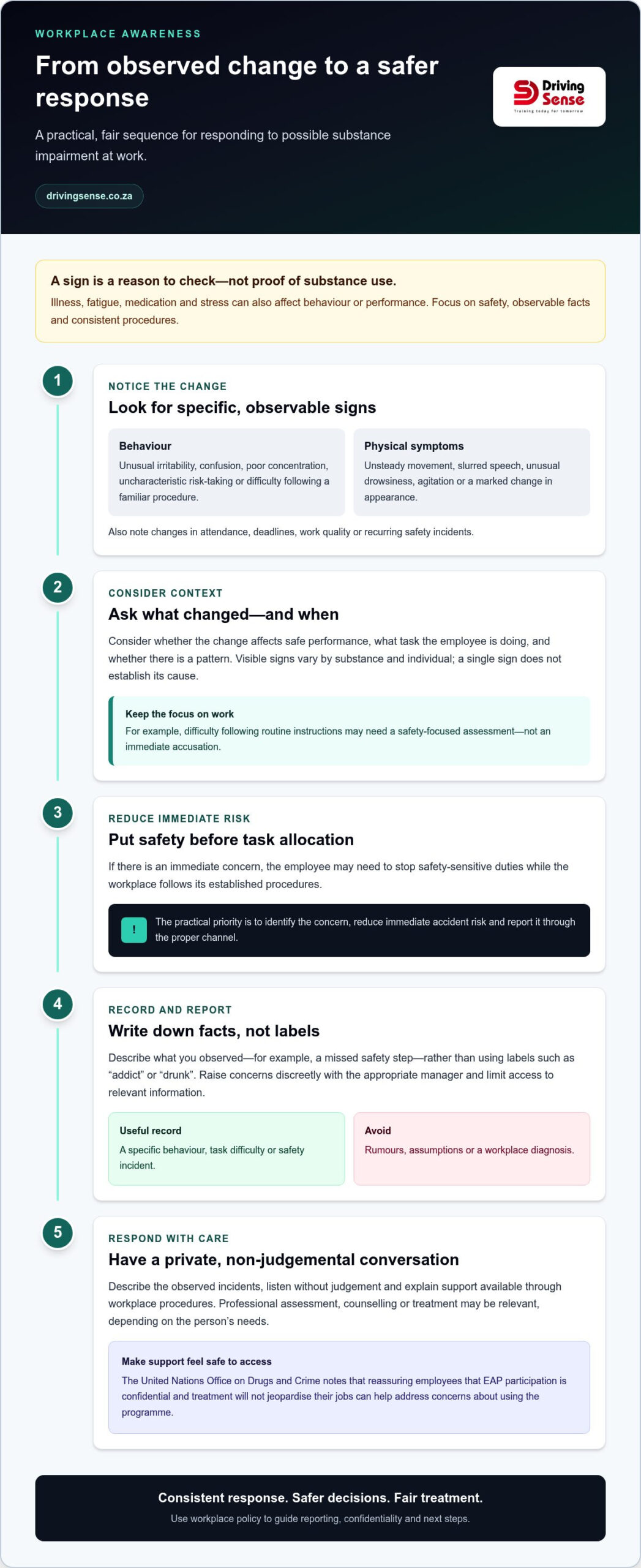
Recognising possible impairment starts with observable changes, not assumptions about an employee’s character or private life. Training on workplace substance risks can help participants identify behavioural changes and physical symptoms that may indicate alcohol or drug misuse. A single sign does not establish its cause. Consider what has changed, when it occurred and whether it affects safe performance.
Behavioural signs may include unusual irritability, confusion, poor concentration, uncharacteristic risk-taking or difficulty following a familiar procedure. Physical symptoms can include unsteady movement, slurred speech, unusual drowsiness, agitation or a marked change in appearance. For example, a previously reliable driver who struggles to follow routine instructions may need a safety-focused assessment, not an immediate accusation. Fatigue, illness, medication and stress can also affect behaviour or performance.
Look for patterns and risks related to the person’s tasks. Repeated unexplained absences, missed deadlines, declining work quality or recurring safety incidents may call for a confidential conversation. These are warning signs, not diagnostic evidence. In a high-risk role, an immediate concern may require the employee to stop safety-sensitive duties while the workplace follows its established procedures. Record specific observations, such as a missed safety step, rather than labels such as “addict” or “drunk”.
Training can explain how stimulants and depressants may affect people differently, and why visible signs vary by substance and individual. Simulation goggles can demonstrate how impairment may affect perception, coordination and decision-making. This can help teams understand why someone may misjudge distance, lose balance or make an unsafe choice. The practical focus is workplace safety: identify the concern, reduce immediate accident risk, and report it through the proper channel.
Possible addiction warning signs include repeated impairment, continued use despite clear work consequences, or recurring difficulty meeting responsibilities. These signs call for a careful, private response, not a workplace diagnosis. Managers can describe observed incidents, listen without judgement and explain the support available through workplace procedures. Professional assessment, counselling or treatment may be relevant, depending on the person’s needs. The United Nations Office on Drugs and Crime notes that reassuring employees that EAP participation is confidential and treatment will not jeopardise their jobs can help address concerns about using the programme.
For a consistent response, train supervisors to document facts, protect sensitive information and escalate immediate safety concerns through policy. Employees should know how to report a concern without spreading personal details amongst colleagues. Where teams need practical preparation for workplace hazards, emergency safety training can support safety awareness alongside impairment recognition.
Training for employees, managers, supervisors, and HR professionals
Effective training gives each workplace role clear responsibilities for prevention, reporting and assistance. It should link awareness to documented procedures, respectful conversations and safe decisions.
Training audiences and course content
Employees learn how substance use can affect work and how to raise concerns through approved channels. Managers and supervisors practise responding sensitively, recording observable facts and escalating immediate safety risks. HR professionals can focus on consistent processes, confidentiality, employee assistance and referral pathways. Choose course content that addresses workplace scenarios and the organisation’s own policy, not awareness alone.
Many organisations use annual refresher training, particularly in high-risk industries. A useful programme prepares participants to approach a colleague professionally, without diagnosing or shaming them. The United Nations Office on Drugs and Crime notes that reassuring employees about confidential EAP participation and job security during treatment can help address concerns about using the programme.
Training duration and delivery
Workplace drug and alcohol risk training is described as a three-day master class, while a separate prevention course is scheduled for ten days. These durations apply to those courses, not to a universal requirement. Ask what the programme covers, how it fits shift patterns, and whether practical exercises or policy discussions are included.
Online or in-person delivery should suit the workplace, learner group and activities involved. In-person discussion can support role-play around a supervisor conversation; online learning may help distributed teams access consistent material. Review the delivery format and completion evidence in the course details, and assess accreditation by the named body, course scope and certificate issued.
Training works best when responsibilities are understood before an incident occurs. Employees should know how to report an immediate safety concern and where assistance is available. Managers should document dates, observed behaviour, work impacts and actions taken, separating facts from assumptions. HR can maintain restricted records and apply procedures consistently, while trade union representatives can support employees through workplace processes where appropriate.
A clear record helps an organisation explain a safety action, such as temporarily removing someone from a hazardous task. It should not become a diagnosis or a file of unrelated personal details. Use the designated reporting route, limit access to those who need the information, and record any referral or follow-up agreed with the employee.
Employee assistance programmes can provide a confidential route to counselling or specialist assessment. Managers remain responsible for workplace processes, not treatment decisions. Tell employees how to access assistance and what information is shared. For example, a supervisor may refer an employee to the established support channel after discussing a documented concern, then record the referral without collecting unnecessary clinical details.
Workplace substance abuse awareness training in South Africa should connect learning with prevention, fair documentation and practical assistance. Employees, managers, HR and worker representatives each contribute through their defined roles, helping the organisation respond consistently instead of relying on informal judgement.
Mental health, stress and substance use
Stress, mental health concerns and substance use can intersect, but one does not prove another. A person facing workload pressure may use alcohol or drugs to cope, while another may experience distress without using substances. Managers should not treat a change in mood as evidence of misuse. Instead, note observable changes, such as missed steps during a safety check, and follow workplace procedures. This distinction supports health and safety while keeping the conversation grounded in work-related facts.
South African workplaces include people with varied experiences and support needs. More than 50% of drug users in South Africa are currently employed. This figure indicates that substance use can affect working communities, but it does not identify which employee may be affected. A practical prevention strategy combines clear fitness-for-work expectations with accessible support. For example, an employee experiencing sustained pressure could be directed towards an established assistance route, rather than being labelled or discussed informally amongst colleagues.
Education can help employees understand why substances may affect work differently. Substances fall into two categories: stimulants and depressants. Their effects vary, and an employee’s apparent energy level alone cannot establish what they have taken. Training can explain how impairment may affect attention, judgement or coordination, using job-related scenarios such as operating equipment or checking a delivery. This helps staff connect individual wellbeing with their responsibilities for safe work, without encouraging self-diagnosis or speculation about colleagues.
To implement a supportive response, organisations can set out a simple sequence in their procedures: identify a work-related concern, address immediate safety needs, speak privately, and explain available support. A manager might notice that an employee who is usually attentive has become withdrawn and is missing routine instructions. The manager can describe those specific observations, ask whether assistance is needed, and refer the employee to the relevant workplace support channel. Any safety decision should follow established policy and focus on the task at hand.
Mental health support and substance-use prevention work best when employees know how to seek assistance without workplace gossip. Explain who receives a referral, how sensitive information is handled, and what the employee can expect. Managers can also review workplace pressures, including shift demands or unclear responsibilities, and raise operational issues through established channels. These steps do not replace professional care; they support a structured workplace response that treats wellbeing, performance and safety as related considerations.
Workplace substance abuse policies and procedures
A written policy turns workplace expectations into consistent steps for employees and managers. It should explain fitness for work, how concerns are reported, who responds, and how safety decisions are recorded. For example, a supervisor who sees an employee struggling with a safety-critical task needs a defined route for pausing that task and escalating the concern. Clear procedures can reduce uncertainty during incidents and support productivity.
South Africa’s Occupational Health and Safety Act 85 of 1993 allows employees on prescribed medication to continue their duties if the medication does not threaten their health or safety, or that of others in the workplace. A policy should therefore address medication in terms of task-related safety, rather than assume that taking prescribed medicine automatically prevents someone from working. Employees need a clear way to raise relevant concerns with an appropriate manager.
Testing procedures also need clear boundaries. Employers should obtain employees’ consent before conducting substance tests. A policy can explain when testing may be considered, who administers the process, how results are handled, and who may access them. It should also describe how employees are informed and how the outcome connects to workplace procedures. For instance, a safety-sensitive incident may trigger a documented review under the organisation’s established process.
Useful policies distinguish immediate safety measures from longer-term support. They can set out the following practical steps:
- Record observable facts, such as a missed safety check, rather than assumptions about substance use.
- Address any immediate risk by following the workplace’s established safety procedure.
- Discuss the concern privately and explain the relevant reporting or review process.
- Provide information about employee assistance and any applicable referral route.
Explain employee assistance in plain language, including how employees can access support and what confidentiality means within the programme. The United Nations Office on Drugs and Crime notes that assuring employees their EAP participation is confidential and that seeking treatment will not jeopardise their jobs can help address concerns about using the programme. Communicate this support without presenting it as a substitute for addressing immediate workplace risks.
Implementation depends on staff understanding their responsibilities. Managers need the skills to follow reporting steps consistently; employees need to know how to raise safety concerns; and HR needs a defined role in documentation and procedure. Organisations can use training discussions to test a policy against realistic examples, such as an employee reporting medication that may affect a particular duty. Reviewing the process after incidents can reveal unclear steps and strengthen prevention.
Driving Sense: Emergency Safety Training
Driving Sense provides Emergency Safety Training for organisations strengthening their response to workplace hazards. If substance-related impairment is one concern within a wider safety programme, this training can complement clear reporting procedures and manager awareness. It does not replace a dedicated substance-use policy or employee support pathway.
Organisations can also consider Compliance Training when employees need to understand workplace procedures and responsibilities. The appropriate training depends on operational risks, the roles involved and the procedures employees must follow. For example, teams may need practical preparation for responding to an incident, while managers need clarity on escalation and safety responsibilities.
Contact Driving Sense to discuss Emergency Safety Training or Compliance Training for your workplace.
Make safer workplace practice part of everyday operations
Make awareness a working part of your safety culture, not a standalone discussion. Review how reporting, manager response and employee support fit together, then identify where staff need practical training to apply those procedures confidently. Workplace substance abuse awareness training in South Africa can support this effort when it aligns with your organisation’s risks and responsibilities.
Driving Sense offers Emergency Safety Training, Driver Training and Compliance Training. These services can help organisations strengthen relevant safety and compliance capabilities alongside internal policies, without treating training as a substitute for clear procedures and appropriate employee support.
Consider which roles need additional preparation, and what practical capability would best support your workplace. Contact Driving Sense about training to discuss a suitable next step for your organisation.
Frequently Asked Questions
Who is this Training Course for?
This training is relevant to employees, managers, supervisors and HR professionals, with learning shaped around each role. Employees need to understand workplace expectations and reporting routes; supervisors need to respond to incidents; HR professionals oversee consistent records and procedures. For example, a shift supervisor may need to know whom to notify when an employee’s condition raises an immediate concern, while HR manages formal follow-up.
Which South African laws require employers to address substance abuse at work?
The South African statute specifically relevant here is the Occupational Health and Safety Act 85 of 1993. It allows employees taking prescribed medication to continue their duties if the medication does not threaten their health or safety, or that of others at work. This provision concerns medication and workplace safety; it should not be presented as a substance-abuse policy requirement. Employers should assess applicable legal obligations with qualified South African employment-law advice.
What are the recommended steps for implementing a workplace substance abuse policy in South Africa?
Start by identifying safety-sensitive roles and the situations your procedures must address, such as suspected impairment during a shift. Set out reporting, assessment, testing, confidentiality, support and review processes clearly. Assign responsibility for each step, then explain the policy to employees and managers through training. For example, a driver and their supervisor should know the same reporting route before an incident occurs.
What are the rules for workplace alcohol and drug testing in South Africa?
Employers should obtain employees’ consent before conducting substance tests. A workplace procedure should explain the reason for testing, who is responsible for arranging it, how results are handled, and who may access them. Keep the process consistent with the organisation’s policy and restrict information to those who need it for their role. Handle a test result through a documented process, not informal discussion among colleagues.
What are the risks of disciplining or dismissing employees for substance-related conduct?
Acting on assumptions rather than documented conduct can lead to inconsistent decisions, damaged trust and disputes. Before taking disciplinary action, separate observed behaviour from conclusions about its cause, record relevant events, and follow the organisation’s established process. For example, missing a safety procedure is an observable work matter; on its own, it does not establish substance use. Consider whether the employee needs immediate safety measures or access to support.
How can employers refer employees to treatment and support services in South Africa?
Explain the available employee assistance route privately and describe how the employee can access it. If the programme offers counselling or referrals, clarify what participation involves and how confidentiality is managed. The United Nations Office on Drugs and Crime notes that assuring employees EAP participation is confidential and treatment will not jeopardise their jobs can help address concerns about using the programme. Where appropriate, keep referral information separate from workplace incident records.
How much does workplace substance abuse awareness training cost in South Africa?
Costs depend on course scope, delivery format, participant numbers and workplace requirements; a quote is provided on request.
