
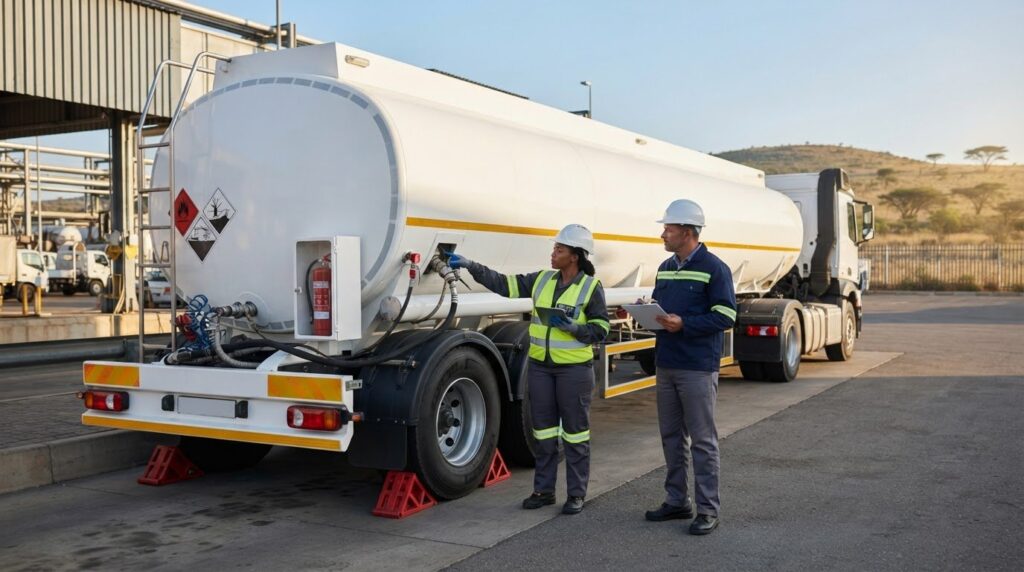
Dangerous goods transport compliance is determined before a vehicle reaches the road. In South Africa, the legal requirements for transporting dangerous goods by road sit within Chapter VIII of the National Road Traffic Act, Act 93 of 1996, and include operational requirements under SANS 10231; drivers must also hold a valid Professional Driving Permit with a Dangerous Goods category D endorsement and a valid permit issued under SANS 1157, irrespective of the vehicle’s GVM.
Knowing that a permit is required is only the starting point. Operators also need practical guidance on drivers’ conduct en route, quantity limits for flammable liquids, and safe loading and offloading. These requirements shape daily planning and the controls used to protect people, vehicles and cargo.
This guide explains the South African rules and procedures in practical terms, including the flammable-liquid limits listed for Ekurhuleni, the route behaviour covered by SANS 10231, and the steps that support safer loading and offloading. It also outlines the vehicle, equipment and documentation requirements operators need to understand when organising dangerous-goods road transport.
Key Takeaways
- Plan route conduct around SANS 10231 requirements, and ensure drivers understand the procedures that apply throughout a dangerous-goods journey.
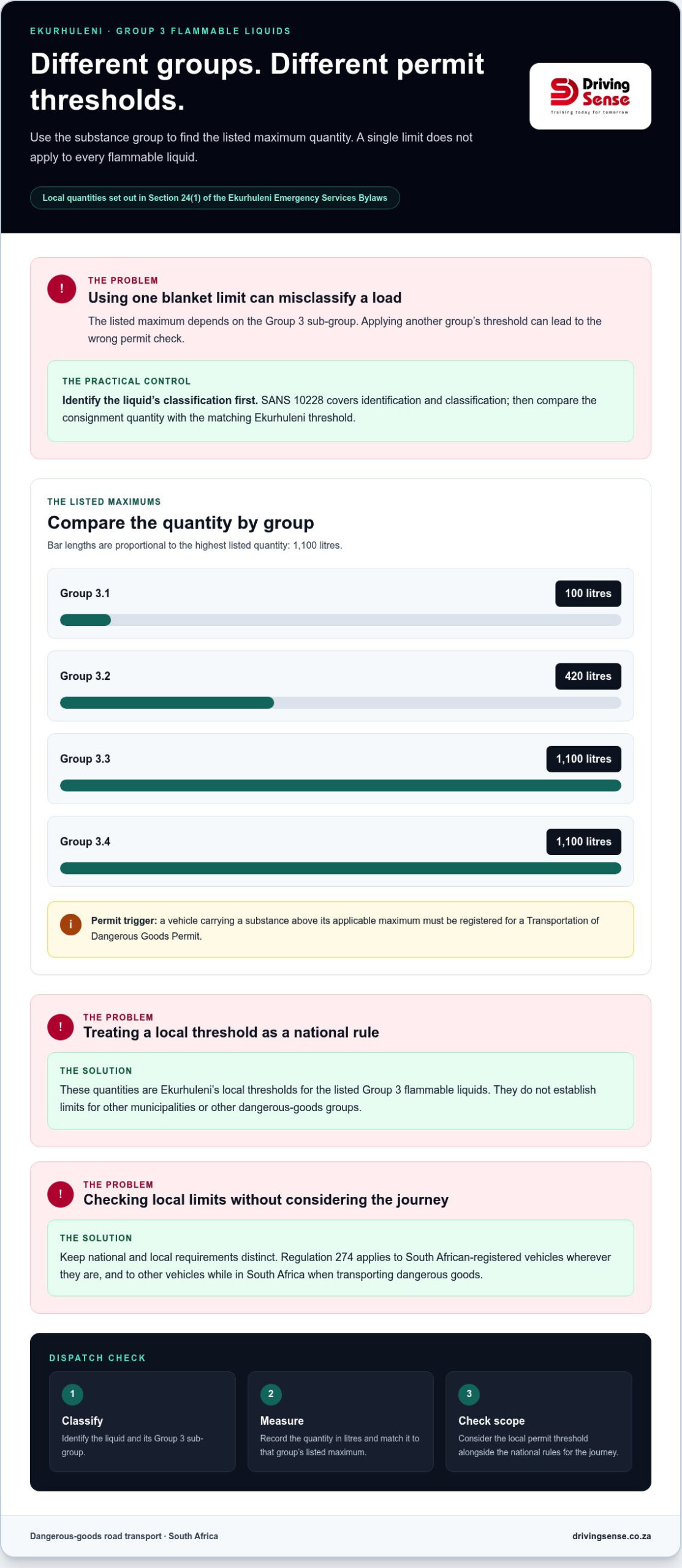
- For Ekurhuleni, the listed maximum quantities for Group 3 flammable liquids differ by group, from 100 litres for Group 3.1 to 1 100 litres for Groups 3.3 and 3.4.
- Use clear, consistent loading and offloading procedures to manage risks at each transfer point and support safe handling of the consignment.
- Match the vehicle’s warning signs and fire-fighting equipment to the applicable requirements before transport begins.
- Prepare packaging, placards and transport documents as part of one coordinated process, so essential cargo and emergency information is available when needed.
Behaviour on route
South African route conduct is covered by SANS 10231, the operational standard for road vehicles carrying dangerous goods. Drivers should follow their planned journey and the vehicle’s emergency instructions, while operators ensure required permits and safety equipment are in place.
Route conduct is one part of the legal requirements for transporting dangerous goods by road. Drivers need to understand their load, keep required emergency information accessible and follow established procedures if an incident occurs.
Vehicle and safety equipment
Check the vehicle’s warning diamond, fire extinguishers and permit before departure. The orange danger warning diamond is 250 mm square, or 100 mm on a vehicle with a GVM below 3,500 kg. A vehicle with a GVM of 3,500 kg or less must carry one 9 kg extinguisher or two 4.5 kg extinguishers. Each truck tractor needs one 9 kg extinguisher, and each trailer or semi-trailer needs two 9 kg extinguishers.
SANS 1518 covers vehicle and portable-tank construction, testing, approval and maintenance. These requirements make the vehicle’s design and condition relevant alongside its visible safety equipment.
Transport documents and compliance records
Before travel, confirm the driver holds a valid Professional Driving Permit with the Dangerous Goods category D endorsement and a valid permit issued under SANS 1157, regardless of vehicle GVM. The dangerous-goods driver’s certificate must be no more than six months old. The driver must be at least 25 years old for a category D permit, and dangerous-goods drivers are tested every second year for a PrDP.
Carry a Transport Emergency Card for each dangerous-goods item. Each card is valid for 3 years. Keep permits, training certificates and load documents together, so the driver can produce relevant records during a roadside inspection or incident response.
What inspections, certificates and compliance records are required, and how often? Drivers need the valid permits and training certificate described above, plus a Transport Emergency Card for each item, valid for 3 years. In Ekurhuleni, dangerous-goods vehicle inspections are held on Tuesdays and Thursdays from 08h00 to 15h00, excluding public holidays.
What penalties and liability apply for dangerous-goods transport violations in South Africa? Violations may lead to enforcement action and legal liability under applicable road-traffic provisions. The outcome depends on the breach and its circumstances. Complete, accessible records help show which compliance controls were in place.
Where can South African operators find current official forms, fees and guidance? Refer to the official transport or municipal emergency-services authority responsible for the relevant permit or local area. Ekurhuleni’s dangerous-goods vehicle inspections are carried out at Blitz Coetzee Testing Station in Reservoir Road, Boksburg.
Flammable liquid quantity limits
Flammable-liquid thresholds depend on the substance group and applicable local rules. In Ekurhuleni, listed maximum quantities determine when a Transportation of Dangerous Goods Permit is required.
Quantity-based requirements
Section 24(1) of the Ekurhuleni Emergency Services Bylaws sets maximum quantities for dangerous substances. A vehicle carrying liquid, gas or solid substances above the applicable maximum must be registered for a Transportation of Dangerous Goods Permit. For flammable liquids, the listed thresholds differ by Group 3 sub-group.
Use the correct group and unit when calculating a consignment. Ekurhuleni lists 100 litres for Group 3.1, 420 litres for Group 3.2, and 1 100 litres for each of Groups 3.3 and 3.4. These are local maximum quantities, not a single threshold for every flammable liquid.
- Group 3.1: 100 litres.
- Group 3.2: 420 litres.
- Group 3.3: 1 100 litres.
- Group 3.4: 1 100 litres.
Before dispatch, identify each liquid’s classification, then compare its quantity with the matching Ekurhuleni threshold. For example, a Group 3.1 load exceeding 100 litres is above that listed maximum. A Group 3.2 consignment uses its separate 420-litre threshold. Avoid applying one group’s limit to another.
Class and journey variations
Requirements vary by dangerous-goods classification and quantity, rather than by a universal liquid limit. SANS 10228 covers identification and classification, so correct classification is the first practical step. The relevant Ekurhuleni thresholds above apply to Group 3 flammable liquids. They do not establish limits for other municipalities or dangerous-goods groups.
Journey location also matters. Regulation 274 applies to vehicles registered in South Africa wherever they are, and to other vehicles while in South Africa when transporting dangerous goods. Operators should therefore distinguish national transport rules from local permit thresholds. Ekurhuleni’s quantity limits apply to the local permit process described above.
Do requirements differ by dangerous-goods class, quantity or type of journey? Yes. Ekurhuleni sets different maximum quantities for Groups 3.1 to 3.4, while Regulation 274 defines which vehicles the national rules cover. The substance classification, load quantity and journey location all affect the applicable requirements.
For a consistent dispatch check, record the product classification and quantity, identify the relevant municipality, then compare the load against its applicable threshold. If the consignment exceeds Ekurhuleni’s listed maximum, registration for a Transportation of Dangerous Goods Permit is required under section 24(1). Teams developing these controls can use dangerous-goods compliance guidance to support their operational processes.
Loading and offloading procedures
SANS 10231 covers safety and standard operating procedures for loading and offloading dangerous goods. A written process should guide each transfer, from preparing the work area to confirming the load is secure. Clear responsibilities help the driver and site team coordinate each stage.
Follow a planned sequence for each consignment. Before work begins, match the goods being handled with the load information and site procedure. If the product, destination or handling instruction differs from the plan, pause the transfer and resolve the discrepancy before proceeding.
- Prepare the work area. Identify the transfer point, the people involved and the steps for controlling access. Keep the work area orderly, with a clear route for the vehicle and personnel. A delivery at a depot, for example, needs an agreed position before unloading starts.
- Agree responsibilities. Confirm who directs the transfer and who monitors the vehicle and goods. The driver and receiving team should understand the sequence, communication method and pause point. Clear handover matters when one team loads and another accepts the consignment.
- Match the load to the plan. Compare the dangerous goods with the relevant transport and handling information. Confirm that the intended destination and unloading arrangements correspond with the consignment. A mismatch between the goods and the site’s procedure should stop work until addressed.
- Manage the transfer. Follow the documented method, maintain communication, and avoid unauthorised changes during loading or offloading. Keep people not involved in the task away from the immediate work area. If the process becomes unclear, pause and refer to the responsible person.
- Complete the handover. Once the transfer is finished, confirm that the load or receiving point is in the planned state. Record relevant completion details according to the organisation’s procedure. The driver and site team should know whether the vehicle is ready to depart.
This approach makes the procedure practical at both ends of a journey. Before departure, the loading team can check preparation and handover. On arrival, the receiving team can follow the corresponding sequence before accepting the goods. Consistent instructions also reduce reliance on assumptions when personnel change.
Incident readiness belongs in the same operating procedure. The course covers safety procedures for responding to an incident, so teams should know how to stop work, communicate the issue and follow the established response process. SANS 10232 Part 3 is the Emergency Response Guide standard for dangerous-goods transport.
Review the procedure when the consignment, site arrangement or assigned roles change. Keep the current instructions accessible to the people performing the task, and brief them before work starts. This turns SANS 10231’s loading and offloading focus into repeatable operational controls.
What vehicle requirements and safety equipment apply to dangerous-goods road transport?
South African rules combine vehicle standards, visible warnings and fire-fighting equipment. Regulation 273 A incorporates SANS standards into the dangerous-goods transport rules.
Operators should compare the vehicle configuration with its required equipment before dispatch. The relevant standards include SANS 1518 for vehicle and portable-tank construction, testing, approval and maintenance.
Vehicle standards and warning signs
SANS 1518 covers road vehicles and portable tanks used to transport dangerous goods. Its scope includes construction, testing, approval and maintenance. Use it as the reference point when assessing whether the vehicle and tank meet the applicable technical requirements.
Dangerous-goods vehicles must display an orange danger warning diamond. The diamond must be 250 mm square, or 100 mm on a vehicle with a GVM below 3,500 kg. The smaller dimension applies specifically below that GVM threshold, so don’t apply it to a vehicle at or above 3,500 kg.
Before dispatch, include the diamond in a visible-equipment check. Confirm that the required warning is displayed and that its size matches the vehicle’s GVM category. This check is distinct from assessing the vehicle’s construction and maintenance under SANS 1518.
Fire extinguishers and emergency information
Extinguisher requirements depend on the vehicle configuration and GVM:
- A dangerous-goods vehicle with a GVM of 3,500 kg or less must carry one 9 kg fire extinguisher or two 4.5 kg fire extinguishers.
- Each truck tractor transporting dangerous goods must carry one 9 kg fire extinguisher.
- Each trailer or semi-trailer transporting dangerous goods must carry two 9 kg fire extinguishers.
For a combination vehicle, assess the truck tractor and trailer or semi-trailer requirements separately. For example, the tractor requires one 9 kg extinguisher, while the trailer or semi-trailer requires two 9 kg extinguishers. Don’t substitute the smaller-vehicle rule for these configuration-specific requirements.
Emergency information is another required part of the vehicle’s transport arrangements. A vehicle carrying dangerous goods must carry a Transport Emergency Card for each dangerous-goods item in its load. SANS 10232 Part 1 covers emergency information systems for road transport, while SANS 10231 sets operational requirements for road vehicles.
A practical pre-departure check should compare the vehicle configuration, GVM, warning diamond and extinguisher provision with applicable requirements. Then confirm that each dangerous-goods item has its own Transport Emergency Card. Keeping these checks together helps identify equipment gaps before the vehicle enters service.
For a trailer or semi-trailer transporting dangerous goods, verify that it carries two 9 kg fire extinguishers. Keep this requirement tied to the trailer or semi-trailer when checking the vehicle’s equipment, rather than treating it as the truck tractor’s allowance. The required provision for each trailer or semi-trailer is two 9 kg fire extinguishers.
What packaging, labelling, placarding and documentation are required?
Packaging, placards and transport documents serve different purposes in dangerous-goods road transport. SANS 10229 covers packaging and large packaging for dangerous goods transported by road and rail in South Africa. SANS 10232-1 prescribes vehicle placards as part of the emergency information system.
Start with the consignment. Identify and classify each item, then match its packaging, markings and documents with the goods being transported. SANS 10228 covers dangerous-goods identification and classification. This classification provides a practical reference when preparing the paperwork and checking emergency information.
Packaging and vehicle placards
Use SANS 10229 as the packaging standard for dangerous goods transported by road or rail. Check that the packaging corresponds with the goods and is represented accurately in the consignment documentation. Keep packaging information aligned with the item’s classification, rather than relying on a generic description for a mixed load.
Vehicle placards communicate hazard information externally. A South African vehicle carrying dangerous goods must display three placards for each cargo containment area. Their prescribed form is set out in SANS 10232-1. Check each containment area separately, then confirm the required placards are displayed before the vehicle departs.
Placards and package labelling are not interchangeable checks. Packaging is addressed by SANS 10229, while vehicle placards fall under SANS 10232-1. A dispatch review should therefore inspect both the packaged goods and the vehicle’s placarding, rather than assuming one satisfies the other.
Declarations and emergency information
The dangerous-goods declaration should accurately describe the consignment. It must include the proper shipping name, UN number, packaging quantity and type, gross mass or volume, and net mass. It should also include applicable consignor, operator and consignee contact details. Check every field against the actual load before finalising the declaration.
For a mixed consignment, review the description and quantity for every listed item. Confirm that the packaging type matches the goods and that mass or volume details are recorded in the required form. Accurate contact details help the consignor, operator and consignee communicate when transport arrangements need attention.
Emergency information cards must comply with SANS 10232-4. Keep the relevant card information consistent with the goods and declaration, so the documents describe the same consignment. Before dispatch, check that the declaration and emergency cards are present, legible and accessible with the transport paperwork.
A practical document check follows a clear sequence: classify each item, verify its packaging, inspect placards for each containment area, then reconcile the declaration and emergency cards. Applying these steps can help teams strengthen dangerous-goods handling procedures through structured training.
Driving Sense: Emergency Safety Training
Driving Sense provides Dangerous Goods, Driver Training, Compliance Training and Emergency Safety Training for organisations strengthening their transport procedures. These courses are a practical next step when written controls need to be understood and applied consistently by drivers and operational teams.
Use training to strengthen staff understanding of route conduct, load handling, emergency information and workplace response procedures. The right focus depends on each person’s responsibilities and procedures, from driving a vehicle to coordinating dangerous-goods operations. Driving Sense offers tailored courses to build relevant knowledge and support compliance.
If your team needs structured training alongside its dangerous-goods transport controls, contact Driving Sense to discuss your requirements.
Strengthen your transport controls
Use the next step to turn the legal requirements for transporting dangerous goods by road into clear responsibilities across your operation. Assign ownership for keeping procedures current, communicating changes to drivers and site teams, and identifying where employees need further guidance. A consistent approach connects written controls with everyday decisions.
Driving Sense offers Emergency Safety Training, Driver Training and Compliance Training to help organisations build this capability. These courses develop relevant knowledge for employees’ roles and reinforce an established safety culture. Identify which responsibilities need the most attention, then choose a training focus aligned with your operational priorities.
Contact Driving Sense for support with your organisation’s training needs and take a considered step towards stronger transport procedures.
Frequently Asked Questions
What rules apply to loading, segregation and securing dangerous goods?
Follow the site’s documented handling procedure and SANS 10231’s loading and offloading requirements. Before transfer, identify the goods and their packaging, then organise the load so items can be accessed and handled without confusion. Keep different goods separated where their classifications or handling instructions require it, and secure packages against movement using a method suited to the vehicle and load. Record any load changes before departure.
What are the route, parking and operating restrictions for dangerous-goods vehicles?
SANS 10231 covers behaviour on route, so operators should plan the journey and brief drivers on the procedures that apply. Include the intended route, delivery access, suitable stopping arrangements and site-specific parking instructions in the operational plan. Drivers should use designated loading and receiving areas, avoid unplanned stops where practicable, and follow instructions if a journey disruption requires a change. Keep route decisions consistent with the operator’s safety procedures.
What emergency procedures and reporting duties apply after a dangerous-goods spill or accident?
Follow the incident procedure and use the emergency information for the specific goods involved. SANS 10232 Part 3 is the Emergency Response Guide standard, and each dangerous-goods item must have its Transport Emergency Card available. Prioritise protecting people, communicate the incident details to response personnel, and record the location, goods involved, observed conditions and actions taken. Complete notifications and records through the organisation’s incident-reporting process and applicable authority instructions.
What dangerous goods classifications and UN numbers apply in South Africa?
SANS 10228 covers dangerous-goods identification and classification. Transport documents must include the UN number for each dangerous-goods item; Ekurhuleni’s listed Group 3 flammable-liquid subgroups are 3.1, 3.2, 3.3 and 3.4.
