
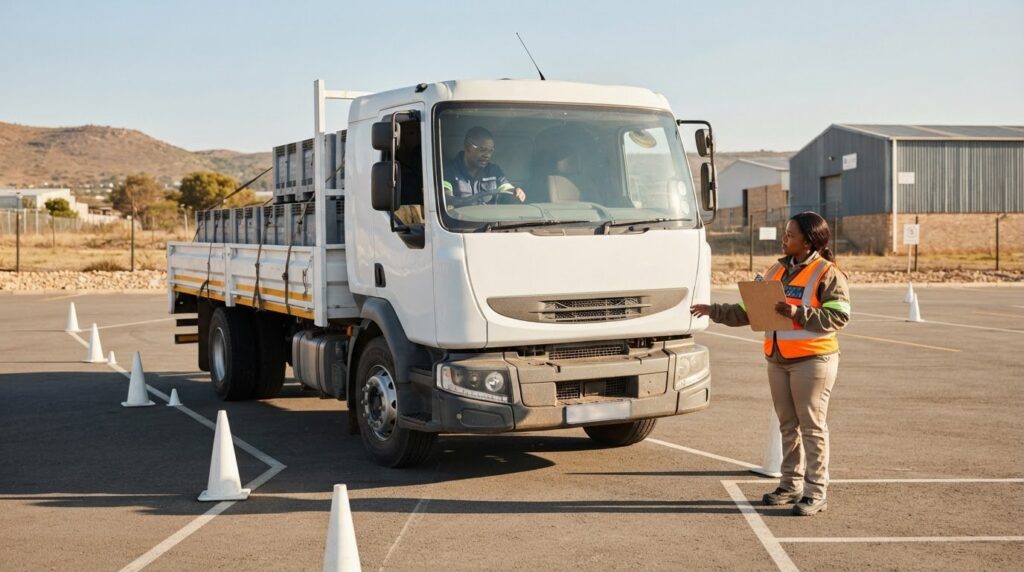
A heavy vehicle competency assessment is more than a road drive: it can include a pre-trip inspection, a demonstration drive, vehicle control and road-law knowledge. According to the South African Qualifications Authority (SAQA), competency must be assessed in a vehicle loaded to at least 25 percent of its rated capacity. Understanding the assessment areas helps drivers prepare for a practical evaluation of their everyday skills.
It’s reasonable to want clarity about what assessors observe, which errors matter and how licence classes, coupling procedures and unit standards relate to the process. This guide explains who may be assessed, what happens during the practical test and how performance is evaluated, including vehicle checks, manoeuvres, road rules and safe operating techniques. It also explains how professional driving qualifications and unit standards fit into competency assessment in South Africa, helping you understand what to expect.
Key Takeaways
- Identify how licence class and existing credentials affect eligibility for a competency assessment.
- Understand how assessors observe vehicle checks, driving habits, manoeuvres and coupling procedures in practical conditions.
- Recognise the driving behaviours and errors that can affect an assessment, from vehicle control to road awareness.
- See how professional driving qualifications and unit standards relate to demonstrating competence.
- Use Driver Training and Compliance Training from Driving Sense to strengthen workplace driving capability and support safer operating practices.
Competency test eligibility and licence classes
Eligibility depends on the vehicle, the driver’s licence and the competency evidence relevant to the work. Heavy vehicle driver competency testing should reflect whether the role involves a rigid vehicle or a combination.
Driver licence prerequisites
Before arranging an assessment, compare the driver’s current licence class with the vehicle and duties involved. A licence for a rigid vehicle and evidence for operating a combination relate to different configurations, so the assessment scope should match the work. Heavy vehicle driver competency testing is most useful when it evaluates the driver against the vehicle type they are expected to operate.
First identify the assigned vehicle, then establish which licence or competency evidence the driver already holds. This helps focus the assessment on relevant skills instead of treating every heavy vehicle role as interchangeable.
Licence and competency verification
How can employers verify a heavy vehicle driver’s licence and competency in South Africa? Review the licence class alongside the driver’s existing ticket, licence or unit of competency, then compare that evidence with the vehicle and assigned task. Record what you reviewed and whether the evidence matches the role.
For example, a driver assigned to a vehicle combination needs evidence relevant to combination operation, not just general experience driving a rigid vehicle. An assessment report can document demonstrated capability and identify areas that may need further checks or training.
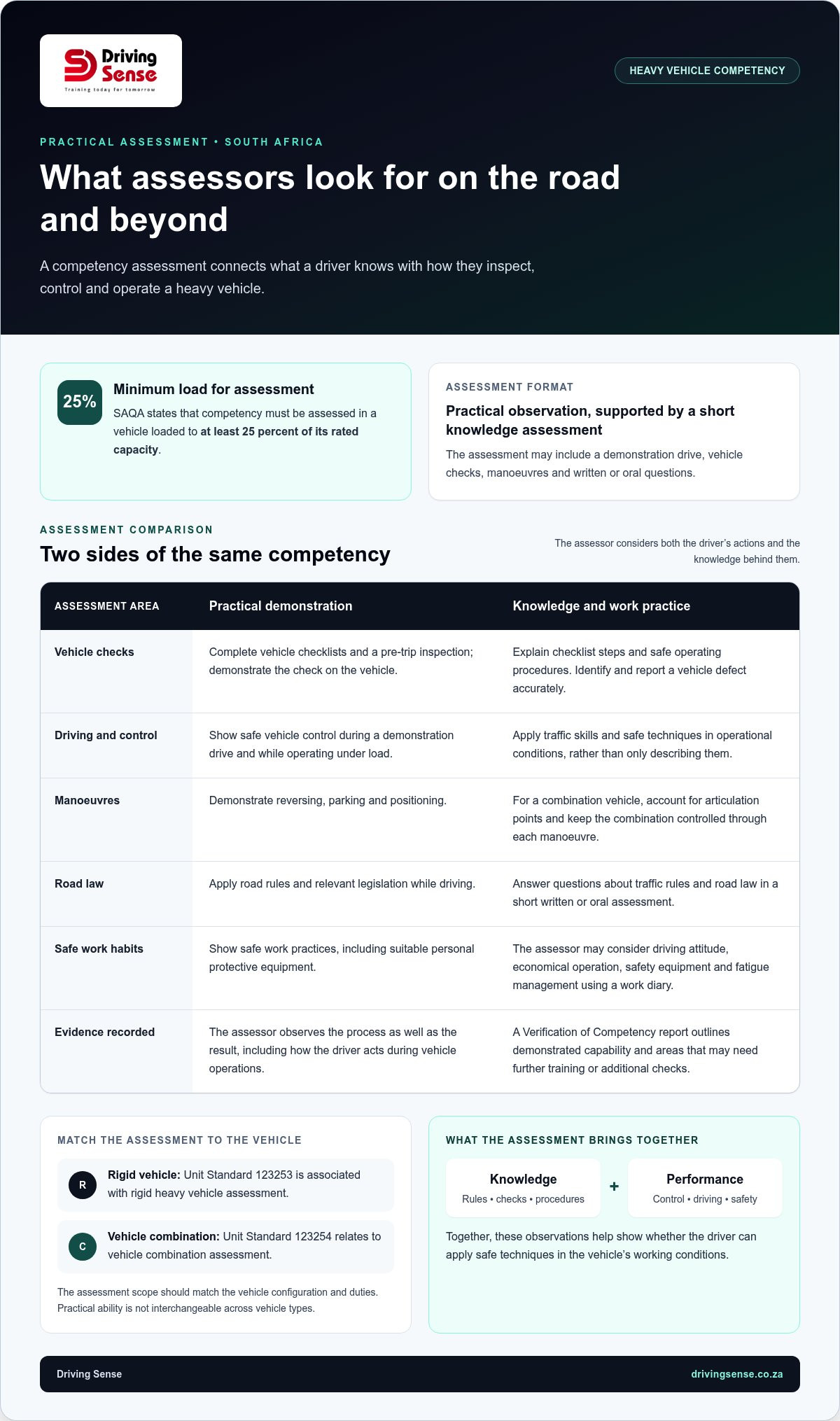
Licence classes and unit standards help distinguish the operating context. Unit Standard 123253 is associated with rigid heavy vehicle assessment, while Unit Standard 123254 relates to vehicle combination assessment. These identifiers indicate different assessment areas; they do not make a driver’s practical ability interchangeable across vehicle types.
Employers can use a straightforward review process:
- Identify whether the assigned vehicle is rigid or a combination.
- Review the driver’s current licence and existing competency evidence.
- Compare the evidence with the vehicle configuration and duties.
- Set the assessment scope to cover the relevant operating tasks.
Heavy vehicle driver competency testing assesses practical ability in relation to the work, while a licence records the class the driver holds. Reviewing both gives employers a clearer basis for assigning duties and identifying development needs. A credential alone does not show how a driver performs specific tasks in a particular vehicle.
For a rigid vehicle, the assessment can focus on its operation; for a combination, it can cover the skills needed to control that configuration. Match the evidence, vehicle and assessment scope before assigning the driver. This keeps the competency record relevant to the role and makes follow-up training more targeted if the assessment identifies a gap.
Real-world heavy vehicle driver competency assessment
A practical assessment observes how a driver applies knowledge during vehicle operations. It may combine a demonstration drive, vehicle checks, manoeuvres and a short knowledge assessment.
In South Africa, learner-test and driving-test charges are separate. The amount payable depends on the relevant licensing authority and test transaction, rather than being one combined fee.
Driving and manoeuvring assessment
The assessor observes vehicle control during driving and practical tasks, including reversing, parking and positioning. For a combination vehicle, the driver must account for articulation points and keep the vehicle combination controlled through each manoeuvre.
The South African Qualifications Authority (SAQA) lists a licence test, road law, vehicle control, a demonstration drive and a pre-trip inspection among competency areas. These checks help show whether the driver can apply safe techniques in operational conditions, not just describe them.
Written or oral knowledge assessment
A heavy vehicle competency assessment can test key knowledge through a short written or oral assessment, alongside direct observation of practical ability. Questions may cover traffic rules, road law, vehicle checklists and safe operating procedures.
The assessor may also consider driving attitude, economical operation, safety equipment and fatigue management using a work diary. For example, a driver might explain a pre-trip check, then demonstrate it on the vehicle before driving.
The practical assessment should reflect the vehicle’s working conditions. According to South African Qualifications Authority (SAQA), competency must be assessed in a vehicle loaded to at least 25 percent of its rated capacity. This allows the driver’s control and handling to be observed under load, rather than only in an unloaded vehicle.
Assessment activities may include:
- Completing vehicle checklists and a pre-trip inspection.
- Demonstrating safe driving, traffic skills and vehicle manoeuvres.
- Applying road rules and relevant legislation while operating.
- Showing safe work practices, including suitable personal protective equipment.
- Managing fatigue and recording work information in a diary.
Each activity connects knowledge with conduct. A driver might identify a vehicle defect during an inspection, report it accurately and demonstrate safe control during the drive. The assessor observes the process, not just the final answer.
After assessment, the driver receives a Verification of Competency report outlining demonstrated capability and areas that may need further training or additional checks. This record helps employers identify operational gaps and plan appropriate follow-up. Where practical skills need development, professional driver training can support safer driving practice.
The Truck Driver In-Cab Assessment evaluates drivers in real-world conditions, with an assessor observing their habits, techniques and compliance with road safety regulations. It covers pre-start checks, engine operation, driving practices, reversing, parking, and trailer coupling and uncoupling. The assessment checks that drivers apply park brakes, select neutral gear and complete systems checks before starting the engine.
During moving off and driving, the assessment checks acceleration, gear use and speed control. The rigid heavy vehicle assessment evaluates whether the driver operates and manoeuvres the vehicle in line with the manufacturer’s specifications. The heavy vehicle assessment covers vehicle checklists, practical driving and manoeuvres, traffic skills, traffic rules and legislation, driving attitude and technique, economical operation, safety and PPE, and fatigue management using a work diary.
Driving performance and error criteria
Assessment criteria focus on observable driving behaviour, vehicle control and responses to road conditions. Checks may differ between off-road manoeuvres and driving in traffic.
Off-road and on-road test criteria
Off-road checks may include vehicle positioning, reversing and parking, where the driver must control the vehicle without creating a hazard. On-road observation focuses on gear selection, clutch use, braking, steering, speed, cornering, overtaking and road sense.
For a medium rigid vehicle, the assessor may monitor how the driver responds to traffic, road conditions and other road users. The key question is whether each action maintains control and supports safe progress.
Performance is assessed across the drive, not through one isolated manoeuvre. Monitoring conditions, following road rules and braking safely are key behaviours. Poor speed control or unsafe steering can indicate a weakness that needs attention.
Errors should be considered in context. Skidding or running off the road are examples of incidents that indicate a loss of control. A dangerous response to a developing hazard also matters, even if the vehicle completes the route.
Scoring and fail criteria
Assessment records compare observed actions with the relevant competency checklist. The assessor considers whether the driver demonstrates safe control, follows traffic rules and completes manoeuvres properly, rather than relying on an overall impression.
A fail decision may reflect an unsafe action that compromises control or road safety. The assessment report can identify the specific skill or behaviour needing further training, such as poor braking technique or inadequate observation before reversing.
English-language entry criteria relate to understanding assessment instructions and communicating essential information. During a course or assessment, a driver needs to understand directions, respond to safety instructions and explain relevant checks. These abilities support safe assessment but are distinct from driving performance itself.
Employers can prepare drivers by discussing the assessment sequence and reviewing practical skills beforehand. A focused review might cover steering and braking, speed monitoring, observation of other road users and vehicle control during manoeuvres. Avoid coaching for just one route: drivers need to make safe decisions when conditions change.
Use the assessment outcome to identify practical next steps. If the report identifies a vehicle-control gap, practise that skill under appropriate supervision before reassessment. If the issue concerns road awareness, review hazard monitoring and defensive driving behaviour. This makes heavy vehicle driver competency testing useful beyond a pass-or-fail result: it can help identify operational training needs.
The guide includes a practical driving-performance checklist covering gear, clutch, braking, steering, road sense, speed, cornering, overtaking and manoeuvring. It names skidding and running off the road as possible driving incidents.
Professional driving qualification and unit standards
Professional qualifications and unit standards describe the capability being assessed, while the vehicle configuration determines the practical tasks.
For a South African heavy vehicle driver, age, medical fitness and experience are licence-class eligibility considerations. The competency assessment separately examines whether the driver can operate the relevant vehicle and perform its work safely.
Professional driving permit (PrDP) testing is distinct from demonstrating practical driving competency. A competency assessment evaluates driving ability and relevant evidence; it does not, by itself, determine permit eligibility.
Vehicle combination driving and articulation
A combination assessment focuses on controlling the towing vehicle and trailer as one moving unit. Drivers must account for articulation points when turning, reversing and positioning, because the trailer does not follow the same path as the prime mover.
This distinction matters for heavy combination vehicles, including double configurations. Unit Standard 123254 is associated with vehicle combination assessment, helping define the assessment context rather than treating every heavy vehicle as a rigid vehicle.
Test eligibility and preparation
Before arranging a heavy vehicle driving test, match the driver’s current licence and competency evidence to the vehicle class and intended task. A current licence, ticket or unit of competency provides evidence of existing capability; practical assessment then examines performance against the relevant work requirements.
Prepare by reviewing the vehicle configuration, road rules and driving tasks covered by the assessment. The test vehicle and the driver’s experience should align with the class being assessed, whether it involves a rigid vehicle or a combination.
Driving practices and road rule compliance
Professional driving competence includes monitoring conditions, complying with road rules and braking safely. Defensive driving helps reduce the risk of accidents, injury or damage, including when other road users behave incorrectly or conditions become adverse.
Unit Standard 8038 is associated with assessment material for operating different vehicles. Unit Standard 123253 relates to rigid heavy vehicle assessment, while Unit Standard 123254 covers vehicle combinations. These identifiers help distinguish the operating context and assessment focus.
The National Certificate in Professional Driving is listed with qualification ID 50285. A qualification provides a structured professional framework, while the relevant unit standards identify specific assessment areas; neither should be confused with a driver’s practical performance in a particular vehicle.
For example, a driver assigned to a rigid vehicle should demonstrate the skills relevant to that configuration. A driver expected to operate a combination needs to manage its articulation points and maintain safe control throughout the task. Matching qualification evidence, licence class and vehicle helps employers assess readiness for operational demands.
Book and prepare for a heavy vehicle test in South Africa
First establish whether you need a formal licence test or a workplace competency assessment. The booking process and preparation should reflect the purpose, vehicle class and driver’s assigned duties, so clarify these points before arranging a date.
Heavy vehicle competency assessments are available Monday to Saturday. For heavy vehicle driver competency testing, first identify whether the assessment concerns a rigid vehicle or a combination, then define the practical tasks and knowledge areas to evaluate. This gives the organiser a clear scope and helps the driver prepare for relevant duties rather than unrelated tasks.
Use a structured preparation sequence:
- Define the purpose, such as licence testing or workplace competency verification.
- Identify the vehicle class and configuration, including whether it is rigid or articulated.
- Specify the practical tasks to be observed, such as checks, reversing, parking or coupling.
- Arrange a competency assessment date from Monday to Saturday.
- Prepare the driver’s current licence and relevant competency evidence for review.
The assessment vehicle should match the competency being examined. A driver assessed on a combination needs to demonstrate relevant combination-handling skills, while a rigid vehicle assessment should focus on its applicable driving and manoeuvring requirements. Establishing the scope before booking helps ensure the practical tasks fit the role.
Preparation should also address the driver’s operational responsibilities. For example, the driver can practise a systematic vehicle inspection, safe positioning before reversing and appropriate observation during a demonstration drive. A combination driver can review how the trailer tracks through turns and how articulation affects manoeuvring. These exercises connect prior experience with skills the assessor can observe.
Keep the assessment record aligned with the booking details. Record its purpose, vehicle configuration, planned tasks and documents presented, then retain the outcome for organisational records. If the assessment identifies a skills gap, use the findings to guide further practice in the relevant area, such as braking, vehicle control or coupling.
Distinguish preparation for a formal licence test from workplace competency verification. A licence test relates to the licensing process, while a competency assessment examines defined work tasks. Making this distinction before booking helps the organisation select an assessment that fits its operational requirement. A clear scope also helps the driver understand which skills to focus on beforehand.
To plan practical preparation around the driver’s assessment tasks, discuss driver assessment preparation.
Driving Sense: Emergency Safety Training
Driving Sense provides Emergency Safety Training for organisations strengthening workplace readiness alongside professional driving capability. When an assessment identifies a practical skills gap, Driver Training can support further development; Compliance Training can help organisations connect driver practices with broader workplace requirements.
These services complement competency assessment rather than replace a formal licence test or assessment. Consider them when results point to training needs or when your organisation is reviewing how driving duties fit within its safety procedures. For teams handling regulated materials, specialised transport safety courses may also be relevant.
Contact Driving Sense to discuss training aligned with your organisation’s needs.
Put assessment insights into practice
A competency assessment is most valuable when its findings guide driver support after evaluation. Organisations can use observed strengths and development needs to set practical learning objectives, reinforce safe operating habits and align driver capability with workplace procedures. This makes heavy vehicle driver competency testing part of an ongoing approach to operational readiness, rather than an isolated event.
Driving Sense offers Driver Training to support professional driving development, alongside Compliance Training and Emergency Safety Training for related workplace needs. These services can help organisations connect driver performance with broader safety and compliance priorities, with the next step guided by their operational requirements.
To discuss how training could support your organisation’s driver competency objectives, contact Driving Sense about your test. A considered follow-up can help turn assessment findings into clear, practical actions for safer work.
Frequently Asked Questions
What happens during the test?
The assessor observes how the driver handles the vehicle and responds to real operating conditions. For example, the driver may be asked to demonstrate a pre-start check, then show controlled driving and manoeuvring. For a combination vehicle, the assessment can include coupling or uncoupling and related brake checks. The assessor also considers whether the driver follows safe procedures consistently, rather than completing each task in isolation.
Who is eligible?
Drivers should hold a current licence appropriate to the vehicle class being assessed and provide evidence of existing competency, such as a relevant ticket or unit of competency. Employers can compare the licence class with the vehicle and duties the driver will undertake. For example, a rigid-vehicle credential should not be treated as evidence of competence with an articulated combination unless the relevant qualification or assessment supports that scope.
What tests are included in South Africa’s heavy vehicle driver competency assessment?
The assessment may combine a practical demonstration with a short written or oral knowledge check. Practical components may include vehicle inspection, driving, vehicle control and manoeuvres; knowledge questions may cover road law, traffic rules and safe operating procedures. The scope should reflect the vehicle and work being assessed. A driver preparing for a combination-vehicle role, for instance, needs to demonstrate relevant combination-handling skills.
What happens if you fail a heavy vehicle driving test in South Africa, and when can you retake it?
A failed test means the required standard wasn’t demonstrated. The driver should use the assessor’s feedback to identify what needs attention before trying again. If the issue was poor reversing control, focused practice should address positioning and observation rather than unrelated tasks. Arrange a new test through the applicable booking process; the retake date depends on available appointments and the test provider’s arrangements.
