
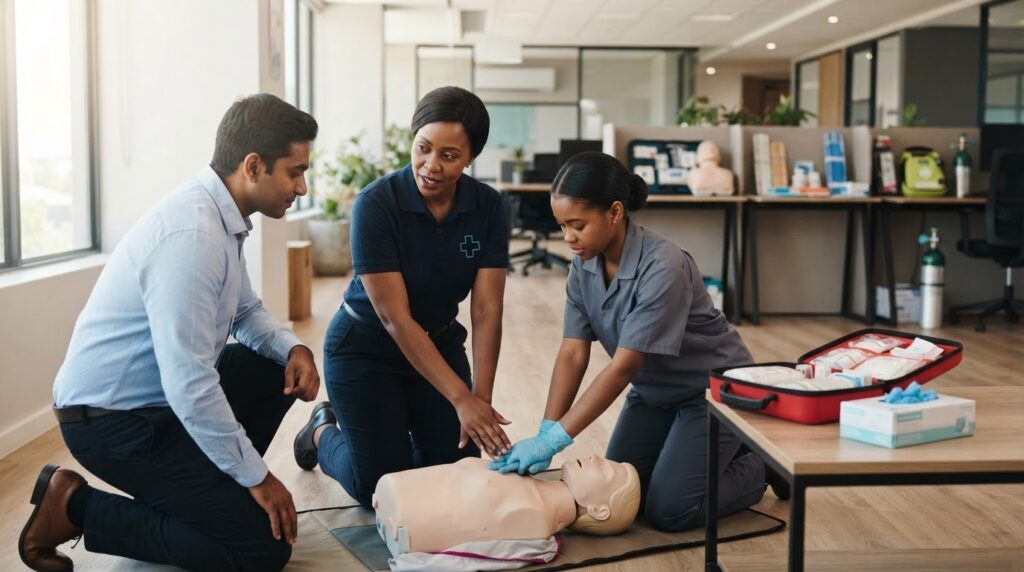
The highest first aid level isn’t automatically the workplace compliance answer. South African General Safety Regulation 3 requires at least one employee with a valid first aid certificate to be readily available when more than 10 employees work at a workplace, with a certified first aider available for each group of up to 50 employees, or up to 100 in shops and offices. Choosing first aid levels 1, 2 and 3 for workplace compliance therefore starts with understanding the required coverage and what each course prepares a person to do.
It’s reasonable to want a clear comparison before deciding how to train staff and plan workplace cover. This guide explains the differences between first aid levels, course durations, certificate validity and safe steps for assisting an injured person. It also outlines what affects course costs: the price depends on the course and delivery requirements and is provided after a quote request. With these points in mind, you can assess your workplace’s training needs and plan how to maintain first-aid cover during normal operations.
Key Takeaways
- Compare course durations before planning staff cover: Level 1 includes training and portfolio work, while Levels 2 and 3 have different course lengths.
- Build certificate renewal into your training plan, as South African first aid certificates are valid for three years.
- Choose a training level by matching its scope to workplace risks and the first-aid responsibilities assigned to staff.
- When assisting an injured person, protect yourself from contact with bodily fluids by using gloves or, if gloves are unavailable in an emergency, a plastic bag over your hands.
- Work out the required first-aider coverage for your workplace, then consider course delivery requirements when planning training costs.
Course durations and prices
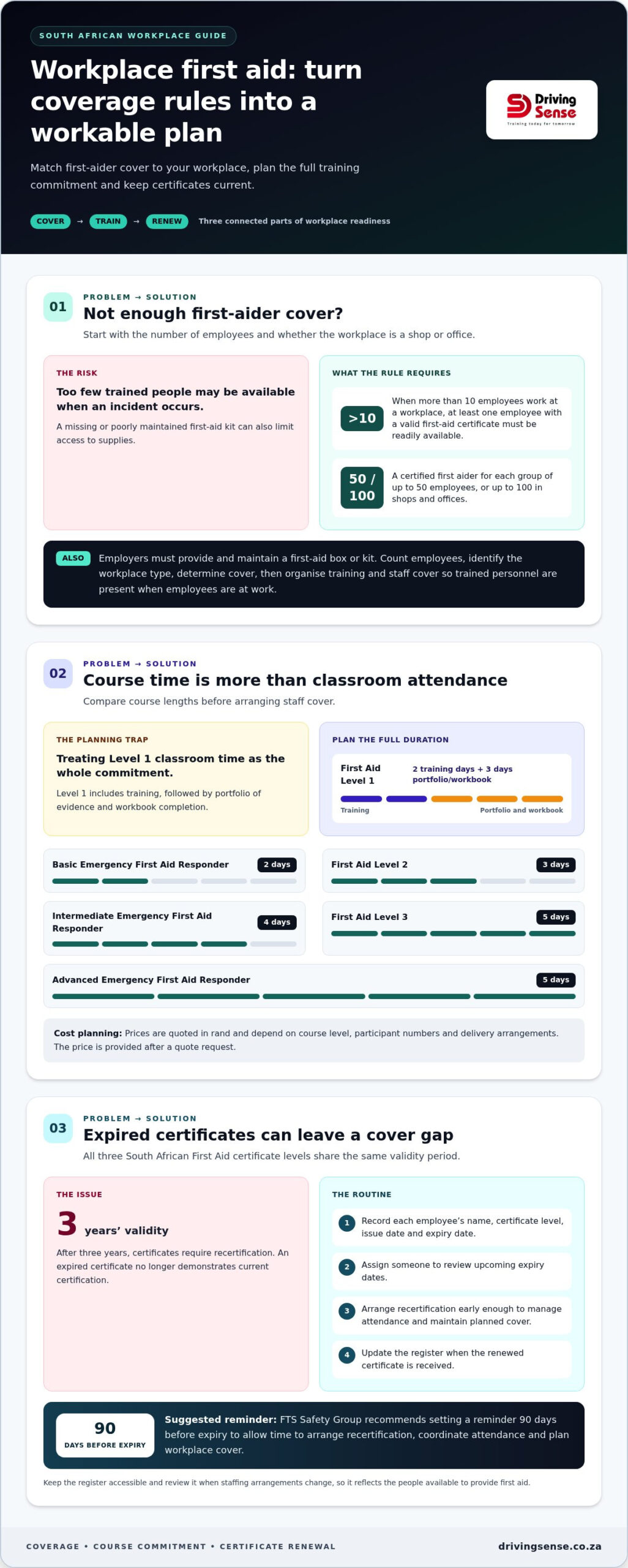
Course length affects staff scheduling, workplace cover and the time needed to complete assessments. In South Africa, the Level 1 course includes 2 days of training, followed by 3 days for portfolio of evidence and workbook completion. Plan for both parts, rather than treating classroom attendance as the full course commitment.
Other course durations depend on the level and course title. A Basic Emergency First Aid Responder course lasts 2 days, while the Intermediate Emergency First Aid Responder course lasts 4 days. The Advanced Emergency First Aid Responder course takes 5 days. Separately, First Aid Level 2 training takes 3 days, and Level 3 takes 5 days.
- Allow 2 training days plus 3 days for portfolio and workbook work for Level 1.
- Set aside 3 days for First Aid Level 2 training.
- Plan 5 days for First Aid Level 3 training or the Advanced Emergency First Aid Responder course.
Course prices in South Africa are quoted in rand and depend on the course level, participant numbers and delivery arrangements. The price is provided after a quote request. When comparing options, consider the full course commitment and how staff attendance will be managed, not just time spent in a classroom.
What does South African law require for workplace first aiders and first aid kits? General Safety Regulation 3 requires employers to ensure an adequate number of employees are trained to render first aid. When more than 10 employees work at a workplace, at least one employee with a valid first aid certificate must be readily available; workplaces need one certified first aider per group of up to 50 employees, or up to 100 in shops and offices. Employers must also provide and maintain a first aid box or kit.
What steps should employers take to comply? First, count employees and identify whether the workplace is a shop or office. Then determine the required first-aider coverage, arrange suitable training and organise staff cover so trained personnel are present whenever employees are at work. Keep the first-aid kit accessible and maintained.
What penalties or risks can employers face for non-compliance? The immediate operational risk is having too few trained first aiders available when an incident occurs. A missing or poorly maintained kit can also limit access to workplace first-aid supplies. Meeting coverage and equipment requirements provides a practical basis for reducing these gaps.
First aid certificate validity
South African First Aid Level 1, Level 2 and Level 3 certificates are valid for 3 years. After three years, first aid certificates require recertification. This applies across the three levels, so a workplace training record should show each certificate’s level and expiry date. A certificate’s issue date provides the starting point for calculating when renewal is due.
A common validity period makes expiry tracking an operational task, not an administrative detail to leave until a certificate lapses. If a designated first aider’s certificate has expired, it no longer demonstrates current certification. Keep the record accessible to the person responsible for training and workplace safety, so cover can be planned before renewal becomes urgent.
Set up a register for each trained employee. Record the certificate holder’s name, certificate level, issue date and expiry date. Add the employee’s role or work location if that helps managers identify who provides cover in each area. Keep the certificate with the record so its details can be checked against the original document.
- Enter each certificate’s level and expiry date in one central register.
- Assign responsibility for reviewing upcoming expiry dates.
- Arrange recertification early enough to manage staff availability and maintain planned cover.
- Update the register when a renewed certificate is received.
FTS Safety Group recommends setting a reminder 90 days before first aid certificates expire, allowing time to arrange recertification. Use that reminder to identify who needs renewal, coordinate attendance and plan workplace cover during training. If several certificates expire around the same time, a register helps organise the sequence rather than relying on memory or separate diary entries.
For example, if a Level 2 certificate was issued on 15 March, record its expiry three years later and schedule the reminder 90 days beforehand. Apply the same method to Level 1 and Level 3 certificates. The example illustrates how to manage dates; the certificate’s own issue and expiry details should guide the workplace record.
After recertification, replace outdated details with the new certificate information and retain a clear record of the update. This gives managers a current view of trained staff and helps them identify gaps caused by expiry, absence or role changes. A straightforward certificate renewal planning process can support consistent record keeping across the workplace.
Review the register when staffing arrangements change, such as when a trained employee moves to another work area or leaves the organisation. This keeps records focused on people available to provide first aid, rather than everyone who has completed a course. Renewal planning works best when certificate dates and staffing cover are managed together.
First aid training levels
South African workplace requirements determine the number of trained first aiders, while the appropriate course level depends on the role and workplace context. Compare coverage needs with the course duration and qualification employees will receive.
Workplace level requirements
General Safety Regulation 3 requires employers to ensure an adequate number of employees are trained to render first aid. When more than 10 employees work at a workplace, at least one employee with a valid certificate must be readily available. The required coverage is one certified first aider for each group of up to 50 employees, or up to 100 in shops and offices, during normal working hours.
These thresholds were substituted on 5 December 2025. Employers must also have trained first aid personnel present whenever employees are at work. The requirement concerns coverage, not simply how many staff members have attended a course at some point.
Start by counting employees and identifying whether the workplace is a shop or office. Then map trained staff to work areas and normal operating arrangements. For example, a roster should show who provides cover when a trained colleague is absent or assigned elsewhere.
Training level options
Course titles and durations help distinguish available training routes. South African First Aid Level 1 includes 2 days of training plus 3 days for portfolio of evidence and workbook completion. Level 2 training takes 3 days, while Level 3 takes 5 days. These durations help employers plan attendance, but the level should also suit each employee’s assigned first-aid role.
Basic, Intermediate and Advanced Emergency First Aid Responder courses take 2, 4 and 5 days respectively. Use the course’s stated qualification and learning outcomes to compare it with the workplace’s training needs. Avoid treating different course titles as interchangeable solely because their durations match.
Which providers are accredited by the Department of Employment and Labour or a relevant SETA? Choose a provider whose accreditation applies to the specific course and qualification being delivered. Review the course documentation for the accrediting or issuing body, qualification details and certificate awarded. Generic accreditation language alone does not show what a participant will receive.
Before enrolment, align three details: required workplace cover, the employee’s assigned responsibilities and the course qualification. Schedule training so staff can attend without leaving operational periods uncovered. A central training record should capture each employee’s level, course title and completion status, supporting workforce planning alongside certificate expiry tracking.
Protective measures when assisting an injured person
Before assisting an injured person at work, consider how to protect your hands from direct contact. MAKROSAFE advises wearing gloves, or covering your hands with a plastic bag if gloves are unavailable in an emergency. This gives a responder a clear first step before providing assistance.
Use the following sequence when an incident occurs:
- Identify whether gloves are available before touching the injured person.
- Put on gloves before assistance, where gloves are accessible.
- If gloves are unavailable in an emergency, cover your hands with a plastic bag.
- Proceed with assistance while keeping the protective covering in place.
The alternative matters because an emergency may happen before someone can retrieve supplies. For example, if a colleague is injured nearby and gloves aren’t immediately available, MAKROSAFE’s guidance supports covering your hands with a plastic bag. The bag is an emergency alternative, not a reason to delay getting gloves when they are accessible.
Workplace preparation can make this step easier. Make gloves accessible to people assigned first-aid responsibilities, and ensure staff know the plastic-bag alternative for an emergency. A short briefing can clarify where gloves are kept and what to do if they cannot be reached promptly. Keep the instruction simple so responders can recall it under pressure.
Protective measures are only one part of assisting someone. Responders should stay within their training and the support available at the workplace. For example, a person who has completed first-aid training can take this protective step before assisting, then use the skills covered by that training. Gloves or a plastic bag protect the hands; they don’t replace first-aid knowledge.
After an incident, include used protective equipment in the workplace’s normal restocking process. If gloves were used or the emergency alternative was needed, note whether supplies need attention before another incident. This follow-up connects the response procedure to workplace readiness without assuming the same equipment will remain available after use.
Employers can incorporate this guidance into workplace instructions for first aiders and staff. A useful briefing identifies where gloves are kept, explains the plastic-bag alternative and reminds responders to cover their hands before assisting. An example, such as an incident away from the usual supply point, can help employees understand when the emergency alternative applies.
For employees, the key action is clear: use gloves where available; if they aren’t available in an emergency, cover your hands with a plastic bag. MAKROSAFE’s recommendation gives workplaces a straightforward protective measure to include in first-aid preparation and response training.
Which first aid level is required for workplace compliance in South Africa?
South African General Safety Regulation 3 sets workplace first-aider coverage requirements, but the stated requirement focuses on valid certification and availability. It does not identify Level 1, Level 2 or Level 3 as the single mandatory course for every workplace. Employers need to assess their employee numbers, workplace category and operating arrangements when planning coverage.
When more than 10 employees work at a workplace, at least one employee with a valid first aid certificate must be readily available. The required coverage is one certified first aider for each group of up to 50 employees. Shops and offices instead require one for each group of up to 100 employees. These figures were substituted on 5 December 2025.
General Safety Regulation 3 also requires employers to ensure an adequate number of employees are trained to render first aid. Trained personnel must be present whenever employees are at work. Apply the relevant threshold to the workplace, then consider who is available during normal working hours and across work areas.
- For a workplace with more than 10 employees, ensure at least one employee with a valid certificate is readily available.
- For other workplaces, plan one certified first aider per group of up to 50 employees.
- For shops and offices, plan one certified first aider per group of up to 100 employees.
For example, a workplace with 51 employees falls into two coverage groups under the up-to-50 threshold. A shop or office with 101 employees falls into two groups under the up-to-100 threshold. These examples illustrate how the group limits apply; they do not replace the separate requirement for a readily available first aider when more than 10 employees work at a workplace.
Coverage planning should account for actual availability, not just the number of certificates held. A roster can show which trained employees are present during normal working hours, while work-area assignments help managers identify gaps. If trained staff work different shifts or locations, the schedule should make clear who is available whenever employees are at work.
Employers must also make a first-aid box or kit available and keep it maintained. Include this equipment requirement alongside staff coverage when reviewing workplace arrangements. A practical review can record employee numbers, whether the workplace is a shop or office, trained staff availability and the condition of the kit. This connects the applicable threshold to day-to-day readiness.
To apply first aid level 1, 2 and 3 for workplace compliance, first establish the required coverage, then select training appropriate to staff responsibilities and workplace needs. The key compliance test is valid certification and ready availability, supported by an adequate number of trained employees and a maintained first aid kit.
Driving Sense: Emergency Safety Training
Driving Sense provides Emergency Safety Training for organisations planning workplace response and staff preparedness. After identifying the required first-aider coverage, consider how emergency training fits your wider workplace safety arrangements. This is particularly relevant when reviewing staff responsibilities, response procedures and the training needs associated with workplace risks. Driving Sense also offers Compliance Training, which can support organisations addressing broader compliance requirements alongside their safety planning. The appropriate next step is to outline your workplace’s training priorities and discuss how the available training can support them. Contact Driving Sense to discuss your organisation’s requirements, or visit drivingsense.co.za.
Make first-aid readiness part of operational planning
Choosing between first aid levels 1, 2 and 3 for workplace compliance is one part of a wider readiness plan. The next step is to connect staff training with responsibility allocation, induction procedures and routine safety reviews, so first aid arrangements remain part of everyday operations rather than a standalone record. Assign ownership for training records and renewal planning, then incorporate those responsibilities into established workplace processes.
Driving Sense provides Emergency Safety Training, Driver Training and Compliance Training for organisations addressing safety and compliance needs. Consider how these services fit your workplace priorities, particularly when planning staff development alongside first-aid preparedness. A structured discussion can help identify the relevant training focus for your organisation without treating every workplace as having identical requirements.
Contact Driving Sense about workplace first aid and take the next step towards a considered training plan for your workplace.
Frequently Asked Questions
What are First Aid Level 1, Level 2 and Level 3 qualifications in South Africa?
These are three levels of first-aid training, with the appropriate choice depending on the employee’s workplace role and training needs. The level names alone don’t determine which course suits an organisation. For example, an employer assigning a staff member first-aid responsibilities should compare the course qualification with those duties and the workplace’s response arrangements, rather than selecting a level solely because it is the highest.
What are the differences in course content and duration for First Aid Levels 1, 2 and 3?
The levels differ in course duration, while the course documentation describes the learning outcomes and assessment requirements. Level 1 includes 2 days of training, followed by 3 days for portfolio and workbook completion; Level 2 takes 3 days, and Level 3 takes 5 days. Before scheduling attendance, compare the course’s stated outcomes with the responsibilities assigned to the employee, and allow time for any required completion work.
How long are South African first aid certificates valid, and how are they renewed?
South African First Aid Level 1, Level 2 and Level 3 certificates are valid for 3 years, after which recertification is required. A practical renewal process links each employee’s certificate to their workplace role, so managers can identify whose credential needs updating. Keep renewed documents with the training record, and update the employee’s status when recertification is completed. This makes it easier to distinguish current certificates from outdated records during routine reviews.
How much do First Aid Level 1, 2 and 3 courses cost in South Africa?
Course prices depend on the course selected and its delivery requirements; the price is provided after a quote request. For budgeting, first decide which level matches the employee’s responsibilities, then establish how training will be arranged and who needs to attend. This defines the training requirement before requesting a quote. Avoid comparing amounts without checking that course levels and delivery arrangements are comparable.
Which South African first aid training providers are accredited by the Department of Employment and Labour or relevant SETA?
Choose a provider whose accreditation applies to the specific course and qualification. Check the course documentation for the accrediting or issuing body, qualification details and certificate awarded.
