

A screening result is useful only when it can be interpreted and handled consistently. A pre-hire driver background check service in South Africa should help employers screen candidates, receive results and file them in recruitment records. A failed criminal background check may indicate an open case awaiting trial or a criminal conviction, so understand the finding before using it to inform a hiring decision.
For organisations recruiting drivers, screening is one part of a broader process that must fit the role, recruitment workflow and record-keeping practices. When choosing a provider, understand what the screening covers and how results are delivered, so your team can handle the information clearly and consistently.
This article explains how to assess a South African provider, prepare for screening, receive and file results, and interpret a failed check. It also explains how driver screening fits alongside practical training and workplace compliance.
Key Takeaways
- Assess whether a South African screening provider’s process and result format fit your recruitment workflow and record-keeping needs.
- Plan how screening results will be received, reviewed and uploaded so that each decision is supported by an organised record.
- Interpret a failed criminal background check carefully: it may indicate an open case awaiting trial or a criminal conviction.
- Consider the checks included and the work involved when assessing costs and turnaround times, rather than relying on a single headline figure.
- Use driver and emergency safety training to complement screening when your organisation is building a broader approach to workplace and road risk.
Receiving and uploading screening results
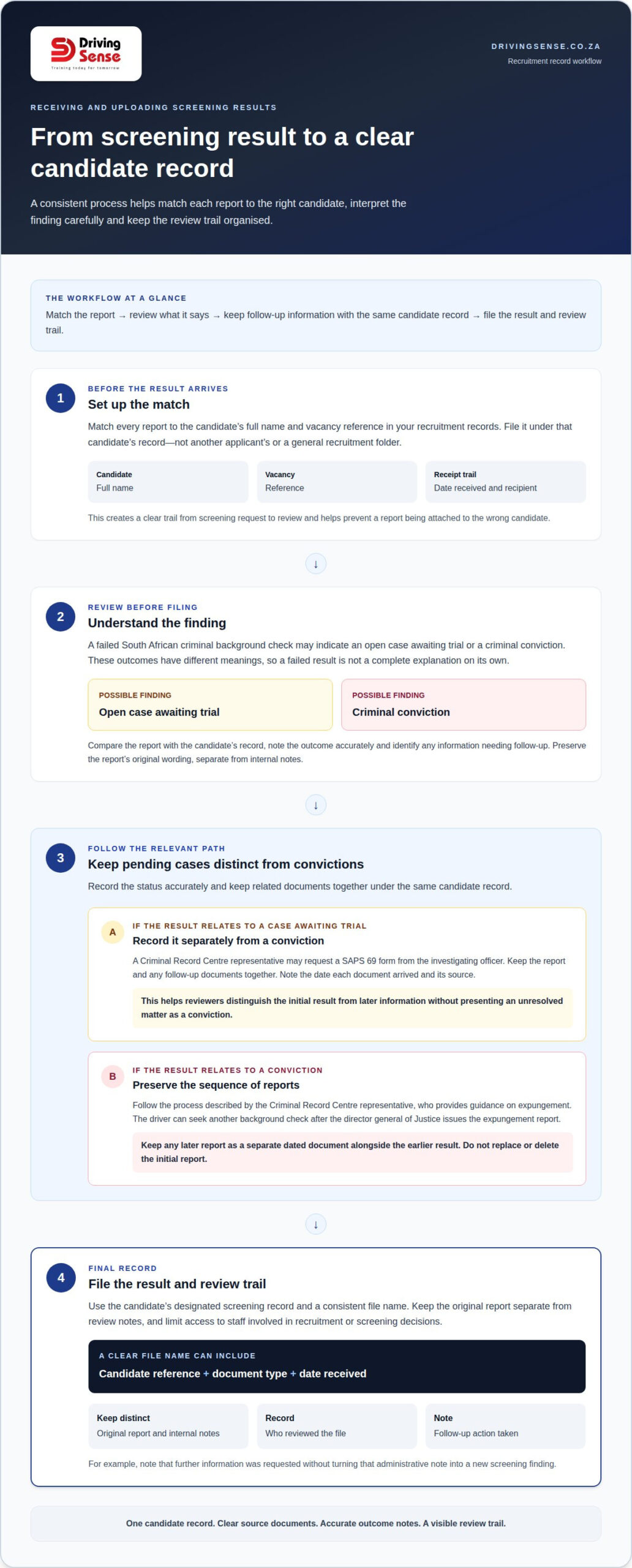
- Set up a consistent process for receiving and matching results before they arrive. Match each report to the candidate’s full name and the vacancy reference in your recruitment records. For example, file a report for a driver applying for a delivery role under that candidate’s record, not another applicant’s or a general recruitment folder. Record when the result arrived and who received it. This creates a clear trail from screening request to review and helps prevent reports being attached to the wrong candidate.
- Review the outcome and supporting details before filing the report. A failed South African criminal background check may indicate an open case awaiting trial or a criminal conviction. These outcomes have different meanings, so don’t treat a failed result as a complete explanation on its own. Compare the report with the candidate’s record, note the outcome accurately and identify any information that needs follow-up. Preserve the report’s original wording, keeping it distinct from internal notes.
- If the result relates to a case awaiting trial, record that status separately from a conviction. A Criminal Record Centre representative may request a SAPS 69 form from the investigating officer. Keep the report and any follow-up documents together under the same candidate record, so reviewers can see which information relates to the pending case. Note the date of each received document and its source. This helps the recruitment team distinguish the initial screening result from later information without presenting an unresolved matter as a conviction.
- For a conviction, follow the process described by the Criminal Record Centre representative. The representative provides guidance on expungement, and the driver can seek another background check after the director general of Justice issues the expungement report. Keep any later report as a separate dated document alongside the earlier result. This preserves the record sequence and helps authorised reviewers understand what changed. Do not replace or delete the initial report when adding a later result.
- File the result in the candidate’s designated screening record, using a consistent file name. Include a clear identifier, such as the candidate reference, document type and date received. Store the original report separately from review notes, and limit access to staff involved in recruitment or screening decisions. Record who reviewed the file and what follow-up action they took. For example, note that further information was requested without turning that administrative note into a new screening finding.
South African background check providers
Match the provider’s screening scope to the driving role. Before submitting a request, document the applicant information, consent process, checks requested and result format.
-
Confirm applicant documents and consent
Collect the applicant’s identifying details and the documents the provider requires. Carefully match names and identifying information so the result can be linked to the correct candidate. Obtain and record the applicant’s consent before requesting screening. Explain which checks you intend to request and how they relate to the role. Keep the consent record with the recruitment file, and avoid requesting checks unrelated to the work.
For example, a role involving regular driving may call for checks relevant to identity, criminal history and driving credentials. Confirm document requirements before submission, then record which items you received. If a document is unclear or details differ between records, resolve the discrepancy before treating the result as belonging to that applicant.
-
Apply POPIA rules to screening
Apply POPIA by limiting applicant information to the screening purpose, controlling access and storing records securely. Tell applicants what information you intend to process and how the result will inform recruitment. Limit access to staff who need the information for their work, and avoid circulating reports through broad email groups or shared folders.
Keep the result separate from general recruitment correspondence, with a clear record of who accessed it and why. Set a consistent retention and deletion process for screening records in line with your organisation’s information-handling procedures. These steps support accountability without exposing sensitive details to staff who have no role in the decision.
-
Compare provider costs and check times
Compare written service descriptions, not just headline prices. Check which screening components are included, whether each is charged separately and what information the provider needs to begin. The scope of the request and how each check is handled shape the process. Don’t assume a criminal record check also covers licence status, traffic fines or accident records.
Ask for the sequence of steps and identify any stages that depend on applicant documents or external records. A missing document, identity discrepancy or result requiring clarification can change the workflow. Plan recruitment around those dependencies, and record the provider’s stated delivery expectations for the specific screening package.
-
Verify the driving licence and PrDP
Compare the applicant’s licence and PrDP details with the role’s driving requirements. Confirm that names, identifying details and document information match, and record any discrepancy for resolution. Treat licence and PrDP checks as distinct from criminal screening. A criminal result alone does not establish whether the applicant holds the driving credentials required for the position.
For driving history, traffic fines and accident records, ask the provider which categories its screening covers and how each result is presented. Review each category separately, rather than treating an absent record as confirmation of a clear history. Keep relevant results with the candidate file and note how they informed the role-specific review.
How do employers verify a South African driver’s licence and professional driving permit (PrDP)?
- Start by defining the driving tasks attached to the vacancy. A courier, passenger transport driver and heavy-vehicle operator may need different credentials. Record the vehicle type, journeys and responsibilities in the role profile, then compare the applicant’s licence and PrDP information with those requirements. This gives reviewers a consistent basis for assessing whether the documents are relevant to the position, rather than relying on a general statement that the applicant can drive.
- Request clear copies of the applicant’s driving credentials and match the details to their identity documents. Compare names and other identifying information across the records, then note any differences for resolution. For example, a change in surname may explain a mismatch, but the recruitment file should record how it was clarified. Don’t assume a document belongs to the applicant simply because it came with their application.
- Review the licence and PrDP as separate credentials. Record the information shown on each document, including validity details and the driving category or role it appears to cover. Compare those details with the actual job duties. For example, when considering an applicant for a passenger-driving role, assess the relevant permit information separately from the general driving licence. Don’t treat one document as proof of the other.
- Use a documented verification process to establish whether credential details correspond with the issuing record. A provider may include licence or permit validation in its screening scope, but identify exactly which credentials and details the result covers. Keep the verification outcome, date received and supporting documents together in the candidate record. If the result identifies a mismatch, pause that part of the assessment and document what information is needed to resolve it.
- Record the decision against the role criteria, not assumptions about the applicant. Separate verified credential details from interview notes and other screening findings. For instance, if the licence details match but the PrDP information needs clarification, record these as distinct outcomes. This helps the recruitment team explain which driving requirement remains unresolved and prevents a partial check from being treated as complete evidence of suitability.
Cost of driver background check services in South Africa
- Request a written breakdown for the exact screening package your recruitment process needs. The price depends on the case and is provided after a quote request; factors include the checks requested, candidate volumes, document handling and reporting requirements. A package covering criminal screening alone is not directly comparable to one that also includes licence or permit verification. Compare matching scopes first, then assess the quoted totals in South African Rand.
- List each check separately before comparing provider quotes. For a driver vacancy, that may include criminal screening, identity checks, licence validation and PrDP verification. Ask which items are included in the proposed service and which are optional. This avoids treating a basic criminal check as equivalent to a broader driver-screening package. Use the same checklist for each quote so the recruitment team can see differences in scope.
- Check how candidate numbers affect the quote. An organisation recruiting one driver for a specific route may need a different workflow from a business screening several applicants for multiple vacancies. Give the provider the expected recruitment volume and explain whether requests will arrive together or separately. Then compare the stated charges and any setup or administration components. This makes each quote easier to assess against your hiring plan.
- Review what the quoted service includes once a result is returned. For example, confirm whether the package provides only a report or also identifies the checks completed and delivers results in a usable format. Consider whether your team needs separate results for a licence and PrDP. A quote that clearly sets out its deliverables helps you assess operational value rather than choosing an option solely because its initial amount appears lower.
- Record the quote assumptions before approving screening expenditure. Note the checks requested, applicant information required, expected delivery process and any stated conditions. If the role changes from light delivery work to passenger transport, revisit the scope because the screening needs may differ. Keep the approved quote with the recruitment plan, then compare the final invoice with the agreed services. This creates a clear record for budget reviews and future recruitment planning.
How long do pre-hire driver checks take in South Africa?
- Start screening as soon as the applicant reaches that stage of recruitment. The overall timeline depends on the checks required for the role, whether documents are complete and how quickly each result becomes available. A criminal check alone follows a different sequence from a request that also includes licence and PrDP verification. Map each check against the recruitment timetable, then identify which results need review before a final decision.
- Prepare the applicant’s information before submitting a screening request. Compare names and identifying details across the application and supporting documents, then resolve inconsistencies through your recruitment process. For example, a spelling difference between an application and an identity document may need clarification before the provider can proceed. Complete submissions reduce avoidable pauses caused by missing or conflicting details. Record when the request was submitted and which documents accompanied it.
- Ask the provider to explain its process and what can affect each stage. Identify when a request is considered complete, how results will be delivered and whether a discrepancy leads to further review. A licence check and a criminal check may rely on different information and follow separate workflows. Record the provider’s stated timing for each component rather than treating a multi-part screening package as one uniform task.
- Build time to review results into the recruitment schedule. Receiving a report does not complete the employer’s work: the team still needs to match it to the applicant, understand the findings and record any follow-up. If a result identifies an open case awaiting trial or a conviction, clarification may require further steps. Assign a reviewer to each candidate file so screening results do not go unnoticed in an inbox.
- Track progress against clear recruitment milestones. Record the request date, when each result arrives, outstanding documents and the reviewer’s next action. For example, if criminal screening is complete but a credential check is outstanding, track those statuses separately. This shows which part of the process is holding up a decision and helps managers plan interviews or start dates responsibly. Update the candidate record whenever a new result or clarification arrives.
- Use a consistent process across vacancies, while tailoring the checks to each driving role. A passenger transport position and a delivery role may require different credential checks, affecting the sequence of work. Compare actual elapsed time across completed requests to identify recurring delays, such as late applicant documents or internal review queues. Use those records to improve recruitment planning, not to assume every future request will follow the same timetable.
Driving Sense: Emergency Safety Training
Driving Sense supports organisations that want to complement driver screening with practical workplace preparation. Its Emergency Safety Training can support emergency-response readiness, while Driver Training can help employees whose roles involve driving. These programmes serve a different purpose from background checks: screening informs recruitment decisions, while training develops capability and preparedness after hiring.
Once your recruitment process is established, consider how to support drivers in their operational roles. Compliance training and specialised freight handling instruction may also be relevant where employees’ responsibilities require that preparation. The appropriate training depends on the work they perform and the risks your organisation manages.
Contact Driving Sense to discuss training for your organisation.
Turn screening into a stronger driver onboarding process
A well-designed recruitment process should lead to a clear plan for supporting drivers after they join your organisation. Treat the transition from selection to onboarding as an opportunity to align role expectations, workplace procedures and practical preparation, so employees understand how their responsibilities contribute to safe operations.
A pre-hire driver background check service in South Africa can form part of a wider approach that includes consistent onboarding and role-relevant development. Driving Sense offers Emergency Safety Training, Driver Training and Compliance Training to support organisations in these areas. Consider which capabilities your team needs to strengthen, based on its work and operational priorities.
Discuss how these priorities connect with your organisation’s driver and safety requirements. Contact Driving Sense for help planning a practical next step, and continue building a workforce equipped to contribute responsibly.
Frequently Asked Questions
Which South African providers offer pre-employment driver background checks?
Driving Sense provides pre-employment screening for organisations in South Africa. If you need a pre-hire driver background check service in South Africa, consider whether your recruitment programme also requires a wider driver assessment. Screening and evaluating practical driving competence address different questions. Keep their purposes distinct during selection so a background report is not mistaken for evidence of driving ability.
What checks are included in a South African driver background check service?
The checks included depend on the screening arrangement selected. Driving Sense provides pre-employment screening, and its business information also describes professional driver evaluations. These are not interchangeable: a screening report provides information for recruitment, while an evaluation concerns the driver’s professional capability. Define the outcome you need for a vacancy and ensure the resulting records are assessed for that purpose.
How can employers check a driver’s criminal record in South Africa?
Employers can arrange a criminal-record check through a screening provider as part of recruitment. Use the result as one input to a documented, role-related decision, rather than treating it as a complete assessment of the applicant. For example, record who reviewed the finding, how it relates to the position’s responsibilities and what decision followed. This creates a clear rationale for the recruitment outcome without confusing screening information with driving competence.
How do South African driver screening providers compare on price, turnaround, and coverage?
Compare providers using a procurement record that captures the quoted amount, expected delivery, service scope and stated assumptions. For a pre-hire driver background check service in South Africa, keep the decision rationale alongside the selected quote so future recruitment teams can assess whether the arrangement still suits their needs. Review actual delivery against expectations after each hiring exercise, and use those records to improve planning without assuming every request will follow the same timeline.
What are the risks of hiring a driver without verifying credentials and driving history?
Skipping verification can leave an organisation unable to show how it assessed a candidate’s readiness for a driving role. That gap may complicate internal reviews after an incident or operational concern, because the recruitment record provides little evidence of the decision process. A documented assessment helps managers explain how they considered role requirements and available information. It also supports consistent hiring practices across teams and vacancies.
