

Safety training is easier to support when its value is expressed in operational terms. The case for how to present safety training benefits to management is to connect relevant training with the risks employees face, the costs incidents can create, compliance responsibilities and the continuity of business operations. Set clear objectives and explain how outcomes will be assessed, rather than relying on broad assurances.
Management needs to weigh training against competing priorities, so a practical, evidence-led business case matters. This article explains how safety training can help protect employees, reduce accident-related costs, support compliance and strengthen productivity, while showing how to frame those benefits in terms leaders can evaluate. It also considers how relevant training and follow-up assessment can make the investment more closely aligned with workplace risks and business needs.
Key Takeaways
- Frame safety training as a practical investment in employee wellbeing, retention and organisational reputation.
- Show how relevant training helps employees recognise hazards, respond to risks and work more safely.
- Include the wider costs of incidents, such as disruption, equipment repairs and the time needed to replace or train staff.
- Connect safer work practices with operational continuity, employee contribution and productivity.
- Present training as part of an ongoing approach to understanding workplace responsibilities and supporting compliance.
Employee satisfaction, retention, and company reputation
Safety training shapes how employees experience the workplace as well as how they complete tasks. A warehouse employee who can identify an unstable load, for example, has a clearer basis for working safely and raising concerns. Relevant instruction also shows that management takes workplace health and safety seriously. This can support morale and trust, although training alone cannot determine whether an employee stays.
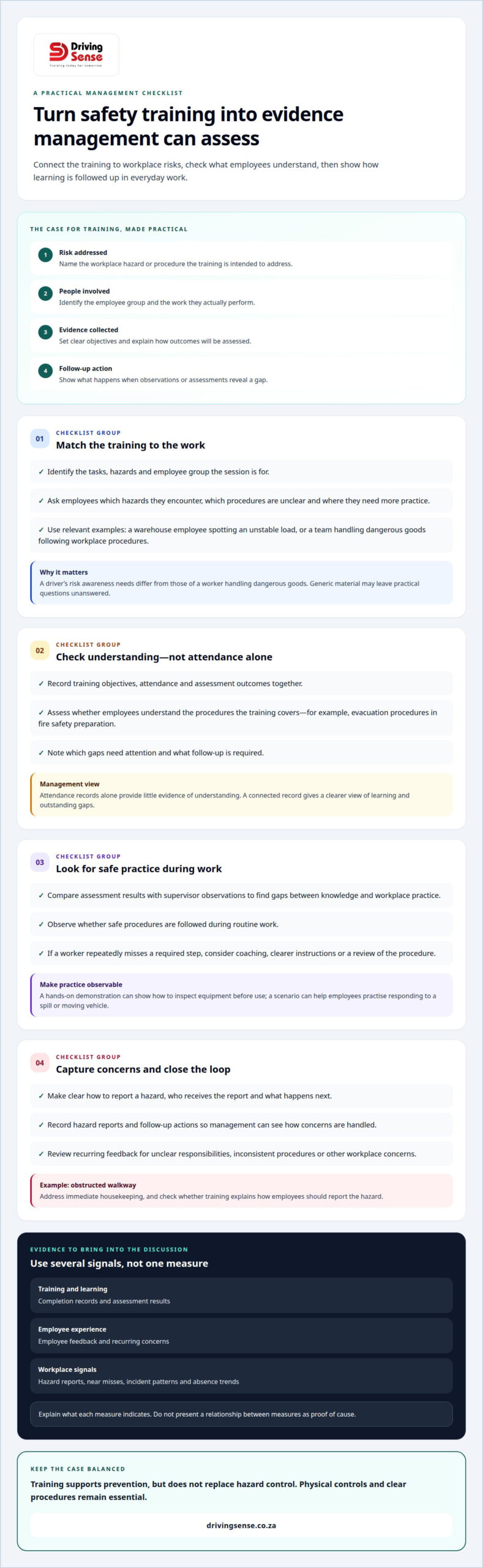
Which safety training measures should you present to management? Show completion and assessment results alongside employee feedback, hazard reports, near misses, incident patterns and absence trends. To discuss retention and reputation, include relevant staff feedback and recurring concerns. Explain what each measure indicates without presenting correlation as proof of cause.
Effective safety training reflects the work employees actually perform. A driver’s risk awareness needs differ from those of a worker handling dangerous goods, so generic material may leave practical questions unanswered. Ask employees to identify hazards they encounter, unclear procedures and tasks where they need more practice. Their input helps tailor training to working conditions and encourages active participation.
Employee involvement can continue after a session. Supervisors can observe whether safe procedures are followed during routine work and note where further coaching would help. If employees repeatedly report an obstructed walkway, for example, management can consider both immediate housekeeping and whether training explains how to report hazards. This turns feedback into a defined action rather than a discussion without follow-through.
Employer safety obligations and potential liability belong in the case for management, but attendance records alone provide little evidence of understanding. A stronger record connects training objectives, attendance, assessment outcomes and follow-up actions. For example, a manager reviewing fire safety preparation can see who attended, whether employees understood evacuation procedures and which gaps need attention. This supports oversight without treating training as a substitute for hazard control.
Well-being also depends on whether employees can raise concerns and be heard. A practical session can explain how to report a hazard, who receives the report and what happens next. When employees understand these steps, they have a clearer way to help maintain safety and health. Managers can review recurring feedback for issues that affect confidence, such as unclear responsibilities or inconsistent procedures.
- Use employee feedback to identify training needs that attendance figures cannot reveal.
- Compare assessment results with supervisor observations to find gaps between knowledge and workplace practice.
- Record hazard reports and follow-up actions so management can see how concerns are handled.
- Connect training objectives with staff wellbeing, retention and the organisation’s reputation for responsible work.
A clear case for how to present safety training benefits to management links measures to decisions leaders can make. Explain the risk addressed, the employee group involved and the follow-up action required. This gives management a more useful view of training’s contribution to employee confidence, workplace culture and organisational accountability.
Preventing workplace injuries, illnesses and deaths
Safety training helps employees recognise workplace hazards, follow controls and respond appropriately when conditions change. It can help reduce injuries and lost workdays by supporting early risk recognition and safer work procedures, but it works alongside hazard control, not in place of it.
Managing hazards through training
Training helps employees identify, report and manage hazards in their actual work. A hazard recognised before a task begins can be addressed before it causes harm. For example, a team handling dangerous goods needs to understand relevant workplace procedures, equipment risks and reporting routes, rather than relying on general safety reminders.
A focused training programme can use routine and non-routine tasks to make hazards easier to recognise. Employees might identify an obstructed walkway during a workplace exercise, then practise reporting it through the correct process. Managers can use these observations to identify recurring risks and address them at source. Training supports prevention, while physical controls and clear procedures remain essential.
Preventing accidents and injuries
Preventing accidents through training means building the knowledge and practical skills employees need to work safely. Employees who recognise changing conditions can pause, follow procedures and alert a supervisor before an unsafe situation escalates. A hands-on demonstration can show how to inspect equipment before use, while a scenario can help workers respond to a spill or moving vehicle.
Effective safety training engages employees with realistic examples instead of simply presenting instructions. Supervisors can reinforce learning by observing work and giving timely feedback. If a worker repeatedly misses a required step, the response might include coaching, clearer instructions or a review of the procedure. This connects training with daily behaviour and helps address accident risks associated with routine tasks.
Reducing illnesses, deaths and lost workdays
Preventing occupational illness and fatal incidents means helping employees recognise exposure risks and follow protective procedures. Harmful conditions may develop gradually or become urgent when controls fail. For example, training can explain how to identify a hazardous substance, follow handling instructions and report a leak promptly, helping reduce the chance of unsafe exposure.
When an injury or illness keeps an employee away from work, the absence can affect team capacity and continuity. Training that clarifies safe methods, warning signs and escalation routes can help address risks before harm occurs. It can also help employees respond appropriately when an incident develops, limiting further exposure or injury. Managers should review incident and near-miss patterns to target relevant follow-up.
To present the prevention case, connect each training topic to a specific workplace hazard, the behaviour employees need to demonstrate and the follow-up measure. For emergency scenarios, emergency safety training can help employees practise appropriate responses.
Reducing accidents, operating costs, and insurance premiums
Training has a financial case when management can see how incidents create direct and indirect costs. Present training expenditure alongside the costs it is intended to help control, such as equipment damage, claims administration and disrupted work.
Training costs and potential savings
Training costs include the resources used to develop employees’ safety skills, including time away from normal duties. A useful comparison considers both the training activity and the workplace losses it may help prevent.
For example, a warehouse may train workers to use equipment safely and follow inspection procedures. Management can assess the programme’s scope, the employees involved and the risks addressed, then compare those factors with relevant incident records and equipment repair needs. This provides a reasoned basis for assessing value without presenting projected savings as guaranteed.
Include indirect effects in the comparison. After an accident, a supervisor may spend time reporting the incident, arranging cover and restoring normal operations. These demands can affect several teams, even when the initial event appears limited. A clear business case identifies these cost categories and explains how relevant training addresses the associated risks.
Workers’ compensation premiums and other costs
Workers’ compensation premiums are one potential business cost affected by workplace safety performance. OSHA’s recommended practices state that safety and health programmes can reduce business costs, including workers’ compensation premiums. For South African management, present this as a potential cost consideration, not a promised premium reduction.
Claims can also involve medical care, legal services, incident administration and reporting. For example, a formal investigation after an injury may draw managers and employees away from planned work. Training that strengthens hazard recognition and safe procedures can support prevention, while incident and claims records help management understand where financial exposure arises.
Separate documented costs from potential benefits in your presentation. Show actual claims and related expenses where available, then explain which training objectives address the contributing risks. This distinction makes the case more credible than assigning savings to training without evidence. Course attendance does not automatically reduce premiums or change other insurance terms.
Downtime and operating costs
Downtime is work interrupted by an incident, investigation, equipment damage or staff absence. Reducing it matters because delays can affect output, schedules and the availability of trained workers for other tasks.
Consider a production area where damaged equipment must be isolated after an incident. The cost is not limited to repairs: staff may wait, supervisors may reorganise duties and replacement workers may need instruction. Training focused on safe equipment use and incident response can help employees follow procedures that reduce avoidable disruption.
Management can assess this operational impact by linking incident records with stoppages, repair needs, replacement staffing and administrative time. Compare patterns before and after relevant training, while noting changes in equipment, staffing or workload that might also affect results. This gives management a more disciplined view of whether training supports cost control.
A concise proposal distinguishes recorded expenditure from expected operational benefits. Set out the risk, the training response and the business measures management can review, such as incidents, repair needs, claims administration and work interruptions. This makes the financial rationale clear without overstating what training alone can achieve.
Increasing productivity and improving business operations
Safe work practices can support reliable output when employees understand how to complete tasks safely. OSHA’s recommended practices state that safety and health programmes can increase productivity and enhance business operations.
Productivity and work-related absences
Productivity and work-related absences are connected because an absent employee can leave tasks uncovered or shift work to others. If a trained machine operator is away, for example, a supervisor may need to adjust the shift plan or assign another qualified worker.
Relevant training helps employees understand safe procedures and recognise when a task should pause for advice. This can support workforce stability by helping prevent incidents that interrupt work. Management can consider absence patterns alongside staffing changes, task delays and training records, rather than treating any one measure as proof of cause.
Start a practical review with one work area. Compare planned tasks with completed work, then note whether safety-related interruptions, unclear procedures or staff absences affected delivery. This helps leaders identify where additional instruction or clearer work practices could support continuity.
Productivity, quality and reputation
Productivity, quality and reputation are linked when safe work practices help employees perform tasks consistently. For example, a team following a clear equipment-handling procedure may avoid unsafe shortcuts and preventable damage to materials.
Training should address decisions employees make during real work, such as how to respond when equipment behaves unexpectedly. Supervisors can observe whether employees follow the intended procedure, record recurring errors and provide focused guidance. These steps help management consider safety alongside rework, missed specifications and customer concerns.
Reliable processes can also support an organisation’s reputation. If a delivery is delayed because a task has to be repeated, customers may feel the operational impact. Present safety training as part of maintaining consistent practices, not as a guarantee of flawless output. Review quality issues alongside safety observations to identify shared process gaps.
Productivity and morale
Productivity and morale can reinforce one another when employees have the skills and confidence to work safely. For instance, a new employee who receives task-specific guidance may feel better prepared to ask questions before using unfamiliar equipment.
Managers can support a positive working environment by making time for instruction, inviting questions and recognising safe practices. These actions show employees that maintaining safety is part of the job, not an obstacle to performance. They may also support an organisation’s ability to retain experienced workers, especially when procedures are applied consistently across teams.
To assess this connection, combine employee feedback with supervisor observations and operational measures, such as task completion, errors and handover quality. If a team reports confusion about a procedure, it may need clearer instruction before management expects faster output. This makes productivity planning more realistic and helps leaders address the cause instead of putting pressure on employees.
Frame the case around a defined operational outcome, such as fewer interruptions during shift handovers or more consistent completion of a particular task. Explain how relevant training supports that outcome and which workplace measures management can review over time.
Legal responsibilities and safety training compliance
In South Africa, a compliance case should connect workplace safety requirements with the tasks employees perform. Safety training helps explain relevant procedures, responsibilities and reporting channels.
Improving legal and regulatory compliance
Safety training supports compliance by helping employees understand requirements and workplace procedures relevant to their duties. This matters because unclear instruction can leave staff unsure how to perform a task safely or report a concern.
For example, an organisation can identify a task involving hazardous materials, set learning objectives for safe handling and explain its reporting process. It can retain training materials, attendance records and assessment results alongside relevant workplace procedures. These records help management understand what instruction took place and where further support may be needed.
Training is one part of an effective compliance system, not proof by itself that every obligation has been met. Management should connect instruction with risk controls, current procedures and follow-up actions. If a process changes, employees need guidance on the revised steps before applying them at work.
Safety compliance and workforce awareness
Workforce awareness means employees can recognise the safety procedures relevant to their roles and understand how to act on them. A written policy cannot guide a worker who does not know when it applies.
A practical session can use a familiar workplace example, such as a blocked emergency exit or damaged equipment. Employees can discuss the immediate response, identify the person or channel for reporting and explain which work should pause. This active approach connects responsibilities with everyday decisions.
Managers can assess awareness through questions, brief assessments and supervisor observations. If employees give inconsistent answers about a procedure, the gap can guide refresher instruction or clearer communication. Recording findings helps the organisation target training instead of repeating material without assessing its relevance.
Compliance with safety regulations
Compliance with safety regulations involves aligning workplace practices with applicable requirements and ensuring employees understand the procedures relevant to their duties. It matters because training can help translate formal expectations into actions employees can apply during routine and non-routine work.
For instance, a supervisor can explain a task-specific procedure before an employee starts unfamiliar work, then observe whether the steps are followed. If workplace conditions or processes change, the training programme should address the updated hazards and instructions. Management can review these changes against internal procedures and document follow-up.
A useful compliance review brings together risk assessments, procedures, training records and observed practice. If a document describes a control that employees do not follow, the organisation has an issue to address. Training may help, but the review should also consider whether the procedure is clear and the control is workable.
For support aligning employee instruction with workplace compliance needs, explore compliance training.
Driving Sense
Driving Sense helps organisations connect safety training with workplace risks, employee responsibilities and operational priorities. Its tailored training supports management’s case by linking course objectives to specific hazards, the skills employees need and how learning will be assessed. This gives leaders a clearer basis for considering training as part of risk management, rather than as a standalone activity.
Depending on workplace needs, relevant options include Emergency Safety Training, Driver Training, Compliance Training and Dangerous Goods training. These courses address distinct operational risks, from emergency response to safe handling responsibilities. Consider them when preparing a training proposal or aligning instruction with identified employee needs.
Contact Driving Sense to discuss your organisation’s safety training requirements.
Make the next safety decision measurable
Turn the management discussion into a decision with clear ownership. Identify who will coordinate training, which employee groups it covers and how progress will be reviewed. This gives leaders a practical framework for aligning safety priorities with operational planning and keeping responsibility visible after approval.
The best way to explain safety training benefits to management is through a focused proposal tied to workplace needs and meaningful measures. Driving Sense offers Emergency Safety Training, Driver Training and Compliance Training to support organisations developing relevant employee training plans. The appropriate focus depends on the risks and responsibilities the organisation needs to address.
For assistance shaping a training approach around your organisation’s requirements, contact Driving Sense about safety training. A considered next step can help your organisation move from discussion to a more structured approach to workplace safety.
Frequently Asked Questions
Why Should Organizations Invest in Training?
Organisations should invest in training because it builds the task-specific capability employees need to work safely and consistently. It also gives leaders a structured way to address operational risks before they disrupt delivery. For example, a targeted learning plan can prepare affected staff to use a revised method when a process changes. The case is strongest when training responds to an identified need and has a defined follow-up measure.
What are the business benefits of workplace safety training?
Workplace safety training can strengthen employees’ ability to follow procedures, recognise unsafe conditions and respond appropriately. For management, its value can also include better coordination between teams and fewer interruptions caused by uncertainty about responsibilities. During a shift handover, for example, clear instruction on reporting unresolved hazards helps the incoming team act on them. These benefits are easier to assess when linked to specific work processes.
What is the financial return on investment of safety training?
The financial return is calculated by comparing the value of measurable benefits with training expenditure. A common method is to subtract training expenditure from the estimated financial benefit, divide the result by training expenditure and express it as a percentage. The calculation depends on which benefits can be reliably costed, such as reduced repair needs or less incident administration. Make assumptions visible instead of presenting projections as recorded savings.
How can you calculate the cost savings from safety training?
Start with a consistent period of incident-related records, then identify costs connected to the hazards training addresses. Include recorded costs such as repairs, replacement staffing and time spent processing incidents. Compare the same categories after training, noting changes in workload, equipment or staffing that could affect results. This gives management a transparent comparison rather than attributing every difference to training.
How can safety training benefits be linked to productivity and staff retention?
Connect training with work outcomes employees and managers can observe. When introducing a new process, for example, record whether trained employees can complete their assigned tasks without repeated procedural clarification. Gather feedback about confidence and access to guidance during onboarding, then review it alongside staff continuity patterns. This does not show that training alone affects retention, but helps leaders assess whether capability and support are improving together.
How should you build a safety training business case for management?
To explain safety training benefits to management, first define the operational problem, then set out the affected roles, proposed learning objectives and intended review measures. A proposal for a new production process, for instance, could identify which teams need instruction and how supervisors will assess readiness. Include implementation requirements and decision points so leaders can see what approval enables and how progress will be reviewed.
How can safety training costs be compared with the cost of workplace accidents?
Compare training expenditure with documented accident-related costs using equivalent time periods and clearly defined categories. For example, assess a team’s training costs against recorded equipment repairs, claims administration and temporary staffing in the relevant work area. Keep one-off and recurring costs distinct. This helps management understand the financial comparison without assuming training would have prevented every incident.
What evidence and data make a safety training presentation persuasive to executives?
Executives need evidence connecting a defined workplace need to a planned intervention and an assessable result. Use current risk assessments, relevant incident records, training objectives, attendance data and assessment findings. A brief example from a specific team can clarify how the proposed learning applies to work. Separate observed results from forecasts, identify who will monitor progress and state when management will review the evidence.
