

OHS non-compliance can lead to prosecution, not just an enforcement notice. Under section 38 of South Africa’s Occupational Health and Safety Act, a person who contravenes the Act or wilfully gives an inspector false or misleading information may, on conviction, face a fine of up to R50 000, imprisonment for up to one year, or both. The penalties for OHS non-compliance in South Africa can therefore have serious consequences for individuals as well as organisations.
For employers, the central issue is how safety responsibilities are assigned and carried out. Employees also have duties that contribute to a safe working environment. Understanding who may be liable, what the law requires and how enforcement can lead to prosecution helps organisations manage compliance more effectively.
This article explains employer and employee obligations, possible financial and criminal consequences, and the steps that may follow an inspection or alleged breach. It also describes how structured safety and compliance training can strengthen workplace practices.
Key Takeaways
- Understand how employers’ duties under section 8(1) and the CEO’s position under section 16 shape potential liability.
- Learn how an unresolved enforcement notice may lead to a file being referred for possible prosecution.
- Account for the wider financial impact of workplace injuries, including compensation, medical care and replacing or training employees.
- Explore how Compliance Training and Emergency Safety Training can support stronger workplace safety practices.
Employer and employee health and safety obligations
South Africa’s Occupational Health and Safety Act No. 85 of 1993 assigns employers a central role in workplace safety. Employees also contribute through their conduct, communication and participation in workplace procedures.
Employer Health and Safety Duties
Section 8(1) requires every employer to provide and maintain, as far as reasonably practicable, a working environment that is safe and without risk to employees’ health. This duty makes hazard control part of operational management, rather than a response reserved for after an injury. Employers need to consider the work, equipment and conditions employees encounter.
Section 16 provides that the actions of a chief executive officer are deemed to be those of the employer. This connects executive oversight with the organisation’s health and safety responsibilities. For example, if a workplace safety issue requires management attention, responsibility cannot be treated as solely a matter for frontline staff. Clear allocation of oversight helps keep decisions and actions accountable.
Employee Health and Safety Obligations
Employees support workplace safety by following procedures, applying instruction to their tasks and reporting hazards or unsafe conditions. These actions help make employer controls effective in day-to-day work, where risks can vary by task, equipment or environment. For example, reporting a damaged guard can help prevent someone else from relying on unsafe equipment.
Instruction and supervision are especially important for young employees, who may need support to understand unfamiliar tasks and hazards. Regular communication gives employees a practical way to clarify procedures and report concerns. It also helps supervisors identify when instructions need reinforcing, rather than assuming a written policy alone will change behaviour.
Employer Compliance Steps
Employers can put section 8(1) into practice by identifying workplace hazards, assessing the risks they create and applying suitable controls. A baseline risk assessment can help organise this work by recording hazards before incidents occur. Employers should also communicate procedures, provide relevant instruction and supervise tasks so that written controls translate into day-to-day conduct.
Consultation and follow-up help connect these measures to actual working conditions. A process for recording reported hazards, assigning corrective actions and reviewing whether those actions worked can show where further attention is needed. The chief executive’s responsibilities under section 16 make effective reporting and escalation channels relevant to senior oversight, not merely site-level administration.
- Record workplace hazards and the controls selected to address them.
- Give employees task-related information and instruction, with supervision suited to the work.
- Use employee reports and follow-up reviews to identify unresolved safety issues.
Administrative fines
South African OHS penalties depend on the offence and the legal process. An administrative enforcement notice is different from a fine imposed after conviction, a distinction that matters when assessing potential liability.
For failing to report an incident or provide safety equipment, section 38 may apply if the conduct constitutes a contravention of the Act: on conviction, the fine may be up to R50 000, imprisonment up to one year, or both. The cited fine is not expressed as a daily amount; section 38 describes a maximum penalty on conviction.
Fines for Specific OHS Violations
A fine for a specific safety failure depends on whether the conduct amounts to an offence under the Occupational Health and Safety Act. Section 38 provides a maximum fine of R50 000 on conviction for contravening the Act or wilfully giving an inspector false or misleading information. The amount is a ceiling, not an automatic charge for every workplace breach.
An alleged failure involving incident reporting or safety equipment must be considered in context: which requirement applied, what happened and whether the conduct amounts to a contravention. A workplace concern, an inspector’s notice and a criminal conviction are distinct stages. Organisations should record reports, equipment provision and corrective action, including when each step occurred.
Fines for Continuing Offences
A continuing breach may keep an unsafe condition unresolved, but the cited section 38 penalty does not state a separate fine for each day. It sets a maximum fine on conviction for the specified conduct, so a daily amount should not be assumed from that figure. The distinction helps prevent a maximum penalty from being misread as a daily rate.
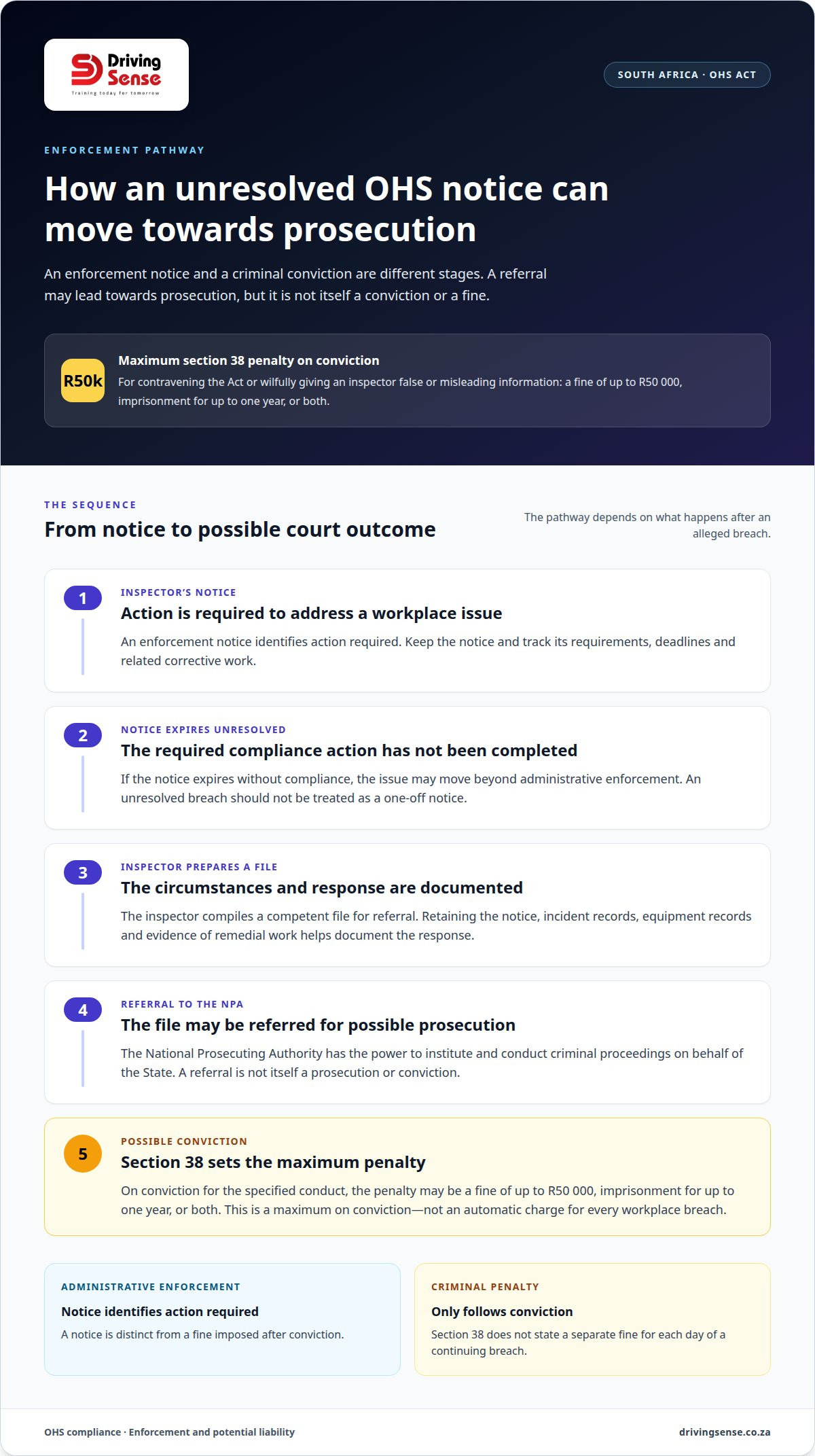
The timeline can also matter. If an inspector’s enforcement notice expires without compliance, the inspector compiles a competent file for referral to the National Prosecuting Authority. A business receiving a notice should track its requirements, deadlines and corrective actions rather than treating an unresolved issue as a one-off administrative matter.
Administrative enforcement and prosecution serve different functions. An inspector’s notice identifies action required to address a workplace issue; a referral can move the matter towards criminal proceedings. Section 20(1) of the National Prosecuting Authority Act No. 32 of 1998 vests the power to institute and conduct criminal proceedings on behalf of the State in the prosecuting authority. A referral is not itself a conviction or a fine.
For compliance management, retain the notice, related incident records, equipment records and evidence of remedial work together. This makes it easier to identify which requirement remains outstanding and to document the response taken. Where a business needs structured help reviewing safety controls and records, workplace safety compliance support can form part of that process.
Compensation and other non-compliance costs
A workplace injury can create costs beyond regulatory fines or prosecution. Potential employer costs include compensation claims, medical specialist fees, replacing an injured employee, and recruiting and training a replacement. These costs arise in different ways, so an incident can affect both immediate spending and the organisation’s ability to maintain staffing.
Compensation claims are one possible financial consequence of workplace injuries, but they are not the same as criminal penalties. A claim concerns compensation; a fine or imprisonment follows a separate legal process. When reviewing an incident, an employer should distinguish the employee’s compensation matter from any enforcement action relating to a safety failure.
Medical specialist fees can add to costs when an injured employee needs specialist care. Treatment-related expenses are a separate consideration alongside any compensation claim. Clear incident and workplace records can help an organisation understand what happened and manage information relevant to its response.
Replacing an injured employee can also disrupt operations. If a worker cannot perform their usual role, the employer may need to arrange cover or redistribute tasks while considering what work employees are equipped to do. Recruiting and training a replacement brings further costs as the organisation resources the process and prepares the new employee for the role.
These cost categories are connected, but they are not interchangeable. A single incident may involve several, including:
- a compensation claim relating to the workplace injury;
- medical specialist fees associated with care;
- replacement arrangements while the injured employee is unavailable; and
- recruitment and training for a new employee.
Distinguishing these costs helps decision-makers assess the broader financial impact of a safety failure. For example, a spreadsheet that records only a direct claim may omit specialist fees and the resources used to recruit and train a replacement. Recording each category separately gives management a clearer picture of the incident’s potential organisational impact without conflating these expenses with statutory fines.
After an incident, employers can organise records around the injury, related care, staffing changes and replacement training. This provides a practical basis for reviewing the event’s effects and identifying where workplace controls need attention. It also connects financial consequences to the conditions and processes that preceded the injury, rather than treating each cost as an isolated accounting item.
Criminal fines and imprisonment
Criminal penalties follow prosecution and conviction, and the offence determines the penalty available. Penalties for OHS non-compliance in South Africa can include fines, imprisonment, or both.
Penalties for Responsible Persons
Liability depends on the conduct and the person’s role, rather than job title alone. Section 16 of the Occupational Health and Safety Act deems a chief executive officer’s actions to be those of the employer. This connects executive conduct with employer responsibility, but does not make every director automatically liable for every workplace breach.
For an employer, director or other responsible person, the relevant issues include the alleged contravention and the actions taken in relation to it. Records showing who received a safety concern and how it was handled can help clarify individual roles. Section 16 specifically addresses the chief executive officer, not every director.
Penalties Prescribed for Non-Compliance
Section 38 applies to a person who contravenes the Act or wilfully gives an inspector false or misleading information. The consequences of non-compliance can depend on the nature of the conduct and the circumstances of the case. These are maximum penalties for the specified conduct, not automatic outcomes for every breach.
Severe Occupational Health and Safety Act violations may result in imprisonment for up to two years. The section 38 maximum is one year, while the severe-violation figure reaches two years. The applicable provision matters; the maximum alone does not establish the sentence.
Fine Calculations and Sentencing Factors
The section 38 penalty is expressed as a maximum, not as a daily rate or calculation formula. The offence established, the provision that applies and whether the case involves false or misleading information shape which maximum is relevant. Section 38 also allows a fine alongside imprisonment, so the outcomes are not always alternatives.
For example, wilfully misleading an inspector falls within section 38’s stated offence. A different alleged safety breach must be considered under its applicable legal provision. The court’s decision concerns the case before it; the maximum does not determine the sentence by itself.
Assessing penalties for OHS non-compliance in South Africa means distinguishing the alleged conduct, the person’s role and the provision involved. Organisations should keep accurate incident, instruction and enforcement records to clarify what happened and how concerns were handled. These records establish the sequence of events; a job title or maximum penalty alone does not determine liability.
What penalties does South Africa’s Occupational Health and Safety Act prescribe for non-compliance?
South Africa’s Occupational Health and Safety Act provides for penalties and court orders, depending on the offence. Section 46 gives a magistrates’ court jurisdiction to impose any penalty or make any order provided for in the Act.
That provision establishes the court’s authority; it does not set one universal penalty for every OHS breach. The relevant offence and its applicable provision determine which penalty may be considered. For example, an alleged contravention under section 38 must be assessed against the conduct described there, rather than treated as carrying an automatic standard fine.
Section 38 applies to a person who contravenes the Act or wilfully gives an inspector false or misleading information. On conviction, the person may be fined up to R50 000, imprisoned for up to one year, or receive both penalties. Those figures are maximums for the specified offence, not a statement that every breach results in the maximum sentence.
An inspector’s enforcement action is also different from a court penalty. If an enforcement notice expires without compliance, the inspector compiles a competent file for referral to the National Prosecuting Authority. A referral may move the matter towards prosecution, but it is not itself a conviction, fine or prison sentence.
Under section 20(1) of the National Prosecuting Authority Act No. 32 of 1998, the prosecuting authority holds the power to institute and conduct criminal proceedings on behalf of the State. The inspector’s referral and the prosecuting authority’s role are therefore distinct steps. A workplace notice should not be confused with the later decision to pursue criminal proceedings.
Organisations should identify the notice’s requirements, address the stated issue and retain records of their response. For example, records of corrective action can help explain how the organisation responded to an inspector’s concern. Documentation does not remove the requirement to comply with the notice, but it makes the response clear.
Section 46 also means the court may make an order provided for under the Act, rather than imposing only a fine or imprisonment. The specific order depends on the applicable provisions and case. A business should therefore consider both the potential penalty and any order relevant to the alleged contravention.
Understanding these distinctions helps separate a maximum statutory penalty, an enforcement notice and a prosecution referral. To strengthen workplace procedures and compliance understanding, take steps to improve your OHS compliance.
Strengthening prevention also requires attention to workplace conditions. Under Sec. 30(2) of South Africa’s Occupational Health and Safety Act, an inspector enforcing a prohibition may block, bar, barricade or fence off the affected workplace area, plant or machinery. This is an enforcement measure, distinct from a penalty imposed after conviction.
Research indicates that many study sites lack a written and conspicuously displayed health and safety policy alongside the Occupational Health and Safety Act. Findings also highlight a general lack of consultation and communication between employers and employees regarding health and safety matters, alongside inadequate resource allocation to manage workplace risks and minimise incidents. Employees at these sites often experience work-related injuries or illnesses while exposed to occupational hazards. South Africa formally ratified the International Labour Organisation Occupational Safety and Health Convention, 1981 (No. 155), in February 2003.
Driving Sense
Driving Sense provides training to help organisations strengthen workplace safety practices. Its Compliance Training can help employees and managers understand workplace procedures, while Emergency Safety Training addresses preparation for safety-related situations. These programmes can complement an organisation’s broader approach to responsibilities under South Africa’s Occupational Health and Safety Act.
This support is relevant when staff need clearer instruction, procedures require reinforcement or safety training should be part of ongoing compliance efforts. The appropriate focus depends on the organisation’s work and training needs, not on the penalties that may follow a breach.
Contact Driving Sense to discuss your organisation’s training requirements.
Build OHS capability into everyday work
Understanding penalties for OHS non-compliance in South Africa is a starting point. Managing risk over time depends on embedding safety responsibilities in daily operations. Organisations can consider whether employees have the practical knowledge to recognise hazards, follow procedures and respond appropriately when working conditions change.
Driving Sense offers Compliance Training, Emergency Safety Training and Driver Training to support workplace capability across relevant operational needs. The right focus depends on employees’ roles and the risks associated with their work. Integrating training into a broader compliance approach can help turn organisational expectations into consistent workplace practices.
For organisations planning their next step, contact Driving Sense for OHS support to discuss relevant training for your workplace. A considered approach can help make safety responsibilities clearer and support a more prepared workforce.
Frequently Asked Questions
What are the maximum fines and prison sentences under the Occupational Health and Safety Act?
For the specified offences in section 38, the maximum is a fine of R50 000, imprisonment for up to one year, or both. Severe violations may carry imprisonment of up to two years. These figures relate to different descriptions of offences and are maximum penalties, not automatic sentences. The relevant provision and conduct determine which penalty may apply following conviction.
Can employees or contractors be prosecuted for OHS non-compliance in South Africa?
Yes, an employee or contractor may face prosecution if their own conduct amounts to an offence under the Act. Section 38 refers to a person who contravenes the Act or wilfully gives an inspector false or misleading information, rather than limiting liability to employers. A person’s role alone does not establish an offence; the alleged conduct and applicable legal provision are central to the case.
What steps can South African employers take to comply with OHS law and avoid penalties?
Employers can organise compliance around workplace hazards: assess risks, put suitable controls in place, communicate procedures, and provide relevant instruction and supervision. For example, a change in equipment or tasks should prompt a review of related hazards and employee guidance. Record assessments, training, reported concerns and corrective actions, and respond to inspector notices according to their stated requirements. These steps support compliance but cannot guarantee that penalties will not apply.
What enforcement powers do South Africa’s Department of Employment and Labour inspectors have?
Inspectors can issue an enforcement notice requiring action. If it expires without compliance, they compile a file for referral to the National Prosecuting Authority. When enforcing a prohibition, an inspector may block, bar, barricade or fence off the affected workplace area, plant or machinery.
