

Could a driver hold a dangerous goods certificate and still need to check other requirements before a journey? In South Africa, the phrase often refers to a driver’s dangerous goods training record. It should not be confused with a Professional Driving Permit endorsement or a permit relating to the vehicle. A certificate alone does not establish that every transport obligation has been met.
Drivers and employers can understandably be unsure which document applies, particularly when informal or outdated advice blurs separate responsibilities. This article explains what a dangerous goods certificate may cover, how training records differ from driver and vehicle documents, and what to verify before arranging training or transport.
Requirements can depend on the goods, the load and the transport circumstances, and compliance involves more than the driver alone. Start by confirming current requirements with the relevant authority and your organisation’s compliance lead, then match training to the driver’s role. Driving Sense provides dangerous goods training for organisations nationally, with arrangements suited to operational needs.
Key Takeaways
- The phrase dangerous goods certificate may refer to training evidence. Confirm exactly which document is required for the driver’s role and transport circumstances.
- Separate driver-related permissions from vehicle and load documentation, and establish who is responsible for checking each item.
- Before arranging training, define the duties involved, verify current requirements and ask the provider to confirm the course scope and documentation issued.
- Record each requirement checked, including the source and date, to support consistent compliance reviews.
- Use role-relevant training alongside workplace procedures, supervision and record management as part of a broader risk-control approach.
What does a dangerous goods certificate mean in South Africa?
The phrase dangerous goods certificate is often used informally for evidence that someone has completed relevant training. It does not identify one document with a universal legal effect. A document’s purpose, issuer and relevance depend on the person’s duties and the transport circumstances.
A dangerous goods certificate may record relevant training, but its title alone does not prove that every requirement for a person, vehicle or load has been met.
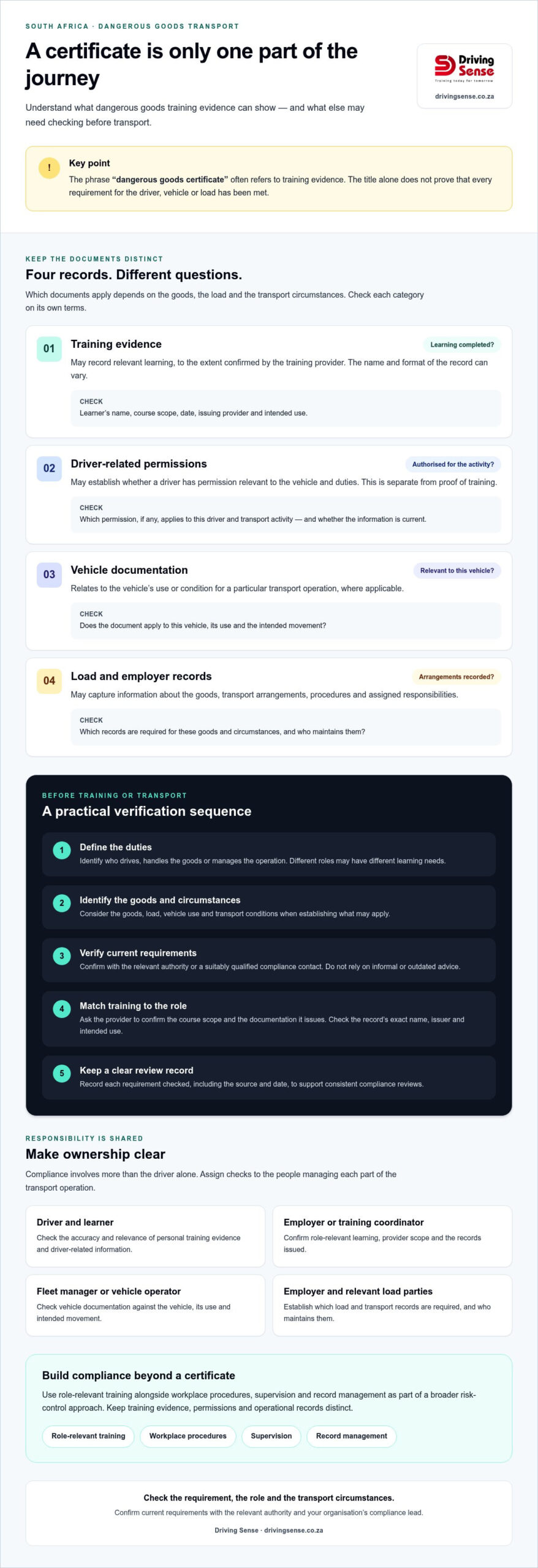
Training evidence is different from a driver-related permit, vehicle documentation or an organisation’s compliance records. Each answers a different question: has the person completed relevant learning, is the driver appropriately authorised, does the vehicle meet applicable requirements, and has the organisation checked its transport arrangements? The term Dangerous goods covers materials that can present risks during transport. Classification depends on the substance and its hazards, so the goods involved matter when checking what applies.
What can a dangerous goods certificate refer to?
In conversation, the phrase may mean a certificate or another record issued after training. The name and format can vary, and the word “certificate” does not confirm which topics were covered, who issued the record or whether it meets a particular requirement. Before relying on a document, check its exact name, issuing organisation, scope and intended use. Do not assume a certificate held by one worker can replace a permit or another person’s training record.
Who may need dangerous goods training or documentation?
Drivers may need role-relevant training or documentation when their duties involve transporting dangerous goods. Employees who handle these goods as part of transport operations may also need appropriate instruction. Employers, fleet managers and compliance managers oversee how responsibilities and records are managed across the operation.
Check applicability against current South African requirements and the specific duties, goods, vehicle use and transport conditions involved. An employee who handles goods but does not drive, for example, may have different learning needs from a driver. Identify those duties rather than making one assumption for every role. Confirm requirements with the relevant authority or a suitably qualified compliance contact, and ask the training provider to explain what its course covers and what documentation it issues. This helps keep training evidence, permissions and operational records distinct and supports a more reliable compliance process.
How do training, driver permits and vehicle documents differ?
These records serve different compliance purposes. A training record should not be treated as a substitute for a driver permission, vehicle document or load record. Which documents apply depends on the transport operation. Check current South African requirements using authoritative sources.
| Document category | Purpose | Who should check it? | Verification question |
|---|---|---|---|
| Training evidence | Records learning completed, to the extent confirmed by the training provider. | The learner and employer or training coordinator. | Does the record identify the learner, course scope, date and issuing provider? |
| Driver-related permissions | May establish whether a driver has the permission relevant to the vehicle and duties. | The driver and the employer or fleet manager. | Which permission, if any, is required for this driver and transport activity, and is the information current? |
| Vehicle documentation | Relates to the vehicle’s use or condition for a particular transport operation, where applicable. | The vehicle operator or fleet manager. | Does the document apply to this vehicle, its use and the intended movement? |
| Load and employer records | May record information about the goods, transport arrangements, procedures and assigned responsibilities. | The employer and relevant parties managing the load and journey. | Which records are required for these goods and circumstances, and who maintains them? |
What does training evidence demonstrate?
A training document can show that a person completed learning, provided the provider confirms what the training covered and what the document represents. Check that the learner’s name is accurate, the course scope is clear, the date is recorded and the issuing provider is identifiable. Do not assume a certificate has a particular legal status, validity period or renewal cycle without verifying the applicable requirement.
When arranging instruction, confirm the course scope and resulting documentation with the provider before enrolment. Employers can discuss role-relevant dangerous goods training with Driving Sense as part of their wider safety and compliance approach.
Which other permissions and records may be relevant?
Check driver, vehicle, load and employer records separately. Not every category will apply to every operation, and no single document should be assumed to replace another. For road transport, check whether the National Road Traffic Act and related regulations are relevant to the specific movement, then verify current requirements through official legislation or the appropriate authority. Record the source and date of each check so the organisation can review its basis if circumstances or rules change.
Which South African requirements should an employer verify?
Before assigning a driver or arranging a movement, assess the work being done, the goods involved, the vehicle’s intended use and the transport conditions. A requirement that applies to one role or load may not apply to another. Base decisions on the operation’s actual details, not a generic checklist or an old online summary.
Training does not, by itself, establish full operational compliance. A training record may evidence learning, but it does not confirm that the driver, vehicle, load and organisational arrangements meet every requirement that applies to a particular journey.
What details should be checked before assigning a driver?
Start with reliable information about the goods and proposed movement. Confirm the goods’ classification from appropriate documentation, then define the driver’s duties, the vehicle being used and any conditions that could affect how the load is transported. Use these details to identify which driver, vehicle, load and workplace requirements need checking.
Verify each requirement against current, authoritative sources. Depending on the issue, these may include applicable legislation and regulations, official government guidance, or information from the authority responsible for the relevant permission or record. The National Road Traffic Act and its related regulations may be relevant to road transport. Confirm the provisions currently in force and their application to the specific operation before relying on them. If the position is unclear, refer it to a qualified compliance adviser or the appropriate authority rather than treating a blog post or informal interpretation as definitive.
How should organisations manage responsibilities and records?
Make accountability explicit. The employer can assign a responsible person to check driver competence and records, confirm relevant vehicle and load documentation, and ensure transport procedures reflect the operation. Drivers should know which instructions and records apply to their duties, while fleet and compliance managers maintain oversight of the organisation’s checks.
A simple compliance register can help preserve the basis for each decision. For every requirement checked, record:
- Requirement: what needs to be confirmed and which role, vehicle or movement it concerns.
- Source: the legislation, official guidance or relevant authority consulted.
- Check date: when the source was reviewed and by whom.
- Evidence and action: the records retained, any issue identified and the next review point.
Keep training documentation with the relevant personnel records, and maintain separate records for permissions, vehicles, loads and procedures where applicable. Review the checks when duties, goods, vehicles or transport conditions change, or when an authoritative source indicates that a requirement has been amended. This makes it easier to show what was checked and why the organisation considered it relevant.
How can drivers and employers prepare for dangerous goods training?
Effective preparation starts with the work the learner will actually perform, not an assumed certificate label. A driver’s transport duties may differ from an employee’s goods-handling responsibilities. Establish role requirements first, then confirm that the proposed training is suitable and what documentation it will produce.
Use a clear sequence:
- Define duties: describe the learner’s transport or goods-handling responsibilities.
- Confirm requirements: identify which requirements need checking with an appropriate authority or compliance contact.
- Identify learners: select employees whose duties call for the relevant knowledge and instruction.
- Arrange training: confirm the course scope and resulting documentation with the provider before enrolment.
- Retain records: file completion evidence and note any separate requirements that remain to be addressed.
What information should an employer gather first?
Prepare a brief role profile for each learner, covering job responsibilities, transport duties and relevant goods-handling tasks. Gather existing training records and list unanswered questions, such as whether a particular permission or vehicle record needs separate verification. Assign someone to review course suitability and maintain completion records, so responsibility does not fall between operational and compliance teams.
Keep learning preparation separate from legal or administrative checks. Training can develop knowledge and skills within its stated scope; it does not confirm that a driver, vehicle or load meets every requirement for a particular operation. Record which requirements have been checked, where the answer came from and when it was reviewed.
What should learners confirm with a training provider?
Before enrolment, ask the provider to explain the course scope, topics covered, whether there is an assessment and what evidence of completion is issued. Check that the training is relevant to the learner’s assigned duties. Do not rely on the phrase “dangerous goods certificate” as proof that a course or document meets every need. Ask which matters fall outside the training so the employer can verify separate legal, permit or operational requirements through the appropriate channels.
Driving Sense provides dangerous goods training tailored to organisational roles and needs. Discuss dangerous goods training for your organisation and confirm the course scope and documentation before arranging enrolment.
How can dangerous goods training support a stronger compliance system?
Training is most useful when it forms part of a wider operational control system, rather than being treated as a document to file and forget. Role-relevant learning can help employees apply consistent handling practices, recognise when a situation falls outside their authority and raise concerns through agreed channels. Procedures, active supervision and well-managed records remain important in day-to-day work.
A dangerous goods certificate or other completion record may help an employer document learning, but it does not demonstrate by itself that workplace procedures are followed or every transport obligation has been met. Managers can reinforce learning by clarifying responsibilities, making procedures accessible and checking that employees know how to raise a concern before a task proceeds.
What should organisations look for in a training arrangement?
Assess whether the proposed course reflects the duties employees actually perform and the organisation’s operating conditions. Before making arrangements, ask the provider to clarify:
- which topics and learning objectives are covered, and how they relate to the identified roles;
- the available delivery format and whether it suits the organisation’s operational requirements; and
- what completion documentation is issued and what it represents.
Confirm these details directly with the provider. Do not infer accreditation, regulatory approval or a particular legal effect from a course title or certificate. Verify any such status independently if it is relevant to the organisation’s requirements.
When should an organisation review its training approach?
Review training needs when employee responsibilities, goods handled, operating procedures or applicable requirements change. Incident findings, near misses and competency reviews can also reveal where further instruction or clearer procedures may be needed. Use those findings to identify specific learning gaps, then check whether the existing course remains suitable for the affected roles.
Driving Sense, founded in 2006, provides dangerous goods training to organisations nationally across South Africa. Employers can discuss training suited to their operational roles and needs, and confirm course scope and documentation directly before making arrangements. Discuss dangerous goods training for your organisation.
Put the right checks and training in place
Understand a dangerous goods certificate in context: confirm what the document records, who issued it and whether it is relevant to the person’s duties. Training evidence, driver permissions, vehicle documents and load records serve different purposes. Check each applicable requirement against current authoritative guidance rather than assuming one document covers them all.
A practical next step is to define the work involved, identify who is responsible for verifying requirements, and confirm course scope and completion documentation with the training provider before enrolment. Recording what was checked, the source consulted and the review date can support a consistent approach as roles or operating conditions change.
Driving Sense provides dangerous goods training as part of its corporate safety and compliance offering, with arrangements for organisations nationally across South Africa. Discuss dangerous goods training for your organisation and confirm the course scope for your team.
Frequently Asked Questions
What is a dangerous goods certificate in South Africa?
A dangerous goods certificate is a phrase often used for a document recording relevant training, but it does not necessarily identify one standard document or prove that every transport requirement is met. Check the document’s exact name, what learning it records and who issued it. Its relevance depends on the person’s duties and the transport circumstances, so confirm current requirements with an appropriate authority or qualified compliance contact.
Who needs a dangerous goods certificate?
Drivers and employees whose duties involve transporting or handling dangerous goods may need relevant training or documentation, depending on their roles and circumstances. Employers, fleet managers and compliance teams should establish which records and checks apply to the operation they oversee. Do not assume the same requirement applies to every employee or load. Confirm the position using current authoritative guidance and the actual duties, goods and vehicle arrangements.
How do I get a dangerous goods certificate?
First, identify the training or document required for your role, then confirm that requirement with an appropriate authority or your organisation’s compliance contact. Ask a training provider to explain the course scope, learner requirements and documentation issued on completion before enrolling. After training, retain the resulting record and check whether separate permissions or transport documents are needed. A course provider can confirm its training details, but should not be assumed to determine every legal requirement.
Is a dangerous goods training certificate the same as a driver permit?
No. A training certificate may record learning completed, while a driver permit relates to permission to drive in particular circumstances. They serve different purposes, and one should not be assumed to replace the other. Confirm the precise document required for the driver’s duties and transport operation, and check its status with the relevant authority. Also distinguish both from vehicle, load and employer records, which may have separate purposes and responsibilities.
How long is a dangerous goods certificate valid?
There is no single validity period that can safely be assumed from the phrase “dangerous goods certificate” alone. The document’s issuer, scope and purpose matter, and a separate requirement may set conditions for a particular role or transport activity. Check the certificate and confirm any applicable period or renewal requirement with the issuing provider and relevant authority before relying on it. Do not treat an informal or outdated online claim as confirmation.
Does dangerous goods training alone make a transport operation compliant?
No. Training can support a person’s knowledge and competence within the course scope, but it does not confirm that all requirements for a journey have been met. Depending on the operation, separate driver, vehicle, load or organisational checks may be relevant. Employers should verify applicable requirements using current authoritative sources, assign responsibility for the checks and maintain appropriate records. Compliance depends on the whole operation, not simply the presence of a training document.
What should an employer check before sending a driver for dangerous goods training?
Document the driver’s actual duties, the goods involved, vehicle use and any goods-handling responsibilities. Check which requirements apply using current authoritative guidance, then ask the training provider to confirm the course topics, suitability for the role and documentation issued. Identify who will approve the course and retain completion records. Keep training arrangements separate from checks for permits or other transport documents, and resolve uncertain requirements with the appropriate authority or a qualified compliance adviser.
