
Rollover risk is not confined to sharp bends: a truck can become unstable on a straight road when speed, steering input and load movement combine. Effective truck rollover prevention training techniques help drivers understand how lateral load transfer and acceleration affect stability, then make controlled driving decisions to reduce risk.
Drivers know smooth handling matters; the challenge is recognising how quickly stability can change. This article explains how truck rollover prevention training techniques use lateral load transfer, simulation scenarios and lateral acceleration to make rollover risk easier to assess. It also explores how vehicle design, cargo behaviour and driver decisions affect stability on curves, ramps, roundabouts and straight roads, helping organisations build a practical framework for safer fleet operations.
Key Takeaways
- Understand how lateral load transfer indicates changing stability and why load movement can increase rollover risk.
- See how simulation scenarios help assess a truck’s response to demanding manoeuvres before translating lessons into driver training.
- Recognise how lateral acceleration, vehicle design and cargo characteristics influence stability.
- Identify controllable contributors to rollovers, including sudden movements, speed and load management.
- Apply a deliberate approach to speed on curves, ramps and roundabouts, where road conditions and vehicle load shape safe handling.
Lateral load transfer ratio (LTR)
For South African operations, the applicable licence requirement depends on the vehicle and driving role. Stability training explains vehicle dynamics; it doesn’t replace any licence requirement that applies to the driver’s work.
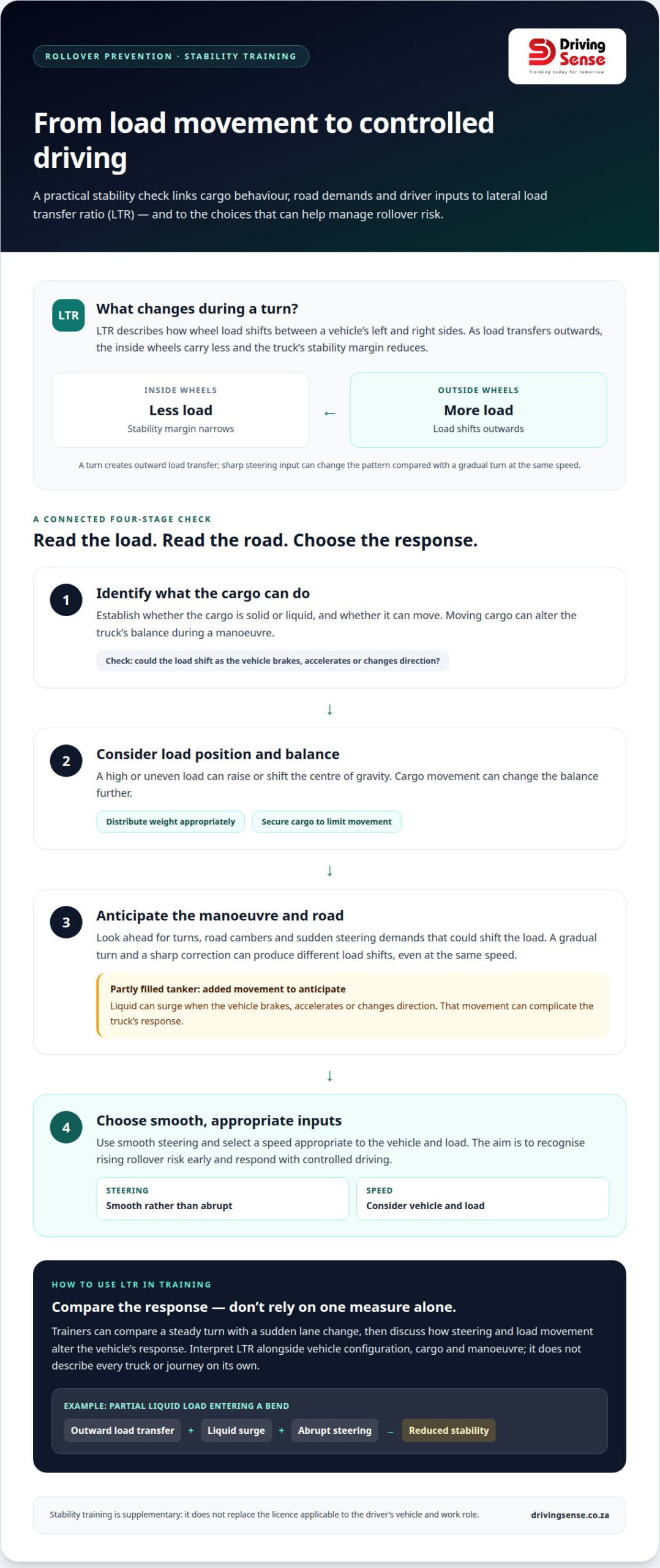
Lateral load transfer ratio, or LTR, describes how wheel load shifts between a vehicle’s left and right sides. During a turn, centrifugal force transfers load towards the outside wheels. As that difference increases, the inside wheels carry less load, reducing the vehicle’s stability margin.
LTR is useful because it connects a driver’s actions with the truck’s physical response. A gradual turn produces a different load shift from a sharp steering correction at the same speed. Training can use these examples to show why smooth steering and appropriate speed help manage rollover risk.
Load distribution and cargo securement also affect the centre of gravity and rollover risk. A load placed high or unevenly can raise or shift the centre of gravity, while cargo that moves during a turn can alter the truck’s balance. Securing cargo and distributing its weight appropriately help limit movement and uneven loading.
Partial loads need particular attention in tankers. In a partly filled tank, liquid can surge as the vehicle brakes, accelerates or changes direction. The timing and force of this movement can complicate the truck’s response, so drivers need to anticipate how cargo behaviour interacts with steering and speed.
Drivers and trainers can use a consistent sequence to connect road conditions with vehicle stability:
- Identify whether the cargo is solid or liquid, and whether it can move.
- Consider how load placement affects the centre of gravity and side-to-side balance.
- Anticipate turns, road cambers and sudden steering inputs that could shift load.
- Choose smooth control inputs and a speed appropriate to the vehicle and load.
These checks make LTR more than a technical measure. For example, a tanker entering a bend with a partial liquid load may experience both outward load transfer and liquid surge. Abrupt steering can combine with those movements and further reduce stability.
LTR values are most useful when interpreted alongside vehicle configuration, cargo and manoeuvre. A trainer can compare a steady turn with a sudden lane change, then discuss how load movement and steering alter the pattern. The aim is to recognise rising rollover risk early and respond with controlled driving, rather than relying on one measurement to describe every truck or journey.
Drivers must hold the licence applicable to their vehicle and work role; stability training is supplementary and cannot replace it.
Simulation scenarios and rollover stability
Simulation allows a heavy truck’s response to be assessed in controlled manoeuvres, including abrupt steering changes. One evaluation tested an intelligent heavy truck in a fishhook manoeuvre at 55 km/h and 65 km/h. Comparing these cases shows how a change in approach speed can alter vehicle response during the same demanding manoeuvre.
Fleet policies can set expectations for speed control, awareness of high-risk routes and smooth manoeuvres. Maintenance procedures should include inspecting truck brakes before each trip, at a minimum. Vehicle technologies can support simulation and perception: an intelligent heavy-truck framework uses lidar, radar, cameras and GPS to interpret its surroundings.
The scenarios are useful because they separate a driver input from its consequences. In a fishhook test, a sudden steering sequence places changing lateral demands on the vehicle. Comparing runs at 55 km/h and 65 km/h lets an analyst examine how the truck responds under different conditions, without treating one result as suitable for every vehicle or road.
A rollover-index evaluation uses three cases and a TruckSim “2A truck” model. In the intelligent heavy-truck motion planner, the reference novel rollover index is set to zero. Its cost function considers trajectory tracking, the novel rollover index and obstacle artificial potential fields. This means the system balances staying on its intended path, stability and nearby obstacles.
The model-predictive motion planner produces longitudinal force and front steering angle as control outputs. These illustrate how automated control can adjust movement in response to a planned path and stability assessment. They do not replace driver judgement, suitable fleet procedures or vehicle maintenance.
A structured simulation review can examine the following points:
- Scenario: Record whether the test is a fishhook manoeuvre and which speed is being assessed.
- Vehicle response: Review how stability changes through each steering input, rather than considering only the final outcome.
- Obstacles: Include obstacle potential fields when assessing how route demands affect the planned trajectory.
- Maintenance: Incorporate the pre-trip brake inspection into the fleet’s regular operational checks.
After each run, connect the recorded vehicle response to a practical decision, such as moderating speed before a rapid steering demand. Comparing the 55 km/h and 65 km/h cases helps make that discussion specific, while the three-case TruckSim evaluation offers a structured way to examine rollover-index behaviour. Organisations can use simulation-based driver safety learning to connect vehicle dynamics with consistent driving practice.
Vehicle dynamics and lateral acceleration
Lateral acceleration is the sideways acceleration a truck experiences while changing direction. On a curve, the tyres must generate force to keep the vehicle on its path. The relationship can be represented as a = v²/r, where v is speed and r is curve radius. Greater speed or a tighter curve therefore increases lateral demand on the vehicle.
For example, a loaded truck entering a tightening bend faces more lateral acceleration than it would on a broad curve at the same speed. The vehicle’s mass resists the change in direction, while tyre forces act at road level. These forces can shift load towards the outside wheels, leaving the inside wheels with less grip and reducing stability.
Drivers can manage this demand before reaching a curve. Reducing speed in advance lowers lateral demand as the vehicle turns. Smooth steering also matters: a rapid steering input changes direction sharply and can cause a sudden increase in lateral force. A gradual turn allows the truck to respond progressively.
Cargo tank design and load affect rollover potential. A high centre of gravity increases the leverage produced by lateral acceleration, while liquid cargo can move inside a tank as direction changes. For instance, liquid surge may add to the outward force during a turn, so a tanker’s handling depends on both vehicle characteristics and cargo behaviour.
Road shape adds another variable. A bend with a changing radius demands ongoing adjustment, while a cambered surface can affect tyre contact with the road. If a driver brakes hard while turning, braking and lateral demands occur together. Training should address the complete manoeuvre rather than treating steering, braking and speed as isolated decisions.
A practical review of lateral acceleration can examine these related factors:
- Speed: Assess whether the truck’s approach speed suits the curve ahead.
- Road geometry: Identify bends that tighten or change direction unexpectedly.
- Vehicle and cargo: Consider centre-of-gravity height, tank design and load movement.
- Driver input: Practise gradual steering and avoid abrupt braking during a turn.
Use a familiar route example, such as a loaded tanker approaching a tightening bend, to connect each factor. Ask how speed, steering and cargo movement influence the vehicle’s response at each stage. This helps drivers understand lateral acceleration as a changing demand, not simply a technical term, and supports deliberate choices before a manoeuvre becomes difficult to manage.
What causes truck rollovers and which factors can drivers control?
Truck rollovers can result from several conditions combining, including speed, steering input, cargo movement and road hazards. Drivers may not be able to control every external condition, but they can manage decisions such as approach speed, following distance and responses to changing traffic. Recognising how these factors interact helps drivers avoid sudden actions that increase instability.
Drivers influence vehicle behaviour through speed selection, smooth steering and early hazard recognition. They can also account for how a load may respond during turns or on straight roads. For example, noticing a lane obstruction late may prompt a sharp swerve. Scanning ahead gives the driver more time to consider a controlled response.
Risk is not limited to obvious bends. A straight road can still present an obstruction, uneven surface or traffic disruption that demands a quick decision. An abrupt steering reaction changes the vehicle’s direction rapidly. Maintaining a safe following distance and observing the road ahead can support earlier, more measured adjustments.
Experience alone doesn’t remove the need for active observation. Familiarity with a route may help drivers anticipate its layout, but road and traffic conditions can change between journeys. Approaching a junction, work zone or slow-moving queue, a driver should assess available space and traffic before choosing a path. This reduces reliance on last-minute manoeuvres.
Practical prevention focuses on actions drivers can repeat across different journeys:
- Assess the road: Identify potential hazards, changing surfaces and restricted turning space.
- Manage speed: Choose a pace that allows time to respond to the road ahead.
- Use smooth inputs: Avoid sudden steering, braking or acceleration that may destabilise the vehicle.
- Account for the load: Consider cargo behaviour during turns and changes in direction.
- Recognise unsafe conditions: Respond early when traffic, visibility or road layout increases demands.
Training scenarios can connect each choice to a recognisable event. For instance, a driver approaching an obstruction can discuss the space available, traffic around the truck and possible controlled responses. The safest action depends on the immediate conditions, but the exercise reinforces early hazard recognition and deliberate decision-making.
Rollover prevention requires attention throughout the journey, not only at bends. Drivers should stay alert and avoid sudden movements that can increase instability. They can also account for the vehicle’s load when planning turns and choosing speed. Regular practice helps make these considerations part of everyday driving.
Cargo tank truck drivers are advised to control their load in turns and on straight roadways, and to identify high-risk areas on roads. More than 63% of tanker rollover accidents occur with partial loads; partial loads can be more hazardous than full loads because they allow more load shifting, particularly with liquid loads.
Most truck and tanker rollover accidents in the United States occur on dry, straight roads and highways rather than on ramps and turns. The cargo tank truck rollover prevention video explains warning signs of unsafe behaviours and conditions that contribute to rollovers.
How should truck drivers manage speed on curves, ramps, and roundabouts to prevent rollovers?
Speed management begins before a truck reaches a curve, ramp or roundabout. Reducing speed on approach gives the driver time to assess the road, select a suitable gear and enter with controlled steering. Braking sharply while already turning can add competing demands, so plan to decelerate on the straight approach whenever conditions allow.
A rollover-prevention recommendation says large trucks should travel 10 mph below automobile speed-limit signs. Because this is expressed in mph, it should not be converted into a South African road limit; treat it as a reminder to leave a speed margin. The appropriate approach also depends on the truck, its load, visibility and the road surface.
On a curve, assess whether its radius tightens or the road surface changes. A loaded truck entering a tightening bend needs a controlled speed before the curve, not a sudden correction midway through it. Keep steering smooth, avoid abrupt acceleration and allow the vehicle to follow a stable path through the bend.
Ramps can be particularly demanding because their geometry may combine a curve with a change in elevation. Reduce speed before joining the ramp and avoid sharp steering to compensate for entering too fast. If traffic slows ahead, adjust early and progressively rather than braking hard while the truck is turning.
At a roundabout, identify the intended exit before entry and account for traffic already circulating. A truck may need more room to turn than a smaller vehicle, so maintain a controlled approach and avoid sudden lane changes. If the intended path is obstructed, choose a measured response rather than a sharp steering movement.
Drivers can apply the following sequence at each turn:
- Read the approach: Observe warning signs, curve shape, visibility and traffic conditions.
- Set speed beforehand: Decelerate progressively before steering into the bend or roundabout.
- Maintain a smooth path: Avoid abrupt steering, braking or acceleration during the turn.
- Reassess on exit: Accelerate smoothly once the vehicle has cleared the curve and traffic permits.
A tanker carrying a partial liquid load needs particular care through each manoeuvre because cargo movement can affect stability. Keep the turn controlled and don’t treat a familiar ramp as risk-free: road conditions and load behaviour can differ between journeys.
Driver Training can turn these decisions into repeatable practice using curve, ramp and roundabout examples. Build safer truck-driving habits through structured driver training.
Speed control also depends on the driver’s condition and preparation. Truck drivers should follow the U.S. Federal Motor Carrier Safety Administration’s maximum driving-time and required rest-break guidelines. Cargo tank truck drivers are advised to remain alert and attentive, control speed and maintain proper speed cushions. These practices support measured decisions when approaching and travelling through turns, rather than last-second corrections. Drivers are also advised to avoid sudden movements that may lead to rollovers, including abrupt steering, braking or acceleration during a manoeuvre.
FMCSA, PHMSA and industry partners created the cargo tank truck rollover prevention tool as a training aid for commercial drivers transporting hazardous materials in cargo tank motor vehicles. Its focus is relevant to everyday curve, ramp and roundabout decisions: More than 78% of cargo tank truck rollovers involve driver error. Drivers can use training to reinforce steady speed choices, alertness and smooth control, and to practise maintaining a safe speed cushion as conditions change.
Driving Sense
Driving Sense helps organisations translate rollover-prevention principles into practical driver behaviours and consistent workplace procedures. Its Driver Training can address decisions about speed, steering and changing road conditions, while Compliance Training supports a structured approach to operational requirements. For fleets carrying hazardous goods, Dangerous Goods training can complement this work by addressing the responsibilities involved in transporting those loads.
These services are relevant when an organisation needs to strengthen driver capability, align training with operational risks or reinforce safe practices across its workforce. Training can connect vehicle stability concepts with the decisions drivers make on South African roads.
Contact Driving Sense to discuss training for your organisation.
Turn safer driving principles into routine practice
Rollover prevention becomes part of operational practice when driver learning informs journey planning, route briefings and ongoing safety discussions. A programme built around truck rollover prevention training techniques can connect vehicle stability concepts with decisions drivers face on South African roads. Review how these principles relate to the vehicles, loads and operating conditions your teams encounter, then use that assessment to guide training priorities.
Driving Sense offers Driver Training, Emergency Safety Training and Compliance Training to support organisational safety and workforce capability. These offerings can form part of a broader approach to strengthening safe driving practices and managing operational risk. Discuss training with Driving Sense and take a considered next step towards making safer decisions part of everyday fleet operations.
Frequently Asked Questions
What driver training techniques best prevent truck rollovers?
Training is most useful when it develops hazard recognition and sound decisions under changing road conditions. For example, a trainer can present a route briefing with a blocked lane, then ask the driver to explain their intended response before discussing alternatives. Coaching can also include observation of mirror use, following distance and decision-making at junctions. These behaviours help identify training needs beyond steering technique alone.
What practical exercises and simulators are used in truck rollover prevention training?
Exercises can include route-risk discussions, load-specific case studies and simulator sessions that let drivers practise responding to developing hazards. A scenario might introduce a traffic queue after a bend, requiring the driver to explain how they would adjust their plan. A structured debrief can compare the driver’s choices with the scenario’s risks, turning experience into practical learning without exposing a vehicle or crew to the exercise itself.
How can drivers recognise rollover warning signs and respond safely?
Drivers should treat unusual body lean, unexpected load movement or a sudden change in steering response as reasons to reassess the situation. If the truck feels unstable, avoid sharp steering corrections or abrupt braking, which can add further demands. Maintain a controlled path, reduce speed smoothly if conditions permit, and stop in a safe place when continuing would be unsafe. Report the event so the vehicle and load can be assessed.
How effective is defensive driving or rollover prevention training in reducing truck crashes?
Training develops practical skills, but a specific reduction in crashes cannot be stated without measured evidence for the fleet and programme. Organisations can assess training’s contribution by tracking relevant incidents and near misses, observing driving behaviour, and reviewing assessment results over time. For example, repeated difficulty identifying hazards during route scenarios may indicate where further coaching is needed. Use those findings to refine instruction and reinforce safer operating practices.
