

Employers can face liability for an employee’s road accident, but responsibility isn’t automatic. Legal liability for employers in road accidents in South Africa may arise when an employee’s wrongful act occurs in the course and scope of their work or is sufficiently connected to their employment. If an employer is found vicariously liable, they may seek a contribution from the employee responsible under the Apportionment of Damages Act 34 of 1956.
It’s reasonable to ask whether the person who caused the accident, rather than the employer, should bear the loss. The answer depends on how the employee’s conduct relates to their duties and on the circumstances of the accident. This article explains when that connection may make an employer liable and when the employer may seek recovery from an employee.
You’ll also learn how claims involving the Road Accident Fund and COIDA differ from an employer’s liability to a third party, and which factors matter when assessing a road accident that occurred during work. Understanding these distinctions helps employers identify where liability may lie and how employee accountability fits into the process.
Key Takeaways
- An employer may have a defence where an employee acted solely for personal reasons, without a sufficiently close connection to their work.
- Assessing a claim involves more than establishing employment: the wrongful conduct and its connection to the job must be considered alongside the elements of a delictual claim.
- Road Accident Fund claims and COIDA compensation follow distinct routes, and the applicable route depends on the circumstances of the accident and injury.
- An employment contract’s indemnity clause may guide recovery between an employer and employee, but it does not remove the employer’s liability to third parties.
- Driver Training and Compliance Training can support a structured approach to workplace road safety and employee responsibilities.
Course and scope of employment
An employer may be vicariously liable when an employee’s wrongful act occurs during work or is closely connected to the employee’s job. Whether the employee was driving a company vehicle or their own, the employment connection matters.
Driving within the course of employment
Driving is generally within the course and scope of employment when the journey forms part of the employee’s work duties. A delivery route or a trip to a client may therefore connect the driving to the job. This matters because an employer may face a claim if wrongful driving caused harm. An employee’s intentional wrongdoing may also result in employer liability if it is sufficiently connected to the employment relationship.
Using a personal vehicle for work
Using a personal vehicle does not, by itself, determine whether an employer is liable. The key question is whether the employee’s wrongful conduct occurred during work or was sufficiently connected to their duties. For example, an employee driving their own car to a work appointment may be acting for work purposes. A personal journey unrelated to work points to a different connection, but the circumstances still matter.
Duties for work-related driving
Work-related driving should be included in an employer’s workplace safety planning, with hazards identified and appropriate controls considered. This preventive approach is distinct from deciding vicarious liability, which focuses on the employee’s conduct and its connection to work. For example, workplace safety arrangements can address driving risks without treating every journey as purely personal. Keeping prevention and legal responsibility separate helps clarify each issue.
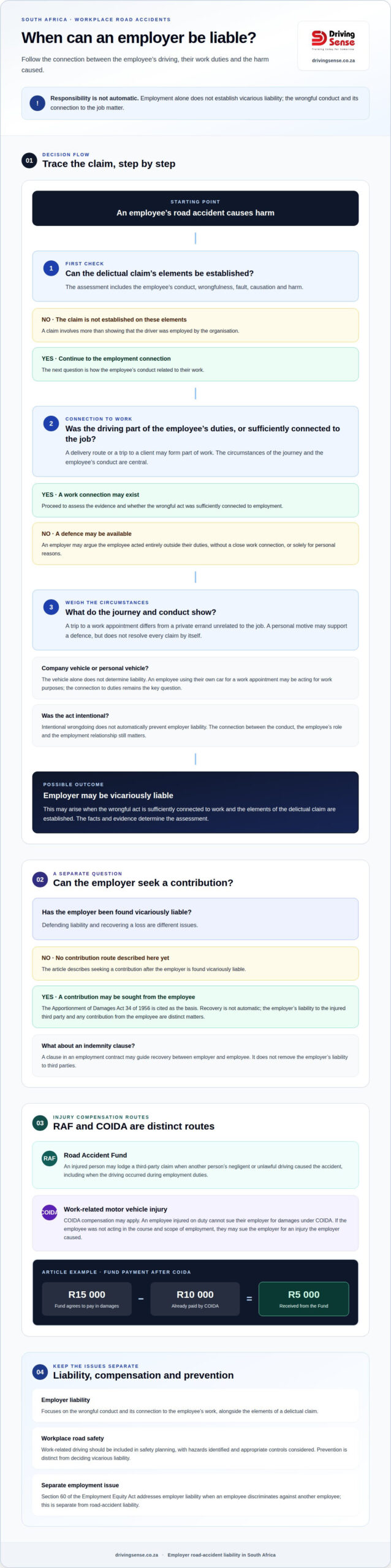
Employment alone is not enough to establish vicarious liability. A claim requires proof of employment, a connection between the wrongful act and the job, and the general elements of a delictual claim: conduct, wrongfulness, fault, causation and harm. An employer may defend a claim by showing that the employee acted entirely outside their duties, without a close connection to work, or solely for personal reasons. The evidence about the journey and conduct is central to those arguments.
Other claims may follow different routes. An injured person may lodge a third-party claim with the Road Accident Fund when another person’s negligent or unlawful driving caused the accident, including during employment duties. For a work-related motor vehicle injury, COIDA compensation may apply. If the Fund agrees to pay R15 000 in damages after COIDA has paid R10 000, the injured person receives R5 000 from the Fund.
An employee injured on duty cannot sue their employer for damages under COIDA. If the employee was not acting in the course and scope of employment, however, they may sue the employer for an injury the employer caused. Section 60 of the Employment Equity Act addresses employer liability when an employee discriminates against another employee, a separate employment issue from road-accident liability.
Can Employers Recover from Employees?
An employer facing a road-accident claim must distinguish between defending liability and recovering a loss. These are separate questions: a defence challenges the employer’s responsibility, while recovery concerns seeking a contribution from the employee after the employer is found vicariously liable.
In South Africa, the Apportionment of Damages Act 34 of 1956 is cited as the basis for an employer found vicariously liable to seek contribution from the employee who committed the wrongful act. This does not make recovery automatic. The employer’s liability to the injured third party and any contribution sought from the employee are distinct matters.
A central defence is that the employee acted entirely outside the scope of employment. For example, an employee on a private journey unrelated to their duties may have no work connection to the driving. The employer may also argue that there was no sufficiently close connection between the wrongful act and the employee’s job. The circumstances of the journey and conduct are therefore important.
An employer may also rely on evidence that the employee acted solely for personal reasons unrelated to their duties. A personal motive may support the argument that the employee’s conduct had no close connection to employment. It does not, by itself, resolve every claim: the employer’s position depends on whether the evidence shows the employee was acting outside work.
Intentional conduct does not automatically prevent a claim against an employer. An employer may be liable for an employee’s intentional wrongdoing if it is sufficiently connected to the employment relationship. A defence must therefore address that connection, rather than relying only on the fact that the employee acted deliberately. The employee’s work role and the circumstances of the conduct may be relevant.
In practice, an employer’s defence should focus on the employee’s purpose and the relationship between the journey and their duties. A trip to a work appointment differs from a private errand unrelated to the job. The same distinction matters when considering whether an employee’s wrongful act was closely connected to work. These facts help frame both the liability question and any later contribution claim.
An indemnity clause in an employment contract may regulate recovery between an employer and employee. It does not protect the employer from liability to third parties. A contract therefore cannot, by itself, prevent an injured person from bringing a claim against the employer. Employers should keep these external and internal responsibilities distinct when reviewing an accident.
Where an accident also prompts a review of employee support, organisations can explore Employee Wellness with Driving Sense as part of their workplace response.
Employer liability for employee road accidents
Responsibility may arise from an employee’s conduct or from an employer’s own alleged wrongdoing. The claim route also matters, particularly when a work-related injury involves the Road Accident Fund or COIDA.
Vicarious liability for employee accidents
Vicarious liability may apply when an employee’s wrongful road conduct occurs during work or is sufficiently closely connected to the job. An injured person must establish employment, that connection, and the delictual elements of conduct, wrongfulness, fault, causation and harm. For example, a negligent collision during a work journey may meet the employment-connection test, depending on the evidence about the journey and conduct.
Direct employer liability
Direct liability concerns an employer’s own alleged conduct, rather than responsibility for an employee’s wrongful act. A claim alleging negligent hiring, training, vehicle maintenance or driver supervision must connect the employer’s conduct to the harm. The general delictual elements still apply, including fault, causation and harm. For example, an allegation about vehicle maintenance must explain how the employer’s conduct caused the accident.
Accidents involving independent contractors
An independent contractor is not automatically treated as an employee for vicarious liability. The claim requires proof of employment, so the actual working relationship matters more than the label “contractor.” If the driver is genuinely independent, establishing that element may be difficult. A separate allegation about the employer’s own conduct needs its own basis and proof.
Road Accident Fund cover for work drivers
The Road Accident Fund route concerns an injured person’s third-party claim when another person’s negligent or unlawful driving caused the accident, including during work duties. The Fund deals with those claims, and vicarious liability does not apply to the Fund claim. A work-related motor-vehicle injury may also qualify for COIDA compensation, which is deducted from a third-party payment.
For example, if the Road Accident Fund agrees to pay R15 000 in damages after COIDA has paid R10 000, the injured person receives R5 000 from the Fund. The figures illustrate the deduction, not a separate payment by the employer. The employment connection remains relevant to COIDA, while the Fund claim follows the third-party route.
Can an employer face direct liability for negligent hiring, training, maintenance or supervision? A claimant would need to prove the employer’s own wrongful conduct, fault, causation and harm. The allegation must link a specific failure to the collision, rather than relying only on the employee’s involvement.
Can an employer be liable for a contractor’s accident? Vicarious liability requires proof of employment and a sufficient connection to the job. The contractor’s actual relationship with the organisation, and any separate alleged conduct by the employer, therefore matter.
What time limits apply to claims against an employer or the Road Accident Fund? The applicable deadline depends on the claim route, the defendant, the claimant’s circumstances and when the claim arises. These factors should be assessed promptly because an employer claim and a Fund claim are distinct processes.
Employer recovery from employees
South African law separates an employer’s liability to an injured person from recovery against an employee. Under the Apportionment of Damages Act 34 of 1956, an employer found vicariously liable may seek contribution from the employee who committed the wrongful act. This is an internal recovery question, not a means of removing the employer from the third party’s claim.
The distinction matters after a work-related collision. For example, if an employee’s wrongful driving results in the employer being held vicariously liable, the employer may consider a contribution claim against that employee. The employer must first be found vicariously liable; the possibility of contribution does not itself establish the employee’s responsibility or determine the amount recoverable.
Keep the two relationships separate. The injured third party’s claim concerns responsibility for the harm, while an employer’s contribution claim concerns the employee’s wrongful act. An employment contract may contain an indemnity clause regulating recovery between employer and employee. However, that clause does not protect the employer from liability to third parties.
For instance, a contract might address how an employer and employee handle losses internally after an accident. That agreement cannot, by itself, prevent an injured person from bringing a claim against the employer. An employer should not treat an indemnity clause as a substitute for addressing the external claim. The third party’s position and the contractual relationship remain distinct.
When considering contribution, start with whether the employer was found vicariously liable and whether the employee committed the wrongful act. A road accident alone does not establish either point. The employee’s conduct and its connection to work must be considered in the context of the employer’s liability. This keeps the recovery question tied to the basis of the claim.
The same distinction applies when the employee disputes responsibility. An employer cannot treat an internal contract as proof that the employee committed the wrongful act. Nor does the possibility of a contribution claim mean the employer has no responsibility to the injured person. Each issue concerns a different legal relationship and must be assessed on its own facts.
For employers, the practical sequence is to identify the third-party claim, determine whether vicarious liability has been established, and then consider any internal recovery route. The Apportionment of Damages Act 34 of 1956 provides the stated basis for seeking contribution. An indemnity clause may also be relevant between the parties, but it cannot displace the third party’s claim.
Recovery from an employee is possible, but it is not automatic. The finding on the employer’s liability, the employee’s wrongful act and any relevant contract terms each play a distinct part. Keeping these questions separate helps prevent an internal agreement from being mistaken for a defence against an injured person’s claim.
What Is Vicarious Liability?
Vicarious liability is the legal responsibility an employer may bear for an employee’s wrongful act connected to their work. In a South African road-accident claim, it can make the employer answerable to an injured person even though the employee was driving.
This principle does not make an employer responsible for every collision involving an employee. The claim must establish employment, a sufficient connection between the wrongful act and the job, and the delictual elements of conduct, wrongfulness, fault, causation and harm. Each element addresses a distinct issue: who acted, whether the conduct was wrongful, and whether it caused the claimed injury.
Consider a driver who causes a collision while travelling to carry out a work duty. The employment connection may be closer than it would be if the same driver were making a private journey unrelated to work. However, the work purpose alone does not establish every element of a claim. The conduct, fault, connection to the job and resulting harm all require consideration.
Vicarious liability also differs from direct liability. The first concerns an employer’s responsibility for an employee’s wrongful act; the second concerns the employer’s own alleged conduct. For example, a claim about an employee’s negligent driving raises a different question from an allegation that the employer’s own conduct caused harm. Keeping these bases distinct clarifies what must be established.
Intentional conduct does not automatically place an accident outside the employment relationship. An employer may be liable for an employee’s intentional wrongdoing if it is sufficiently connected to the job. Conversely, evidence that an employee acted entirely outside their duties, without a close work connection, or solely for personal reasons may support a defence. The facts of the journey and conduct are central.
The Road Accident Fund route is also distinct. When another person’s negligent or unlawful driving causes an accident, an injured person may lodge a third-party claim with the Fund, including if the driver was performing work duties. The Fund deals with those claims; vicarious liability does not apply to the Fund claim. A work-related motor-vehicle injury may also involve COIDA compensation.
For an employer, the practical value of this distinction is clear: identify whether a claim concerns an employee’s conduct, the employer’s own conduct, or a third-party Fund claim. For example, a work journey may raise both employment-connection and compensation questions, but each requires its own analysis. Clear workplace driving arrangements can help organisations address responsibilities before an incident occurs.
To strengthen this preventative approach, explore workplace Driver Training as part of your organisation’s road-safety planning.
Driving Sense
Driving Sense helps organisations strengthen workplace safety and compliance through practical training. Where work-related driving forms part of operations, Driver Training can support employees’ driving capability, while Compliance Training can reinforce organisational procedures. Emergency Safety Training and Dangerous Goods training may also be relevant to workplaces managing broader operational risks.
These services support prevention and preparedness; they do not determine legal liability or replace advice on a specific claim. Organisations can consider them when reviewing how staff are prepared for work-related driving and related safety responsibilities.
For information about training that suits your organisation’s needs, contact Driving Sense.
Build a Stronger Road-Safety Framework
Understanding legal liability for employers in road accidents in South Africa is one part of responsible risk management. The next is making road safety an operational priority. Clear driving procedures, role-appropriate preparation and consistent compliance practices can help organisations address risks before an incident occurs and support employees on work-related journeys.
Driving Sense offers Emergency Safety Training, Driver Training and Compliance Training to support workplace preparedness. Organisations can consider how these services fit their driving arrangements, safety processes and workforce responsibilities, then identify practical improvements suited to their operations.
Make road safety part of your organisation’s ongoing planning. To discuss training that supports your workplace, contact Driving Sense and take the next step towards a more structured approach.
Frequently Asked Questions
What Must Be Proven for a Claim?
A vicarious liability claim requires proof of employment, a connection between the wrongful act and the job, and the elements of a delictual claim. Those elements include conduct, wrongfulness, fault, causation and harm. For example, evidence that an employee was driving to perform a work duty may help establish the employment connection, while information about the collision and resulting injury relates to other parts of the claim.
Who Is Liable in an Accident?
Liability depends on who acted wrongfully and how the accident relates to employment. An employee may be responsible for wrongful driving, and an employer may also face a claim if the conduct was sufficiently connected to the employee’s work. An injured person may have a Road Accident Fund claim if another person’s negligent or unlawful driving caused the accident. A work-related injury may also involve COIDA.
What legal test determines whether an employee was acting in the course and scope of employment while driving?
The assessment asks whether the employee’s wrongful conduct occurred in the course and scope of employment or was sufficiently closely connected to the job. The journey’s purpose and the employee’s reason for driving are relevant. A trip to carry out a work duty differs from a private journey unrelated to work. Who owns the vehicle does not, by itself, settle the employment-connection question.
Who is liable when an employee causes an accident while using a company vehicle for personal reasons?
Using a company vehicle does not, by itself, make an employer liable for a personal journey. If the employee acted entirely outside work, without a close connection to their duties, or solely for personal reasons, the employer may defend a vicarious liability claim. The employee’s conduct and the circumstances remain relevant. A third-party claim may still be assessed through the route that applies to the accident.
What evidence and steps are needed to claim compensation after a work-related road accident in South Africa?
Start by recording the circumstances of the collision and preserving information that may explain the journey, its work purpose and the injury. Relevant material can include witness accounts, journey or work instructions, and records of the harm suffered. The claim route depends on the circumstances: an injured person may pursue a Road Accident Fund third-party claim, while a work-related injury may involve COIDA. Keep the records organised for assessment.
