

What if the strongest case for driver training to reduce insurance costs isn’t a promised premium cut, but evidence that your fleet is managing risk more consistently? In South Africa, claims and insurance costs can put sustained pressure on fleet budgets. It can also be difficult to separate the effect of training from other safety controls.
It’s reasonable to ask whether training will influence your next insurance discussion. It may support a stronger risk-management case, but lower premiums aren’t guaranteed, and changes can take time to emerge. A credible evaluation depends on consistent records and a fair comparison of fleet performance before and after training.
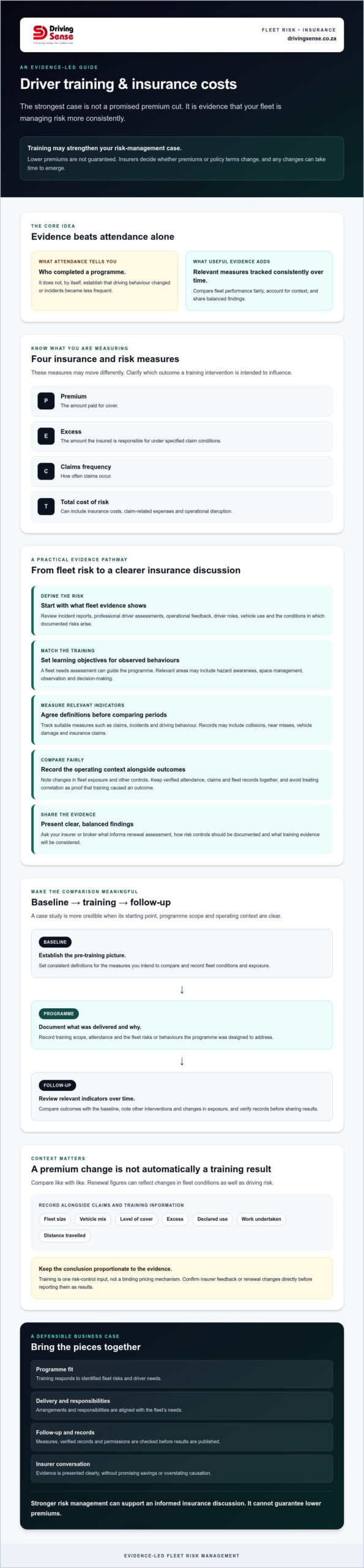
This guide explains how to match training to risks identified through fleet data and driver assessments, then measure outcomes using relevant indicators such as claims, incidents and driving behaviour. It also shows how to account for changes in fleet exposure and other interventions, so the evidence you share with insurers is clear, balanced and useful, rather than an unsupported claim of savings.
Key Takeaways
- Driver training to reduce insurance costs may strengthen your risk-management case, but insurers decide whether premiums or policy terms change.
- Separate premiums, excesses, claims frequency and total cost of risk to understand which outcomes your fleet is measuring.
- Match training to behaviours identified in fleet data, then assess whether relevant indicators change over time.
- Use a case-study framework to compare outcomes, and verify records and permissions before publishing results.
- Build a defensible business case by aligning the programme, delivery arrangements, responsibilities and follow-up measures with your fleet’s needs.
Can driver training reduce fleet insurance costs? Start with the insurer’s perspective
Driver training may contribute to better risk management and support an informed insurance discussion, but it doesn’t compel an insurer to reduce a premium or change policy terms. The commercial case for driver training to reduce insurance costs therefore rests on evidence of relevant risk controls and outcomes, not simply on the fact that a course took place.
Start by distinguishing the measures being discussed. A premium is the amount paid for cover; an excess is the amount the insured is responsible for under specified claim conditions. Claims frequency tracks how often claims occur, while total cost of risk can include insurance costs alongside claim-related expenses and operational disruption. These measures may move differently, so clarify which one a proposed training intervention is intended to influence.
What insurers may consider when assessing a commercial fleet
Depending on the policy and underwriting approach, relevant information may include claims history, driver profiles, vehicle types, vehicle use and fleet exposure, such as the work undertaken and distance travelled. These aren’t universal criteria or a guaranteed checklist. Ask your insurer or broker what information informs the renewal assessment and how it wants risk controls documented.
Compare like with like when reviewing a renewal. A premium change may reflect a different fleet size, vehicle mix, level of cover, excess or declared use, rather than a change in driving risk. Record these details alongside claims and training information so your comparison accounts for changes in the fleet’s operating context.
Why training does not automatically lower a premium
Training is one risk-control input, not a binding pricing mechanism. Attendance records show who completed a programme, but they don’t establish whether driving behaviour changed or incidents became less frequent. Evidence requirements and recognition of training may also vary between policies and providers. Confirm what your insurer will consider before presenting a programme as relevant to renewal.
Improved risk management can strengthen an insurance discussion, but it cannot guarantee premium savings. Training is most credible when its content responds to an identified fleet risk. For example, a programme may address hazard awareness, space management or decision-making, concepts associated with defensive driving. Choose a focus that reflects the fleet’s actual work and available evidence, rather than assuming all drivers have the same needs.
For a case study, establish the baseline, training scope and operating context, then compare suitable post-training measures. Note changes in exposure and other controls, and keep verified attendance, claims and fleet records together. Discuss the findings with the insurer without presenting correlation as proof that training caused an outcome. Confirm any renewal changes or insurer feedback directly before reporting them as results.
How driver training can influence fleet risk and what evidence to track
Training can support safer driving when it addresses behaviours linked to actual fleet risks. Incident reviews, for example, may point to a need to strengthen hazard awareness, space management or decision-making. The useful question is whether learning responds to those patterns and whether relevant indicators change afterwards. Course attendance alone doesn’t demonstrate improved performance.
Choose training against observed fleet risks
Review incident reports, professional driver assessments and operational feedback from managers and drivers. Consider how vehicles are used, the roles drivers perform and the conditions in which documented risks arise. A general course may not address a specific pattern, so use a fleet needs assessment to define learning objectives and appropriate follow-up.
For instance, if reviews identify recurring reports of close following, space management may warrant attention. If incidents occur where hazards are difficult to anticipate, the programme could address observation and decision-making. These are areas to investigate, not proof that training will prevent a recurrence.
Select indicators that make change assessable
Agree consistent definitions before comparing reporting periods. Decide how the fleet will record collisions, near misses, vehicle damage and insurance claims, including how events involving multiple vehicles or types of damage will be counted. Where reliable records exist, review event counts alongside exposure measures such as kilometres driven, vehicle numbers and the length of each reporting period.
Exposure-adjusted comparisons are more informative than raw totals because they account for how much the fleet was operating during each period. A lower incident count may coincide with fewer vehicles or less distance travelled, so totals alone can give an incomplete picture. Interpret any change in an adjusted rate alongside changes in routes, work patterns, reporting practices and other risk controls.
Keep training records with the outcome data. Useful measures include driver attendance and completion, assessment results, agreed follow-up actions and the date each measure was collected. Telematics may provide additional information on driving behaviours, if available. Document what is measured, who can access it and how it is used within the organisation’s governance arrangements.
Fewer incidents may also mean less time spent on reporting, vehicle downtime or disrupted work, but measure these outcomes rather than assuming training caused a change. Organisations considering tailored corporate driver training can use fleet data and driver assessments to help define learning needs, then evaluate outcomes against an agreed baseline.
Case study framework: demonstrate whether driver training changed fleet outcomes
A credible case study should show what was measured, what changed and what can reasonably be concluded. Unless verified client evidence has been approved for publication, present this as an evaluation framework, not a report of results. This matters when discussing driver training to reduce insurance costs, because a change in fleet performance doesn’t by itself establish that training caused it or that an insurer changed its view of the risk.
Establish a credible baseline before training
Define the baseline and follow-up periods before the programme begins, using comparable records for each. Gather claims and incident data alongside exposure measures, such as kilometres travelled and vehicle numbers, and record how events are classified. Document existing training and other risk controls so readers can understand the starting position and the intervention’s context.
Check the source and completeness of each measure with the people responsible for the records. Before sharing case details, verify client approval, permissions to use the information and any privacy or anonymisation requirements. If a measure is unavailable or unreliable, state that limitation rather than estimating a value to fill the gap.
Describe the intervention and follow-up
Set out what the training was intended to address, which drivers it covered and how participation and completion were recorded. Then compare the agreed indicators across the baseline and follow-up periods. For any published case study, use placeholders until the evidence has been verified and approved:
- Baseline: [approved period, incident and claims measures, exposure data and existing controls]
- Intervention: [verified training scope, attendance and assessment information]
- Follow-up: [approved measures, reporting period and any change in fleet exposure]
- Insurance discussion: [verified insurer feedback or confirmed renewal-term change, if any]
Report findings without overstating causation
Check whether the periods are genuinely comparable. Routes, vehicle mix, fleet size, driver roles, reporting practices and other safety measures may have changed, affecting results independently of training. Describe these factors alongside the findings, and separate measured data from the client’s interpretation of what it means.
Be precise about the insurer’s response. An insurer acknowledging receipt of evidence is not the same as changing a premium, excess or other renewal term. Confirm feedback or renewal changes directly with the client and insurer before publication. If no change is verified, say so clearly. A measured case study can support a more informed review while remaining transparent about what the evidence cannot establish.
How to compare training options and build a defensible business case
Compare driver-training options against the fleet’s documented risks, not simply by course length or delivery format. Assess whether the content is relevant to your vehicles and driver roles, how learning is assessed, what records are supplied and whether follow-up actions are included. Then consider delivery factors: on-site or dedicated-facility arrangements, scheduling, which drivers can attend and the effect of releasing them from operational duties.
Questions to ask a corporate driver-training provider
Ask how the programme can be tailored to your vehicles, roles and identified risk patterns. Confirm what will be recorded, including attendance, completion, assessment results and recommended follow-up, and establish how those records can support your evaluation. Check whether delivery can be arranged on-site or at a dedicated training facility, then choose the option that best fits operational requirements.
Calculate value without relying on a promised discount
Build the business case around verified inputs and measurable outcomes. Include the training investment and internal administration, then compare them with documented changes in relevant fleet indicators. Where reliable business records support it, assess associated operational effects such as vehicle downtime. Don’t treat a lower claim count as proof that training caused the change, or assume it will result in a lower premium.
A comparison matrix can help decision-makers distinguish what a provider supplies from what the organisation measures and what remains under insurer control:
| Provider inputs | Internal measures | Insurer-controlled outcomes |
|---|---|---|
| Training scope, delivery arrangements, attendance and assessment records | Training and administration costs, exposure, incidents, claims and supported operational effects | Premium, excess, cover and renewal terms, as confirmed by the insurer |
For a fair comparison, agree the baseline, reporting periods and definitions before delivery, and record operational changes that may influence results. Present measured findings separately from interpretations, and treat any insurer decision as a distinct outcome rather than an automatic consequence of training. This gives you a defensible basis for considering driver training to reduce insurance costs as part of broader fleet risk management.
Once your evaluation criteria are clear, review Driving Sense corporate driver-training options to consider how tailored training and delivery arrangements may fit your organisation’s requirements.
Put an evidence-led driver-training and insurance review into practice
Turn the evaluation into a coordinated process with named responsibilities, agreed measures and a review date. Fleet operations can identify day-to-day risks and coordinate participation; risk can oversee the assessment framework; finance can track investment and relevant business costs; and human resources can support training records. Assign an insurance contact to confirm what evidence the broker or insurer wants to see, rather than assuming that a particular programme qualifies for a discount.
A practical sequence from risk review to renewal
Before training begins, review available fleet evidence and specify the behaviours or risks the programme should address. Agree the baseline, training scope, intended outcomes and follow-up timetable with relevant stakeholders. During delivery, record participation and assessment outcomes, and store records securely with access limited to appropriate personnel and retention arrangements defined by the organisation.
At follow-up, compare the agreed indicators with the baseline and document relevant operational changes, such as shifts in vehicle numbers, routes or fleet use. Share suitable evidence with the broker or insurer ahead of renewal, and ask which criteria inform its assessment. Keep measured results distinct from interpretations, and don’t present a change in claims or incidents as proof that training caused it.
When a tailored training partner can support implementation
A corporate training partner may help align programme content with identified fleet risks and support delivery planning. Driving Sense provides tailored corporate driver training and professional driver assessments to organisations across South Africa, with delivery on-site or at dedicated facilities. Founded in 2006, the company has over 20 years of experience. These capabilities can support a structured training plan, but they don’t establish or guarantee an insurance outcome.
Before engaging a provider, ensure the proposed scope, attendance documentation, assessment approach and follow-up expectations fit your evaluation plan. This makes it easier to assess the programme for operational relevance as well as cost, without relying on a promised premium reduction.
Explore Driving Sense’s tailored corporate driver-training programmes when your objectives, baseline measures and evidence requirements are clear.
Make your next fleet-risk review evidence-led
Driver training can contribute to a stronger approach to fleet risk, but an insurer decides whether premiums or policy terms change. The most credible case for driver training to reduce insurance costs starts with learning needs identified through fleet evidence. It then measures outcomes against a consistent baseline while accounting for changes in exposure and operations.
Before delivery, agree objectives, responsibilities, records and follow-up measures, and ask your broker or insurer what evidence it considers relevant. This gives your organisation a sound basis for assessing training’s contribution without presenting attendance or a change in claims as guaranteed savings.
Driving Sense provides tailored corporate driver training and professional driver evaluations, with delivery on-site or at dedicated facilities. Founded in 2006, the business has over 20 years of experience supporting organisations. A well-planned, measured programme can help your organisation make considered progress towards safer fleet operations. To discuss a programme suited to your fleet’s needs, contact Driving Sense about tailored corporate driver training.
Frequently Asked Questions
Can driver training reduce fleet insurance premiums?
Driver training may contribute to improved risk management, but it doesn’t guarantee lower fleet insurance premiums. An insurer decides whether premiums or policy terms change, based on its assessment of the fleet and the information available. Training may form part of a broader case if it addresses identified risks and is supported by relevant records. Compare renewal terms alongside changes in fleet size, vehicle use, cover and excess before attributing a premium movement to training.
Will an insurer give a discount for driver training?
An insurer may consider evidence of driver training, but a discount isn’t automatic or guaranteed. Recognition and underwriting criteria can differ between policies and insurers, so ask your broker or insurer what information it considers relevant and how it wants that evidence presented. Keep training attendance and assessment records, but don’t describe them as proof of a discount unless the insurer has confirmed a change to the renewal terms.
How can a business prove that driver training improved fleet safety?
A business can assess whether fleet safety indicators changed by defining a baseline before training and comparing it with a follow-up period. Use consistent records for collisions, near misses, damage and claims, and consider exposure measures such as kilometres travelled and vehicle numbers. Record training attendance, completion and assessment outcomes as well. Explain operational changes that could affect the comparison, and avoid claiming training caused an improvement unless the evidence supports that conclusion.
What driver training should a company choose to manage insurance risk?
Choose training that addresses risks identified through fleet data, driver assessments and operational feedback. For example, if reviews highlight concerns with hazard awareness, space management or decision-making, use those findings to shape the learning objectives. Consider the vehicles and roles involved, how learning will be assessed and what follow-up is documented. A generic course may not address your fleet’s specific needs, so establish the purpose and measures before selecting a programme.
How long does it take to see results from driver training?
There’s no fixed timeframe for identifying a change. It depends on the training objectives, data quality, fleet exposure and frequency of relevant events. Agree a follow-up timetable before delivery, then review comparable reporting periods using consistent definitions and exposure measures. Behavioural assessment results may be available sooner than meaningful claims trends, which require sufficient comparable data. Discuss renewal timing and evidence requirements with your broker or insurer rather than assuming an immediate insurance effect.
Should driver training be repeated for a corporate fleet?
Repeat training when evidence indicates that learning needs to be refreshed or fleet risks have changed. There’s no single interval that suits every organisation. Review incident patterns, assessment findings, driver roles, vehicle use and operational feedback when deciding whether further training is appropriate. Keep records of previous participation and follow-up actions so new learning can build on earlier work. This supports a planned, risk-led approach rather than repeating a course without a clear purpose.
